Ancient Egyptian beer was made by soaking and lightly baking emmer wheat and barley, crumbling the resulting bread into water, and letting wild yeast ferment the mixture in a porous terracotta jar until it thickened into a sweet, low-alcohol drink. There was no hopping, no distillation and no cultured yeast. Bread and beer were literally the same product at different stages, which is the single fact that explains almost everything else about Egyptian brewing.
That process took hours rather than weeks, and it ran at a scale that still surprises people. Excavations at Abydos turned up an industrial brewery dating to the reign of King Narmer, around 5,000 years ago, and the workers’ village at Amarna, built about 1350 BC, had breweries that supplied an entire town.
Below is the method step by step, then the evidence behind it, and finally a look at what the finished drink probably tasted like compared to anything you would pour from a tap today.
Table of Contents
- What Ingredients Did Ancient Egyptians Use for Beer?
- How Beer Was Made in Ancient Egypt: The Brewing Process
- Step 1: Soaking and Malting the Grain
- Step 2: Mashing and Baking a Beer Bread
- Step 3: Mixing the Beer Bread with Water
- Step 4: Fermenting the Wort
- Step 5: Straining, Settling, and Drinking the Beer
- Did Ancient Egyptian Beer Taste Like Modern Beer?
- What Did Ancient Egyptian Beer Taste Like?
- Why Was Beer So Important in Ancient Egypt?
- What Evidence Proves How Ancient Egyptians Made Beer?
- Frequently Asked Questions
- Did ancient Egyptians make beer with bread?
- What type of barley did ancient Egyptians use for brewing?
- Did ancient Egyptian beer contain hops?
- How strong was beer in ancient Egypt?
- What was the oldest known Egyptian beer called?
- How did ancient Egyptians keep beer from spoiling?
- Conclusion
What Ingredients Did Ancient Egyptians Use for Beer?
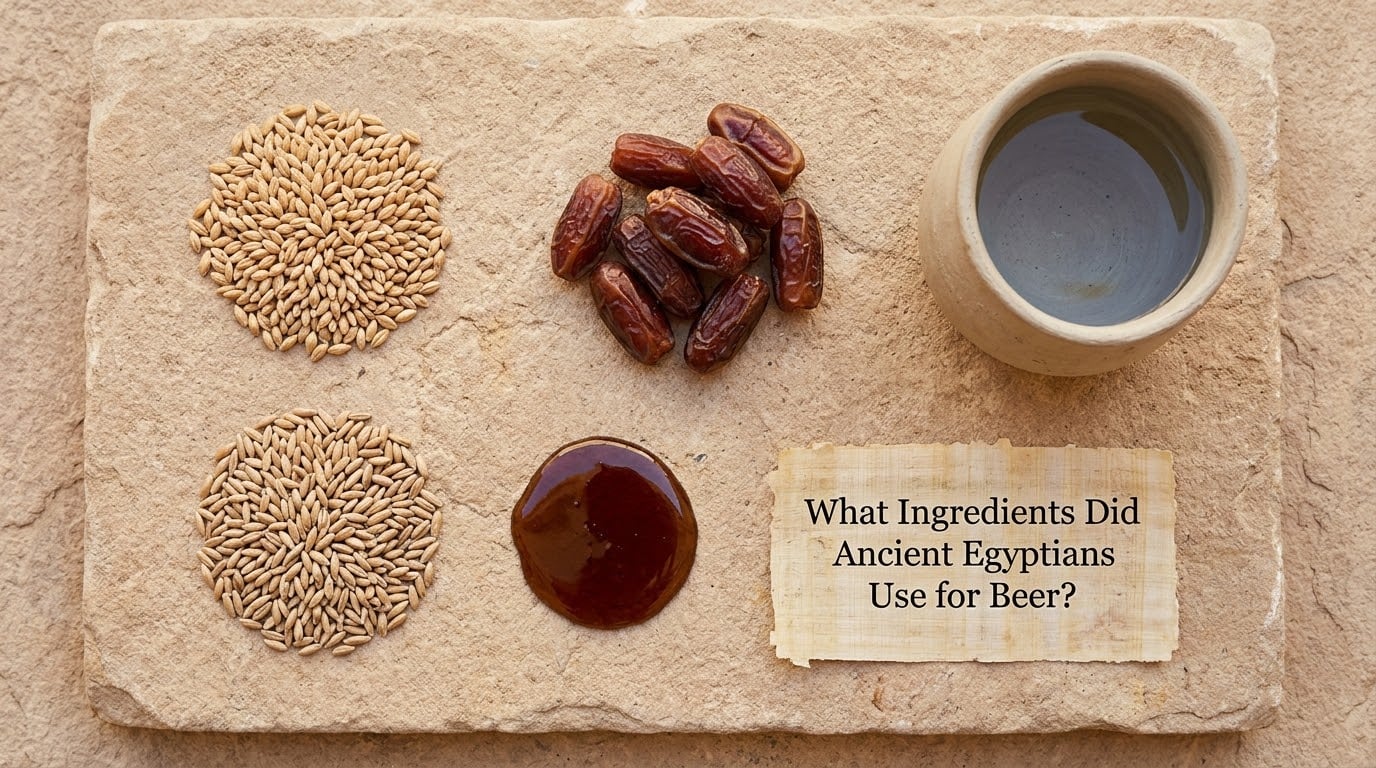
The core grain was emmer wheat and barley, with water as the second ingredient and nothing else required to make a drinkable brew. Emmer matters because it is a hulled, ancient relative of modern wheat that breaks down into fermentable sugars readily, and its straw was also used as kindling and for mud brick.
Flavour came from additions rather than from the grain itself: dates, honey, grapes, figs, herbs, and sedges were mixed in at various stages depending on how rich a batch was meant to be.
Spices are the big myth here. Anyone who tells you Egyptians brewed a spiced, resin-heavy ale is describing a later or an imported tradition, not the everyday brew. What they did use as bittering and aromatics were local plant materials such as sedges and herbs, which is a much narrower list than most popular retellings suggest.
The grain-malt relationship itself is worth understanding before you go further, because it is what separates brewing from baking. If you want the underlying science, our guide to what malt does in beer flavor covers the same conversion in a modern setting.
How Beer Was Made in Ancient Egypt: The Brewing Process
The process ran in five stages: soak and malt the grain, mash it and bake the mash into bread, break the bread back into water, ferment that liquid in a ceramic jar, then strain and drink it. Steps two and three are the odd ones, because the mash was baked and then rehydrated rather than mashed and boiled as it is today.
Step 1: Soaking and Malting the Grain
Grain was soaked until it softened and began to germinate, which released enzymes that convert the grain’s starch into fermentable sugar. The germination was then stopped by drying, and the softened or partially sprouted grain went on to the next stage.
This is malting, but a partial and uncontrolled version of it. Modern malting follows a schedule measured in hours and days on a temperature-controlled floor; Egyptian malting depended on ambient heat and however long the grain sat. The goal was never maximum extract. It was simply enough sugar for the yeast to work with.
Step 2: Mashing and Baking a Beer Bread
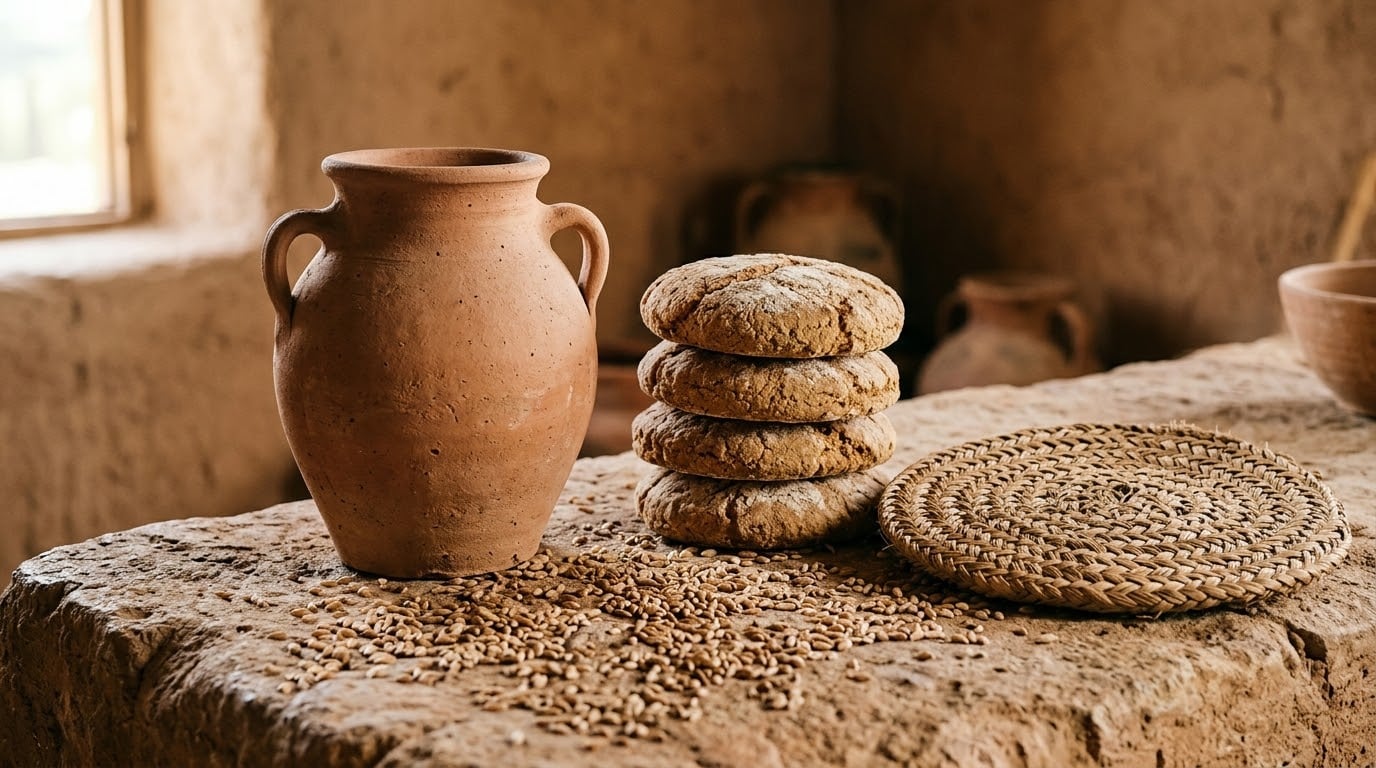
The treated grain was mixed with water into a dough and baked into a dense, lightly cooked loaf known as beer-bread, sometimes called hefeqet in later Egyptian texts. The loaf was deliberately under-baked, because residual heat and remaining enzymes in the crumb continued converting starch to sugar after it left the oven.
This is where Egyptian brewing stops looking like modern brewing. The bakery and the brewery were frequently the same building, sometimes the same staff, and the same grain produced both daily bread and the fermentation substrate. The loaf was an intermediate stage, not a waste product.
Step 3: Mixing the Beer Bread with Water
The baked loaf was crumbled or broken into pieces and mixed with water to make wort, the sweet liquid that carries the sugars the yeast will feed on. The more grain in the mix and the longer it sat, the stronger and more nourishing the result.
Water came from the Nile and from other available sources, and nobody was measuring temperature or keeping the mash sanitary by modern standards. The porous, unglazed clay of the brewing jar partly handled that problem on its own, as we get to below.
Step 4: Fermenting the Wort
Yeast living in the air and on the walls of the vessel converted the wort’s sugars into alcohol and carbon dioxide, thickening it into a porridge-like drink. Dr Delwen Samuel, working with the Amarna excavation material, reconstructed a flow diagram of this process from the chemical residue left in brewery jars, and she described the fermentation as fast and naturally driven rather than managed.
There was no thermometer, no hydrometer and no iodine test for starch, so readiness was judged by the senses: how thick the mix had turned, how far the sweetness had gone, and how the surface looked once it settled. Wild fermentation also acts as its own safety mechanism. What does not suit the yeast goes sour or dies off, and the batch that survives is the batch that keeps.
If you want the modern version of what is actually happening inside the vessel, what yeast does in beer and fermentation explains the same chemistry with cleaner terminology.
Step 5: Straining, Settling, and Drinking the Beer
Grain solids were removed with a sieve or a woven mat, and the liquid was left to settle before it was drawn off. Scenes in tombs show it being poured into jars and drunk through long reed or ceramic straws, which kept the sediment at the bottom and filtered out large particles as you drank.
This is also where ancient beer meets modern life most directly. Without hops as a preservative, and without filtration or pasteurisation, the beer did not keep. It was brewed and consumed almost immediately, in small batches, all year round. There was no version of this that could sit in a warehouse for a year and taste the same in October.
Did Ancient Egyptian Beer Taste Like Modern Beer?
No. Ancient Egyptian beer was closer to a sweet, thick, bread-based gruel than to any beer on a modern tap, and the difference came down to four things: the grain treatment, the lack of hops, the fermentation control and the lack of any preservation step.
| Factor | Ancient Egyptian beer | Modern beer |
|---|---|---|
| Grain handling | Soaked, partly malted, baked into bread, then crumbled back into water | Malted grain milled and mashed directly, wort boiled |
| Bittering and aroma | No hops; dates, honey, herbs and sedges added for flavour | Hops for bitterness and aroma, spices optional |
| Vessel | Single-fired, unglazed, porous terracotta jar that breathes and cools | Stainless steel, sealed and temperature-controlled |
| Yeast | Wild yeast from the air and the vessel walls, self-selecting | Cultured, selected and pitched strain |
| Judging readiness | Sight, touch and smell of the mash and the settled liquid | Hydrometer, thermometer, timed schedule |
| Shelf life | Days at most; brewed and drunk almost immediately | Weeks to months, hops and pasteurisation assist |
| Typical result | Thick, sweet, sediment-rich, low alcohol | Filtered, clarified, far more variable in strength |
The contrast between brewing cultures is worth a look on its own if you enjoy the comparison side of beer. How British beer differs from American beer shows how quickly two places with identical raw materials end up with completely different drinks, let alone a gap of three thousand years.
What Did Ancient Egyptian Beer Taste Like?
The safest description is sweet, thick and grain-forward, closer to a warm porridge or a modern beer-meal liquid than to a crisp lager. Because the wort came from bread rather than from a boiled mash, it kept a bread character that would have been obvious to anyone drinking it.
Colour and sweetness would have varied a lot. A batch rich in dates or honey would be noticeably sweeter and darker than one brewed from plain emmer, and over-malted or over-baked grain could push it towards a bready, faintly sour taste rather than a clean one. Water conditions and the resident yeast of each brewery’s jars would shift the result too.
What nobody should expect is bitterness of the modern kind. There was no hop-derived bitterness at all, so the drink would have read as round and malty, with whatever herbal or fruit character came from the additives. Reconstructions of Egyptian-style brews today tend to land somewhere in that zone: lower alcohol, fuller body, noticeably sweet, and much closer to a mead-adjacent drink than to an IPA.
Why Was Beer So Important in Ancient Egypt?
Beer was a staple food with calories in it, not a luxury or a weekend indulgence, and that is the point most popular retellings miss. It carried carbohydrate, protein and liquid in a single container, in a hot climate where food went off quickly and safe drinking water was not guaranteed.
It was also a form of currency and a wage. Pyramid labourers are widely described as receiving a daily ration of four to five litres of beer, and Amarna’s workers’ village had breweries set up specifically to supply the community.
Religion reinforced all of it. Beer was a temple offering, an expected provision for the dead in funerary models of working bakeries and breweries, and part of the mythology of Hathor, known as the Lady of Drunkenness. One well-known myth has red-coloured beer used to draw the lioness goddess Sekhmet away from her rampage against humanity.
There is a popular claim that beer existed mainly because the water was unsafe. Sceptics on history forums push back on this, and they have a point. Beer was brewed with water, so it was never a pure substitute for it, and untreated Nile water was also filtered and settled for other uses. Beer mattered because it was valuable, filling and fermentable, not because nothing else hydrated anyone.
One myth worth retiring while we are here: Egyptians did not invent beer. The ” Egyptians invented beer” line is a modern back-fill that erases earlier and parallel brewing in the Levant and Mesopotamia. Beer was one of the first drinks humanity produced, and Egypt inherited it rather than originating it.
What Evidence Proves How Ancient Egyptians Made Beer?
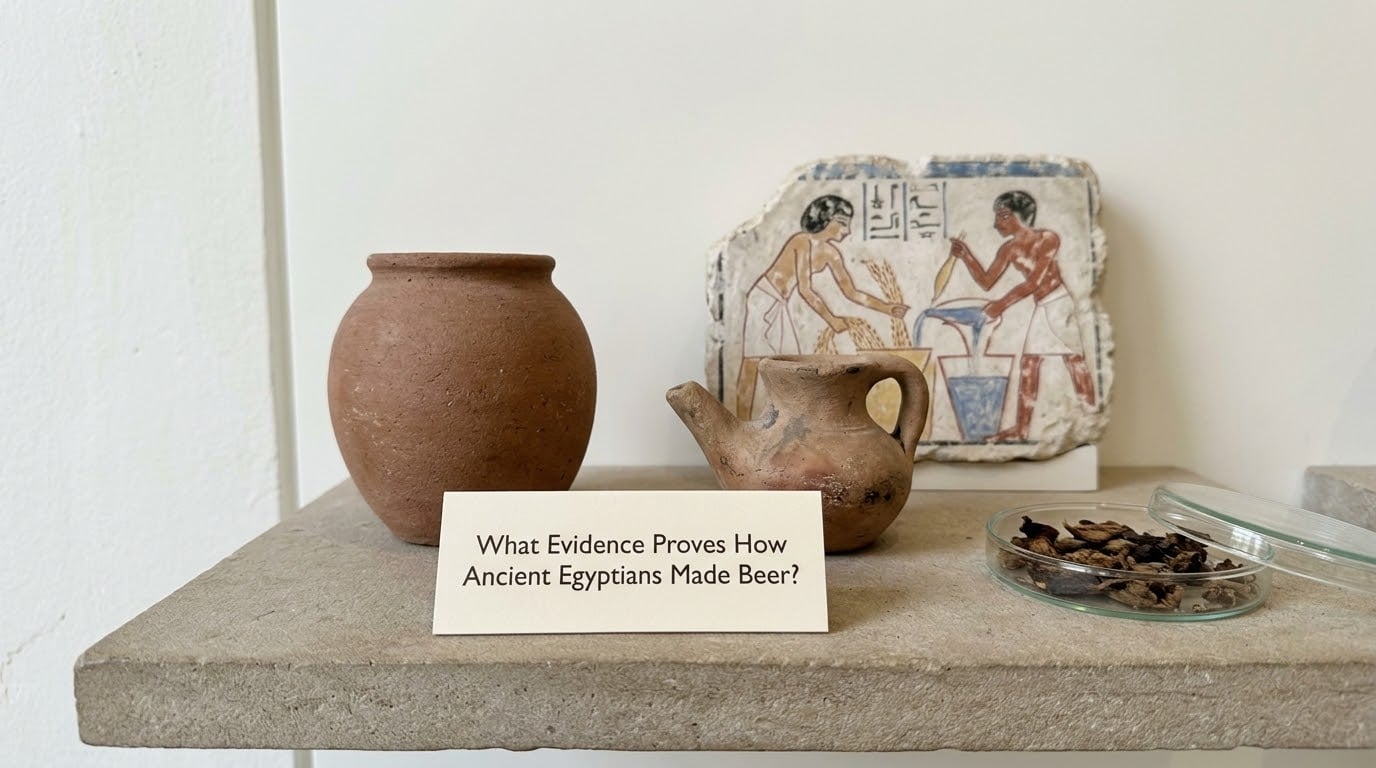
Five ceramics vats holding residues consistent with brewing, found at Hierakonpolis in Upper Egypt, are the earliest hard physical evidence, dating to roughly 5,600 years ago. Everything we know about the process either comes from finds like these or from later texts and scenes that describe the same method.
| Source | What it shows |
|---|---|
| Hierakonpolis vats | Earliest surviving evidence of organised brewing, with residues in the vessels |
| Abydos brewery | Industrial-scale mass production dating to the reign of King Narmer |
| Amarna workers’ village, c. 1350 BC | Full-scale brewing facilities supplying a working town, excavated under Barry Kemp |
| Residue analysis from brewery jars | Chemical fingerprints of ingredients and sugar conversion, drawn into a process flow diagram by Dr Delwen Samuel |
| Funerary models, including an 11th Dynasty example dated c. 2009-1998 BCE | Baked beer-bread loaves, jars and strainers, and the whole sequence in one object |
| Tomb scenes and written records | Serving, drinking through straws, offering to gods, and the vocabulary of the process |
Two honest caveats. Greek writers who visited Egypt much later left accounts of Egyptian life that are useful but secondhand and partly stylised. And a text like the Hymn to Ninkasi, often pulled into Egyptian beer discussions, is Sumerian and Mesopotamian, not Egyptian. It is a superb description of early brewing, but it is not evidence about the Nile Valley.
The sharpest distinction to keep in mind: vats, residues, models and scenes show that brewing happened and what it involved, while the exact resting times, temperatures and yeast strains are reasoned reconstruction rather than written-down fact.
Frequently Asked Questions
Did ancient Egyptians make beer with bread?
Yes, and that is the central point. Grain was soaked and lightly malted, mixed with water into a dough, and baked into a dense under-baked loaf known as beer-bread or hefeqet. The baked loaf was then crumbled back into water to make wort for fermentation. Bread and beer came out of the same facility, often from the same batch of grain, and the loaf was an intermediate step rather than a side product.
What type of barley did ancient Egyptians use for brewing?
Two-rowed hulled barley, used alongside emmer wheat as the main brewing grains. Barley suits the climate and the process because it germinates quickly and converts its starch into sugar with the enzymes released during sprouting. Emmer was arguably the more valued of the two, and its straw doubled as fuel and as mud brick reinforcement, which made it a genuinely multipurpose crop.
Did ancient Egyptian beer contain hops?
No, and none has been found in any Egyptian archaeological context. Without hops there was no hop-derived bitterness and almost no preservative action. Flavours came instead from dates, honey, grapes, figs, herbs and sedges added to the mash, and the practical cost of that absence was shelf life: the beer was brewed and consumed almost immediately rather than stored.
How strong was beer in ancient Egypt?
Generally low, most likely somewhere in the range of modern session beer or below, though it varied widely with grain quality and how much bread was used. A thick, bread-heavy mash also carries residual unfermented sugar, so the drink could feel substantial while still being comparatively low in alcohol. Nothing in the evidence points to a strong brew.
What was the oldest known Egyptian beer called?
There is no securely attested single name for the oldest Egyptian beer. The word that appears most often in later Egyptian texts for the beer-and-bread mash is hefeqet. Beer-bread and hefeqet are often treated as interchangeable, but strictly speaking hefeqet refers to the mash or substrate rather than to a named brand. Older Predynastic remains are usually described by site rather than by name.
How did ancient Egyptians keep beer from spoiling?
They mostly did not, and that is the honest answer. With no hops, no filtration and no pasteurisation, beer was brewed in small batches and consumed within days. Unglazed porous clay jars did help, since their walls hosted a resident wild yeast culture that inoculated each new batch, and souring acted as its own form of protection by killing anything the yeast could not handle.
Conclusion
The short version of how beer was made in ancient Egypt is a five-part method that anyone could run without equipment: soften and partly germinate the grain, bake it into an under-baked loaf, crumble that loaf into water, let wild yeast ferment it in a porous clay jar, then strain and drink it within days.
Start with the bread. Once you understand that the loaf was the fermentation substrate rather than a byproduct, the rest follows: no hops, no chilling, no cultured yeast, no storage. It was a fast, sweet, filling drink made daily in a country that brewed on a genuinely industrial scale by 1350 BC, and it fed builders, scribes and gods in roughly equal measure.