Kettle souring is a brewing technique that sours unfermented wort with selected Lactobacillus bacteria, usually inside the brew kettle, so the beer develops clean lactic acidity in about 24 to 72 hours instead of the months a mixed-culture sour needs. The wort is inoculated, held warm while the bacteria work, then boiled again to kill the bacteria before hops and yeast go in.
If you have searched what kettle souring means and found yourself somewhere between a chemistry textbook and a brewery conversation, this guide should settle it. Below I walk through the biology, the full process, the temperature and pH numbers people argue about, how the method compares to other ways of souring beer, and how to taste and read kettle sours in a taproom.
Table of Contents
- What Kettle Souring Means in Brewing
- How Kettle Souring Produces Clean Acidity
- The Kettle Souring Process Step by Step
- What each stage should look like
- Kettle Souring Temperatures, Timing, and Acidity
- What Kettle Souring Means for Acidity Control
- Kettle Souring vs. Other Ways to Make Sour Beer
- What Kettle-Souring Beer Usually Tastes Like
- Can You Taste Kettle Souring in a Finished Beer?
- How to Recognize Kettle-Souring Beer on a Label
- Kettle Souring for Homebrewers: Pros and Common Challenges
- Frequently Asked Questions
- Is kettle souring the same as adding lactic acid to beer?
- How sour should a kettle-sour beer taste?
- Can I kettle sour beer at room temperature?
- What culture is used for kettle souring at home?
- Does a brewery have to say a beer was kettle soured?
- Conclusion
What Kettle Souring Means in Brewing
Plainly, kettle souring means deliberately acidifying wort with a pure lactic acid bacteria culture while the wort is still unfermented, then finishing that wort off as beer. The bacteria convert sugars into lactic acid. That is the whole trick: you get the sourness that normally takes a barrel and a wild ecosystem, but you get it in a fermenter on your own schedule.
It is not the same as souring finished beer. Brewing an ordinary beer and dosing it with food-grade lactic or citric acid gives you sharpness too, but the flavor is a bolt-on. Kettle souring builds acidity into the wort before fermentation, so the yeast ferments an already tart wort and the sourness reads as part of the beer rather than an addition on top of it.
Commercial breweries use it because clean tartness sells well and takes up a few days of tank space instead of a year of barrel capacity. Homebrewers use it because the technique scales down to a single bucket and an immersion chiller.
How Kettle Souring Produces Clean Acidity
Lactobacillus is an obligate anaerobe, which means it is comfortable and productive when oxygen is kept out. Pitched into warm wort, it consumes the wort’s fermentable sugars and excretes lactic acid. The more sugar it eats, the more acid appears and the lower the pH falls.
Clean comes down to which microbes are in the vessel. A single selected culture gives you lactic acid and little else, so the result is described as clean, bright, or wine-like. A barrel that has housed a mixed microbial community can also produce acetic acid and the earthy, barnyard, or cured-meat compounds that sour aficionados call funky.
Here is a concrete example. Take a kettle-soured red ale with a modest grain bill, sour the wort for two days until the pH reaches roughly 3.4, then ferment it with a clean English ale yeast. You get a tart, lightly fruity red ale with a defined lactic tang and no barnyard character. The acidity reads like a squeeze of lemon or a dry Riesling rather than like vinegar.
The Kettle Souring Process Step by Step
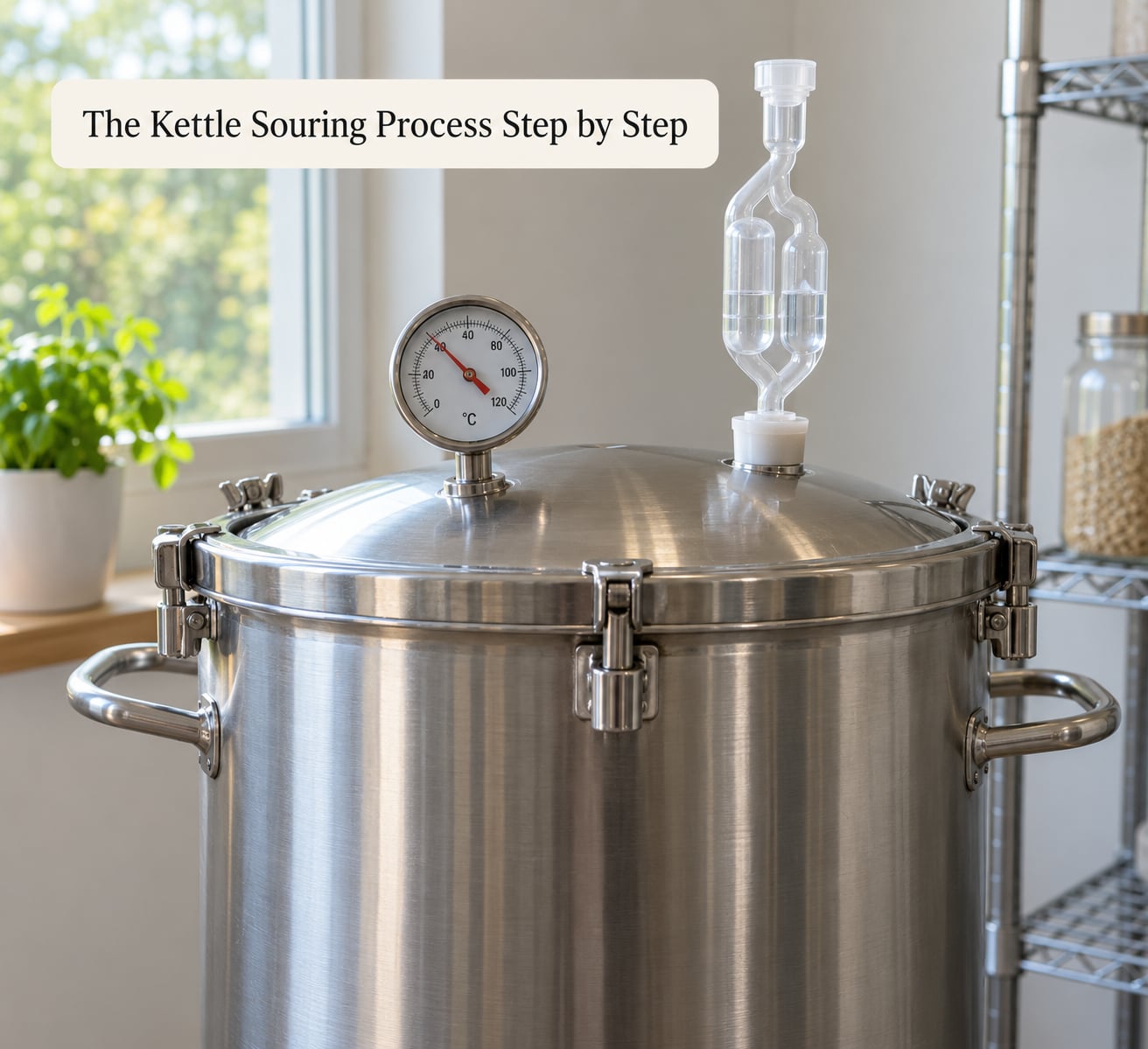
The sequence is not complicated, but the order matters and there is little room for improvisation in the middle. Typical homebrew practice looks like this.
- Sanitize everything that touches the souring wort. The vessel, the transfer lines, the airlock, and the thermometer. Kettle souring is not a contamination shortcut, and the single most common cause of a strange-tasting kettle sour is an unsanitized surface rather than a bad culture.
- Mash and sparge as normal, then boil briefly. Most recipes call for a short boil of 10 to 20 minutes. The goal is wort quality and hop utilization for the bittering hops, not a full 60-minute boil at this stage.
- Cool into the inoculation range. Most commercial and homebrew Lacto cultures work somewhere between 95°F and 115°F. Follow the strain manufacturer’s window, since a culture held above its range may stall.
- Pitch the culture and hold temperature. A pure Lacto pitch, a prepared kettle-sour culture, or an unrefrigerated probiotic capsule dissolved in a small amount of wort all show up in practice. Cover the vessel and keep oxygen out; a CO2 blanket is used by some breweries and skipped by others with little measurable difference.
- Let it sour until you hit your target. Most batches land between one and three days. Taste or measure as you go, because acidity climbs faster than many brewers expect, especially at the warmer end of the range.
- Boil the wort again. Bring the soured wort back to a boil and hold it through your normal boil time. This kills the bacteria so your yeast is not fighting them for sugars, and it carries away volatile acidity.
- Add hops, chill, and pitch yeast. Hop timing is where many kettle sour recipes differ. Adding hops early can inhibit the bacteria because hop resins and iso-alpha acids suppress Lacto growth, so bittering hops are often added during the post-sour boil while aroma hops go in later to protect delicate fruit and floral notes.
What each stage should look like
| Stage | Purpose | Typical timing | What to look for |
|---|---|---|---|
| Sanitizing | Protect the batch from stray microbes | Before every transfer | No need to watch, just do it properly |
| Mash and sparge | Convert starch to fermentable sugar | Standard single-infusion mash | Runoff looks clear, gravity is on target |
| Pre-boil | Build wort and extract bittering hops | 10 to 20 minutes | Wort is hot and lightly bitter |
| Cooling | Enter the culture’s viable range | Down to 95-115°F for most cultures | Temperature holds steady |
| Souring | Bacteria convert sugars to lactic acid | 24 to 72 hours | Punchy lactic tang on the nose and tongue |
| Post-sour boil | Kill bacteria, strip volatile acidity | 10 to 60 minutes | Full boil reached and held |
| Fermentation | Yeast attenuates the wort | Normal primary, then cold crash or age | Airlock activity, falling gravity |
Kettle Souring Temperatures, Timing, and Acidity
Temperatures change both the speed and the character of the result, which is why no single schedule fits every culture. Warmer is faster and tends to push the beer toward a sharper, yogurt-like lactic note; cooler is slower and gives a softer, cleaner tartness.
| Culture conditions | Temperature | Time to sour | Typical flavor |
|---|---|---|---|
| Standard pure Lacto pitch | 95-115°F (35-46°C) | 24 to 72 hours | Clean, bright lactic tartness |
| Cooler holding | Around 95°F | 2 to 4 days | Soft, wine-like acidity |
| Warmer, faster souring | 110-115°F | 1 to 2 days | Sharper tang, more pronounced sourness |
| Probiotic capsule or commercial kettle-sour pitch | Follow the product label | Usually 1 to 3 days | Variable, check before boiling |
Check the strain manufacturer’s instructions rather than assuming, because products differ and formulations change from one brand to the next. Experienced brewers tend to agree on one thing: treat pH and taste as your real control, not the calendar.
What Kettle Souring Means for Acidity Control
Acidity is not a switch you flip, it is a curve. Souring wort at 105°F for 24 hours and at 115°F for 24 hours will not land in the same place. Pulling a taste when the beer reaches the tartness you want gives you far more precision than a written schedule.
A basic pH meter makes this repeatable, though plenty of homebrewers work by taste alone. Many also pre-acidify the wort with a small addition of lactic acid before pitching, which drops the starting pH and makes the first hours of bacterial activity more predictable. Treat measured pH as a guide rather than a target: some folks aim around 3.4 to 3.6 for a session sour, others push lower. What kettle souring means for control is that you can stop the bacteria whenever you decide to, and you decide by drinking the wort.
Kettle Souring vs. Other Ways to Make Sour Beer
No method is best at everything. Each one trades flavor complexity for speed, control, or equipment needs, and the right choice depends on the beer you actually want.
| Method | Time to sour | Flavor character | Control | Equipment demands | Good fit |
|---|---|---|---|---|---|
| Kettle souring | 1 to 3 days | Clean lactic tartness, bright and wine-like | High, you stop the fermentation yourself | Fermenter, temperature control, sanitation discipline | Berliner Weisse, gose, fruited and session sours |
| Spontaneous souring | Months to years | Complex, acidic, often funky | Low, the barrel ecosystem decides | Barrels, aging space, patience | Lambic-inspired and long-aged farmhouse styles |
| Mixed-culture barrel souring | 6 months to 2 years | Layered acidity with funk, oak, and fruit | Medium, blending can refine the result | Barrels, blending vessels, blend planning | Complex wild ales and barrel programs |
| Post-fermentation acid addition | Minutes | Straightforward sharp acidity, sometimes thin | High, but only at the end | Food-grade acid and careful dosing | Fast adjustments and experiment batches |
| Co-souring and post-souring | Under 3 days | Clean acidity alongside fermentation | Medium to high | Same as kettle souring, plus yeast timing | Fast turnaround and blending flexibility |
Co-souring pitches yeast and Lacto together so fermentation and souring overlap, and post-souring boils first, then sours. Both compress the timeline further, and both are worth considering if your main constraint is how quickly beer can be finished.
What Kettle-Souring Beer Usually Tastes Like
The signature is a clean, lactic sourness: a sharp but smooth tang, moderate acidity on the finish, and very little in the way of funk. Many examples also show bright fruitiness from fermentation itself rather than from added fruit. Berry and melon notes, lemon-like tartness, and a dry wine-like quality are all common.
What ends up in the glass depends heavily on the grain bill, hop choice, and yeast. A grist with a touch of wheat or rye adds body under the tartness. Dry hopping at low levels adds aroma without dragging in bitterness, and heavy late hop additions can taste grassy next to sharp acidity. A neutral yeast keeps the focus on the fruit produced by the ferment, while an expressive yeast strain will push fruitiness up front.
Can You Taste Kettle Souring in a Finished Beer?
Sometimes, but never reliably. A kettle-soured beer with no acetic character and a bright lactic edge is a strong hint, and a beer full of barnyard and cured-meat funk is a strong signal that it came from a barrel or mixed culture. Still, taste alone cannot confirm the method. Breweries blend, co-sour, acid-dose finished beer, and age kettle sours, so the same glass can come from more than one process.
How to Recognize Kettle-Souring Beer on a Label
Some breweries are straightforward about it. Look for phrases such as kettle soured, kettle sour, lactic soured, Lacto fermented, or sour finished and refermented with a cultured souring agent. Those tell you a selected bacterial culture produced the acidity, and by extension that you can expect clean lactic sourness without long aging.
Plenty of breweries disclose nothing, and the method is not legally required on most labels. Descriptions like sour, tart, gose, Berliner Weisse, or fruited sour describe the finished style or the flavor the drinker will perceive, not how the acidity was created. When a taproom list mentions a beer as a kettle sour, that is a good sign of clarity, and you can always ask the person pouring.
Kettle Souring for Homebrewers: Pros and Common Challenges
The advantages are straightforward. Kettle souring is fast, needs ordinary fermentation equipment, and gives you a defined flavor that is easy to repeat batch after batch. No barrels, no aging cellar, no wild organisms in your equipment, and the sourness lands where you told it to. For a brewer learning about styles, it is also a forgiving place to start working with bacteria.
The challenges are worth being honest about. Inconsistent results are the most common complaint, usually because a batch sat too long or not long enough, or because the culture was not active. Temperature control at homebrew scale is the other big one, since a kitchen does not hold 105°F on its own. A pH meter is helpful but not required; tasting works, measuring just makes it repeatable.
Contamination is a real concern too, mostly for what comes after the sour. Lacto in the souring vessel is intended, and a hop-tolerant strain like Lactobacillus plantarum is unlikely to move into a heavily hopped beer. Once you boil the wort, everything you had should be dead, so sanitizing the transfer path into the yeast stage is where your attention belongs. Decide on final sourness before packaging, because sourness does not fade with time, and if you package a hot batch it only gets sharper in the bottle.
Frequently Asked Questions
Is kettle souring the same as adding lactic acid to beer?
No. Kettle souring means Lactobacillus bacteria convert wort sugars into lactic acid while the wort is still unfermented, so acidity builds before yeast ever arrives. Dosing finished beer with food-grade acid produces sourness in minutes, which is useful and fast but reads as a finishing adjustment rather than an integrated part of the beer.
How sour should a kettle-sour beer taste?
Cleanly tart, with a defined lactic bite that lingers without turning into vinegar. Strongly sour examples exist, but the classic kettle-soured Berliner Weisse or gose lands closer to lightly tart, where the acidity balances sweetness and fruitiness. Taste the wort during souring and pull it when it hits the level you want.
Can I kettle sour beer at room temperature?
Only if your room sits inside the culture’s viable range, which most do not. Most Lactobacillus cultures want roughly 95 to 115 degrees, so a warm closet or a fermentation heater is usually needed. Above that range bacteria can stall and the wort is also far more exposed to stray microbes, so hold the temperature rather than trusting ambient heat.
What culture is used for kettle souring at home?
A pure Lactobacillus culture is the standard choice, either as a commercial pitch such as a kettle-sour strain or as a probiotic capsule containing Lactobacillus plantarum dissolved into a little wort. Some brewers use prepared sour wort from a brewery. Follow the strain instructions on temperature and timing, since what kettle souring means in practice depends on the organism you pitched.
Does a brewery have to say a beer was kettle soured?
Usually not. In the United States the method itself is not a required label statement, and many breweries simply list the style and ingredients. Words like kettle soured, lactic soured, or Lacto fermented are voluntary and helpful when present, while sour, tart, gose, and Berliner Weisse describe the finished beer rather than the method behind it.
Conclusion
What kettle souring means in one line: selected bacteria acidify unfermented wort for a day or three, then get boiled off so yeast can finish the beer clean. Decide first whether you want controlled lactic tartness or the layered funk of a wild fermentation, because the two demand completely different equipment and patience.
If it is controlled tartness, pick your culture, read its temperature range, and let taste or a pH reading rather than the clock tell you when to boil.