A seasonal beer is brewed and released for one stretch of the year, with its ingredients, strength and flavor matched to that season’s weather, produce and holidays. How seasonal beers work comes down to four things: what is actually in season to brew with, a brewing calendar planned months in advance, a deliberately short release window, and an occasion that gives the beer a reason to exist. The brewing method itself never changes.
Nothing about the process is seasonal. The same kettle, the same yeast and the same tanks turn out a Märzen in July and an imperial stout in January. What changes is the recipe, the date on the calendar, and how long the brewery intends the beer to exist.
Table of Contents
- What Makes a Beer Seasonal?
- How Seasonal Beers Work from Grain to Glass
- How Seasons Shape the Ingredients
- Hops and the harvest window
- Vegetables, fruit and spices
- Malts, wood and water
- How Seasonal Beers Work Across the Calendar
- Spring beer styles
- Summer beer styles
- Fall beer styles
- Winter beer styles
- Why Breweries Release Seasonal Beers at Different Times
- How Freshness and Shelf Life Change
- How to Read a Seasonal Beer Label
- Frequently Asked Questions
- Why do breweries call a beer seasonal if it is available all year?
- Are seasonal beers brewed only during the season they are named after?
- How long does a seasonal beer stay fresh after release?
- Does a printed date mean a seasonal beer has gone bad?
- Are winter beers stronger than beers from other seasons?
- Conclusion: Start with the First Pour
What Makes a Beer Seasonal?
A beer is seasonal when a brewery decides it belongs to a particular part of the year, then commits to that window rather than selling it year-round. The reasoning usually blends three things: ingredients that are at their best in that season, a drinking occasion people already celebrate then, and a business reason to keep the lineup changing so drinkers keep coming back.
Ingredient seasonality is the most concrete piece. Fresh hops have to be used within weeks of being picked, so wet-hop and fresh-hop beers cluster around the late-summer and early-autumn harvest rather than spring. Pumpkin arrives in autumn. Spices that most people bake with in November and December are spices a brewery can reach for in October.
Before mechanical refrigeration, brewing was literally a winter activity. You brewed in the cold months because cold storage was the only safe way to keep beer, then drank what was left through the warm season. Anchor Brewing’s Our Special Ale, first brewed in 1975, is the usual reference point for the old winter ritual, and Sierra Nevada’s Celebration Ale built a modern American version of it. When cold storage went away, that constraint lifted and seasonality became a choice breweries make on purpose.
It is worth saying plainly: most breweries do not use only in-season produce. Pumpkin ales are commonly made with canned purée, spices arrive dried and from other continents, and citrus peel is available in any month. Seasonal describes intent and timing far more often than it describes sourcing.
How Seasonal Beers Work from Grain to Glass
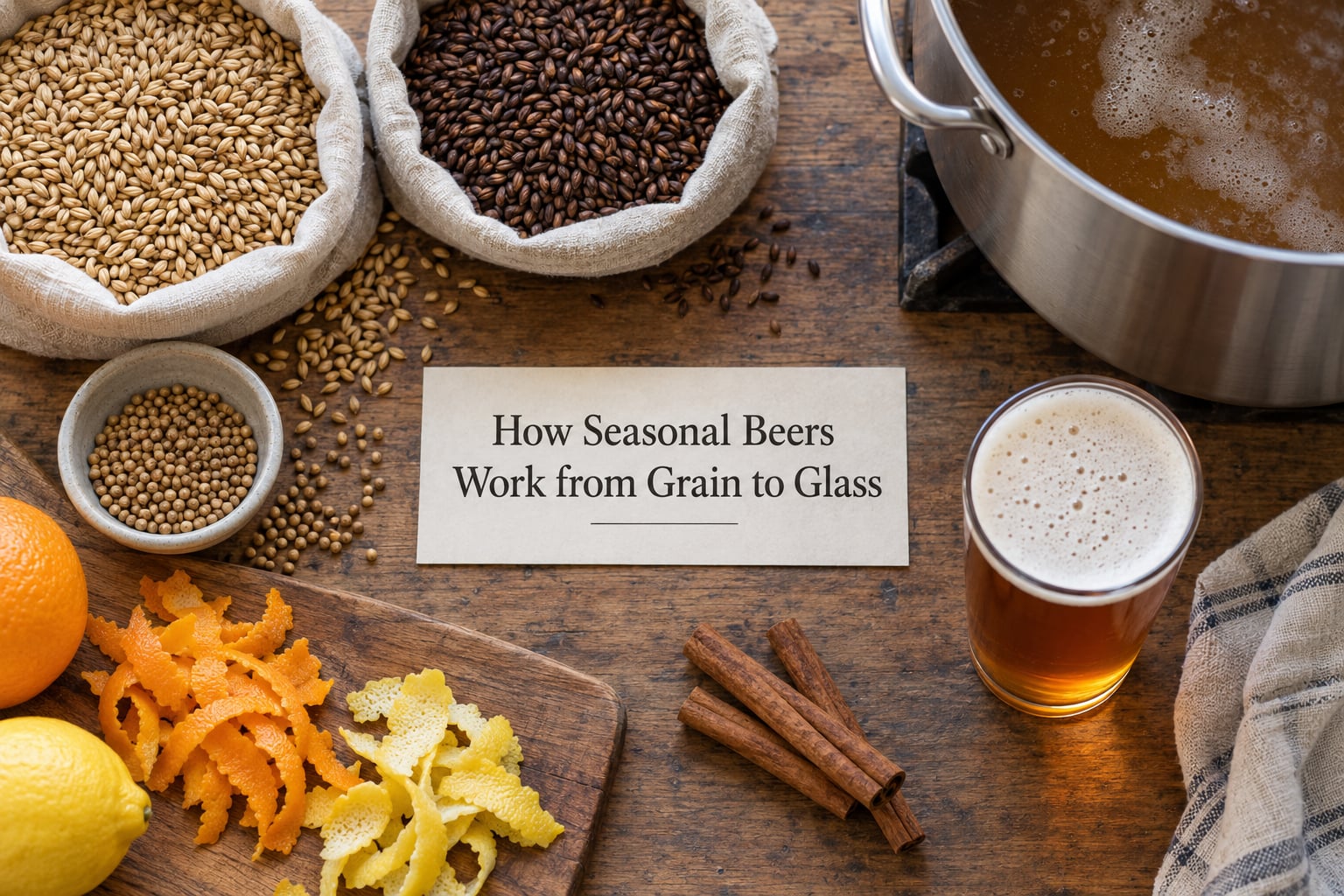
A seasonal beer is planned backwards from the release date. The brewer picks a date on the calendar, then works out how many weeks of brewing, fermentation, conditioning and distribution have to fit between the grain purchase and the first pour. Styles with long cold-conditioning times get brewed earliest, which is one reason Märzen shows up in late summer and holiday stouts start their journey in the autumn.
- Recipe and date lock. The brewer sets the target release, then builds backward from the slowest step in the process to find the brew date.
- Grain and hop selection. Base malts stay constant year-round, but a seasonal recipe leans on specialty malts, a different hop schedule, or whatever produce and spices are tied to the occasion.
- Brew day. Mashing, lautering and boiling proceed as they do for any beer. Fresh-hop additions happen within hours of the leaves or cones arriving from the farm.
- Fermentation. Ale yeast works warm and fast; lager yeast works cold and slow. That difference alone can span six weeks or more.
- Conditioning and lagering. Cold storage settles the beer and smooths the edges. Bottled beer with live yeast will keep evolving in the bottle.
- Packaging and distribution. The brewery tells its distributors how much is coming, and packaging, trucking and shelf placement fill the weeks between the tank and the tap handle.
- Release and the peak window. The beer hits its intended moment, holds it for weeks or a few months, then the brewery moves on to the next SKU on the calendar.
| Stage | What changes at this stage | Typical time |
|---|---|---|
| Planning | Release date fixed, recipe designed around the season | 4-8 months ahead |
| Ingredient buying | Malt and hops ordered; fresh produce or spices sourced | 2-4 months ahead |
| Distributor notice | Volume forecast shared so orders can be placed | 6-12 weeks ahead |
| Brew day | Grain milled, hops added; wet hops used within hours | Days to weeks ahead |
| Fermentation | Yeast converts sugar; esters and character develop | 1-4 weeks |
| Conditioning | Beer settles cold; flavors clean up | 2-12 weeks |
| Release | Kegs and cases move to taprooms, bars and shelves | The seasonal window |
| Peak drinking | Freshness at its best before hops fade or carbonation drops | Weeks to a few months |
How Seasons Shape the Ingredients
Seasonality shows up in the recipe because the recipe is chasing something real: a harvest, a spice, a temperature, or a tradition. Brewers who take it seriously tend to describe their seasonals by the ingredient that anchors them.
Hops and the harvest window
Fresh hops, also called wet hops or first hops, are used within a day or two of picking because they are not dried or stored. That puts most fresh-hop beers in late summer and early autumn in the northern hemisphere, even though drinkers often expect them in spring. The beer only exists for a few weeks of the year, which is why homebrewers plan their whole year around the harvest date.
Vegetables, fruit and spices
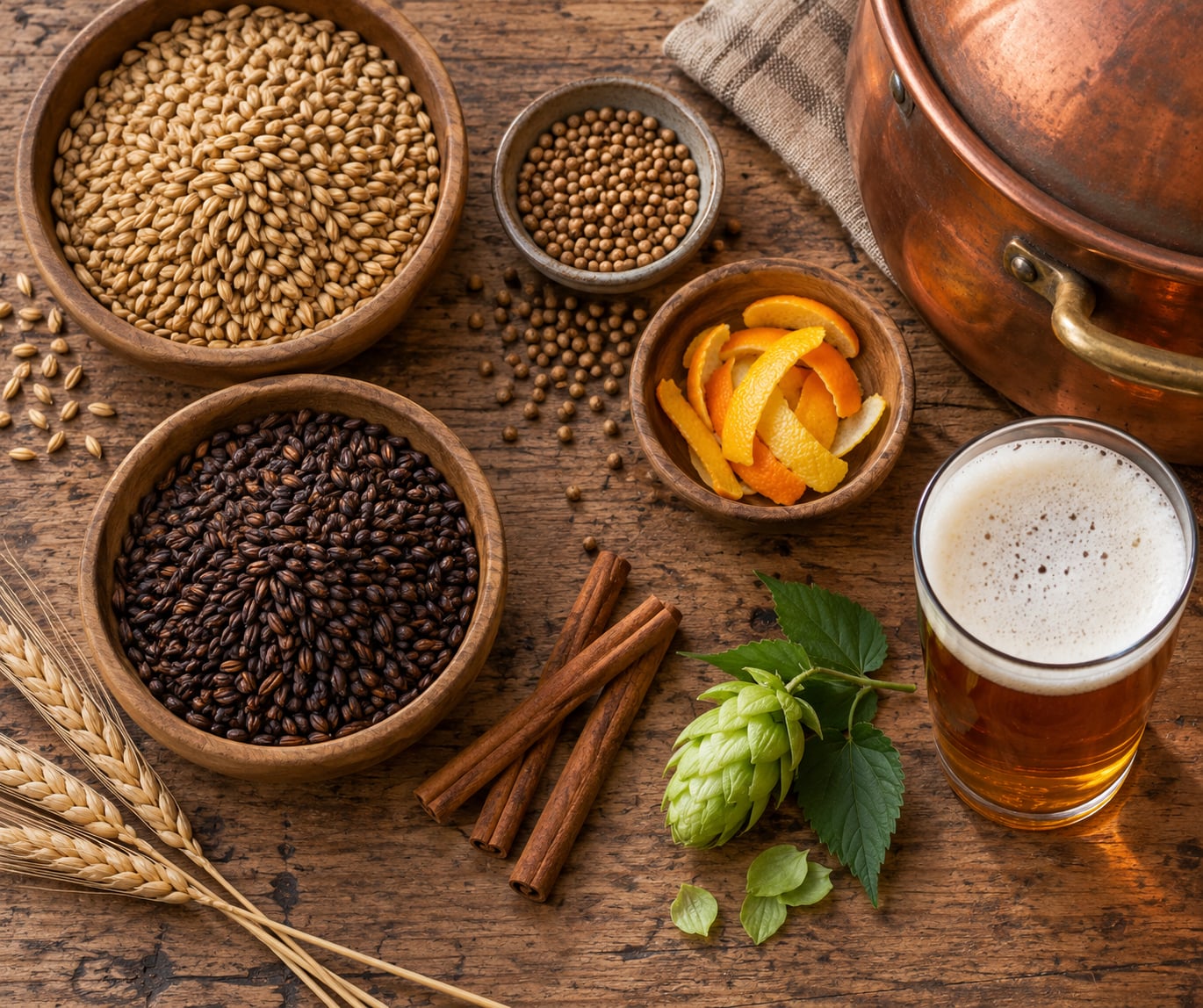
Pumpkin and squash anchor autumn ales, usually with cinnamon, clove and nutmeg for a bake-like profile. Strawberries and rhubarb show up in late spring and summer releases. Citrus peel, coriander and dried fruit belong to winter. Brewhouses that care about authenticity will wait for the real thing; most will use purée or dried spice because the alternative is a beer that only exists in theory.
Malts, wood and water
Roasted and caramelized malts carry the winter and holiday styles, giving the roasted, toasted and caramel flavors that pair with a heavy meal. Barrel aging, which takes months, is another seasonal engine: a barrel-aged release has to be started early enough to be ready when the occasion arrives. Water chemistry and lagering temperature quietly shape a season’s character too, since cold conditioning is only practical in the cooler months at many breweries.
How Seasonal Beers Work Across the Calendar
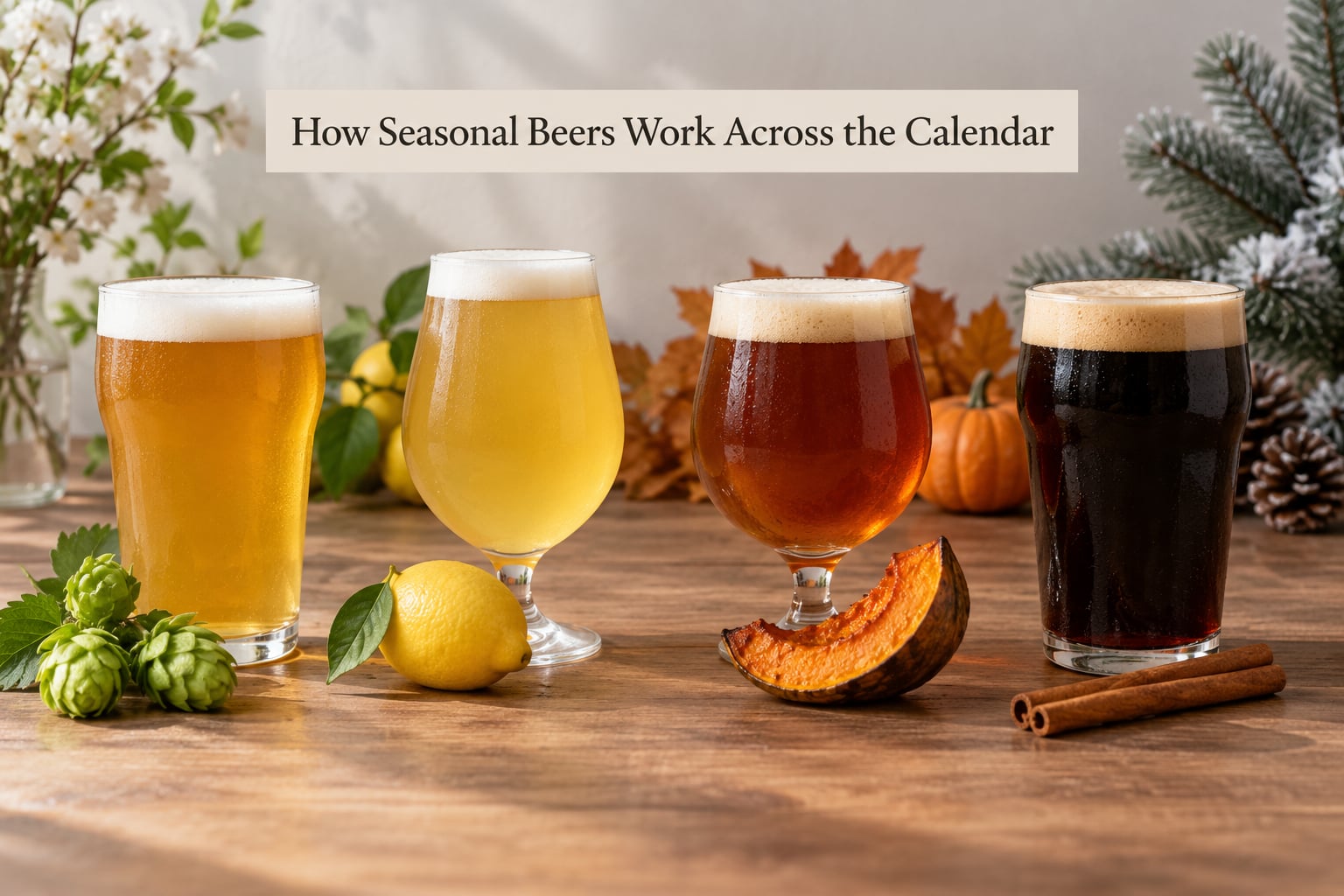
The calendar below is a rough map, not a rulebook. Breweries shift the dates by a few weeks every year, and plenty of them ignore the calendar entirely for one beer or another.
| Season | Typical flavors | Defining styles | Usual ABV | Classic pairings |
|---|---|---|---|---|
| Spring | Light, dry, crisp, herbal | Pilsner, saison, farmhouse ale, hefeweizen, witbier, bock and maibock in the coldest months | Roughly 4-7% | Asparagus, salads, light seafood, picnics |
| Summer | Refreshing, citrusy, hoppy, sour | Pale ale, IPA, pilsner, gose, Berliner Weisse, shandy | Roughly 3-6% | Grilled food, burgers, tacos, anything off the grill |
| Fall | Toasty, malty, spicy, harvest-driven | Märzen and Oktoberfest-style lagers, pumpkin ale, brown ale, fresh-hop pale ale | Roughly 5-8% | Roasted meats, sausages, root vegetables, tailgates |
| Winter | Dark, roasted, warming, high-alcohol | Stout, porter, doppelbock, barleywine, old ale, spiced holiday ale | Roughly 6-12% | Roasts, stews, blue cheese, dessert |
Spring beer styles
Spring is the reset. Beers are lighter, drier and often closer to a lager or a farmhouse ale, made for the first warm days rather than for a holiday. Bock and maibock sometimes appear here because cold lagering is still practical, which surprises people who expect them strictly in winter.
Summer beer styles
Summer releases chase refreshment: pilsner, pale ale, IPA, and the sour-leaning gose and Berliner Weisse. Fruit additions and shandy-style beer-and-splitz drinks fit the season too. ABV usually drops, because drinkability in heat is the whole point.
Fall beer styles
Fall is the busiest window on any brewery calendar. Märzen and other Oktoberfest-style lagers need months of cold conditioning, so they arrive first; pumpkin ale follows; fresh-hop beers land as the harvest comes in. This is also when the first hop harvest beers and the biggest release volumes overlap.
Winter beer styles
Winter favors roasted and strong: stouts, porters, doppelbock, barleywine and spiced holiday ales. Higher alcohol content is genuinely functional here, since a warmer, fuller beer reads as warming in cold weather. A barrel-aged release that takes six months to finish belongs to this part of the year for the same reason.
Why Breweries Release Seasonal Beers at Different Times
The recipe is seasonal; the release date is a separate decision driven by logistics. Long conditioning forces an early brew, and distribution forces an early order. That gap is where most of the complaints about beer seasons start.
A brewery that wants an Oktoberfest-style lager on a tap handle in mid-September had to brew it roughly three months earlier, condition it cold, and let its distributor order it weeks before that. Every step in that chain runs forward, not backward, so the beer arrives when the plan says, not when the calendar says. You will see pumpkin ale in July for the same reason: the real ingredient arrives later than the ordering deadline.
Drinkers on r/beer have argued about this for years, and the complaint is fair enough. Seasonals also create scarcity on purpose. A limited window gives a beer urgency that a year-round IPA never has, and urgency is what brings people into a taproom. Trade estimates have put seasonals at roughly 14% of craft beer sales, which makes them a real revenue line rather than a novelty.
Three categories are worth separating, because they behave differently when you go looking for them:
| Type | How it’s limited | How to find it |
|---|---|---|
| Seasonal | Time only; the recipe repeats every year | Expected during its window in most markets |
| Special release | Time, quantity and geography together | Brewery mailing list, taproom day, release calendar |
| Year-round | Not limited at all | Anywhere the brewery distributes |
| Taproom-only | Geography only | Visit during the window; often unpasteurized |
Market-to-market variation follows the same logic. A distributor who takes three weeks to deliver gives a brewery more room than one who takes six, and a brewery with an on-site taproom skips the distribution step entirely. That is why two cities forty miles apart can be weeks apart on the same seasonal.
How Freshness and Shelf Life Change
A seasonal beer has a peak window, and what fades first depends on the style. Nothing in a beer spoils the way milk does; the changes are aroma, carbonation and oxidation flavors, and how fast they arrive depends almost entirely on hops, oxygen exposure and how the beer was packaged.
- Hop-forward ales and IPAs. Delicate hop aroma is the first thing to go, usually within weeks to a couple months of packaging. If a hazy IPA smells like nothing but malt, it is past its window, and no amount of chilling will fix it.
- Pale lagers and pilsners. Very stable. A canned pilsner sealed properly will taste broadly like itself for a long stretch, which is why lagers are the easiest seasonal to pick up late.
- Sours and farmhouse ales. Hold reasonably well, though carbonation fades in packaged beer and a flat saison is a dull saison.
- Stouts, porters and barleywines. Frequently improve for months, especially barrel-aged or bottle-conditioned versions with live yeast still doing work in the bottle.
- Anything bottle-conditioned. Keeps evolving and will improve, so it deserves a different storage decision than a filtered can.
Print a date and it usually means the day the beer was packaged, not the day it turns. Some breweries print a best-before as well, and others print nothing at all. Absence of a date is not a warning sign.
How to Read a Seasonal Beer Label
Labels carry more scheduling information than most drinkers use. Reading them takes thirty seconds and tells you whether a beer is still in its moment.
- Seasonal or limited wording. Seasonal implies a recurring window. Limited release implies this batch only, and possibly a different recipe next time.
- Style name. A stated style tells you the flavor and strength to expect. BJCP style guidelines are the usual reference, and a brewery following them closely is telling you something real.
- Vintage or date codes. A month and year usually means packaging date. On a bottle-conditioned beer, a lighter date is a feature.
- Alcohol by volume. Seasonal ABV tells you the occasion: anything around 10% or above is a sipping beer, not a session one.
- Suggested pairing. Usually written by the brewery, and usually accurate. Pumpkin ale with pie and a stout with a roast are not guesses.
- Freshness language. Best-by dates, unfiltered or unfined wording, and live-yeast claims are the strongest signals about how the beer was handled.
One practical habit beats all of this. If a seasonal interests you, buy it in the window and within weeks of the date on the can. If you find one well past its season, expect to pay less and expect to drink it sooner.
Frequently Asked Questions
Why do breweries call a beer seasonal if it is available all year?
Some breweries keep a popular seasonal on tap year-round because it sells well enough to justify the tank space. Calling it seasonal then describes its heritage rather than its availability. The recipe is built for a season even when the release window stretches, which is common for styles like pumpkin ale and Oktoberfest lagers that became permanent fixtures.
Are seasonal beers brewed only during the season they are named after?
No. Breweries schedule backward from the release date, and the slowest step sets the brew date. A Märzen conditioned for three months and released in September is brewed in June. Styles needing long aging start even earlier, so the brewing happens months before the drinking season begins.
How long does a seasonal beer stay fresh after release?
It depends entirely on the style. Hop-forward IPAs and pale ales are best within weeks to a couple of months because their aroma fades fast. Lagers stay broadly stable for much longer, and stouts, barleywines and barrel-aged beers often improve for months. Buy in the window and open within a few months if hops are the point.
Does a printed date mean a seasonal beer has gone bad?
A printed date usually marks when the beer was packaged, not when it becomes undrinkable. Some breweries print a best-before date as a freshness estimate, and some print nothing at all. Hop-forward beers are the real exception: past their window they lose aroma and taste flat rather than unsafe.
Are winter beers stronger than beers from other seasons?
Often, yes, and it is a deliberate choice rather than a rule. Higher alcohol adds perceived warmth in cold weather, and dark roasted malts need more body to stay balanced. Expect roughly 6-12% for stouts, doppelbock and barleywine, against the 3-6% typical of summer pilsners, IPAs and sours.
Conclusion: Start with the First Pour
A seasonal beer is defined by its ingredients, its timing and its occasion, not by a special way of brewing. The recipe and the release date are planned separately, which is why the calendar drifts and why some beers arrive early.
Before you buy, check four things: the style, so you know the flavor and strength; the date or seasonal wording on the label; whether it is a seasonal or a special release; and how it was packaged. Then drink it young if hops are the point, and grab a second one before the batch runs out.