Most unsold beer at a bar never becomes waste. It stays in the keg behind the bar, gets poured the next busy night, marked down, sent home with staff, or returned to a distributor. Only the portion that has actually gone bad — stale, oxidized, or contaminated — gets poured out, and even then the bar usually checks with its wastewater utility first. That is the short version of what happens to unsold beer at bars.
The interesting part is how much of this happens quietly. Nobody is standing at the end of the night deciding to dump a keg. A tap just runs a little slower every week until somebody moves it or pulls it.
I have talked to enough bar owners to know there is no single script. Two places running the same tap list on the same block will handle a slow Tuesday completely differently. What follows is what actually tends to happen, format by format, from the first pour to the drain.
Table of Contents
- What Happens to Unsold Draft Beer at a Bar?
- How the Draft-Beer Inventory System Works
- How What Happens to Unsold Beer at Bars Differs by Format
- Can Bars Sell Unsold Beer as a Daily Special?
- Can Employees Drink Leftover Beer?
- Why Do Bars Waste Beer Instead of Giving It Away?
- How Is Unsold Beer Safely Discarded?
- Who Owns Unsold Beer at Each Stage?
- How Can Bars Reduce Unsold Beer Waste?
- Frequently Asked Questions
- Does unsold draft beer sit in the tap overnight?
- How long can a bar keep an untapped keg of beer?
- Can a bar sell nearly empty cans or bottles?
- Is it legal for bar staff to drink or take home leftover beer?
- Can a bar return unsold packaged beer to its distributor?
- What happens if unsold beer is left until it becomes bad?
- What to Remember About Bar Beer Leftovers
What Happens to Unsold Draft Beer at a Bar?
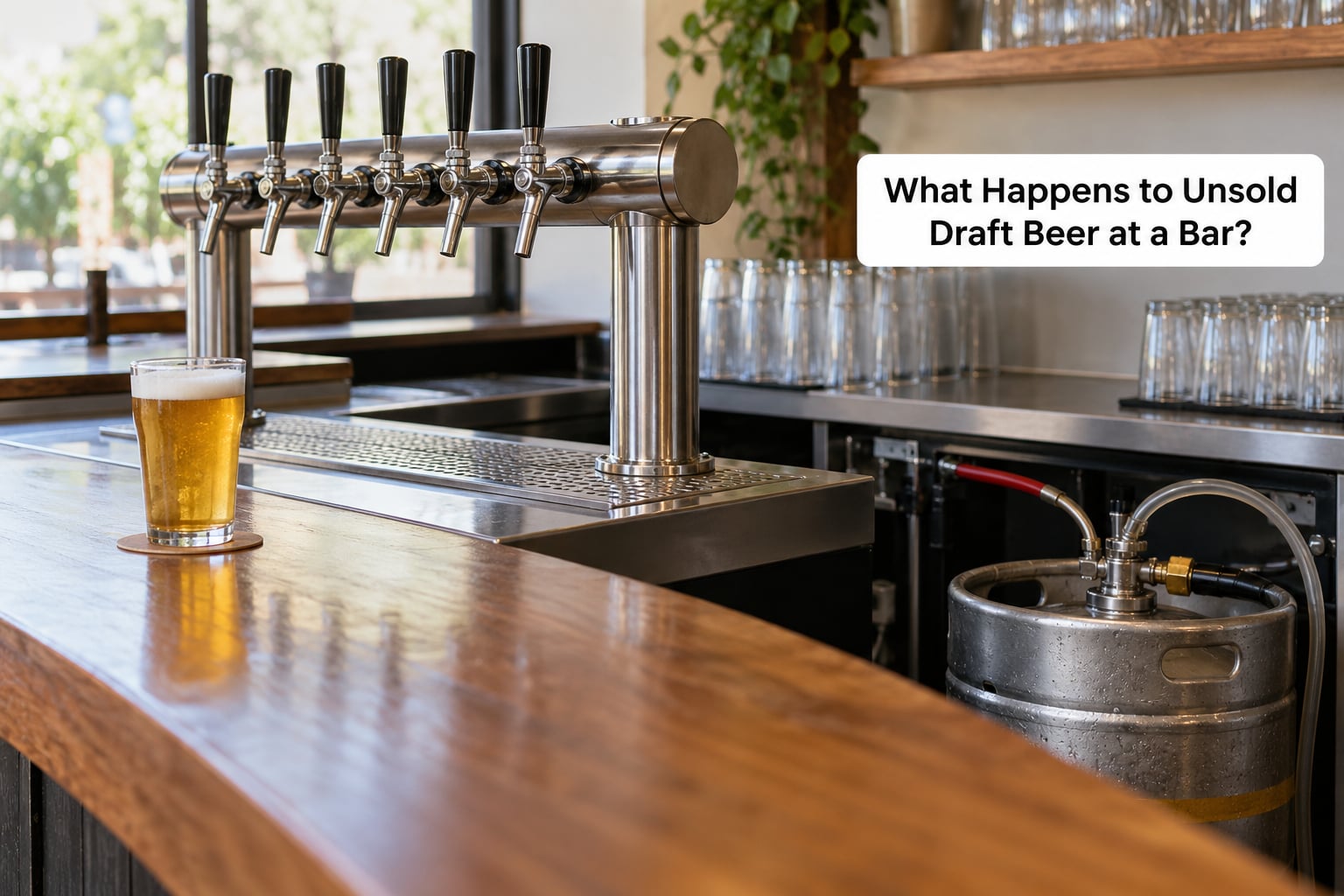
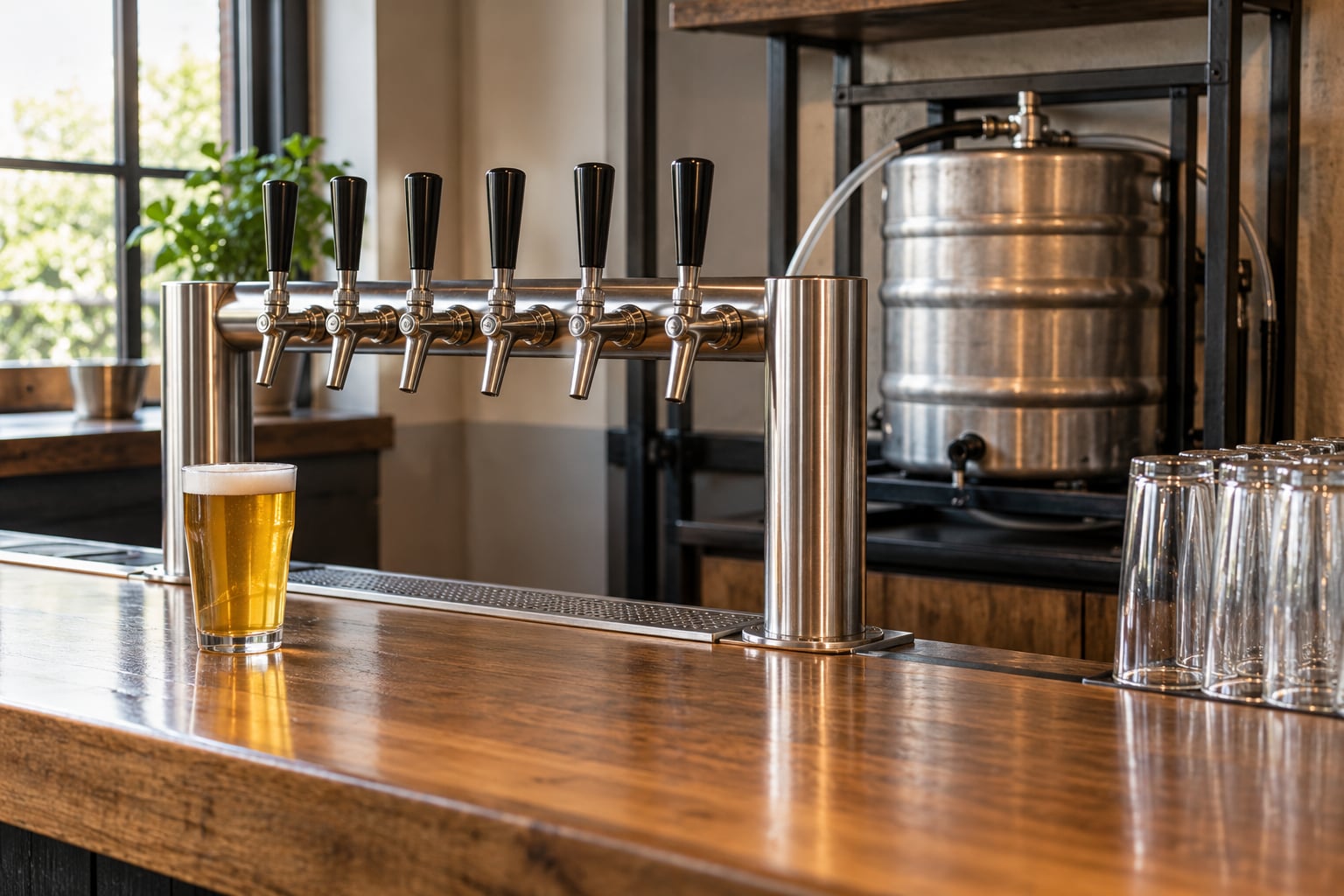
Unsold draft beer usually stays exactly where it is. It sits in a partially emptied keg, still connected to a line, still pressurized, until someone pours it. The beer is not sitting in a glass going warm and it is not exposed to air. That is the single most important thing to understand about draft beer and waste: the clock is much slower than people think.
What actually gets discarded each night is smaller than most people imagine. It is the beer in the tail end of the line, the bit that sits inside the faucet, and the last ounce or two that has been sitting in an unsealed coupler since the last pour. That volume is measured in fractions of a pint, not gallons.
The bigger losses are quieter. A keg goes stale because it sat tapped too long and nobody poured from it. A tap gets moved to the back of the cooler and its sales drop to a trickle. Those are the cases where a bar has a decision to make, and the decision usually comes down to freshness, not waste.
A keg is discarded when the beer inside has genuinely deteriorated, when the container is damaged, or when a line has gone unclean and the beer picked up contamination nobody can test for on the spot. Even then, most bars try to sell it first.
How the Draft-Beer Inventory System Works
Bars do not guess. A well-run bar knows roughly how much beer is in every connected keg, and it knows roughly how much it sold this week. The tracking is more basic than most people imagine.
Kegs are weighed, or the empty weight is subtracted from the full weight to get what’s left. A full half-barrel weighs about 160 pounds and an empty one about 30, so the difference gives you gallons on hand. Smaller kegs work the same way, and so do the ball locks and spear-tapped couplers used on single taps.
Then there’s the line itself. A bar tracks how much beer is trapped in the lines, because that affects what comes out of the first pour of the day. A long system with several couplers can hold a meaningful amount, and it is one of the reasons a manager who swears there is “still a lot in there” might be right.
Par levels sit on top of the math. Each tap has a target level the bar tries to keep stocked, and the order is built from actual sales rather than optimism. If a tap regularly runs dry, the par goes up. If it stalls at a third keg for a month, it comes off the board or gets pushed behind a faster seller.
That is where apparent mismatches come from. A keg that looks fuller than expected is usually because sales came from a different tap, or because the pour was smaller than anyone assumed for a few weeks. A keg that empties faster than the nightly numbers suggest is usually over-pours, a busy holiday weekend, or a line that wasn’t purged after cleaning.
Tapping dates get written on the keg, sometimes on tape, sometimes on the whiteboard behind the bar. Staff write the same kind of markdowns on packaged beer. The point is to answer one question fast: what is the oldest thing we have, and can we sell it this week?
How What Happens to Unsold Beer at Bars Differs by Format
The format decides everything, because only one of them is sealed from air and sitting under pressure.
Draft in a keg is the most forgiving. Unopened and kept cold, a keg is generally fine well past the date a brewery printed on it. Once tapped, the window narrows — commonly a handful of weeks for hop-forward beer, longer for a lager or a stout — as oxygen gets in through the coupler and the beer oxidizes.
Line and faucet residue has the shortest life of anything in the building. It is the oldest beer in the place by definition, sitting in a warm, wet, hard-to-clean environment. This is what gets thrown out most often, and it is why line cleaning is not optional housekeeping.
Cans and bottles are easy to count, easy to rotate, and easy to sell off. A bar will discount them, bundle them, or take them off the menu entirely. The risk here is a licence issue rather than a quality one.
Growlers and crowlers are the awkward middle. An unfilled growler is a container to wash. A filled growler is a fresh product with a clock of hours, not weeks, and it usually has to be sold or discarded the same day. Filled crowlers kept cold hold up somewhat better but still go past their prime quickly.
So the answer to what happens to unsold beer at bars differs completely by format. Draft waits. Cans wait longest of all. Growlers do not wait at all.
Can Bars Sell Unsold Beer as a Daily Special?
Yes — as long as the beer is sound. A bar can discount an end-of-life product, put it into a happy hour, or price it differently for a slow night. The discount is the normal move, not a last resort.
Happy hour is the cleanest version of this. The bar has the beer, the beer is fine, and it moves at a lower price during a window when people would not otherwise order it. No rules are broken, no one is being sold something they shouldn’t have.
Staff allocation is another route. Many operators run a small amount of beer as a shift drink or part of a staff meal allowance, written into the policy so it is recorded rather than skimmed. The details matter and I will get to them below.
To-go fills are the option a lot of drinkers want and few bars use. Filling a crowler from a tap that is about to go off moves the beer instead of losing it, and in most jurisdictions a sealed to-go container is sold the same way as a retail package, subject to the same licence and container rules.
Where a bar crosses the line is selling beer that has already turned. A flat, cardboard-tasting pour or something sour is not a special, it is a complaint waiting to happen. Discounting is legal and sensible; selling something you know is bad is a licence risk and a bad night behind the bar.
Can Employees Drink Leftover Beer?
Often yes, but it depends entirely on the employer’s policy, the local licensing rules, and how the beer is recorded. Staff drinks are normal in the industry, and they are a genuine waste-reduction tactic when the beer was never going to sell.
Three things decide whether it works. First, policy: is there a written allowance, and is it a flat amount per shift or a percentage? Bars that allow this properly track it in the same inventory system as everything else.
Second, licensing. Whether staff may drink on premises, whether the beer can be consumed anywhere other than a designated area, and whether it must be counted as a sale, all vary. Some jurisdictions treat any alcohol consumed on licensed premises as a sale, which turns “shift drink” into a bookkeeping entry rather than a freebie.
Third, proof of age and the open container rule. Take-home beer raises a different set of questions entirely, and the short answer is usually that it depends on the container, the jurisdiction, and whether the bar is licensed for off-premises sales. A can someone finished at work is a different situation from a growler filled for them to carry home.
Taking home unsealed draft is the one most bars will not do. There is no packaging integrity, no way to prove what it was, and the local rules tend to be unhelpful about it.
Why Do Bars Waste Beer Instead of Giving It Away?
Mostly because a free beer is a liability, and because a fridge full of free beer is an invitation.
Over-ordering is the single biggest cause. Bars buy on a schedule set months earlier, a promotion goes wrong, a holiday weekend does not materialise, and the beer is already in the cooler. Nobody decides to waste it — it just arrives faster than it sells.
Bad forecasts do the same damage. If a manager guesses high, a whole keg sits behind a slower tap. Poor pour tracking makes it invisible too, because nobody can see how many ounces an actual pint is.
Line problems quietly ruin product. A system that isn’t cleaned on a schedule lets the oldest beer in the building sit where it can contaminate everything poured after it. A failed coupler, a bad washer, or a growler filler that doesn’t seal properly can spoil a batch in a way nobody notices until customers complain.
Abandoned tabs and comped rounds are smaller but real. Then there is spoilage, damaged containers, kegs that came back from an event, and the slow season — January, February, a bad month for local events — where a bar is carrying more taps than its neighborhood drinks.
And in some cases the beer simply cannot legally be given away. Check your local rules before assuming a donation is fine.
How Is Unsold Beer Safely Discarded?
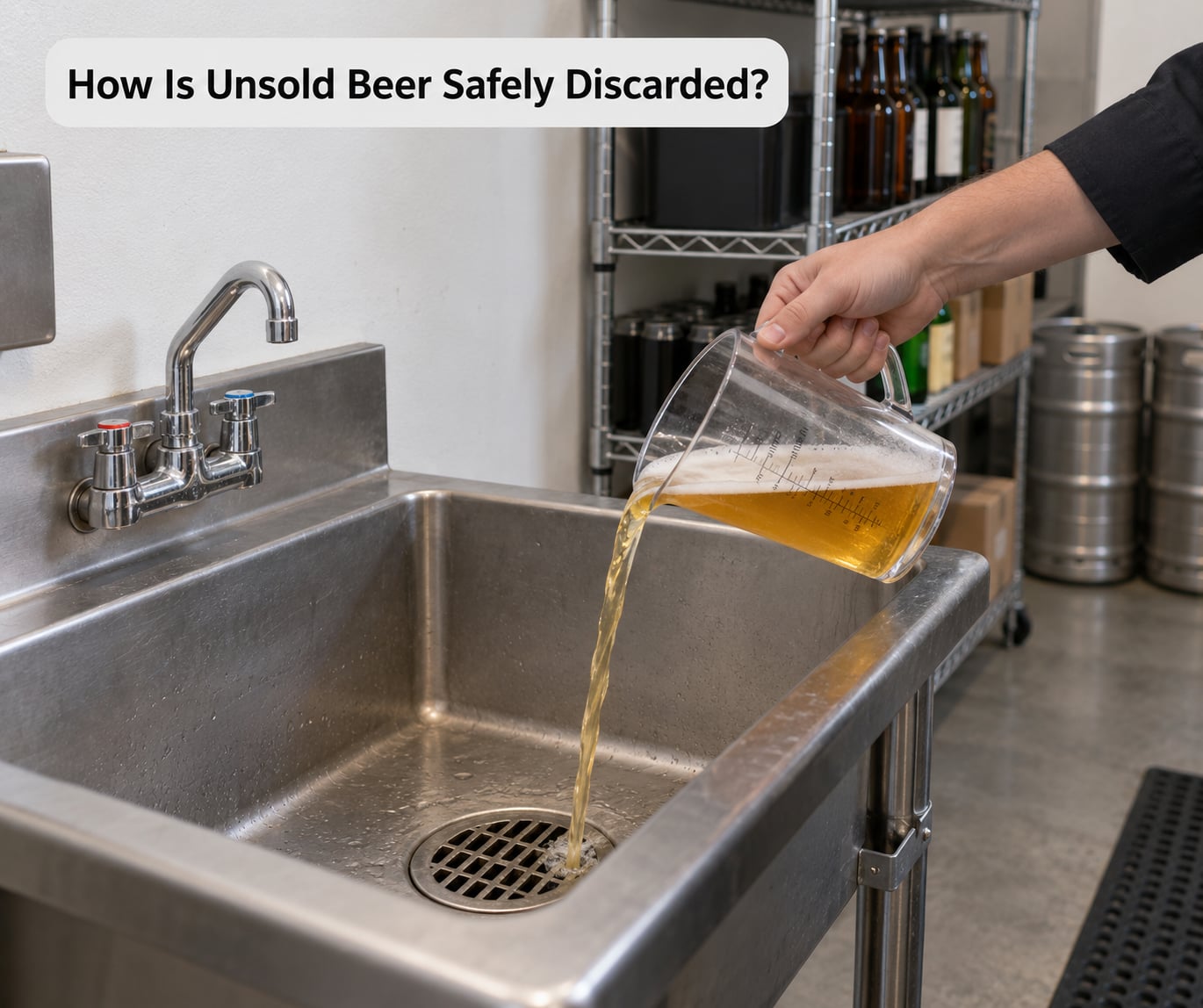
Disposal is the last step, and it is the one with a paper trail. Beer that cannot be sold or repurposed gets drained, and a large slug of beer carries a real organic load that can upset a municipal treatment system.
So the responsible move is to contact the local wastewater utility before a large volume goes down. This is not an unusual request. During the pandemic closures, breweries across the country contacted their treatment plants before dumping, and a regional utility in South Carolina made the point publicly by asking breweries to reach out first. The pattern is normal even though the news coverage made it sound like an emergency measure.
Where a utility approves it, the beer goes down the sanitary sewer, not a storm drain. Storm drains usually lead to a water body with far less treatment, and a few hundred gallons of beer is exactly the kind of load that harms it.
Unopened product is a better outcome than a drain. Some distributors accept returns or credits on unused stock, some breweries will take it back, and unopened packaged beer in date is usually easier to move than anyone expects. The keg itself gets emptied, scrubbed, and returned to the supplier or recycler — the container has value even when the beer does not.
There is also a repurposing route. One pattern that got attention has breweries collecting unsold beer from venues and distilling it into spirit, with the venue covering shipping and a minimum volume required. It is niche, but it turns a cost into a product, and where a local brewery runs it, a bar can ask.
Who Owns Unsold Beer at Each Stage?
It depends on the paperwork, and the answer is not always the bar.
On a normal invoice purchase, the bar bought the beer. Once it is behind the bar, the bar owns it, along with the risk and the loss. That is why a bar is the one making the markdown decision.
Under consignment, ownership stays with the brewery or distributor until the beer is sold. A bar holding consigned stock is looking after someone else’s inventory, which changes who eats the loss and who decides to write it off. Terms vary so much that the only reliable answer comes from the contract.
There is a third situation that comes up on forum threads constantly: who is sitting on unsold beer, the brewery or the distributor. The general pattern is that beer sits wherever it was last invoiced, which usually means it accumulates at the brewery before it moves to a distributor and then to a venue. That is exactly why a small brewer might can small batches of crowlers to match about a week of expected sales — a practice homebrewers describe on Homebrew Talk for the simple reason that anything beyond that is a bet.
So the assumption that a bar can hand over every leftover unit is wrong whenever the beer is consigned, past the distributor’s credit window, or still on someone else’s invoice.
How Can Bars Reduce Unsold Beer Waste?
Start with the tap list, because that is where the money leaks. Everything else is smaller.
Buy smaller kegs. A quarter barrel instead of a half means a slow beer ties up half the cash and a half the freshness window.
Order from actual sales. Par levels should follow the last four weeks of pours per tap, adjusted for the season, not last month’s optimism.
Rotate packaged beer oldest first. It is unglamorous and it works. Date everything on arrival.
Track real pour yield. A quick check on an ounce scale or a marked pitcher catches the over-pour that quietly turns a keg into a short keg.
Clean the lines on schedule. Community guidance referenced on homebrew forums points to roughly every two weeks, which matches the general industry cadence. Homebrewers report leaving beer in lines for a week and flushing before serving, but a bar serves the public and has no reason to cut that corner.
Set a decision date per tap. If a keg has not moved in three weeks, something happens: it goes to happy hour, gets pushed behind a faster seller, or comes off.
Plan for events and slow months. A big booking or a dead January should change the order the same week, not after the fact.
Keep the return relationship warm. Knowing what your distributor will take back, and when, is cheaper than finding out during a dump.
Frequently Asked Questions
Does unsold draft beer sit in the tap overnight?
Usually yes, and it is fine. A keg still coupled keeps the beer sealed from oxygen, and the cold cellar slows everything down. The beer that does not survive the night is the small amount trapped in the line and faucet, which is the oldest beer in the building. Bars run those lines within a day or two, and clean them on a regular cycle regardless of how fast they sell.
How long can a bar keep an untapped keg of beer?
An unopened, refrigerated keg keeps far longer than the date a brewery printed on it. Once tapped, most beers stay drinkable for a few weeks and hop-forward styles are the first to fade, while lagers and stouts hold longer. Once beer tastes flat or cardboard-like, it is oxidation, and no amount of extra chilling brings it back.
Can a bar sell nearly empty cans or bottles?
It depends on the local licensing rules, not on how full the container is. In many places a partially consumed or resealed package cannot legally be sold, and a container that was never sold is treated differently from one that was opened and returned. Check your state and county rules before assuming, because this is one of the areas where a small technicality can cost a bar its licence.
Is it legal for bar staff to drink or take home leftover beer?
Staff drinks are common and often allowed, but only under a written policy that records them. Whether they count as a sale, where they can be consumed, and whether they can go off the premises all depend on local licensing. Take-home draft is the version most bars refuse, because an unsealed container cannot be verified and local rules tend not to allow it.
Can a bar return unsold packaged beer to its distributor?
Sometimes, and it is worth asking in advance rather than after the fact. Many distributors offer credit or swap on unopened, in-date stock, though the window and the conditions vary by agreement. Under consignment terms the beer may never have belonged to the bar at all, so the contract decides who absorbs the loss and who authorises the return.
What happens if unsold beer is left until it becomes bad?
It is drained and disposed of through the sanitary sewer, and the bar normally contacts its local wastewater utility first because a large volume of beer carries an organic load that can overwhelm a treatment system. It goes down the wastewater system rather than a storm drain. Some breweries will take unsold beer back or distil it into spirit, which is a better outcome when a local programme exists.
What to Remember About Bar Beer Leftovers
The first thing to understand is that unsold draft beer usually just sits in its keg. It is sealed, cold, and pressurized, and it will still be there tomorrow. Nothing is being thrown away at close.
Packaged beer works differently. It is counted, dated, rotated, discounted, bundled or returned, and it is only discarded when it has genuinely gone. Whether a bar can write off a loss, give it to staff, or send it back all comes down to what the invoice and the local licence say.
Disposal is the rare case. When it happens, the beer goes into the wastewater system, and the bar is expected to check with the local utility first rather than just pulling the drain.