A beer trade is a private, no-cash swap of craft beer between two people of legal drinking age: one side offers bottles the other cannot easily get, the other side offers something of roughly equal value, and both hand their half over in person or by mail. It is barter, not commerce.
What is a beer trade and how does it work in practice? You post what you have and what you want, agree on specific bottles with someone, package both sides so nothing breaks, and ship on the same schedule. No money changes hands, ever. This guide walks through how to find a partner, how beer gets valued, how to pack a box that survives the trip, and what the shipping rules actually say as of 2026.
If you have never done one, your first trade should be small and local. A six-bottle swap with a person you can meet is a much better first move than a mixed regional box across two time zones.
Table of Contents
- What Is a Beer Trade?
- Why Do People Trade Beer?
- How Does a Beer Trade Work?
- How Does a Beer Trade Start?
- What Makes Beer Valuable for Trading?
- What Is a Fair Beer Trade?
- Where Can You Trade Beer?
- How Do You Ship Beer Safely and Legally?
- How Can You Avoid Beer Trade Scams?
- Frequently Asked Questions
- Do beer trades have to be one-for-one?
- Can two people trade beer without paying any money?
- How do beer collectors determine whether a bottle is rare?
- Is it legal to ship beer through the U.S. mail?
- Should you trade rare beer in person or by mail?
- Conclusion: Make Your First Beer Trade Carefully
What Is a Beer Trade?
In plain terms, a beer trade is an exchange of bottles or cans between two individuals, arranged privately and valued by agreement rather than by a cash payment. Each side gives up something the other side actually wants. Because currency never changes hands, the arrangement is legally closer to barter than to a sale, which is the single most important thing to understand before you start.
The people involved are almost always other beer drinkers. What changes hands is beer, and sometimes collateral: brewery stickers, a taproom shirt, a brewery cap, or a signed growler. Both sides must be of legal drinking age, and in a shipment the recipient is the one who has to show ID at the door.
Three different things get called a “beer trade,” and it helps to keep them apart. A collector trade is the private swap described above. A brewery-to-distributor sale is ordinary commerce: a brewery sells cases to a wholesaler, who sells them to a store. A brewing trade association is a nonprofit lobbying and support group for independent breweries, an entirely unrelated organization. If you search the phrase and land on a trade association, you followed the wrong link.
One more distinction worth naming: a bottle share is not a trade. A bottle share is a group gathering where everyone brings bottles and everyone drinks. It uses the same etiquette, the same valuation instincts, and none of the shipping.
Why Do People Trade Beer?
The short answer is distribution. A small brewery may sell its beer to retailers inside a radius of a few hundred miles and nowhere else. A barrel-aged stout released once at a taproom may never have been packaged for retail at all. From a few hundred miles away, those bottles are not expensive. They are simply unobtainable, and a trade is the only route to them.
Beyond access, the motivations differ from trader to trader, and knowing which one you have will tell you what to ask for.
- Chasing a release. You want the brewery-only bottle that a local taproom sells on one Saturday a year. Somebody in that town has an extra bottle in their fridge.
- Filling gaps in a collection. You keep a vertical of one style across vintages, or every release from a single brewery, or one bottle from every state you have lived in. Completists are the most organized traders in the community and the easiest to deal with.
- Trading up on style. You have a surplus of something ordinary and you want a scarce sour or a sought-after imperial stout. This is the most common beginner trade and the one most likely to be criticized if you offer the wrong thing.
- Clearing leftovers. Mix-packs, subscription leftovers, and releases you bought two of sit in your fridge. Trading them is more satisfying than opening them, and it costs nothing but a box.
- Connecting two scenes. Some people trade to show a distant brewer’s beer to their local friends, and to taste what is happening elsewhere. Traders describe this as sharing a local beer scene with the world, and it is the reason a lot of good faith exists in the hobby.
- Gifting. Plenty of boxes go out with no expectation of anything coming back. Users on trading boards describe receiving beer out of nowhere from strangers, and responding with a bottle of your own later. Nothing about it is required, which is exactly why it works.
There is a reason the hobby has a currency problem. Nobody publishes a reliable price guide for a specific vintage bottle, so value is argued, not quoted. Forums such as r/beergeek, r/nycbeer, and inside.beer are where that argument happens in public, and it can get blunt. Expect it.
How Does a Beer Trade Work?
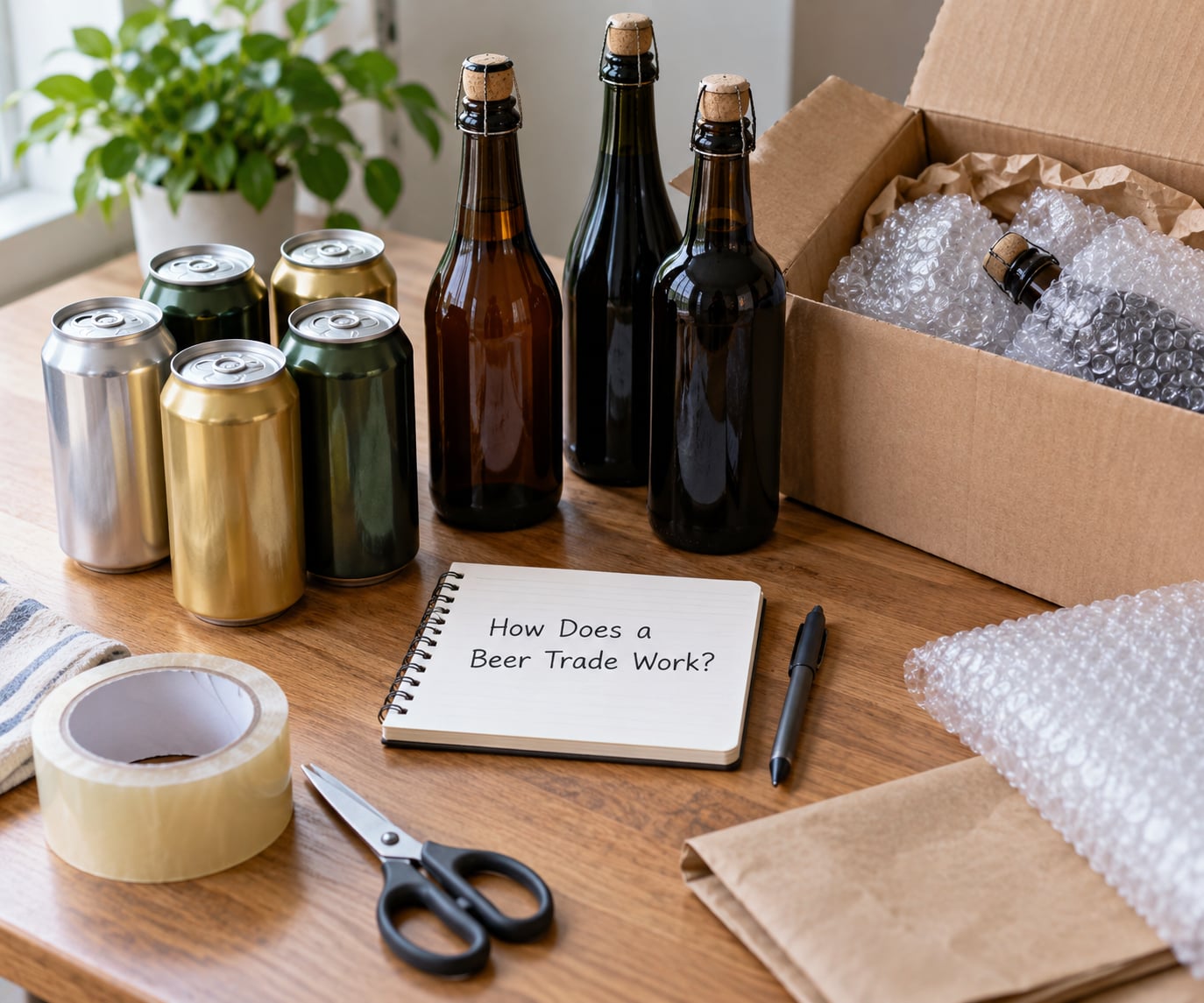
Six steps, start to finish. Most first-timers get stuck at step three, which is the negotiation, because they are trying to calculate a number that does not exist. Treat value as a conversation, not a computation.
- Post what you have and what you want. List your side as FT, for trade, and your wish as ISO, in search of. Include vintage years, bottle sizes, and the condition of anything you are calling rare. A clear post gets real replies; a vague one gets ignored.
- Pick a partner and check their history. Look for a long-standing username, previous trade threads, and a record of shipping promptly. Promptness is the number one reason traders end up on a do-not-trade list, and it costs nothing to ask about before you commit.
- Agree on the exact bottles. Name every bottle, the count, the vintage, and the ratio. “Send me something cool back” was the original norm of this hobby and it still works between people who trust each other. Between strangers, specifics prevent every argument later.
- Confirm the no-cash rule out loud. Neither side sends money, and neither side pays the other’s shipping. A trade that involves cash is not a trade, and offering it can get your post removed from the community you are trying to enter.
- Package and ship on the same window. Both sides pack to the same standard and ship within a few days of each other. Write your forum username and the other person’s username inside the box, and photograph the packed box before it seals.
- Confirm receipt and report honestly. Open the box, count the bottles, check for leaks, and reply in the thread. If something arrived broken, say so plainly and show the damage. Honest condition reporting is the fastest way to build the reputation that gets you better bottles next time.
A realistic post looks like this:
WTT for a brewery-exclusive barrel release. Central PA, can ship Monday.
FT: 4x 750ml vertical of a local imperial stout (2019, 2020, 2021, 2022), all stored cold, labels clean. Plus brewery taproom stickers and a hat.
ISO: 2x brewery-exclusive imperial stout, any vintage, or 3x sought-after wild sour, or a brewery-exclusive release you can spare. Happy to go 3:1 for the imperial stout.
Trade history and references in my profile. Please have an established account.
Note what that post does. It states a location, a shipping day, exact bottles with vintages, a clear ask with an acceptable ratio, and an explicit request for history. It also invites collaboration rather than demanding a whale.
How Does a Beer Trade Start?
Almost every trade begins as a public post in one of a handful of places, then narrows into a private conversation between two people. Local city and regional subreddits handle local trades, while national boards handle cross-regional swaps. Beer-specific forums, Untappd check-ins where people state what is available for trade, and Facebook groups fill the rest.
You can also start through a taproom or a beer festival, where brewers occasionally hand out extra bottles to people with a reputation, and through collectors you have already met at a bottle share. Referrals work best of all. One trusted name introduction carries more weight than a hundred cold posts.
Before you commit to anyone, ask a simple question: will you ship this week? Traders will forgive a mismatched bottle. They will not forgive a box that never arrives.
What Makes Beer Valuable for Trading?
There are ten factors collectors weigh, and none of them is the price on a shelf. Run through this list before you argue that your bottle is worth what you think it is.
- Reputation of the brewery. Consistent quality matters more than size. A brewery with a strong track record and an audience that wants its bottles is easier to trade with.
- Style. Imperial stouts, barrel-aged releases, and sought-after wild sours trade best because demand outstrips supply. Light lagers and common pils move slowly.
- Release method. Brewery-only releases, one-off taproom pours, and limited distribution are the scarcest and most valuable. Widely distributed beer is cheap in trade terms no matter how good it is.
- Age and vintage. Some styles improve for years, some do not. A vertical of a single release across years is worth more than the same count of mixed bottles.
- Production detail. Bottle size matters. A 750ml carries more trade weight than two 355ml cans, and a numbered or special-label bottle carries more than a standard label.
- Package condition. Caps and corks intact, no leaking, no deep gouges, labels uncracked. Nobody wants your scratched bottle.
- Label quality. This is the fastest thing to lose and the hardest to replace. Fade, tears, and peeling drop a bottle out of serious consideration.
- Storage history. Beer that sat warm in a garage for two years is a trade only in the sense that you will be giving it away. Say honestly how it was stored, because experienced traders can usually tell.
- Provenance. Where did it come from, and does that source still exist? A bottle from a brewery that has closed or a taproom that has shut is a different object than a bottle from anywhere else.
- Current demand. What people are actually asking for this month. Trends move, and the beer that was impossible to get last year may sit unsold this year.
The shorthand traders use to describe these factors looks like this:
| Term | What it means | How it reads in a post |
|---|---|---|
| FT | For trade | FT: 4x 750ml vertical, vintages 2019-2022 |
| ISO | In search of | ISO: 2x brewery-exclusive imperial stout |
| BA | Barrel-aged | BA stout, any barrel, current release |
| Dollar for dollar | Even value both ways, no count difference | One bottle for one bottle, equal value |
| 2:1 and 3:1 | Two or three of their bottles for one of yours | 3:1 for the imperial stout, happy to go 2:1 |
| Whale | A bottle so scarce that people bid against each other | Not a whale, just a hard-to-find release |
| Vert | A vertical, several vintages of one beer | 4-bottle vert of a local stout |
| WTT | Want to trade | WTT for a brewery-exclusive release |
What Is a Fair Beer Trade?
A fair trade is one where both sides would be roughly as disappointed if the box never arrived. That is the test, and it is more reliable than any price list. Retail price is close to meaningless here, because the cheapest bottle in a box is often the one your partner most wanted to trade away.
| Ratio | When to use it | Worked example |
|---|---|---|
| 1:1 | Both sides are offering similar value, such as two vintages of the same brewery against two different breweries | You send a four-bottle vert, they send four sought-after sours |
| 2:1 | Your bottles are common and theirs are moderately hard to find | Two mix-pack surplus bottles for one barrel-aged stout |
| 3:1 | You are asking for something genuinely scarce, and you bring extras to soften it | Three common releases plus brewery swag for one brewery-exclusive bottle |
| Dollar for dollar | Both sides value their own contribution highly, so you settle on even bottles each way | One sought-after bottle from each side, no count difference |
Here is a balanced swap. One trader in the Midwest has three leftover bottles of a widely distributed pale ale and a brewery cap. Another trader in the Southeast has a single bottle of a barrel-aged stout from a brewery that does not distribute to the Midwest. Three for one is a defensible ratio because the pale ale is easy to replace almost anywhere, while the stout exists in one brewery’s single release. The Midwest trader adds a sticker and a hat as extras, which is standard courtesy and costs nothing.
Two mistakes make trades contentious. The first is offering common beer without acknowledging it is common. The second is treating a trade as a negotiation to win. On trading boards, both draw public pushback, and beginners report that the criticism stings more than the loss of the bottle.
Where Can You Trade Beer?
Where you trade depends on how far the beer has to travel and how much time you have. A short trip between two cities is a completely different problem from a cross-country box.
| Place | Format | Best for |
|---|---|---|
| Local bottle shares and swap meetups | In person, no shipping, no legal exposure | Your first trade, and anyone without a way to pack and ship |
| Taprooms and brewery visits | In person, relationship-driven | Getting to know a brewer and being remembered later |
| Beer festivals | In person, wide selection, many collectors at once | Multiple trades in a single day, no shipping cost at all |
| Regional and city subreddits | Public posts, usually local traders | Short-distance trades and finding people nearby |
| Dedicated beer forums and boards | Long-running posts with established usernames | National trades, vintage hunting, checking someone’s history |
| Untappd check-ins and status notes | Announcing what a brewery has available | Finding out what was just released locally |
| Facebook groups | Local or regional, membership-based | Local trading, though new members often report a rougher welcome |
| Discord servers and direct messages | Small private communities | Long-term partners and repeat traders |
One piece of stale advice needs correcting. Several widely read beginner guides still tell you to start on a Reddit community built specifically for beer trading. That community was removed by Reddit in 2018 and its users scattered across the places listed above. If you follow an old guide and try to sign up for it, you will waste an evening.
The honest description of the modern scene is fragmentation. There is no single central exchange, and traders bounce between several depending on what they are hunting. That is a complaint you will hear constantly, and it is also why reputation carries so much weight, since a good name travels with you across all of them.
If you can avoid shipping entirely, do it. Local groups like r/Seattle and r/BourbonAndBeyond have recurring bottle share threads, and r/BurlingtonON has discussed organizing one. No box, no carrier, no adult-signature appointment, no legal question about the contents crossing a state line. For a first trade this is the lowest-risk option by a wide margin.
How Do You Ship Beer Safely and Legally?
Packaging is the part beginners underestimate, and it is where most busted trades actually break down. Glass plus a truck does not negotiate. The community standard is the box-in-box method, and it is worth learning properly.
- Confirm the route is legal first. Before anything is packed, check whether alcohol can be shipped to the destination state at all. Rules vary by state and they change. This is general information, not legal advice, and your state or a shipping specialist is the right source for your specific case.
- Seal every bottle individually. Use shrink wrap, packing tape wrapped around the neck and body, or a beer bottle protector. Leave the caps on. A leaky bottle ruins the whole box, not just itself.
- Wrap each bottle in padding. Bubble wrap, at least two inches, with the tape sealing the bubble side inward around the bottle so bubbles do not slide.
- Build the inner box. A snug carton with no room for bottles to touch each other or the sides. Fill the empty space so nothing shifts when the box is turned over.
- Build the outer box. Put the inner box inside a larger carton with another two inches of padding all around, then seal and shake it. If you hear movement, add more.
- Ship early in the week. Use tracking, insurance for anything you care about, and a signature required at delivery. Arrange for someone of legal drinking age who can show government-issued ID to be there to sign, because neither you nor your partner may be available on a random delivery day.
On the legal side, several things are worth stating plainly. The United States Postal Service prohibits mailing beer entirely, so a package with any amount of alcohol in it is not going through USPS, and using the post office to send beer is not a legal workaround. Private carriers such as UPS and FedEx do accept alcohol shipments from licensed shippers under specific conditions, and both generally require an adult signature, a government-issued ID, and an age of 21 or older at the door. Most individual traders are not licensed shippers, which is a real and frequently overlooked problem.
On top of that, a growing number of states restrict or have stopped direct-to-consumer alcohol shipping, and personal state-to-state shipments of beer sit in a murky area where rules differ by origin, destination, and who is doing the shipping. Answers to “is beer trading legal” usually stop at “it is a private barter, not a sale.” Where the beer physically travels, the law is genuinely unsettled and can change without much notice.
The practical result is that many experienced traders simply do not ship. They meet in person, trade at festivals, or hand their half to a friend who is already traveling through the other city. That is not cowardice, it is the sensible reading of a patchwork of rules.
How Can You Avoid Beer Trade Scams?
Most trades finish exactly as agreed. The failures are almost always one of a handful of predictable things, which means most are avoidable.
- Asking you to pay outside the platform. Cash, gift cards, or a payment app for the difference breaks the one rule the community runs on. It also removes any record you have if the bottle never shows up.
- Refusing to give specifics. If someone will not name the bottles, the count, or the vintage, there is a reason.
- A new account with no history asking for a whale. One brewery-exclusive bottle in exchange for a photo of a fridge full of mix-packs. Ask for references and read them.
- Pressure to ship first. Both sides ship in the same window. A partner who needs you to go first will find a reason next month too.
- A valuation far outside the range other people are discussing. Before you accept any offer, read the recent threads on that beer. If your number is wildly better than everyone else’s, the catch is elsewhere.
- Ghosting after a delay. Missing a promised ship date by a week with no message is the most commonly reported complaint. A quick message saying “running late, shipping Friday” prevents almost every dispute.
When something does go wrong, handle it in the open. Post the damage in the thread with photos, state plainly what you received, and ask what the sender wants to do. Replacing a bottle is not mandatory, but a trader who offers to make it right keeps their name clean, and traders with clean names get the good bottles offered to them first.
Keep your own do-not-trade notes. Names go on that list for one of three reasons: a busted trade, a repeated no-show, or being deceptive about condition. The list is usually kept private and unwritten, which is why a bad reputation follows you quietly across every platform.
One last thing that is not a scam but feels like one: buying extra stock purely to trade. Traders call this being a mule, and they frown on it. Every extra bottle someone buys for trading is one fewer for the people who queued at the taproom on release day. Trade what you already have.
Frequently Asked Questions
Do beer trades have to be one-for-one?
No. A one-for-one swap is only one of several common structures. Traders use 2:1 and 3:1 ratios when the bottle being requested is genuinely scarce and the bottles offered are easy to replace, and dollar-for-dollar when both sides value their own contribution equally and want an even count each way. Ratios are a starting proposal, not a rule, and adding brewery stickers, hats, or an extra bottle often settles a trade without changing the count at all.
Can two people trade beer without paying any money?
That is the entire point. Cash cannot change hands in a beer trade, which is why the arrangement is legally barter rather than a sale. Most communities remove posts that offer to pay the difference, because it converts a hobby exchange into an unlicensed alcohol transaction. If the two sides are not close to even in value, the fix is more bottles or better bottles, not money. Shipping is also handled separately: each side pays its own carrier.
How do beer collectors determine whether a bottle is rare?
Scarcity beats fame. Collectors check how far a brewery distributes, whether the release was taproom-only or a one-off, whether the brewery still exists, and how many people are asking for it in current trade threads. Condition matters next: a faded, torn, or leaking label drops a bottle out of serious consideration immediately, and bottles that were not stored cold trade poorly. There is no published price guide, so value comes from what comparable trades actually settle for.
Is it legal to ship beer through the U.S. mail?
No. The United States Postal Service prohibits mailing beer in any quantity, so a package containing alcohol cannot go through USPS under any circumstances. Private carriers such as UPS and FedEx do accept alcohol from licensed shippers, subject to their own rules and an adult signature with government-issued ID at delivery. Many individual traders are not licensed shippers, and states differ widely on shipments crossing state lines, so check the current rules for your specific route before packing anything.
Should you trade rare beer in person or by mail?
In person, whenever that is possible. A meetup at a bottle share, taproom, or beer festival carries no shipping cost, no breakage risk, no adult-signature appointment, and no question about which state’s rules apply. Shipping a genuinely scarce bottle is a calculated risk: box-in-box packaging, no movement when you shake the sealed box, tracking, and insurance. Hand it over in person and all of that disappears.
Conclusion: Make Your First Beer Trade Carefully
Start smaller than feels necessary. Document the bottles you are offering, with vintages and condition, find one person with a real trade history, agree on exact bottles and a ratio in writing, and keep cash out of it entirely. If you can hand your half over in person, do that and skip the shipping question altogether.
Build reputation before you build a cellar. Ship when you say you will, pack bottles so a shake test comes back silent, add something extra when you can, and report damage honestly when it happens. Do that twice and people will start offering you the bottles they are actually excited about, which is the only currency that matters in a beer trade.