Working out how to pick beers for a monthly tasting club comes down to three decisions: how many beers you pour, how much contrast sits between them, and what order you serve them in. Most home clubs land on four to six beers, three-ounce tasting pours, and a lineup that runs from a crisp lager through a hop-forward IPA to something dark and malty. Nail those three things and the night is a tasting. Miss them and it is just a group of people drinking faster than they can taste.
The part hosts overthink is the beer itself. Nobody needs a rare bottle or a scoring vocabulary to make a monthly club work. What matters is that each beer does something the others do not, and that everyone can afford to drink the whole flight slowly.
What follows is the process I would hand a friend starting a club: what to gather, how to choose a lineup, how to pour it, and what to write down. It works for four people in a kitchen and for ten in a bar back room. Budget about an hour of picking for every hour you plan to spend tasting.
Table of Contents
- What You Need
- How to Pick Beers for a Monthly Tasting Club: Step-by-Step
- Set the Goal and Size of the Tasting
- Choose a Theme Without Making Every Beer the Same
- Balance Appearance, Aroma, Taste, and Mouthfeel
- Check Freshness, Sourcing, and Practical Constraints
- Taste in a Useful Order and Record the Results
- Common Mistakes
- Tasting Tips for Better Monthly Picks
- Frequently Asked Questions
- How many beers should a monthly tasting club pour?
- What is the best beer of the month club?
- Are beer of the month clubs worth it?
- How do you throw a beer tasting party?
- Is 7 beers in 2 hours a lot?
- How do you pick non-alcoholic beer for a tasting club?
- Conclusion
What You Need
A monthly tasting club needs less than most people buy. The beer is the only part with a real cost, and even there, four six-packs cover a group of eight comfortably.
- The beer itself. Four to six bottles or cans per member, which sounds like a lot until you pour it. Tasting pours are small.
- Glassware. Two glasses per person, ideally identical, so nobody is judging a beer through a stained pint tumbler.
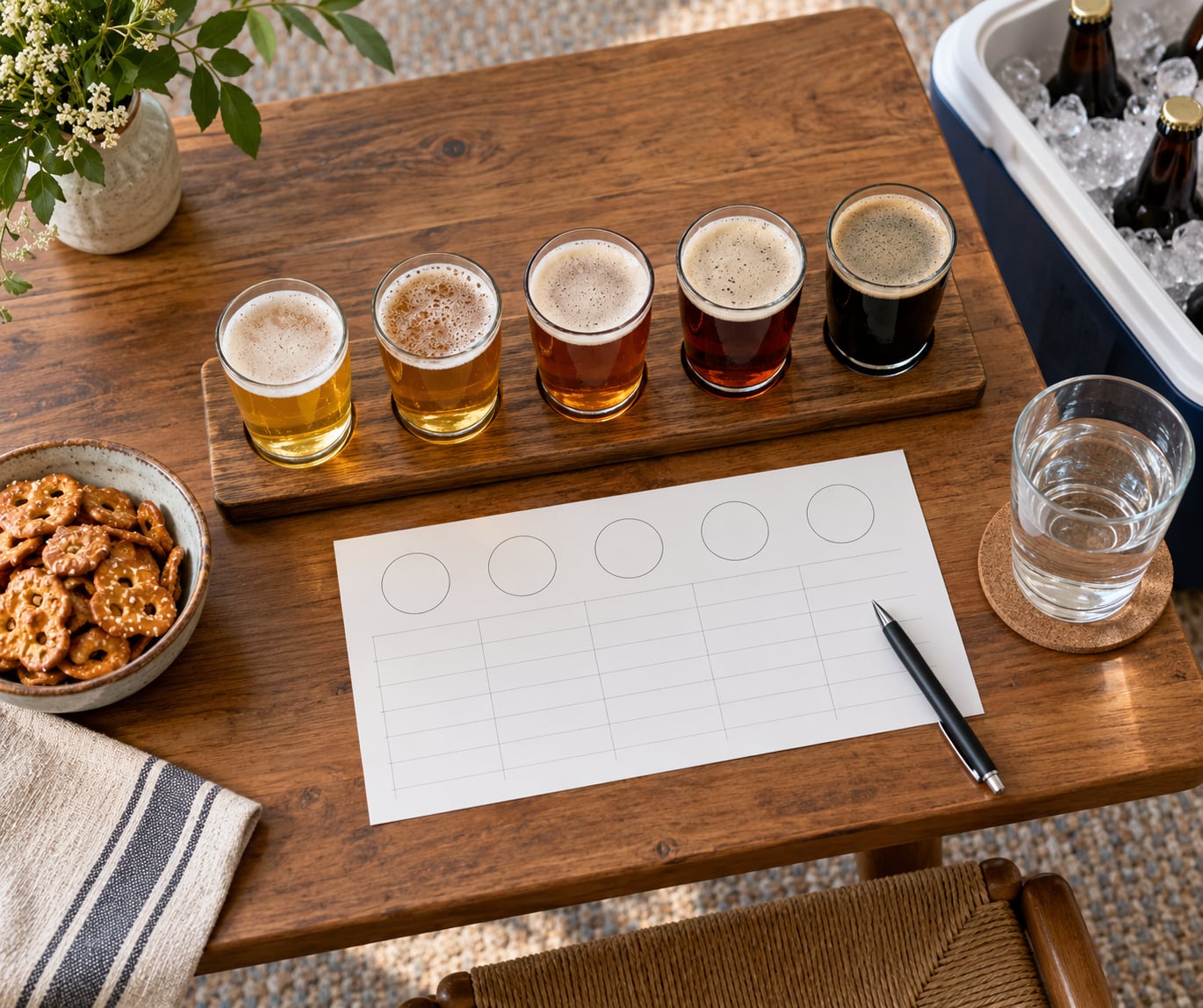
- Tasting sheets. One per person per beer, printed or on a phone. A single sheet with a column per beer beats a page per bottle.
- Pens and a scoring logbook. If the club is a year old, that logbook is the most valuable thing you own.
- Water and crackers or bread. Food goes out before the first pour, and plain water stays available all night.
- A way to chill and pour. Cooler with ice, an opener, and either bottles, crowlers, or a small keg with a basic tap.
- Spit buckets or a pour-out glass. Unfashionable and essential when a saison or a barrel-aged sour shows up.
- Bright, neutral lighting. You are assessing color. A basement bar with one orange bulb makes every beer look brown.
Two glasses per member is the one item people skip. When the club runs eight months and someone finally says the roast stout smells like soy sauce, you want that person comparing it against a clean glass, not the hoppy residue from an hour ago.
How to Pick Beers for a Monthly Tasting Club: Step-by-Step
Beer selection works best as a fixed sequence rather than a pile of bottles on the counter. Set the size of the tasting, choose a spine for the lineup, check that the styles actually contrast, verify freshness and logistics, then decide how it gets poured and recorded. Seven short steps, about an hour of work, and the same quality night after night.
Set the Goal and Size of the Tasting
Decide what the month is for before you pick anything, because the goal changes the lineup. A theme month explores one corner of beer, a brewery spotlight compares beers from a single producer, and a style month teaches a family like lagers or sour ales.
Then set a number and stick to it. Four to six beers is the working range for a home club. Seven is where taste stops working for most people, because by the sixth beer the palate is saturated and everyone is really just ranking bitterness.
The pour math is simple. Three ounces per beer per person, five beers, eight members comes to 120 ounces, which is ten twelve-ounce cans. Six beers for the same group is 144 ounces, or twelve cans. Buying a case per person gives you plenty of margin for refills and for the member who arrives late with a friend.
Homebrew club forums keep circling the same complaint: everyone drinks the flight fast and remembers nothing. Small pours fix that faster than any other single change.
Choose a Theme Without Making Every Beer the Same
A theme gives the month a reason to exist and a title people can remember, but a theme is a spine, not a cage. Every other beer on the table should argue with it. A lager month with four pale ales is a wasted night, no matter how good the ales are.
This style lineup gives you a spread to build from. The order column matters as much as the flavor column, because it decides how you pour.
| Style | Typical ABV | Flavor profile | Pairs with | Flight position |
|---|---|---|---|---|
| Pilsner | 4-6% | Crisp, crackling, spicy hop edge, clean finish | Bratwurst, pretzels, mild cheese | First |
| Hefeweizen | 4.5-5.5% | Bananana and clove, soft, low carbonation bite | Currywurst, pork, mild cheeses | First or second |
| Farmhouse saison | 5-7% | Dry, peppery, hay, high carbonation | Goat cheese, roast chicken, mussels | Second |
| American pale ale | 4.5-6.2% | Moderate hop bitterness, caramel malt | Chili, burgers, cheddar | Middle |
| Hop-forward IPA | 6-7.5% | Big citrus and pine, drying finish | Fried chicken, tacos, aged cheese | Middle to last |
| Sour or wild ale | 4-8% | Tart acidity, funk, Brett character | Feta, charcuterie, dark chocolate | Middle |
| Porter | 4.8-6.5% | Dark, chocolate, roasted bread crust | Smoked sausage, barbecue, sharp cheddar | Near last |
| Stout or milk stout | 5-8% | Coffee, cocoa, heavy body, roast bitterness | Stilton, oysters, dark chocolate dessert | Last |
Seasonal releases are the other reliable theme. Local breweries put out fresh beer in a predictable rhythm, so a club near a dense taproom scene can follow the release calendar instead of guessing. Plan a seasonal month around what your nearest brewery is actually pouring that week.
For a club that plans a year out, a rotation keeps twelve months from blurring together. Twelve themes, each with the styles that most often deliver them:
| Month | Theme | Styles to feature | Style variety to look for |
|---|---|---|---|
| January | New year, clean slate | Pilsner, kolsch, pale lager | One American craft pils |
| February | Hearty winter warmers | Porter, brown ale, Scotch ale | A barrel-aged version |
| March | Stout season | Oatmeal stout, milk stout, imperial stout | A non-imperial option |
| April | Hoppy spring | West coast IPA, session IPA | A low-ABV session beer |
| May | German lagers | Hefeweizen, dunkel, bock, pils | A doppelbock |
| June | Belgian ale | Dubbel, tripel, saison, witbier | A farmhouse saison |
| July | Light summer drinking | Kellerbier, spritz beer, cream ale | A fruit beer or gose |
| August | Sours and wilds | Lambic, gose, kettle sour, Brett ale | A bottle-conditioned wild |
| September | Oktoberfest month | Marzen, festbier, helles | A local take on marzen |
| October | Pumpkin and spice | Pumpkin ale, spiced amber, porter | A non-spiced amber contrast |
| November | Strong and aged | Barrel-aged stout, barleywine, old ale | A young beer for contrast |
| December | Dark holiday releases | Winter ale, doppelbock, ginger beer | A gluten-free or non-alcoholic pick |
Balance Appearance, Aroma, Taste, and Mouthfeel
A good lineup differs in four measurable ways: how it looks, how it smells, how it tastes, and how it feels in the mouth. Check each one before you commit, because two beers can share an ABV and still be indistinguishable, or differ in every direction while being equally thin.
- Appearance. Check color range. If all five beers are pale gold to light amber, swap one for a dark beer.
- Aroma. Compare descriptors before tasting. Citrus, bread crust, tropical fruit, roast, and vinegar are five different rooms.
- Taste. Contrast bitterness against sweetness, and sourness against malt. Two hop-forward beers side by side mostly tell you which one has more hops.
- Mouthfeel. Body, carbonation, and warmth vary a lot. A crisp high-carbonation saison against a soft oatmeal stout reads as two completely different drinks.
A useful shortcut is to aim for one beer from each of three or four columns: light and crisp, hoppy, malt-forward, and dark or roasty. Fill gaps rather than duplicating strengths. When in doubt, add the fourth column, because most bad lineups are three pale beers and one stout.
The BJCP style guidelines are a useful tiebreaker when a club splits over a beer. Saying a helles is too bready is an opinion; saying it reads more malty than the style describes is a conversation the whole group can finish.
Check Freshness, Sourcing, and Practical Constraints
Pick the beers you can actually get fresh and serve cold. Freshness matters most in hoppy beers, where the aroma is the beer, and least in styles built on roasted malt or high alcohol, which hold up for years.
Check the packed-on or best-by date when you buy bottles, and ask a taproom what has been on the block recently. A beer sitting in a retailer’s warm back room for two months loses its hop character before you ever open it.
Source close to home when you can. A local taproom gives you fresher bottles, a chance to ask what just landed, and a place to send members who want to keep drinking a style after the club night ends.
Now check the practical constraints, in this order:
- ABV spread. Include at least one beer under five percent and put the highest-ABV beer last.
- Allergens and diet. Wheat, gluten, and dairy show up in hefeweizens, witbiers, and milk stouts. Ask members about restrictions before the lineup is final.
- Serving temperature. A flat warm pilsner and a room-temperature imperial stout both fail, in opposite directions.
- Pour logistics. Can you chill everything in the space you have, and can you pour twelve glasses in order without confusion?
- Cost per member. Divide the total cost of the lineup by the number of attendees and collect dues in advance. Removing the awkward part of the night, who owes what, is worth the effort.
Designated drivers need an out. Keep a non-alcoholic beer or two in the flight, pour them alongside the others rather than in a separate sad glass, and let them score them the same way.
Taste in a Useful Order and Record the Results
Pour light to dark and low to high ABV, and the flight teaches itself. Your palate reads bitterness and darkness more sharply as the night goes on, so anything delicate has to go first or it will never be tasted fairly.
Run each beer for about ten minutes: smell it, take a small sip, wait, then sip again. Water and a cracker between beers reset things better than any amount of forcing yourself through.
Keep the tasting sheet to six columns. Beer name, style, and ABV on the left; aroma, flavor, and a score on the right. A simple three-tenths scale for each category beats a 50-point system nobody finishes.
Keep the scores in one shared file. Over a year you get a real record: which brewery the club kept rewarding, which styles made everyone grimace, and which month people still talk about.
Common Mistakes
Six mistakes account for most disappointing club nights, and each one has a simple correction.
- Choosing only intense IPAs. Four hop-heavy beers produce four versions of the same flavor and a tired group by pour three. Fix: one hop beer, and give the slot to something dark and malty.
- Buying too many unfamiliar styles. A flight of seven weird beers is confusing, not educational. Fix: keep one or two wild cards and anchor the rest in styles people already know.
- Ignoring freshness. Hop aroma fades long before a porter does. Fix: check dates, buy from a shop with turnover, and ask taprooms when something went on.
- Overlooking ABV. Four eight-percent imperial beers in an evening is a rough night, especially if the members are driving home. Fix: cap the flight at one beer above seven percent.
- Forgetting the non-beer drinks. A club that serves nothing but beer has no pacing control. Fix: put out food before the first pour, keep water flowing, and include a couple of non-alcoholic beers.
- Repeating the same styles. Three months of pale ales teaches nothing. Fix: use the twelve-month rotation, and pull names from the previous three months when you pick.
A seventh one sneaks in: skipping the tasting sheet. People drink fast and remember nothing, and the club has nothing to look back on next year.
Tasting Tips for Better Monthly Picks
Serving details change what people notice more than the beer choice does. A few habits keep the flavor readable across a whole flight.
- Chill to style. Pale lagers and pilsners want to be colder than most people serve them. Pale ales and IPAs want to be cool, not cold. Stouts and imperials want to be cool to room temperature.
- Use clean, matching glasses. Rinse between beers and keep two glasses per person. Shape does change perception of carbonation and head.
- Pour 3 ounces. For six beers, three ounces each. Smaller if the lineup runs long or members are sampling several flights.
- Watch for palate fatigue. After four beers the tongue is done. Water, crackers, and a pause between rounds matter more than choosing a clever fifth beer.
- Rotate styles across months. Follow the seasonal rotation and note what scored best so the club leans into what works for its members.
- Present before opening. In homebrew clubs, members talk about their beer while it is being poured. That keeps the conversation on the beer instead of on the drinking.
- Open bottles in order. Pour the first beer of each style into all glasses before moving on, so nobody tastes a warm beer while everyone else is on the next one.
One more: have someone who is not drinking lead the aroma step. The first person to smell a fresh pour catches everything the rest of the table is too full to notice.
Frequently Asked Questions
How many beers should a monthly tasting club pour?
Four to six beers per member is the working range for a home tasting club, poured at three ounces each. That keeps the whole flight under two standard drinks while still giving enough styles to compare. Seven beers is where taste starts to break down for most people, so if a club wants a longer flight, drop the pour to two ounces rather than adding another beer.
What is the best beer of the month club?
The best club is the one whose lineup a member cannot guess in advance. A good month has one familiar anchor everyone enjoys, three or four contrasting styles, and at least one beer that stretches the group. Clubs that last pick with a rotating theme calendar rather than whatever is on sale, and they record scores so the group builds on what it already knows.
Are beer of the month clubs worth it?
For casual drinkers and homebrewers, yes, mostly because of the structure rather than the beer. A tasting format turns a group of people drinking into a group of people comparing, and the logbook becomes genuinely interesting after a year. The value drops if the host picks without a theme, pours too much, or runs past six beers, which is why a repeatable process matters more than the bottles themselves.
How do you throw a beer tasting party?
Set the lineup a week ahead, chill everything the day before, and put food out before the first pour. Pour light to dark and low to high alcohol at three ounces each, ten minutes per beer, with water within reach. Give everyone a tasting sheet, let the person who brought or brewed each beer speak briefly, and score at the end. Keep the whole night to about two hours.
Is 7 beers in 2 hours a lot?
Seven full beers in two hours is a heavy session, and well past the point where most people can still taste what they are drinking. A tasting flight of seven beers at three ounces each is a very different evening from seven twelve-ounce servings, and so is a flight spread across two hours with food and water between rounds.
How do you pick non-alcoholic beer for a tasting club?
Include it in the flight rather than putting it aside. One or two non-alcoholic beers among four to six regular ones lets designated drivers score alongside everyone else and keeps them in the conversation. Pick styles that mirror the lineup, like a non-alcoholic pilsner next to a pilsner or a zero-proof IPA beside a hop-forward IPA, and serve it cold in the same glassware.
Conclusion
Start with the theme, cap the flight at four to six beers, and lay out the lineup so each beer is lighter, darker, hoppier, or maltier than the one before it. Pick one familiar beer to give the group a reference point, then fill the rest of the slots from styles nobody in the club drinks often.
That is the whole method. Everything else, the sheet, the score book, the twelve-month calendar, is just what turns a good night into a habit worth keeping for a year.