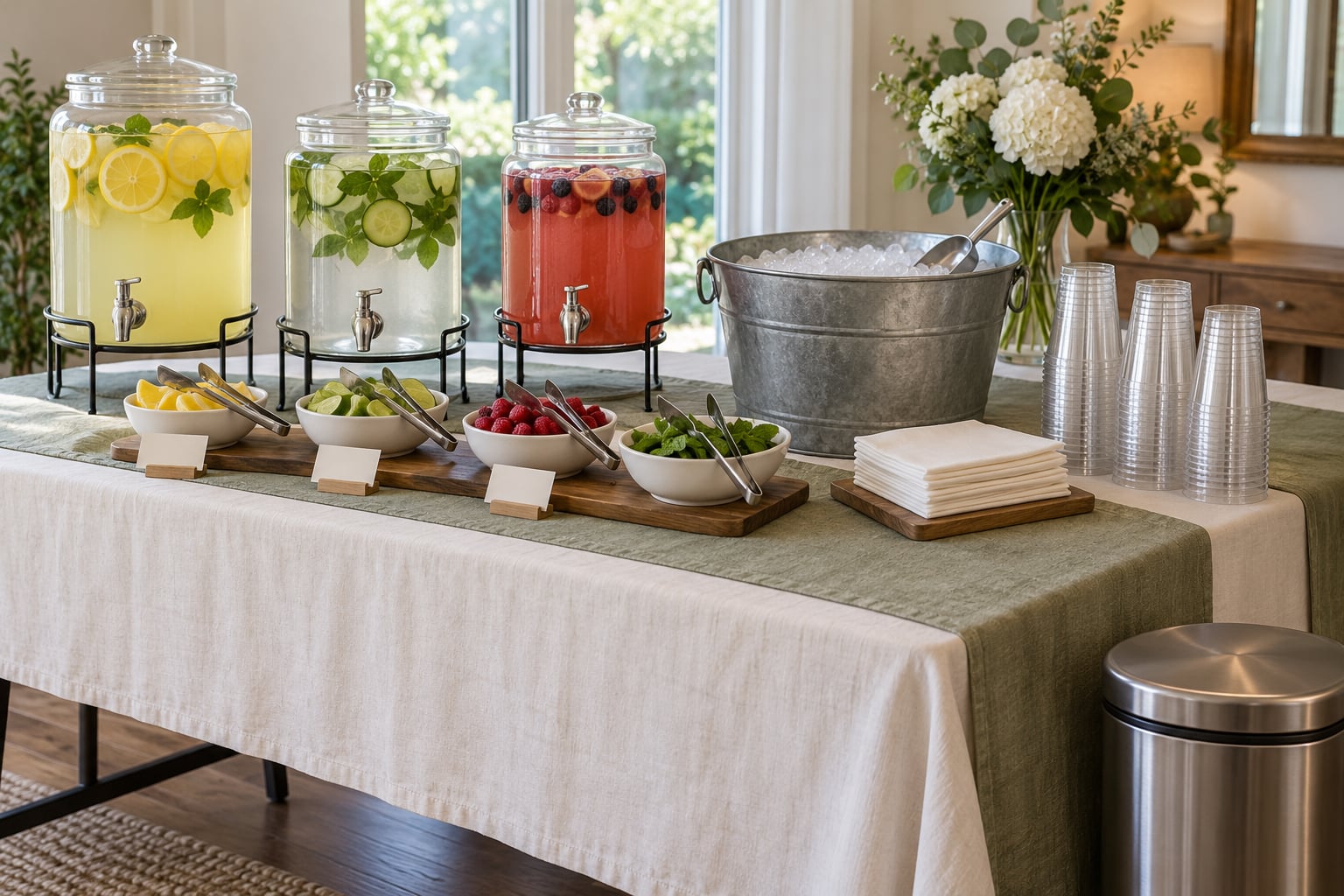
To set up a self serve drink station, you need a table away from foot traffic, two or three labeled drink options, cups, ice, garnishes, and napkins arranged in the order guests use them: cup, ice, drink, garnish, napkins. Set it up 45 minutes before guests arrive, assign one person to restock it, and the line never becomes the thing people complain about.
That is the whole trick. A drink station is not a fancy bar, it is a workflow laid out on a table, and the hosts who do it well have already made the decisions people freeze over at 7 p.m. on a Saturday: which drinks, how much ice, where the trash goes.
I have run this setup at house parties, backyard cookouts and a wedding reception, and the pattern is always the same. Cut the menu down, put the ice where hands get wet anyway, and make the labels big enough to read from six feet away. Everything below is built around that.
Table of Contents
- What You Need
- The basics for any station
- What changes with guest count
- Safety and serving items worth adding
- Step-by-Step
- Choose the drinks and calculate quantities
- Lay out the station for a smooth guest flow
- Prepare and label every drink
- Test the station before guests arrive
- Common Mistakes
- Tips for keeping service running smoothly
- Frequently Asked Questions
- How much drink should I provide per guest for a self serve drink station?
- Do self serve drink dispensers keep drinks cold long enough?
- How should I label drinks and allergens at a self serve station?
- How do I keep the station from becoming crowded or creating a bottleneck?
- What is the safest way to serve alcohol at a self serve drink station?
- Can a self serve drink station work for nonalcoholic events?
What You Need
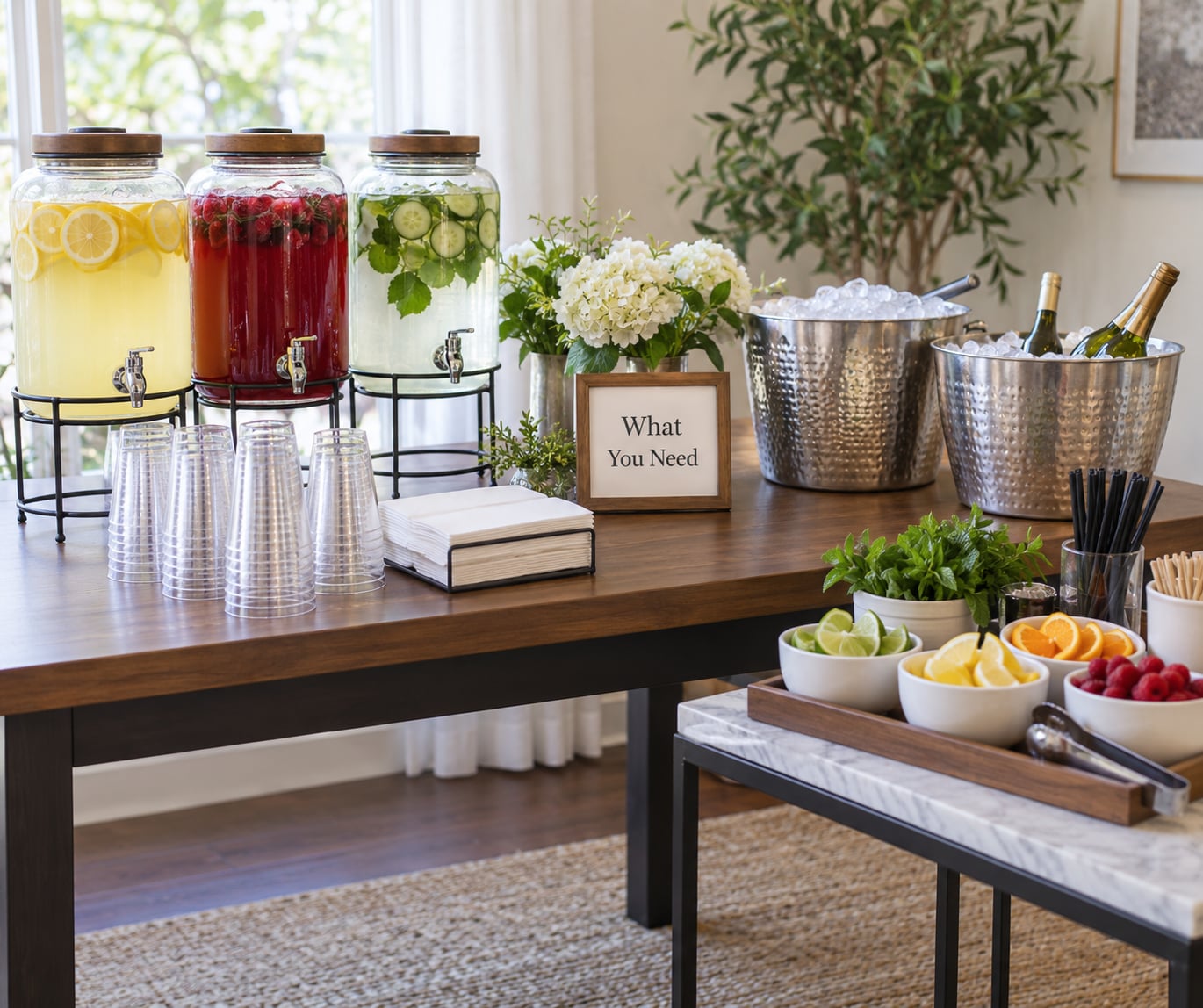
The list below covers a standard home station. The first thing to decide is how many people you are actually serving, because that changes almost every other number on the page.
The basics for any station
- A table or cart at least 3 feet wide, ideally against a wall and out of a doorway.
- Two or three drink options at most. More than three and guests start reading instead of pouring.
- Cups, plus lids if the drinks are carbonated and guests will walk around with them.
- Ice in tubs with a dedicated scoop per tub, never a serving spoon used for anything else.
- Napkins and a small trash bin at the far end, past the drinks, not near the entrance.
- Labels or recipe cards listing what each dispenser holds and what is in it.
What changes with guest count
A party of 15 to 20 people needs one table and one person watching it. Past about 30 guests, one table becomes a bottleneck no matter how well it is arranged, so the move is to split the drinks across two tables or stations rather than adding more options to the same one. Past 50, hire a bartender. Guests at that scale want a drink handed to them, not a puzzle to solve.
For quantities, the planning numbers I use are roughly:
- 1.5 to 2 pounds of ice per guest for an indoor event of 3 to 4 hours. Add 25 to 30 percent for anything outdoors in warm weather.
- 2 drinks per guest per hour is a reasonable planning figure for a casual party, and 1.5 for a dinner where most people are eating.
- At least half your guests will want something non-alcoholic, even when the event is not alcohol focused. Plan for it rather than treating it as an afterthought.
So for 30 guests over four hours, you are looking at about 50 pounds of ice, somewhere around 240 drinks total across every option, and enough cups that nobody is washing one in a sink mid-party. Buy the ice the morning of the event if you can. Bags stacked overnight in a garage or shed clump together and turn into one solid block.
Safety and serving items worth adding
A few things are cheap and quietly important. A step stool or a second table keeps the top of a dispenser reachable for shorter guests and for anyone using a wheelchair. A small towel under each ice tub stops the table from getting slick. And for any event with alcohol, a written list of what is in every drink matters for more than you would expect, because guests with allergies and guests avoiding certain ingredients will not want to interrogate the host mid-party.
Step-by-Step
Choose the drinks and calculate quantities
Pick the menu before you buy anything, and pick it small. Three options is the ceiling for a self serve station: one cold option, one batch cocktail or spirit-based option, and one non-alcoholic option. A fourth can work on a large station with two-sided access, but a single table cannot handle it.
Then multiply. For a 100-guest open house running three hours, at 1.5 drinks per guest per hour, you are planning for 450 drinks across all options. If the soft drink station carries half of that, 225 drinks come out of three or four dispensers. That works out to something like 60 drinks per 2-liter soda, so five 2-liter bottles and two 12-packs per flavor covers a large group with room for refills.
Add a buffer of 10 to 15 percent on everything. Leftover soda is a nuisance, but running dry at 9 p.m. with 20 guests still standing is much worse. Hosts who plan the exact number and nothing more tend to be the ones who run out.
Lay out the station for a smooth guest flow
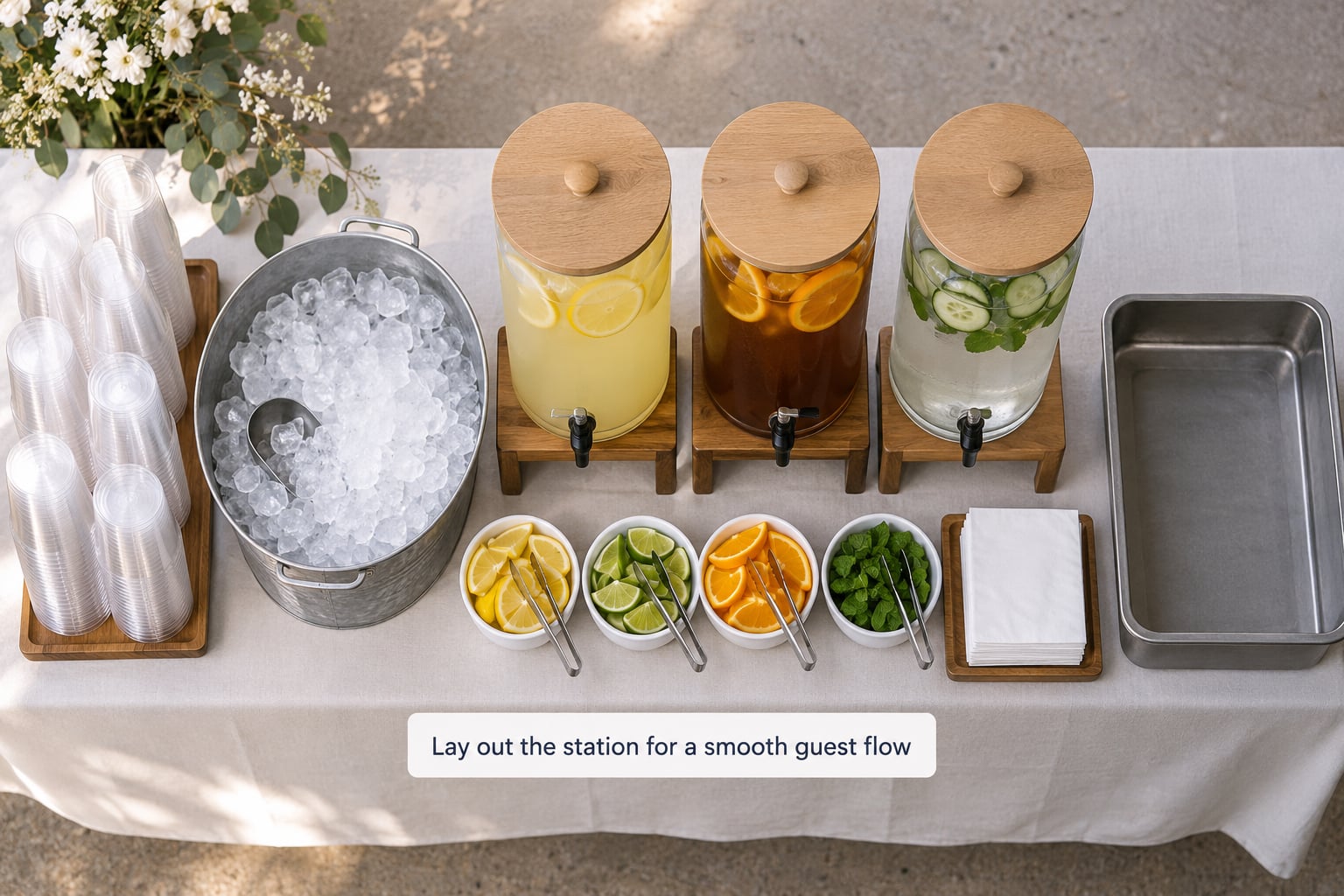
Every station runs the same direction, and it should be the direction people naturally move. Left to right: cups, ice, base drinks, mixers, garnishes, napkins, trash. Guests should never have to reach back over the ice tub to get a cup.
Three layout rules carry most of the benefit. First, give each guest about 18 inches of frontage so two people can serve themselves at once, and if the table is narrow, split it across a wall rather than squeezing people shoulder to shoulder. Second, keep glassware out of the service line. Real glasses on a self serve table get knocked over, break, and turn into a cutting hazard within the hour; put them on a separate side table near a seating area where nobody is walking past. Third, give the return path somewhere to go, a tray or a bin for empties near the seating area, so nobody backtracks through the queue carrying a wet cup.
Trash goes at the end of the line with a clear opening and a lid, not at the start where it becomes the first thing guests touch. Two bins are better than one at anything over 25 people, and one of them should be for recycling if your venue sorts it.
Prepare and label every drink
Chill everything before it goes out. Dispenser beverages that start cold stay cold noticeably longer than ones that start warm, and the same goes for the mixers. If you are using concentrates, dilute them with cold water according to the label rather than eyeballing it, and never top a partially used dispenser back up with fresh concentrate, the strength builds every time and the last guests get something twice as strong as the first.
Portion control is the next piece. A free-pouring bottle at a self serve station will get poured until it is empty, and one determined guest can take a fifth of the total supply. Measured pour spouts solve this for almost nothing, and for anything with real alcohol in it they are the difference between a party and an incident. If you do not have spouts, put the bottle in a decorative bottle neck pourer or set it back in a partially ice-filled bucket so it is physically awkward to over-pour.
Garnishes live in small bowls set on a bed of ice, each with its own pair of tongs. Tongs dedicated to one bowl, never shared. Fruit sitting in water turns soggy and grows bacteria faster than you want to think about in July, and citrus loses its look within an hour or two of being cut, so slice in batches and keep the rest whole in the fridge.
Labels do more work than people expect. Each dispenser gets a card with the drink name, a short ingredient list, and any allergen in plain words. A small wheat, milk or nut symbol next to the ingredients works well for people scanning quickly, and it avoids singling anyone out by naming a medical condition on a sign. Alcoholic drinks should carry their ABV, and every card should be readable from about six feet away, which means large type rather than elegant small type.
Test the station before guests arrive
Walk the station yourself as if you were a guest with no idea where anything is, and you will find the problems in about two minutes. Pour from every container. Pick up a cup from the position you placed it in. Check that the ice scoop is reachable and that the tap on a dispenser opens without two hands.
Here is what to look at. Flow: can two people be served at once without one reaching across the other? Cold: is every drink container sitting in ice or an ice bath, not just nearby? Labels: can you read every card from arm’s length? Light: is the station lit well enough to see a dark liquor or a dark syrup at the bottom of a pitcher? Reach: is everything at a height shorter guests and wheelchair users can manage, with heavy bottles at the bottom and small items on top? Ice level: is there enough that you do not need to refill within the first hour? Stability: are dispensers on a flat surface, away from the edge? Waste: is the trash bin open, close, and lined?
The most common thing you will find is a bottleneck where the ice and the cups overlap. Fix it by moving one of them, and the whole line resolves itself.
Common Mistakes
Too many drink options. Four or more choices turn a drink station into a decision, and groups that are deciding are groups that are queueing. Fix: cut to three and put the fourth recipe on a card so guests can build it themselves. Prevention: decide the menu before you shop, not while standing in the beverage aisle.
Not enough ice. Running out of ice is the most common regret hosts report, and it hits hardest in the last two hours. Fix: build the 1.5 to 2 pound per guest figure, add a quarter for warm weather, and buy backup bags you can break open without leaving the party. Prevention: store bags flat and never move them around after they freeze solid.
Free pouring with alcohol. A self serve bottle with no portion control is how a 30-guest party ends up with a 12-guest problem. Fix: measured pour spouts, ice-set bottles, or a bartender at the station for the first hour. Prevention: decide your portion policy before the event, not during the first argument.
Weak or missing labels. Guests repeatedly asking what is in a drink is a sign, not a curiosity. Fix: name, ingredients, allergens and ABV on every container. Prevention: write labels before the party, on a laptop, and print them.
Glassware in the service path. Breakage near a queue is a real injury risk and it always happens with someone carrying a full drink. Fix: move all glassware to a side table with seating nearby. Prevention: default to plastic cups for anything poured at a busy station.
No place for returned cups. Without a return point, cups pile up next to the dispensers, the table gets unusable, and guests start wandering off with drinks they never finish. Fix: a clearly marked tray or bin near the seating area, emptied by whoever is on station duty. Prevention: put the return point on your layout sketch before you start, not after the first trip.
Treating the non-alcoholic option as an afterthought. A single warm soda on a table full of cold beer is not an option, it is a consolation prize. Fix: give the zero-proof side its own dispenser, its own ice and its own label, and make it look like part of the station rather than an apology. Prevention: count non-drinkers as guests from the start.
Tips for keeping service running smoothly
Assign one person as station steward for 30-minute blocks. That person checks ice level, cups, garnish supply, spills and trash, and swaps with someone else after each block. Hosts who skip this usually spend the second half of their own party watching a melting ice tub instead of talking to guests.
Replenish in batches, not one bottle at a time. A steward who sees a dispenser at half should restock every station below half in a single pass. Back it all up with backup supplies stored out of sight: a cooler’s worth of drinks, extra cups, a second bag of ice, and a change of labels.
If alcohol is part of the event, stop pouring it about an hour before the end. A clear, announced wind-down gets people onto rideshares and taxis and keeps you out of the difficult conversations that come with a guest who has had too much. Keep water and food visible and free for the whole night, not tucked away in a kitchen, and never let the non-alcoholic side look like the leftover option.
Plan for weather and space. Outdoors in warm weather, add 25 to 30 percent ice, keep carbonated drinks sealed until service starts so they do not go flat, and put the station in shade. In an apartment or small house, a rolling cart against one wall works better than a table, since you can roll it out of the way and park it in the corner at the end of the night. If children are present, put the non-alcoholic station on a separate table, low enough for small kids to reach their own cups, and keep glassware and sharp garnishes out of reach entirely.
Frequently Asked Questions
How much drink should I provide per guest for a self serve drink station?
Plan on about two drinks per guest per hour for a casual party, or one and a half if most guests are eating. For a three-hour open house with 100 guests, that works out to roughly 450 drinks across every option. Give at least half of that capacity to non-alcoholic choices, and add a 10 to 15 percent buffer so nothing runs dry late in the night.
Do self serve drink dispensers keep drinks cold long enough?
Most filled dispensers hold temperature well because the liquid volume keeps heat moving slowly through the wall, and a dispenser packed with ice in the base can stay cold for several hours. Start with cold ingredients, keep mixers refrigerated until you set them out, and skip anything that needs refrigeration, like fresh juice, unless you refill it in small batches.
How should I label drinks and allergens at a self serve station?
Every container should carry the drink name, a short ingredient list, and any allergens written in plain words, with alcoholic drinks showing their ABV. A small wheat, milk or nut symbol next to the ingredients helps people scan quickly without you naming anyone’s medical condition on a sign. Print large type and check readability from six feet away.
How do I keep the station from becoming crowded or creating a bottleneck?
Give each guest about 18 inches of frontage so two people can be served at once, and keep the flow moving one direction: cups, ice, drinks, mixers, garnishes, napkins, trash. Cut the menu to three options, since choice is what creates queues. If more than 30 guests are coming, split the drinks across two tables instead of widening one.
What is the safest way to serve alcohol at a self serve drink station?
Use measured pour spouts or set bottles in ice so over-pouring is physically awkward, keep water and food free and visible all night, and never serve anyone you suspect has been drinking steadily. Stop pouring alcohol about an hour before the event ends and help guests get rides or taxis. For events above 50 people, hire a licensed bartender instead.
Can a self serve drink station work for nonalcoholic events?
It works better than most people expect, and it suits weddings, office parties, kids gatherings and morning events where nobody is drinking alcohol. The same layout rules apply, so give the station a cold zero-proof option such as sparkling water, iced tea or lemonade in dispensers, plus mocktail bases that guests can mix themselves. Treat it as the main event rather than a fallback.
If you take one thing from this, make it the layout. Decide your three drinks tonight, order the ice, and arrange the table so cups come first and trash comes last. Everything else, the labels, the steward rotation, the wind-down time, is a small adjustment on top of a layout that already works. Refresh this checklist each season as 2026 keeps bringing new hosts back to the same setup, and the station you build will hold up from the first pour to the last call.