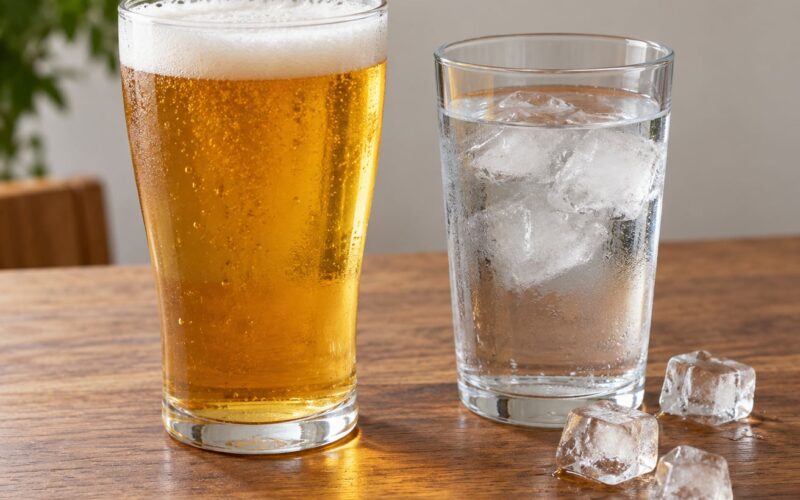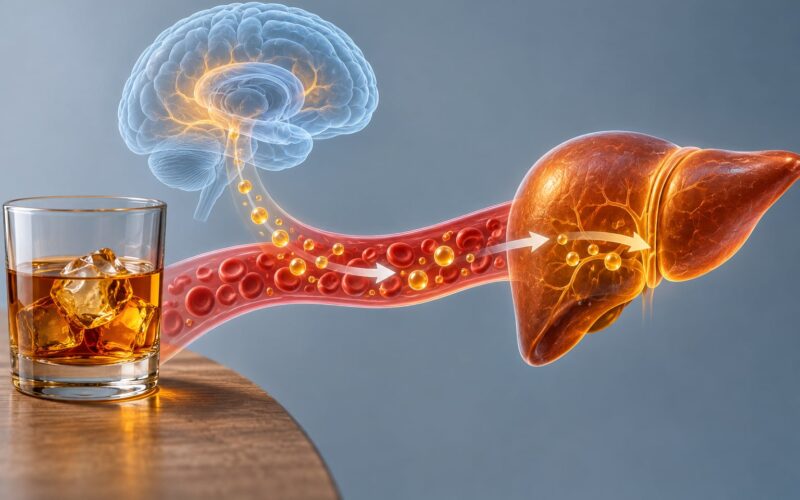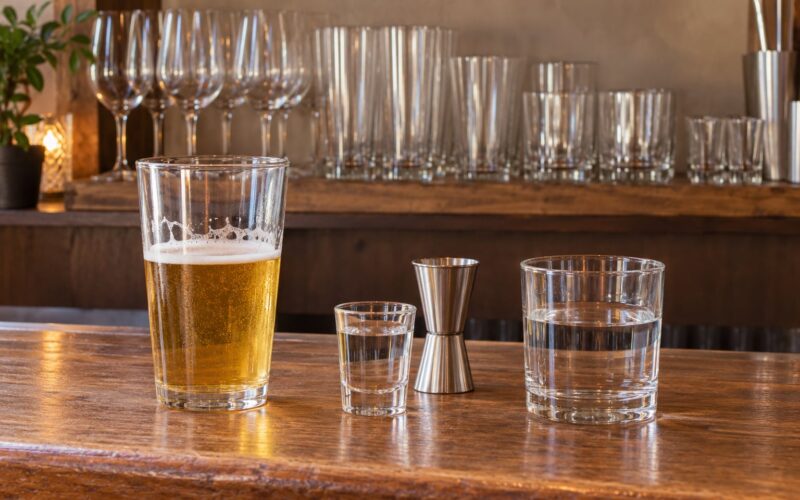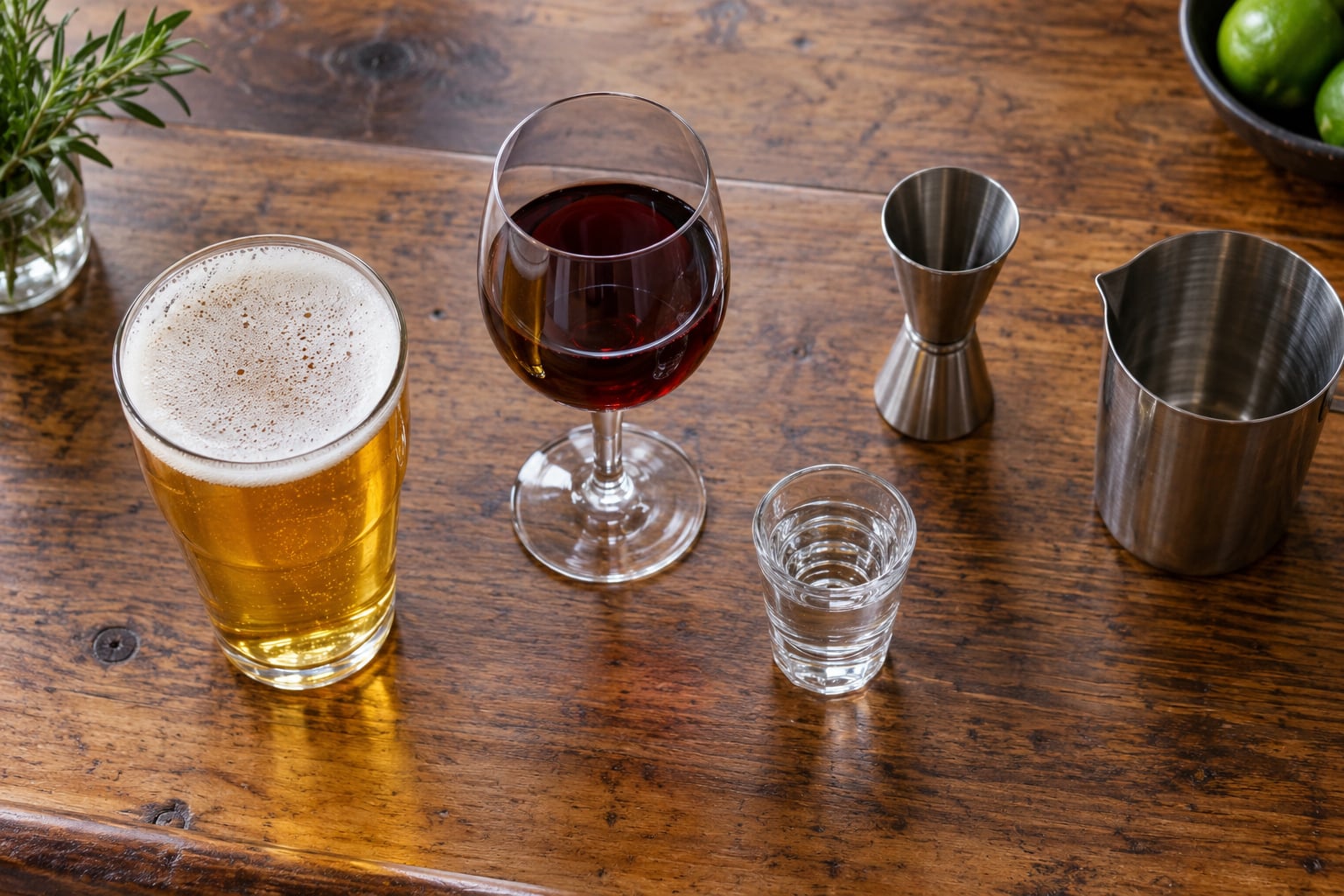
What a standard drink size actually is comes down to one number: 0.6 US fluid ounces of pure alcohol, about 18 mL or 14 grams. Defined in the United States by NIAAA and the CDC, that reference amount is 12 ounces of 5% beer, 5 ounces of 12% wine, or 1.5 ounces of 40% spirits. It measures ethanol, not a glass or a pour.
Getting that distinction right is the whole point. A tall glass of pale ale and a short glass of imperial stout can hold the same volume and contain very different amounts of alcohol, and the word “drink” in a nutrition label or a study means the ethanol, not the serving ware.
Table of Contents
- What a Standard Drink Size Actually Is
- US Standard Drink Examples at a Glance
- How Beer ABV Changes the Standard-Drink Count
- How to Work Out What a Standard Drink Size Is on Any Pour
- Why a Pour, Can, Bottle or Shot May Not Equal One Standard Drink
- How to Estimate Drinks When You Do Not Know the ABV
- Standard Drinks Are Not the Same as a Safe Limit
- Frequently Asked Questions
- Is a standard drink 1 or 1.5 ounces?
- How many ounces is a standard shot at a bar?
- Is a 5 oz pour of wine one drink?
- How many standard drinks are in a bottle of wine?
- How many standard drinks are in a 16 oz can of IPA?
- What is a standard drink size in the UK and Australia?
- The Key Takeaway
What a Standard Drink Size Actually Is
One standard drink is 14 grams of pure alcohol, whatever it arrives in. Because the measurement is ethanol rather than volume, a standard drink is only ever “one” when the liquid and the strength line up with the reference amounts above. Strengthen the beer or enlarge the pour and one drink becomes two without anything else changing.
That is why health agencies publish the reference amounts the way they do. They are calculation anchors, not menu sizes: 12 fl oz of beer at about 5% ABV, 5 fl oz of wine at about 12% ABV, 1.5 fl oz of distilled spirits at about 40% ABV, which is 80 proof. Pick a drink from another category and you do the arithmetic yourself.
For most people the useful version of the definition is the shortcut below. Take the number of ounces times the ABV, and divide by 0.6. The result is the number of standard drinks in the container.
US Standard Drink Examples at a Glance
The table below is the reference set most US guidance uses. The gram column is there so you can see the arithmetic behind the round numbers.
| Beverage | Volume | ABV | Pure alcohol | Standard drinks |
|---|---|---|---|---|
| Beer | 12 fl oz | 5% | about 14 g | 1.0 |
| Wine | 5 fl oz | 12% | about 14 g | 1.0 |
| Distilled spirits | 1.5 fl oz | 40% (80 proof) | about 14 g | 1.0 |
| Fortified wine | 3 fl oz | 20% | about 14 g | 1.0 |
| Hard seltzer | 12 fl oz | 5% | about 14 g | 1.0 |
| Standard wine pour in a large glass | 8 fl oz | 12% | about 22 g | 1.6 |
| Vodka seltzer | 12 fl oz | 10% | about 28 g | 2.0 |
| 750 mL bottle of wine | 25.4 fl oz | 12% | about 71 g | 5.0 |
| 750 mL bottle of 80-proof spirits | 25.4 fl oz | 40% | about 237 g | 17.0 |
Those reference amounts are not a recommendation. US dietary guidance describes moderate drinking as up to two drinks a day for men and one for women, on days when alcohol is consumed, and the same guidance advises against any amount during pregnancy. Treat the table as a conversion key between a bottle and a number, not as a target.
How Beer ABV Changes the Standard-Drink Count
Beer is where the gap between glass and standard drink gets widest, because strength varies more than the wine aisle does. A 4.2% session lager in a 12-ounce glass is a little under one standard drink. The same glass of a 10% double IPA is about 1.8.
| Beer style | ABV | Pour | Pure alcohol | Standard drinks |
|---|---|---|---|---|
| Session lager | 4.2% | 12 fl oz | about 12 g | 0.8 |
| Pale ale | 5.5% | 12 fl oz | about 15 g | 1.1 |
| West coast IPA | 6.8% | 16 fl oz | about 25 g | 1.8 |
| Double IPA | 10% | 12 fl oz | about 28 g | 2.0 |
| Imperial stout | 11% | 12 fl oz | about 31 g | 2.2 |
| Bomber | 8% | 22 fl oz | about 41 g | 2.9 |
| Growler | 6% | 32 fl oz | about 45 g | 3.2 |
| Low-alcohol lager | 3.2% | 16 fl oz | about 12 g | 0.9 |
Beer math follows the same rule as everything else on this page. Volume in ounces times the ABV decimal gives you fluid ounces of ethanol, and one standard drink is 0.6 of those. A 16-ounce pour at 6.8% gives 1.09 ounces of ethanol, so it lands at about 1.8 standard drinks.
If you would rather work in grams, multiply the fluid ounces of ethanol by 23.3. Ethanol weighs about 0.789 g per mL, and one US fluid ounce is 29.57 mL, which gives the 23.3 figure and reproduces the 14 gram standard.
How to Work Out What a Standard Drink Size Is on Any Pour
Three steps, and it works for anything with a label or a listed ABV.
1. Find the volume in fluid ounces. That is the can size, the bottle size, or the pour your bar is serving. A 12-ounce can and a 16-ounce can are not interchangeable, even at the same ABV.
2. Find the ABV as a decimal. 6.8% becomes 0.068, 12.5% becomes 0.125, and 40% becomes 0.4. Proof is just ABV doubled, so 80 proof is 0.4.
3. Multiply the two, then divide by 0.6. The result is standard drinks. For a 5-ounce pour of 12.5% wine, 5 times 0.125 is 0.625, which is about one standard drink.
Cocktails run through the same calculation, using the spirits volume inside the glass. A margarita built on 2 ounces of 40% tequila is 1.3 standard drinks before the lime. A 1.5-ounce Long Island iced tea is also about 1.3, and a 2-ounce Martini at 40% gin is 1.3 as well. Drink size and mixer volume do not change the alcohol math.
Why a Pour, Can, Bottle or Shot May Not Equal One Standard Drink
A standard drink is a health measurement. A standard pour is a bar practice, and the two are not the same thing. Bartenders on Reddit’s r/bartenders describe the working convention as roughly 1.5 ounces for a shot, 1.25 ounces for a shot glass, 2 ounces neat or on the rocks, and 3 ounces for a double or a martini, with plenty of variation by market and by house.
Free pouring adds another layer. Counting drops out of a pour spout, often called a four count, lands somewhere around 1 to 1.5 ounces depending on the spout and the speed of the pour, and bartenders themselves say the count is an estimate rather than a measurement. A measured jigger or a pour spout with a stop is the only version of that pour you can defend as a quantity.
Containers are the other trap. A 16-ounce can of 6.8% IPA is about 1.8 standard drinks. A 22-ounce bomber at 8% is close to three. Both arrive in something that looks like one beer, and neither printed number is the number that matters for the arithmetic.
Wine glasses have their own problem, which is shape. A large bowl plus a generous pour is easy to mistake for a small glass poured lightly, and neither is measurable by eye. Knowing where the wine should sit in the bowl, roughly in the widest part below the stem, gives you a repeatable target instead of a guess.
How to Estimate Drinks When You Do Not Know the ABV
Most of the time the information is available and nobody asks for it. Check the tap menu, which lists ABV for every draft, and check the can, which prints ABV on the side near the nutrition panel. If the ABV is printed anywhere in the room, the count is a two-number multiplication.
When it is not printed, style tells you roughly where you are. Session lagers and light lagers sit near 4%. Pale ales and amber ales sit around 5 to 6%. West coast IPAs run 6 to 7.5%, double IPAs 8 to 12%, and imperial stouts and barley wines can reach 12 to 15%. Treat those as ranges, not figures, and when the range spans two drinks, assume the higher end if you are trying to keep a running total.
Volume is the easier half. Know your glassware before you order. A 16-ounce pint, a 12-ounce can and a 22-ounce snifter are three different denominators, and the tulip or chalice styles served in heavier 16 to 20 ounce glasses make a mid-strength IPA land much closer to two drinks than one.
For spirits at a bar, the honest options are to ask for a measured pour or to assume the common house size. If a bartender says 1.5 ounces, that is one standard drink at 40%. If nobody says anything and the pour looks like a double, count it as one and a half.
Ready-to-drink cocktails and canned cocktails are the easiest place to get a straight answer, since the can states both the serving size and the ABV. A 12-ounce can at 10% is about two standard drinks. The part that still trips people up is that the can’s stated serving may be the whole can or a half can, so read that line rather than assuming.
Keeping a rough note helps more than people expect, and it is not a moral exercise. A tally of drinks and a rough start time is the same information a health guideline needs, and it is what makes an estimate at a brewery taproom possible later.
Standard Drinks Are Not the Same as a Safe Limit
A standard drink is a unit of measure, not a threshold. Knowing that a pour was 1.8 drinks tells you nothing about how it affects you. Body weight, drinking speed, food in the stomach, sleep, medications and existing health conditions all change how quickly blood alcohol rises and how it behaves afterwards.
The commonly repeated idea that the body clears one standard drink per hour is a rough estimate used for planning, and it is wrong often enough to matter. A small person who drinks on an empty stomach can carry measurable alcohol well past an hour later.
Some situations are not a calculation at all. Guidance is clear that no amount of alcohol is considered safe during pregnancy, and alcohol interacts with a long list of prescription drugs, including sedatives, sleep aids and some antihistamines. If any of that applies to you, ask a doctor or a pharmacist for your specific situation rather than using a drink count as the basis for the decision.
NIAAA and the CDC both publish the reference amounts and the guidance limits used here, and they are worth reading directly. Anything about your own health, driving, or medication belongs with a clinician who knows your history.
Frequently Asked Questions
Is a standard drink 1 or 1.5 ounces?
For distilled spirits, 1.5 fluid ounces of 40% alcohol is one standard drink, while a 1 ounce pour of the same liquor is about two thirds of one. The 1.5 ounce figure is the reference amount that lands on 14 grams of pure alcohol. The ounce count changes with strength, so 1.5 ounces of a 20% spirit is only about half a drink.
How many ounces is a standard shot at a bar?
A standard reference shot is 1.5 fluid ounces of 80-proof spirit. In practice bartenders commonly pour between 1 and 2 ounces, with 1.25-ounce shot glasses and 2-ounce neat pours both in normal use. A 2-ounce pour of 40% spirit is about 1.3 standard drinks. Ask for a measured pour if the exact size matters to you.
Is a 5 oz pour of wine one drink?
Yes, when the wine is around 12% ABV. A 5 ounce pour at 12% contains 0.6 fluid ounces of pure alcohol, which is the 14 gram standard drink. A 15% wine of the same size is about 1.25 drinks, and an 8 ounce pour from a large glass at 12% is closer to 1.6.
How many standard drinks are in a bottle of wine?
A 750 mL bottle holds about 25.4 fluid ounces. Multiply by the ABV as a decimal and divide by 0.6, so a 12% bottle works out to about five standard drinks and a 14.5% bottle to about six. A 25 ounce pour straight from the bottle is roughly four of them.
How many standard drinks are in a 16 oz can of IPA?
Divide by ABV. At 6.8%, a 16 ounce can holds 1.09 fluid ounces of pure alcohol, about 1.8 standard drinks. At 7.2% it is about 1.9, and the same can at 5.5% comes out near 1.5. A 12 ounce can of the same 6.8% beer is about 1.4.
What is a standard drink size in the UK and Australia?
Both countries use a smaller reference amount than the United States. A UK unit is 10 mL of pure alcohol, about 8 grams, and an Australian standard drink is 10 grams. A 175 mL pint of 4% beer works out to about 0.7 UK units, and a 25 mL measure of 40% spirit is about one unit.
The Key Takeaway
Check the container size and the ABV, then run the multiply and divide. That is the entire method, and it is enough to make any drink, from a session lager to a bottled cocktail, comparable to every other one.
A standard drink is a measurement, not a recommendation, and knowing which one you had is the useful part. If the question is what that number means for you personally, a doctor or pharmacist can answer it properly.