Altitude affects drinking because the air you breathe at elevation carries less oxygen, and your body works harder to compensate. Your blood alcohol concentration does not actually climb faster up there, but dehydration, faster breathing and broken sleep all stack on top of the alcohol, so the same pint lands heavier than it would at sea level.
That gap between what gets measured and what gets felt is where most of the confusion comes from. Below is the short version before the detail.
- Your BAC does not rise because you are higher up. Studies find altitude leaves blood alcohol concentration essentially unchanged.
- What changes is how the alcohol feels: more dizziness, more sedation, worse coordination, and a worse next morning.
- Elevation makes you lose fluid faster through quicker breathing and increased urination, and alcohol suppresses antidiuretic hormone so you lose more on top of that.
- The first 24 to 48 hours at a new elevation are the riskiest window, because you are not yet acclimatized and altitude sickness symptoms are easiest to mistake for a hangover.
- Pacing, food, water and rest do more for you at altitude than any gadget does.
Table of Contents
- What Does Altitude Do to Alcohol in Your Body?
- Does Altitude Make You Get Drunk Faster?
- How Much Does Elevation Matter?
- Why Can Altitude Change How Alcohol Feels?
- How Does Breathing and Oxygen Affect Intoxication?
- How Do Dehydration and Dry Air Make It Harder?
- Why Can Exertion and Poor Sleep Change Your Tolerance?
- Why Altitude Affects Drinking: Myths and Evidence
- How to Drink More Safely at Altitude
- Acclimatize before you drink
- Put food in front of the alcohol
- Alternate water with every alcoholic drink
- Keep a running count
- Do not mix alcohol with sedating medicines
- Watch the symptoms, not the buzz
- Keep a sober driver
- Practical Tips for Beer-Focused Mountain Trips
- When Should Someone Seek Urgent Help?
- Frequently Asked Questions
- Can altitude increase your blood alcohol concentration?
- Does alcohol make altitude sickness worse?
- Are strong beers more dangerous at high elevation?
- Should you avoid drinking on the first day at altitude?
- Does drinking water prevent alcohol-related altitude headaches?
- Can oxygen or a breathing mask make mountain drinking safer?
- Conclusion: Start Slower and Stay Alert
What Does Altitude Do to Alcohol in Your Body?
Barometric pressure falls roughly one gram per 30 feet of climb. The percentage of oxygen in the air stays at 21 percent at any height, but with less pressure behind it, the partial pressure of oxygen drops, so each breath delivers measurably less of it to your blood.
Your body answers in a predictable way. Heart rate climbs, breathing gets faster and deeper, and blood vessels near the skin open up. You also urinate more, because altitude triggers a diuretic response that releases fluid you would otherwise be holding.
Alcohol then lands on a system that is already busy. It suppresses antidiuretic hormone, so you lose even more water than altitude alone would cost you. It depresses the central nervous system, slows reaction time and coordination, and blunts the ventilatory response you depend on when oxygen is scarce. It also fragments sleep.
A 1995 study by Roeggla and colleagues, published under PubMed ID 7755228, found that alcohol interferes with the early stages of your body’s ventilatory adaptation to mild hypoxia at moderate altitude. Your lungs are trying to compensate for thin air, and alcohol gets in the way of that compensation.
Does Altitude Make You Get Drunk Faster?
No, not in the way most people mean it. Multiple studies, including summaries in BBC Science Focus, have found that altitude has no meaningful effect on blood alcohol concentration. One 12-ounce beer of 5 percent ABV still delivers the same ethanol whether you drink it in Denver at 5,280 feet or in Frisco at 8,000 feet.
What does change is your perception and your impairment. Fewer, harder breaths, a faster heartbeat, lower blood sugar after exertion and four hours of poor sleep all make you feel more intoxicated at the same measured level. Coordination and reaction time are already degraded by alcohol, and hypoxia degrades them too, so the two stack rather than cancel.
So the honest answer is that the folk rule about one drink in Denver equaling two drinks anywhere else is not measuring blood alcohol. It is measuring how tired, dry and oxygen-short you are. That felt effect is real. The measurement behind the slogan is not.
How Much Does Elevation Matter?
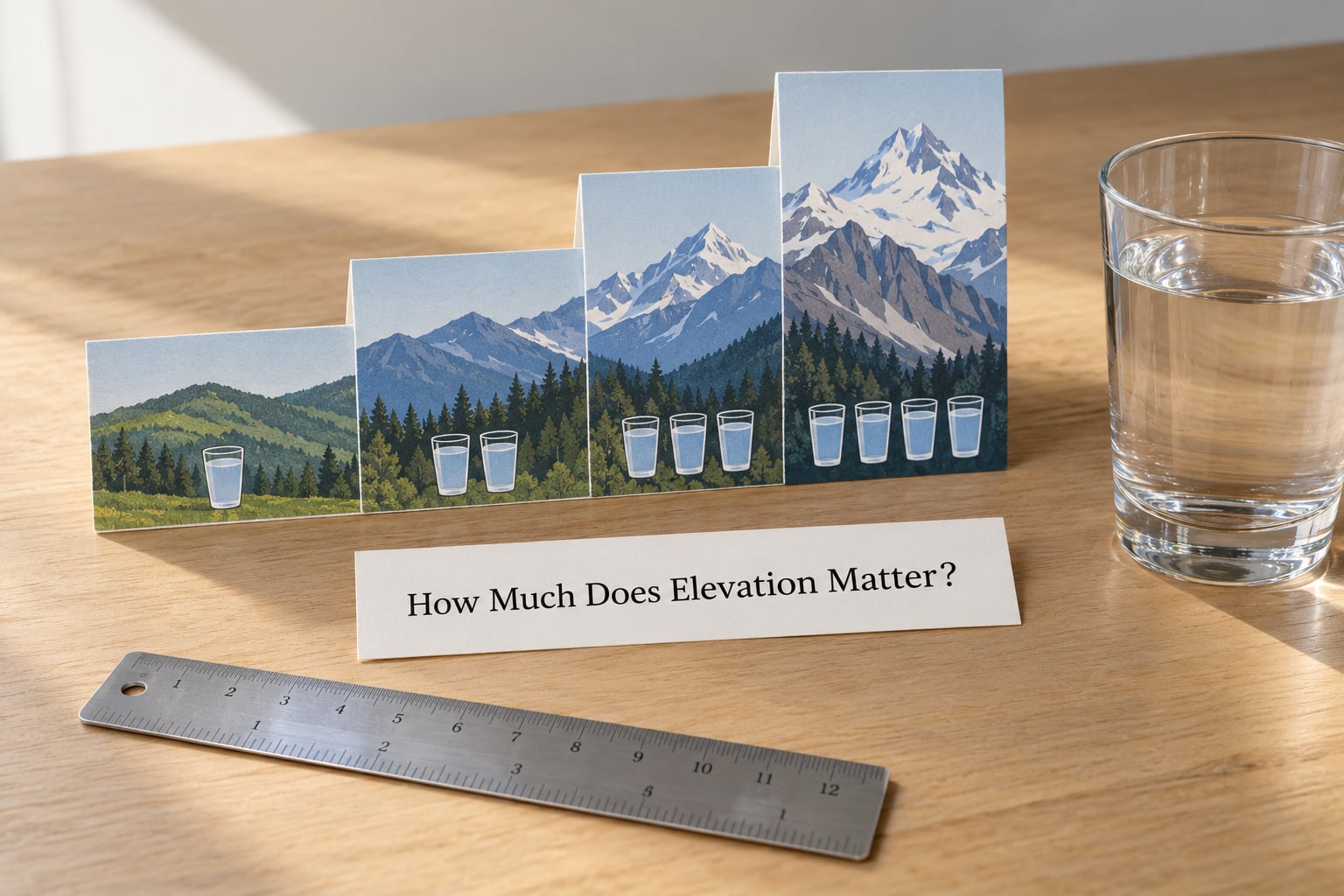
Elevation is a gradient, not a switch. Nobody wakes up impaired at 8,000 feet, and there is no altitude where one beer suddenly counts as two. Here is how rough bands change the picture, with practical adjustments rather than hard cutoffs.
| Elevation | What changes in the environment | Likely effect on drinking | Practical adjustment |
|---|---|---|---|
| Sea level to 3,000 ft | Minimal physiological change | No meaningful difference | Drink as you normally would |
| 3,000 to 6,000 ft (Denver sits at 5,280 ft) | Mild reduction in oxygen, mild increase in breathing rate and urination | Most people notice nothing measurable | Normal intake, extra water with dinner |
| 6,000 to 8,000 ft (Jackson Hole base, Vail, Salt Lake City) | Clear increase in ventilation, heart rate and fluid loss; sleep gets worse | Earlier and heavier-than-usual fatigue, faster dehydration | One drink fewer than usual, water between pours |
| 8,000 to 12,000 ft (Breckenridge at 9,600 ft, Aspen, Telluride) | Meaningful hypoxia, common early altitude symptoms, fragmented sleep | Strongly felt intoxication, nausea and headache risk rise | Wait a day before drinking, then pace carefully |
| Above 12,000 ft (Everest Base Camp at 13,990 ft) | Severe hypoxia, risk of high-altitude pulmonary and cerebral edema | Alcohol actively works against acclimatization | Treat drinking as optional and minimal, follow expedition medical guidance |
Why Can Altitude Change How Alcohol Feels?
Read this section in the order you would feel it. The mechanisms stack in roughly that sequence: first the air, then the water, then the tiredness.
How Does Breathing and Oxygen Affect Intoxication?
At lower oxygen pressure, your body breathes faster and your heart beats harder to keep arterial oxygen where it needs to be. That faster ventilation is where a lot of the altitude experience comes from, because you lose moisture with every extra breath. Breathe faster and you dry out faster.
Alcohol does not turn thin air into extra ethanol in your bloodstream. What it does is interfere with the breathing response you need at height. Roeggla’s 1995 work is the clearest published example: alcohol blunted the initial ventilatory response to mild hypoxia, meaning the compensation your lungs rely on started slower and ran weaker.
The practical result is a head that feels light and buzzy, a faster pulse, and an urge to keep taking breaths deeper than you realize. People describe this as getting drunk faster. It is more accurately described as a body working harder while the alcohol does its usual job.
How Do Dehydration and Dry Air Make It Harder?
Altitude dryness and alcohol pull in the same direction. Mountain air holds very little moisture, so you lose water through breathing and skin. Altitude itself increases urine output. Alcohol suppresses antidiuretic hormone, the signal that tells your kidneys to reabsorb water, so you lose more again.
Alcohol also widens blood vessels, which pushes fluid toward the outside of your body and lowers effective circulating volume. On its own that produces the headache, dry mouth, nausea and fatigue of an ordinary hangover. At altitude you are starting from a deficit, so you reach that state after fewer drinks and with a worse headache.
Why Can Exertion and Poor Sleep Change Your Tolerance?
A day of skiing, hiking or climbing burns glycogen and drops blood sugar, and alcohol on an empty or low-blood-sugar stomach reaches you faster in practical terms even though the total amount is the same. Muscles that worked hard are more sensitive to the sedative effect, which is why the second après-ski pour feels heavier than the first.
Sleep is the other half. Altitude fragments sleep and cuts into REM time, and so does alcohol, just in a different way. You wake more often with a racing heart and a dry mouth. Being tired lowers your judgment of how impaired you are, which is where a lot of real-world risk comes from.
None of this changes the alcohol’s potency. It changes the starting line: less fluid, less sleep, lower blood sugar, less oxygen. Same drink, worse floor.
Why Altitude Affects Drinking: Myths and Evidence
Half the pages ranking for this question say the drunk-faster claim is a myth. The other half say it is obviously real. Both are describing different measurements.
Altitude makes drinks stronger. Not in concentration. A 6 percent ABV beer has the same alcohol by volume whether you pour it at 5,000 feet or 13,000.
You absorb alcohol faster up high. Alcohol absorption depends on concentration, gastric emptying and food, not barometric pressure. What speeds up is how you feel it, because your physiology is already working harder.
Alcohol keeps you warm. It gives you a flush and a feeling of warmth while widening your blood vessels, which actually speeds heat loss. People have died of hypothermia partly because alcohol made them feel warm when they were not.
Alcohol helps you sleep at altitude. It shortens the time to fall asleep and then suppresses REM, so the second half of the night is worse. Altitude already disrupts sleep, and drinking on top of that stacks two problems.
Alcohol prevents altitude sickness. It does not. Descent is what treats acute mountain sickness, and alcohol works against acclimatization because it suppresses fluid retention and breathing adaptation.
An oxygen mask or portable oxygen canister fixes it. Supplemental oxygen helps with hypoxia, but it does nothing about dehydration, blood sugar, sleep or the alcohol itself. It is not a drinking accessory, and people have died in the mountains treating a worsening headache as something to push through.
How to Drink More Safely at Altitude
Treat altitude as one more variable on top of the ones you already manage. Nobody has ever gotten in trouble at altitude for drinking too slowly.
Acclimatize before you drink
Give your body a full day at the new elevation before your first drink, and longer if you flew in from sea level. Many mountain town breweries and taprooms are happy to see you on day two rather than day one, and it makes the trip better anyway.
Put food in front of the alcohol
Protein and carbohydrates slow gastric emptying, which slows how quickly ethanol reaches you. A pint after a plate of food behaves differently from the same pint at 4 p.m. on an empty stomach.
Alternate water with every alcoholic drink
One full glass of water for every beer or cocktail, and an extra glass before bed. Most weekend drinking patterns already sit slightly under a litre of fluid per alcoholic drink; at elevation you need to close that gap, not just match it.
Keep a running count
Count standard drinks, not glasses. One standard drink is about 12 ounces of 5 percent beer, 5 ounces of 7 percent wine, or 1.5 ounces of 40 percent spirits. Tasting pours at a mountain brewery add up faster than people expect because there is no timer.
Do not mix alcohol with sedating medicines
Sleep aids, strong painkillers, some allergy medications and muscle relaxants stack with alcohol on a central nervous system that is already depressed by thin air. If you take any prescription, ask your pharmacist or prescriber before drinking at elevation.
Watch the symptoms, not the buzz
Headache, nausea, dizziness and fatigue overlap between hangover, dehydration and early acute mountain sickness. If symptoms are building rather than fading, stop drinking. The only real treatment for acute mountain sickness is stopping, resting, hydrating and descending if it worsens. The Wilderness Medical Society and CDC both publish ascent and descent guidance.
Keep a sober driver
Mountain roads have shoulders, wildlife and long stretches with no shoulder at all. A designated sober person is the cheapest risk reduction available, and the only one that matters after a bad night.
Practical Tips for Beer-Focused Mountain Trips
Most craft-beer travel plans at elevation look like three taprooms in one afternoon. That format is the problem, not the beer.
- Book two venues instead of three. Fewer transfers means less walking uphill in thin air and less time accumulating drinks.
- Start with a small pour at the first stop, ideally a lower-ABV style such as a session lager, kölsch, pilsner, wheat beer or radler, then decide whether you want another.
- Treat flights as strong styles. Imperial stouts, barleywines, double IPAs and high-ABV sour releases load more ethanol per glass, and your legs are already tired.
- Drink the water sitting in front of you first. Bartenders at elevation deal with this constantly, and asking for a top-up is normal, not a tell.
- Keep one nonalcoholic drink in your hand. It slows your pour rate without anyone having to say anything.
- Plan food between stops. A brewery taproom that serves a real plate is doing you a favor.
- Have a sober driver or a rideshare plan decided before the first pour, not after the third taproom.
- Sleep at a lower elevation than your high point when you can. Sleeping high is what drives most altitude symptoms.
When Should Someone Seek Urgent Help?
Most altitude discomfort is mild and manageable. Some of it is not, and the difference is usually mental state rather than how bad a headache feels.
Call emergency services or get to a lower elevation right away if someone has:
- Confusion, unusual behavior, slurred speech or trouble walking a straight line
- Difficulty staying awake or being woken up
- Breathlessness at rest, or breathing that is rapid and shallow
- Vomiting that keeps repeating and will not hold fluids down
- A severe headache that does not improve with rest, fluids and pain relief
- A wet or crackling-sounding cough, which can signal high-altitude pulmonary edema
- Unsteady walking or loss of balance, which can signal high-altitude cerebral edema
Those last two conditions can progress quickly, and the treatment is descent. Oxygen and specific medicines help under medical supervision, but they are not substitutes for going down. Anyone with heart or lung conditions, or a history of altitude sickness, should talk to a doctor before traveling high and should consider skipping alcohol entirely.
Frequently Asked Questions
Can altitude increase your blood alcohol concentration?
No. Published research has found that altitude has no meaningful effect on blood alcohol concentration, so a 5 percent beer delivers the same ethanol at 9,000 feet as it does at sea level. What changes is how the alcohol feels, because faster breathing, dehydration, lower blood sugar and poor sleep all make you more vulnerable to the same measured amount.
Does alcohol make altitude sickness worse?
It can. Alcohol suppresses fluid retention and blunts the breathing adaptation your body needs at height, so it works against acclimatization. The bigger problem is symptom overlap: headache, nausea, dizziness and fatigue look almost identical early on, which makes it easy to keep drinking through developing acute mountain sickness. Descending is the only reliable treatment.
Are strong beers more dangerous at high elevation?
They load more ethanol per glass, so the same number of pours is more alcohol. A 12 ounce imperial stout at 10 percent ABV is close to three standard drinks. Combined with altitude fatigue and dehydration, that raises your chance of a bad night and a rough morning. Lower-ABV styles are the better choice when you are above 8,000 feet.
Should you avoid drinking on the first day at altitude?
It is the safest choice, and most mountain medicine guidance suggests waiting at least 24 hours after arriving before drinking. If you flew from sea level, you skipped acclimatization entirely and are more exposed. Give yourself a day to eat, hydrate and sleep, then decide. You will probably drink less and enjoy it more.
Does drinking water prevent alcohol-related altitude headaches?
It helps, and it is the first thing to try, but water alone is not a fix. A headache that starts after drinking at elevation may be dehydration, the alcohol itself, or early acute mountain sickness. Hydrate, eat something, rest, and take pain relief if you normally do. If the headache does not improve or gets worse, descend.
Can oxygen or a breathing mask make mountain drinking safer?
Supplemental oxygen addresses hypoxia, which is only one part of the problem. It does not touch dehydration, low blood sugar, sleep loss or the ethanol itself, so it does not make drinking safer. Oxygen can also create false confidence. Severe symptoms still mean descend and get medical help.
Conclusion: Start Slower and Stay Alert
The first action is simple: give yourself a day at the new elevation before the first drink, then pace the rest. Why altitude affects drinking comes down to a lower starting point, not stronger alcohol. Your blood alcohol concentration is what it is, but thin air, faster dehydration and no sleep make you feel it sooner and suffer for it longer.
Eat before you drink, alternate with water, count standard drinks instead of glasses, keep a sober driver, and take a headache or nausea that is building seriously. Drink less than you think you need, and remember that coming back down restores your usual tolerance within a day or two.