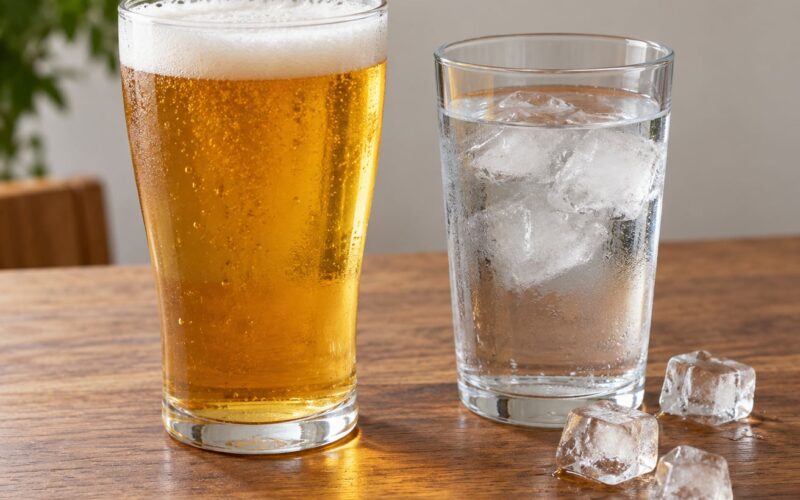
A US standard drink is any drink containing 0.6 fluid ounces of pure alcohol, which is 14 grams or about 17.2 mL of pure ethanol. That is roughly a 12-ounce beer at 5% ABV, 8 ounces of malt liquor at 7%, a 5-ounce glass of wine at 12%, or a 1.5-ounce shot of 80-proof spirits.
Here is the part most people get wrong: a standard drink is measured in alcohol, not in glasses. A tall glass of wine and a gin and tonic can each carry two or three standard drinks, while a beer in a heavy craft pour can quietly pass one before you have taken the second sip. Learning to count standard drinks correctly means you weigh volume and ABV together, every time.
It takes about five minutes per drink to work out, and the arithmetic is genuinely simple once you have one formula. This guide gives you that formula, a beer-focused conversion table, a way to count cocktails nobody measures, and a tally system for a real night out. This is general information for adults 21 and over, not medical advice.
Table of Contents
- What You Need
- Step-by-Step: How to Count Standard Drinks Correctly
- Identify the Beverage and Its Alcohol Percentage
- Measure the Serving Size
- Calculate the Pure Alcohol: How to Count Standard Drinks Correctly
- Convert the Amount Into Standard Drinks
- Record Everything You Consume
- Common Mistakes
- Treat Large or Strong Drinks Carefully
- Do Not Count a Bottle as One Drink
- Read the Limits as Guidelines, Not Goals
- Frequently Asked Questions
- How many standard drinks are in a 12-ounce beer?
- How do I count a craft beer with a higher ABV?
- Are wine and cocktails measured differently from beer?
- How should I count a shared bottle or a drink poured by a friend?
- What if a restaurant or bar does not list the alcohol percentage?
- How do I count standard drinks correctly across a night out?
What You Need
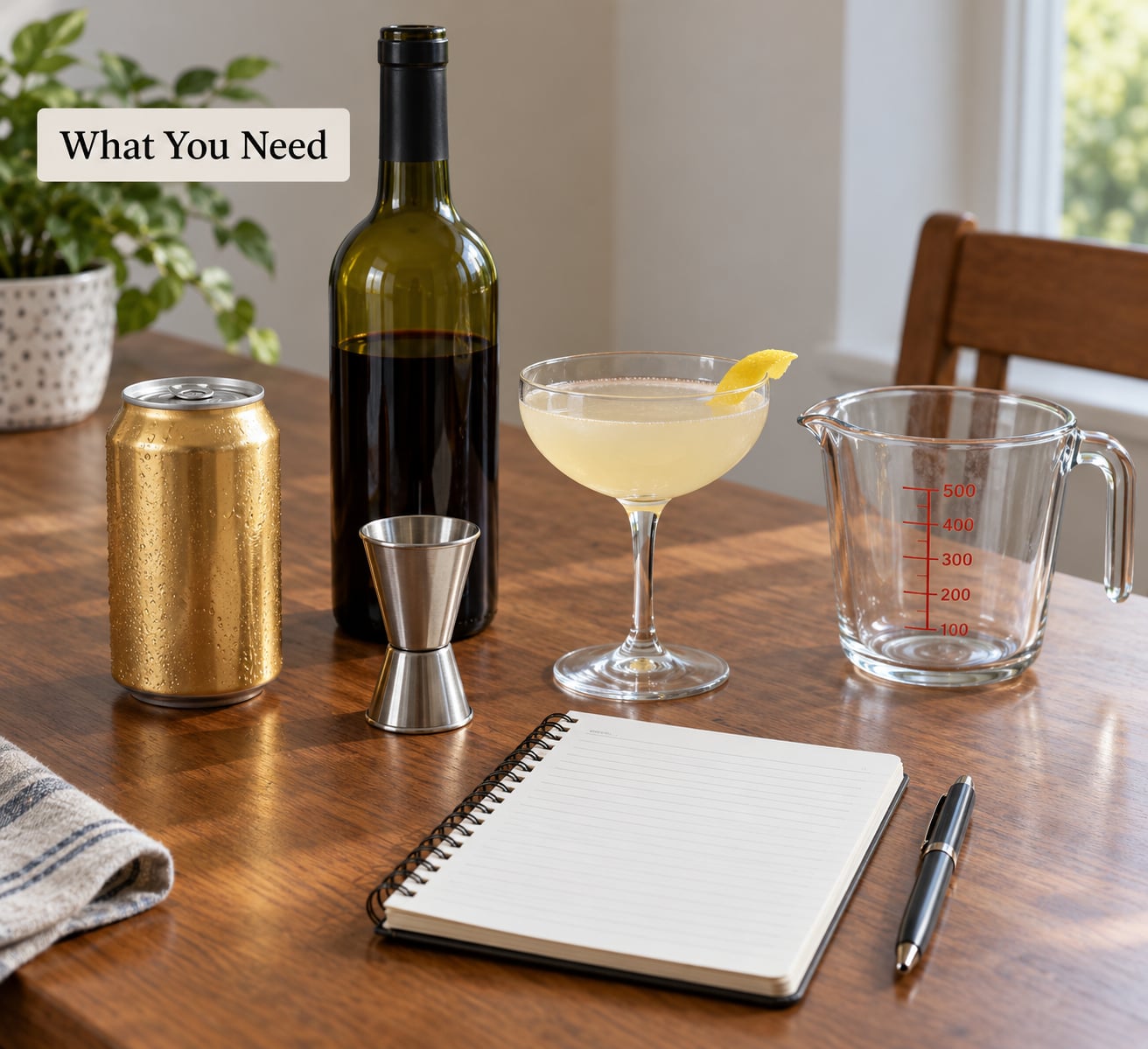
You need very little. The whole method runs on two numbers: how much liquid you drank, and what percentage of it was alcohol.
Before a night out, have these four things ready:
- The US reference. One standard drink equals 14 grams of pure alcohol, which is 0.6 fluid ounces.
- Label or menu access. Every can, bottle, tap list and menu carries an ABV number somewhere. If you cannot see it, ask.
- A pour reference. A jigger, or any glass you know the volume of, turns a guess into a measurement.
- A record. A phone note or a coaster works better than memory, and it takes about five seconds per drink.
That is the whole kit. The rest is arithmetic, and the arithmetic is one multiplication.
Step-by-Step: How to Count Standard Drinks Correctly
Identify the Beverage and Its Alcohol Percentage
ABV is the percentage of the drink’s volume that is pure alcohol. A 5% beer is 0.05 in decimal form, an 80-proof spirit is 40% or 0.40.
For beer, the number sits on the can or bottle and on the tap handle, the menu board or the brewery’s tap list. Beer styles cluster into rough bands: session beers around 4%, lagers and pale ales at 5%, IPAs from 6 to 7.5%, imperial IPAs and barleywines at 10% and up, and malt liquor at 7 to 9%.
Spirits list proof rather than ABV, and the two are simply related. Proof is ABV doubled, so 80 proof is 40% ABV. Wine and fortified wine print ABV directly.
Why the percentage matters so much: two drinks of identical volume can differ by a factor of three. Twelve ounces at 4% and twelve ounces at 12% are not the same evening, and a bar that pours the strong stuff free-pours you a bigger helping of it.
Measure the Serving Size
Use the serving size the label or menu states, not the size of the glass in front of you. A 750 mL wine bottle is 750 mL no matter how tall the pour looks.
Some worked serving sizes:
- Beer can or bottle: 12 oz (355 mL), 16 oz (473 mL), 22 oz bomber (650 mL).
- Draft: ask for the pour. A US pint is 16 oz, a half-pint is 8 oz, and many taprooms serve a third or a sampler.
- Wine: 5 oz (148 mL) is the US reference. Restaurant pours of 6 to 8 ounces are routine.
- Shot: 1.5 oz (44 mL) in the US, and a double is 3 oz.
For cocktails, bartenders on r/Mixology describe the real range: standard mixers such as a gin and tonic or a rum and coke land at 1.5 to 2 oz of spirit, rocks drinks at 3 to 4 oz, and a martini at 4 oz or more, with the bartender holding a lot of latitude.
When you cannot measure, use your own glassware. Pour water into the glass to the level you normally fill with spirit, then pour that water into a measuring cup. That is your personal pour reference, and it is more accurate than any guess.
Calculate the Pure Alcohol: How to Count Standard Drinks Correctly
There is one formula worth memorizing, and it applies to everything:
Grams of pure alcohol = volume in mL × ABV as a decimal × 0.789
The 0.789 is the density of pure ethanol in grams per milliliter. Multiplying a drink’s volume by its ABV gives you milliliters of ethanol; multiplying that by 0.789 converts it to grams. The factor is what turns a volume into a weight, which is the only reason a standard drink can be defined across beer, wine and spirits.
Three worked examples:
- 12 oz beer at 5%: 355 mL × 0.05 = 17.75 mL of ethanol × 0.789 = 14.0 grams. Exactly one standard drink.
- 16 oz IPA at 6.5%: 473 mL × 0.065 = 30.7 mL × 0.789 = 24.3 grams, or 1.7 standard drinks.
- 5 oz wine at 12%: 148 mL × 0.12 = 17.8 mL × 0.789 = 14.0 grams. One standard drink again.
That is why the equivalency list works: the reference servings were chosen precisely to land on 14 grams.
Multiply the pure alcohol in fluid ounces by 1.8 to get standard drinks, or work straight in ounces with a simpler shape: ounces × ABV × 1.8 = standard drinks. A 12 oz beer at 5% is 12 × 0.05 × 1.8 = 1.08, a 16 oz IPA at 6.5% is 1.87, and a 5 oz glass of 12% wine is 1.08. The reference servings land close enough to 1.0 that rounding to a single drink is fair for beer and wine, and never fair for a double or a bomber.
Convert the Amount Into Standard Drinks
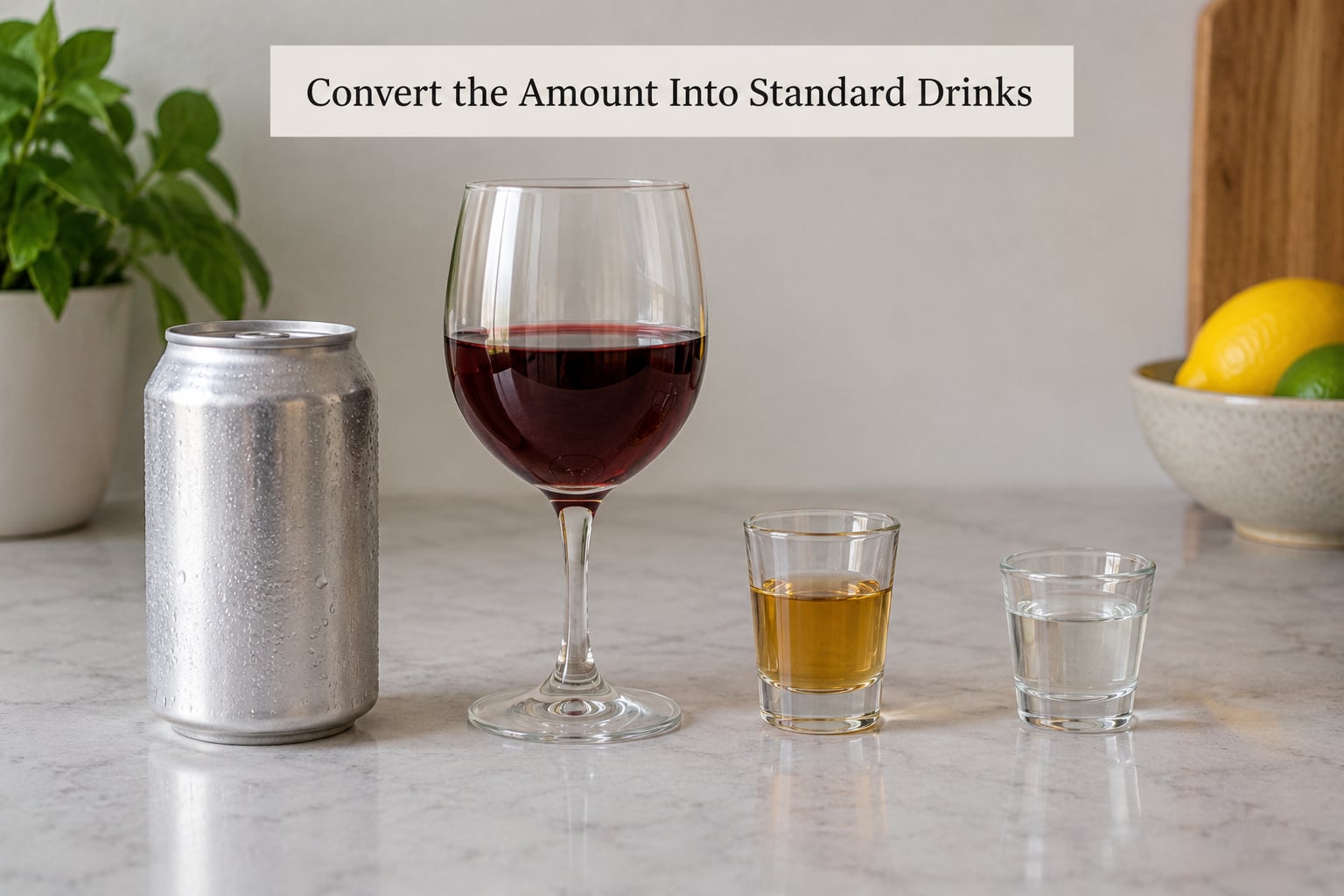
Divide the grams by 14 to get US standard drinks. Everything else follows from that one division.
Here is the beer table, which is where a typical night out usually goes wrong:
| Beer style (ABV) | 12 oz | 16 oz | 22 oz |
|---|---|---|---|
| Session beer 4% | 0.8 | 1.1 | 1.6 |
| Lager 5% | 1.0 | 1.4 | 1.9 |
| IPA 6.5% | 1.2 | 1.7 | 2.4 |
| Malt liquor 7% | 1.3 | 1.8 | 2.6 |
| Double IPA 8% | 1.5 | 2.1 | 3.0 |
| Imperial 10% | 1.8 | 2.6 | 3.7 |
| Barleywine 12% | 2.2 | 3.1 | 4.5 |
Read across the top row of a real night and the total climbs fast. Four 16 oz IPAs at 6.5% is 6.9 standard drinks, not four.
Cocktails need a different trick: count the liquors, then multiply. A single-spirit mixer with a 1.5 oz pour is one standard drink; the same drink at a 2 oz free pour is about 1.4. A rocks drink at 3 to 4 oz of 40% spirit is 2 to 2.7 standard drinks, and a 4 oz martini is closer to 2.7. Add a second spirit and you double the count.
Containers need the same treatment rather than a single “one bottle, one drink” rule:
| 750 mL wine bottle at | Grams of pure alcohol | US standard drinks |
|---|---|---|
| 11% ABV | 65 g | 4.7 |
| 12% ABV | 71 g | 5.1 |
| 13.5% ABV | 80 g | 5.7 |
| 15% ABV | 89 g | 6.3 |
Standard drink sizes also differ by country, and mixing the systems inflates or deflates counts by up to 75%:
| Country | Grams of pure alcohol | Named unit |
|---|---|---|
| United States | 14 g | Standard drink |
| Canada | 13.45 g | Standard drink |
| Australia | 10 g | Standard drink |
| United Kingdom | 8 g | Unit |
A UK unit is smaller than a US standard drink, so a bottle counted in UK units produces a larger-looking number. Use the number for the country whose guidance you are reading, and only that number.
Record Everything You Consume
Write each drink down the moment you finish it. Memory is the weakest link in the whole system, and a night with free pours and shared bottles is exactly the night where recall fails.
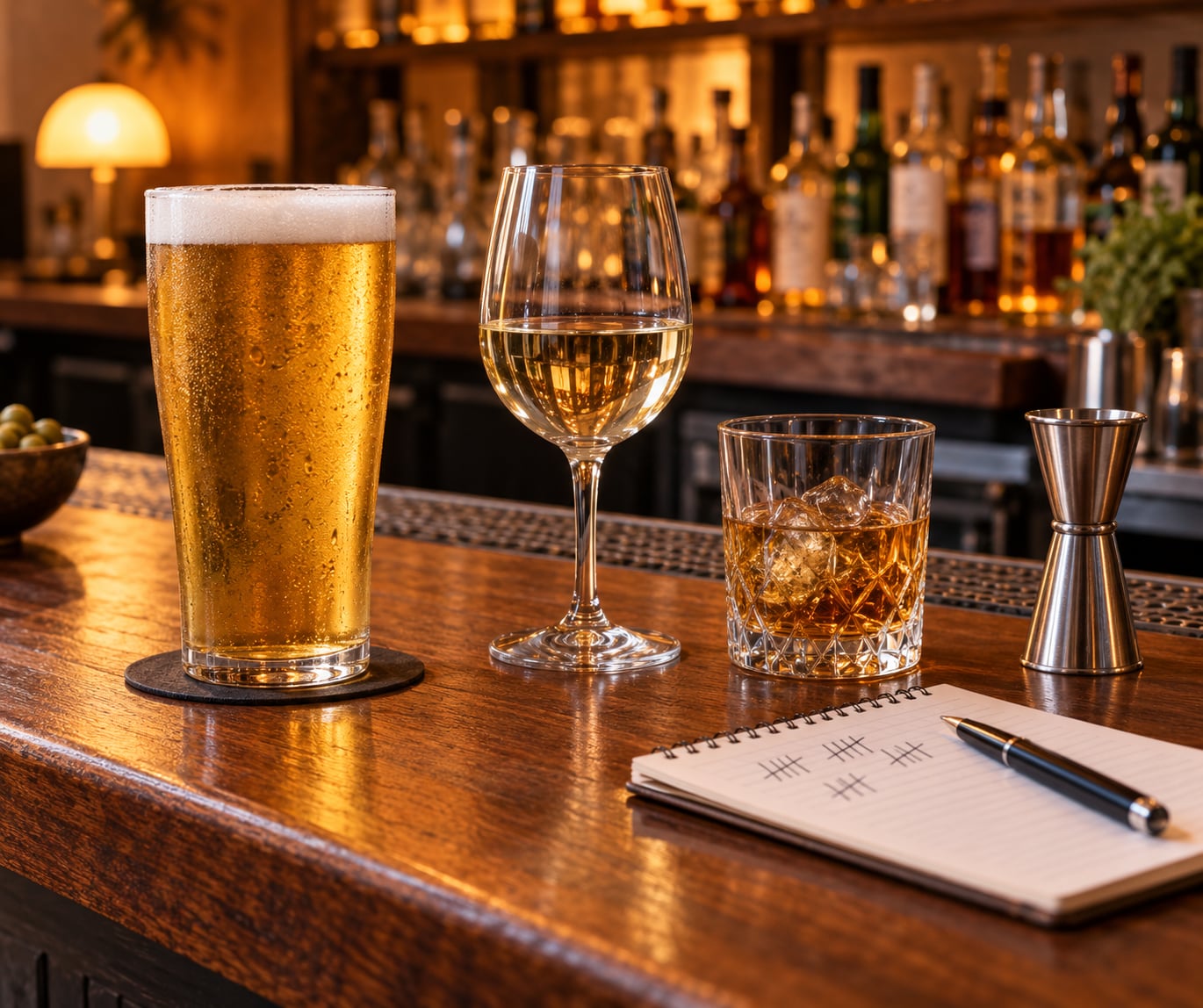
Bartenders on r/bartenders use counting systems on the other side of the bar, and the same tricks work for you. Count garnishes left on the counter, rotate a coaster to a new position per drink, or check the point-of-sale tab before you order the next round. A phone note with one line per drink, timestamped, takes five seconds and settles every argument later.
Log the parts that quietly add up. Tasting flights and brewery samplers count as full pours unless the pour is stated. A shared bottle needs splitting by how much each person actually drank. Refills and topped-up glasses are new alcohol, not saved alcohol.
Keep a running total in standard drinks, not glasses. At the end of the night, the number you want is the one you can defend.
Common Mistakes
Treat Large or Strong Drinks Carefully
The most common counting error is treating every drink as one. A 22 oz imperial IPA at 10% is 3.7 standard drinks in a single glass, and a martini at a generous pour is close to three.
Watch the bands specifically. Malt liquor at 7 to 9% counts faster than a lager even in the same volume. Fortified wine and spirits poured by the ounce scale fast. Cocktails with two liquors count double, and a 3 oz double shot of 40% spirit is exactly two standard drinks.
One r/Mixology user reported that six cocktails over six hours, one per hour, left them more affected than six beers or six shots would have. That gap is not a metabolism mystery. It is the arithmetic above, applied to drinks nobody measured.
Do Not Count a Bottle as One Drink
A bottle is a volume, and a standard drink is an amount of alcohol. Those are different quantities, and only the second one is the unit you want.
A 750 mL bottle at 12% holds 5.1 US standard drinks. At 15% it holds 6.3. A 22 oz bomber of 8% beer holds 3. So a four-pack of 16 oz IPAs at 6.5% is not four drinks; it is about 6.9 standard drinks before anyone at the table has taken a second.
When a bottle is shared, log the share rather than the bottle. A 750 mL red at 12% poured evenly between four people is about 1.3 standard drinks each, which is not the same as one drink each.
Read the Limits as Guidelines, Not Goals
Counting accurately is not a game. Current US guidance on low-risk drinking describes patterns well below the amounts many people consider a normal night, and those figures are not a target to work toward.
You will see the 1/2/3 pacing rule referenced widely: no more than one standard drink in the first hour, two in the second, and one in each hour after that. The widely cited threshold question of four standard drinks in two hours is well above low-risk guidance, and the 0.08% blood alcohol concentration mark used in impaired-driving law corresponds to roughly four standard drinks for many men within a short window.
Rates vary widely with body weight, food, pace and individual metabolism, and only a clinician can tell you what any of it means for you. If drinking is becoming hard to control, cutting back, or a concern, that is a conversation worth having with a doctor.
Frequently Asked Questions
How many standard drinks are in a 12-ounce beer?
A 12-ounce beer at 5% ABV is exactly one US standard drink: 355 mL multiplied by 0.05 gives 17.75 mL of ethanol, which is 14 grams after the 0.789 density factor. The 12-ounce size is the reference only because of that percentage. The same 12 ounces at 6.5% is 1.2 standard drinks, and at 10% it is 1.8. Always pair the volume with the ABV printed on the can.
How do I count a craft beer with a higher ABV?
Use grams divided by 14, or the shortcut of ounces multiplied by ABV to check your work. A 16-ounce IPA at 6.5% works out to 24.3 grams, or 1.7 standard drinks. A 22-ounce bomber at 8% is 3.0, and a 12-ounce imperial pour at 12% is 2.2. If the tap list does not show an ABV, ask the bartender for the beer rather than the style.
Are wine and cocktails measured differently from beer?
The formula is identical; only the reference serving differs. Wine is measured at 5 ounces and 12% for one standard drink, so a generous 8-ounce restaurant pour at 13% runs to about 1.9. Cocktails vary more because bartenders free-pour. Mixers at 1.5 to 2 oz of 40% spirit are one to 1.4 standard drinks, rocks glasses at 3 to 4 ounces are two to nearly three, and any drink with two liquors doubles the count.
How should I count a shared bottle or a drink poured by a friend?
Count the alcohol you personally consumed, not the container. A 750 mL bottle at 12% holds 5.1 US standard drinks, so an even split between four people is about 1.3 each. If someone pours for you, estimate the volume in your glass and use its ABV, the same as any other pour. Free pours are wider than measured ones, so round up when you are unsure.
What if a restaurant or bar does not list the alcohol percentage?
Ask the bartender directly; knowing the ABV is a normal question and a good one. If nobody knows, use the closest published figure for that style, and for cocktails assume a standard mixer pour of 1.5 to 2 ounces of 40% spirit, which is one to 1.4 standard drinks. Request the drink in a measured pour or with a jigger if you want a number you can rely on.
How do I count standard drinks correctly across a night out?
Log each drink as you finish it, converting volume and ABV into standard drinks immediately, then keep a running total. Use a tally mark, a rotated coaster, or a timestamped phone note, and check the bar tab before your last round. Include tasting pours, refills and shared bottles in the total. Counting glasses instead of alcohol is the mistake that turns a moderate night into a heavier one than you meant.
Start with the 14-gram reference and one formula: volume in mL, times ABV as a decimal, times 0.789, divided by 14. Everything else, from a 22 oz bomber to a martini to a shared bottle of wine, falls out of that line.
Find the ABV before the first pour and write each drink down as you finish it. A total you can defend is the only one worth having at the end of a bar crawl.