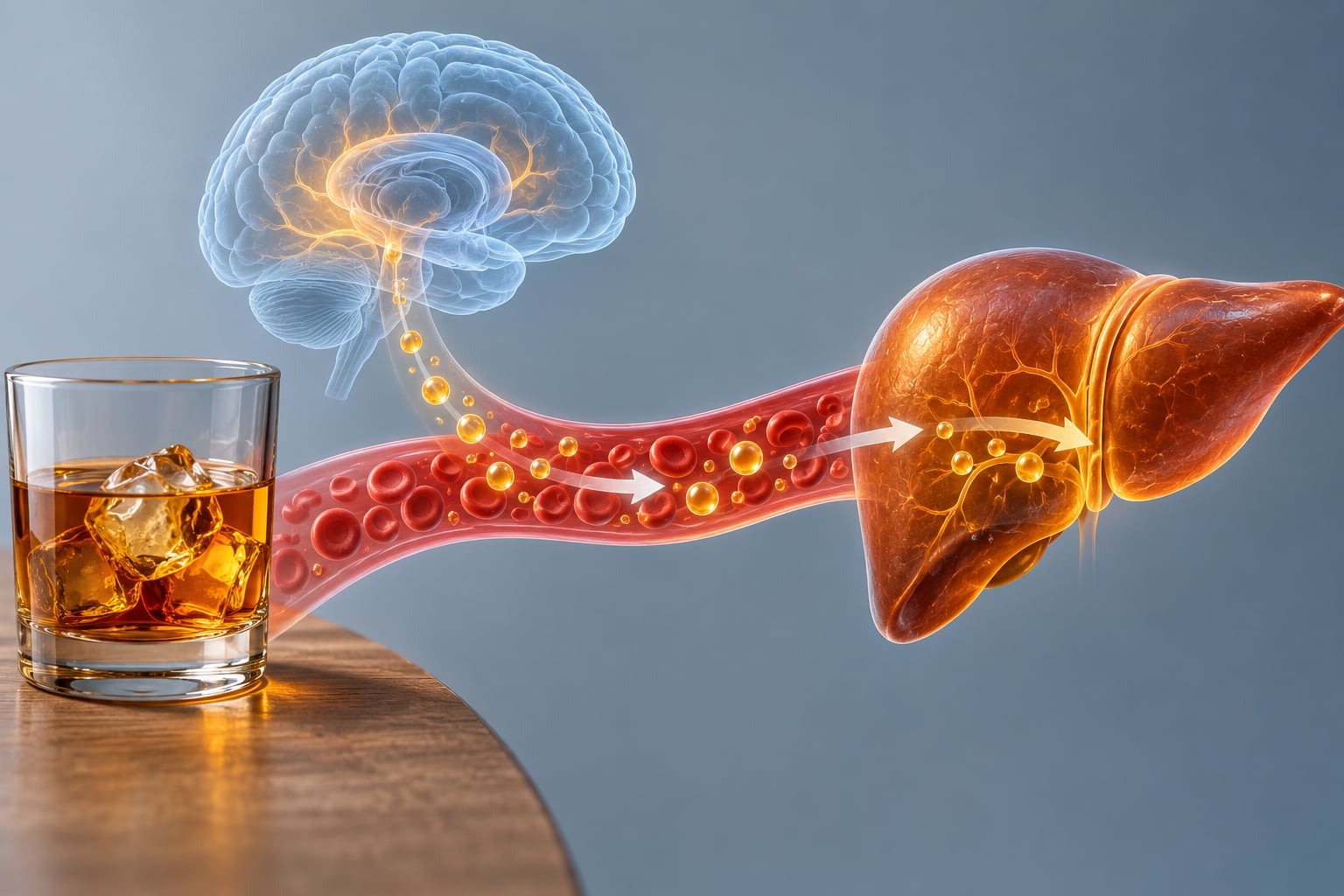
If you have ever needed more drinks to get the same feeling you used to get from two, that is tolerance. Here is how alcohol tolerance actually works in plain language: your liver gets more efficient at clearing alcohol out of your blood, and your brain adapts to the suppression alcohol causes, so the same drink produces a weaker buzz and weaker impairment.
That second half is the dangerous part. Tolerance changes what you feel. It does not change how much alcohol is in your blood, how fast your reaction time slows, or how much alcohol it takes to impair your driving. A high-tolerance drinker can reach a blood alcohol concentration that would knock most people out while looking only mildly buzzed.
The short version:
- Tolerance is a brain and liver response, not a personality trait. Repeated exposure changes receptor sensitivity and enzyme activity.
- Feeling less drunk is not the same as being less impaired. Judgement, reaction time and coordination still deteriorate with blood alcohol concentration.
- Metabolism barely shifts. Liver enzymes become somewhat more efficient, but your blood alcohol level for a given amount of alcohol changes far less than people assume.
- It comes in three flavours: functional, metabolic and behavioural.
- Stopping drinking restores sensitivity over weeks, not days, and the rebound can feel unpleasant and slightly frightening.
Table of Contents
- What Is Alcohol Tolerance?
- The three types of alcohol tolerance
- How Alcohol Tolerance Actually Works
- Step one: absorption puts alcohol straight into your blood
- Step two: two enzymes do all the work
- Step three: your brain rewires its receptors
- Step four: your brain stops telling you that you are impaired
- Why Your Response to Alcohol Can Change
- What Happens to Your Brain and Nervous System
- How Tolerance Differs From Dependence and Withdrawal
- Withdrawal, and when it becomes an emergency
- Can You Lower Alcohol Tolerance?
- Why Tolerance Can Make Drinking Riskier
- Frequently Asked Questions
- Do you actually build a tolerance to alcohol?
- How long does it take to build alcohol tolerance?
- Does alcohol tolerance make you metabolize alcohol faster?
- What is the difference between tolerance and dependence?
- Why do I get drunk faster now that I have stopped drinking?
- What is the 1/2/3 rule for alcohol?
- Conclusion: Treat Alcohol Tolerance as a Risk Signal
What Is Alcohol Tolerance?
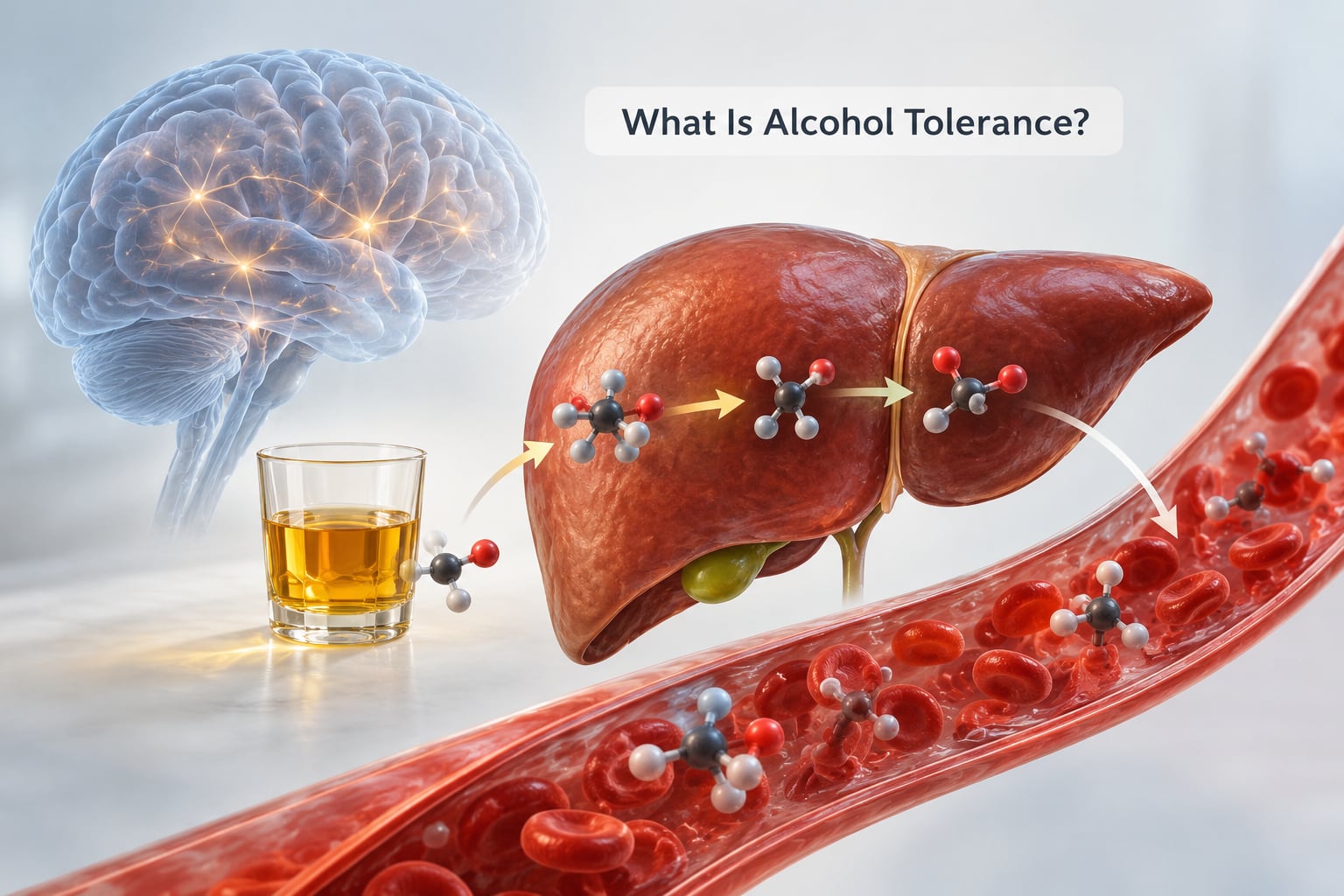
Alcohol tolerance is a reduced response to a given dose of alcohol after repeated exposure. Formally, it means you need more alcohol, or a higher concentration in your blood, to produce the same impairment and feeling you once got from much less.
It is worth being precise about what tolerance is not. Tolerance is not how much you drink, it is how you respond to what you drink. It is not your blood alcohol concentration, which is a measurement of the alcohol actually in your blood. It is not sobriety, because a person with high tolerance can be severely intoxicated while still talking normally and walking straight.
Three words get mixed up constantly, so keep them apart. Intoxication is the buzz and the subjective high. Impairment is the measurable damage to attention, reaction time, coordination and judgement. Dependence is a clinical state involving withdrawal and craving. Tolerance touches the first two and says nothing on its own about the third, which is why tolerance is treated as a warning sign rather than a diagnosis.
The three types of alcohol tolerance
Behavioural researchers split tolerance into three categories because they move on different clocks and behave differently under stress.
| Type | What actually changes | Typical timeframe | What it looks like |
|---|---|---|---|
| Functional tolerance | The brain’s response to alcohol at a given concentration | Minutes to weeks | You need several drinks to feel the same effect you once got from one |
| Metabolic tolerance | How efficiently liver enzymes clear alcohol and acetaldehyde | Days to weeks of frequent drinking | Alcohol leaves your system somewhat faster and you sober up more quickly |
| Behavioural or environmental tolerance | Your learned compensation and the cues around drinking | Years | You unconsciously pace, choose smaller pours, or drink differently in familiar settings |
Functional tolerance is the one everybody means when they say tolerance, and it is the most studied. Metabolic tolerance is real but small, which matters because it is widely overstated. Behavioural tolerance is the least visible and the most dangerous, because a practised drinker can look completely normal while carrying a blood alcohol concentration that would hospitalise a friend.
Two related labels show up in the research. Acute tolerance describes a reduction in effect within a single drinking session, which does occur and is well documented in laboratory studies. Cross-tolerance means tolerance to one central nervous system depressant partly transfers to another, which matters because it applies to sedatives, benzodiazepines, sleeping tablets and opioids.
How Alcohol Tolerance Actually Works
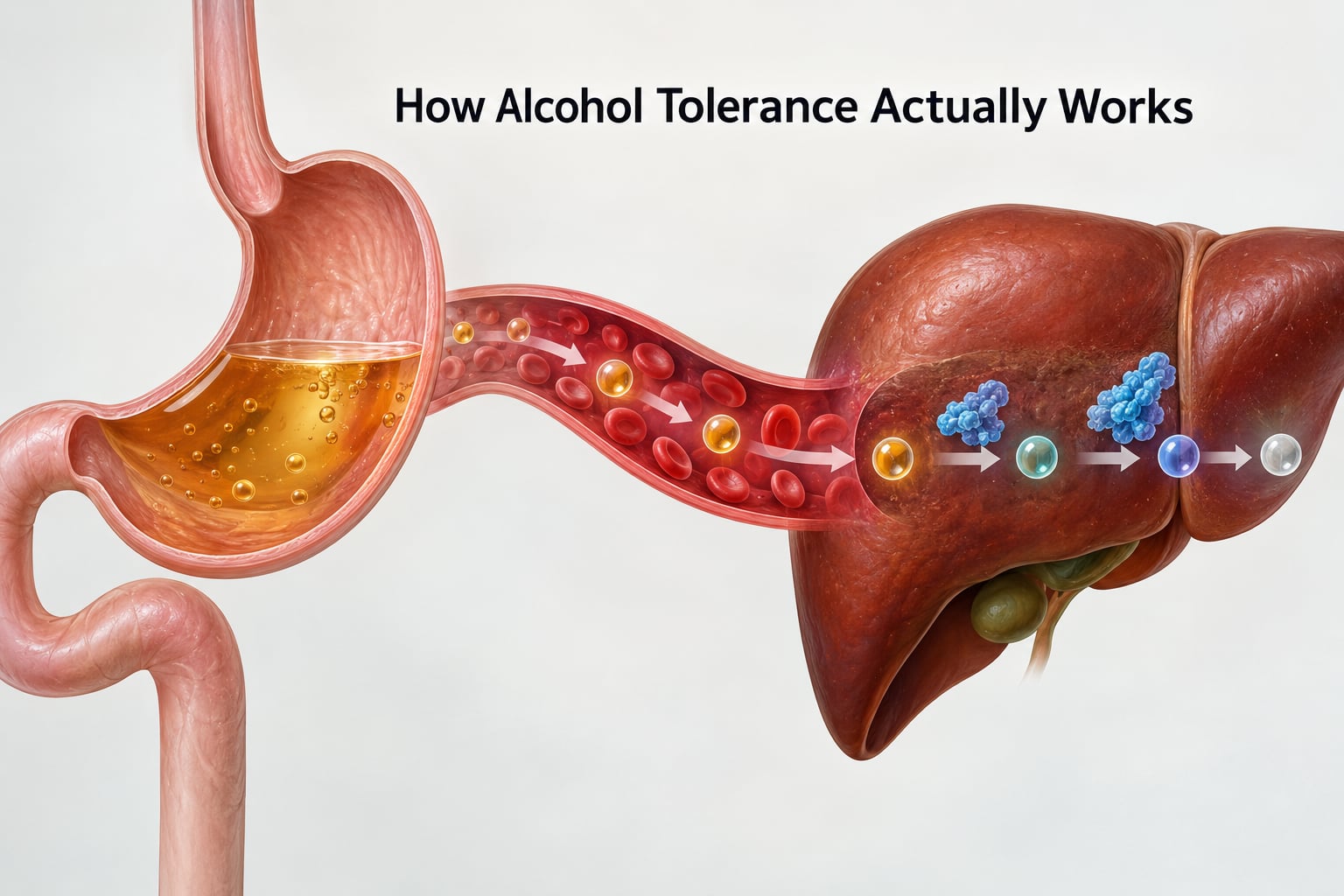
How alcohol tolerance actually works comes down to two parallel systems doing the same job from opposite ends: the liver clears alcohol out of your blood, while the brain compensates for the suppression alcohol causes. Neither one makes you sober. Both of them make you feel less affected while the alcohol keeps working.
Step one: absorption puts alcohol straight into your blood
Alcohol is a small molecule that does not need to be digested. If your stomach is empty, it passes straight through into the bloodstream, and a meaningful share of it is absorbed from the upper small intestine. Everything that speeds up absorption, such as drinking on an empty stomach or drinking quickly, raises your blood alcohol concentration faster. Nothing about tolerance changes this part.
Step two: two enzymes do all the work
Once alcohol is in the blood, the liver runs a two-step conversion. Alcohol dehydrogenase converts ethanol into acetaldehyde. Acetaldehyde dehydrogenase then converts acetaldehyde into acetate, which the body treats roughly like a mild acid and eventually turns into water and carbon dioxide.
That middle step explains a lot. Acetaldehyde is a reactive molecule that produces flushing, nausea and much of what people call a hangover, and East Asian populations who carry a less active ALDH2 variant often flush after very small amounts precisely because acetaldehyde accumulates.
Repeated heavy drinking nudges both enzymes toward greater activity, so alcohol clears somewhat faster. This is metabolic tolerance, and the effect is real but modest. It is nowhere near enough to make a large quantity of alcohol safe, and it does not change the rate at which alcohol reaches your brain in the first hour of a night out.
Step three: your brain rewires its receptors
Alcohol is a central nervous system depressant, and it works by pushing existing neurotransmitter systems off balance. It increases the effect of GABA-A, the main inhibitory receptor in the brain, which is why alcohol feels sedating and why it is dangerous alongside other sedatives. At the same time it blocks NMDA, a glutamate receptor that handles learning, memory and excitability.
Your brain does not like being held in that state, so it adapts. Over repeated exposure it down-regulates GABA-A signalling and up-regulates NMDA signalling, a process researchers call neuroadaptation or down-regulation. The system gradually returns toward its baseline, which is why the same concentration of alcohol now feels milder. A peer-reviewed review on large-conductance calcium-activated potassium channels, the so-called BK channels, describes this compensation as a central mechanism driving tolerance.
The compensation is real and it is also incomplete. Your brain never fully compensates for every effect at once, which is exactly why a high-tolerance drinker can be calm, talkative and coordinated while their attention and decision-making have deteriorated sharply.
Step four: your brain stops telling you that you are impaired
Early on, alcohol interferes with the internal feedback that tells a person they are drunk, producing the clumsy stumble and the garbled speech people recognise. With functional tolerance, that feedback weakens. The signals that would normally make you stop drinking get quieter, so the drink count rises without any decision being consciously made.
Why Your Response to Alcohol Can Change
Your response to alcohol changes for reasons that have nothing to do with tolerance, which is why two people drinking the same drinks on the same night can end up in very different places. Sorting these factors out is the difference between an honest read of your response and a flattering one.
- Body mass and body composition. Alcohol distributes into total body water, so a smaller person reaches a higher blood alcohol concentration from the same drink count.
- Genetics. Variants in ADH1B and ALDH2 change how fast ethanol becomes acetaldehyde and how fast acetaldehyde clears. People who flush usually clear acetaldehyde slowly and often feel effects sooner, not later.
- Sex. Average body composition and enzyme activity differ, so women and men drinking identical drinks do not reach identical concentrations.
- Age. Older adults typically have less total body water and less lean mass, so the same drink does more. Liver function and medication use also change.
- Food. Food slows gastric emptying, so a drink taken with a meal rises more slowly than one taken on an empty stomach.
- Drinking rate. Spacing drinks out keeps the liver able to clear alcohol as it arrives, rather than piling up faster than it can process.
- Sleep and hydration. A night of poor sleep leaves you more sensitive to alcohol’s sedating effect even when your tolerance has not changed.
- Medications. Some drugs accelerate metabolism, others slow it, and combining alcohol with sedatives is genuinely dangerous rather than merely inadvisable.
- Liver health. Liver disease slows alcohol clearance and, for heavy drinkers, makes accumulation more likely at lower amounts.
- Setting and pace. Behavioural tolerance means a familiar bar, a familiar group and a familiar drink routine can quietly change how much you consume.
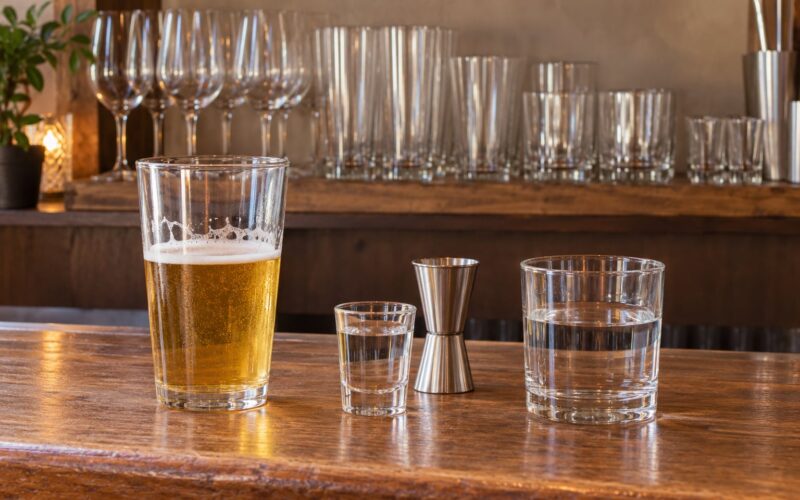
A few standard reference points make those factors concrete. In the United States a standard drink is 14 grams of pure alcohol, roughly 12 ounces of 5 percent beer, 5 ounces of 7 percent wine or 1.5 ounces of 40 percent spirits. The CDC defines binge drinking as four or more drinks for women and five or more for men in about two hours, and heavy drinking as eight or more drinks per week for women and fifteen or more for men.
| Reference | Definition | Why it matters |
|---|---|---|
| Standard drink | 14 grams of pure alcohol | Pours vary wildly, so a large glass of wine can be three standard drinks |
| Binge drinking | Four or more drinks (women) or five or more (men) in about two hours | Blood alcohol rises faster than the liver can clear it |
| Heavy drinking | Eight or more drinks weekly for women, fifteen or more for men | The level associated with sharply increased health risk and AUD likelihood |
| Legal driving limit | 0.08 percent blood alcohol in most US states | Impairment is reliably measurable well below this number |
What Happens to Your Brain and Nervous System
Alcohol slows the brain by suppressing signalling, and tolerance changes the dose needed to do it without restoring normal function underneath. Reaction time, attention and coordination get worse as blood alcohol concentration rises, regardless of whether the drinker feels anything unusual.
The specific effects worth naming are attention narrowing, where you notice less of the room and less of the conversation; slowed reaction time, which shows up badly in driving but also in cooking, stairs and crossing a street; impaired judgement, which is where decisions like one more round or one more shot get made; memory gaps, because alcohol disrupts the NMDA-driven consolidation of new memories, which is why a blackout usually starts with missing minutes rather than lost hours; and disrupted sleep, since alcohol shortens time to sleep onset but fragments the second half of the night.
There is a documented asymmetry here that rarely gets explained. Functional tolerance tends to develop most strongly for the effects people seek out, such as the euphoric relaxation and the reduction of social inhibition. Tolerance for the effects people would prefer to avoid, such as slurred speech, clumsiness and next-day nausea, tends to be weaker.
The result is a person who feels sharper and more in control while being measurably less safe. That is the mechanism behind nearly every alcohol-related accident involving a high-tolerance drinker, and it is also why a drink that does not make you feel drunk can still leave you unfit to drive.
How Tolerance Differs From Dependence and Withdrawal
Tolerance, physical dependence and alcohol use disorder are three different things that often appear together, and confusing them leads to bad decisions in both directions. People either panic about a high tolerance that carries no other features, or dismiss withdrawal symptoms because they assume they are just tired.
| Feature | Tolerance | Physical dependence | Alcohol use disorder |
|---|---|---|---|
| Core feature | Reduced response, so more is needed for the same effect | The body adapts and needs alcohol to avoid withdrawal | A diagnosed condition with impaired control and continued use despite harm |
| Diagnostic status | Not a diagnosis on its own | Not a diagnosis on its own | DSM-5-TR diagnosis based on a pattern of symptoms |
| Symptom example | Two drinks no longer do much | Shaking, sweating and anxiety when you stop | Craving, failed attempts to cut down, using despite problems |
| What happens if you stop | Nothing unusual; sensitivity returns | Withdrawal, sometimes severe | Withdrawal plus the behavioural pattern described in the criteria |
The DSM-5-TR criteria for alcohol use disorder count two or more symptoms within a year for a mild diagnosis and eleven or more for severe. Tolerance and withdrawal count as two of those symptoms only when they occur in the context of problematic use that the clinician would recognise as excessive. Tolerance by itself in a healthy drinker is not a disorder, and a doctor assessing this will ask about control, consequences and craving rather than drink count.
Withdrawal, and when it becomes an emergency
Mild withdrawal usually starts within six to 24 hours of the last drink and includes shaking, sweating, nausea, headache, anxiety, poor sleep and restlessness. It typically eases over a few days. Alcohol is one of the few substances where withdrawal can be medically serious, and seizures and delirium tremens are the two complications that require urgent care.
Call emergency services if someone who has been drinking heavily cannot be woken, is breathing slowly or irregularly, has a seizure, is vomiting without becoming more awake, or has a pulse that is slow or very fast. Do not let them lie down on their side alone, and do not assume they will sleep it off. In the United States the SAMHSA National Helpline is 1-800-662-4357, and NIAAA publishes free information on treatment and on recognising a problem.
Can You Lower Alcohol Tolerance?
You can lower alcohol tolerance, but only by giving the brain and liver enough time without alcohol, and no shortcut works. A standard drink taken every few days does not reset anything; functional tolerance shifts most noticeably after weeks of not drinking, and months is a more realistic horizon for meaningful change.
What happens during a break is worth describing, because it surprises people. Within days, functional tolerance fades and your old low-tolerance response returns. Within a few weeks, some metabolic enzyme activity normalises. For a week or two after stopping, many people feel unsettled, unusually sensitive to alcohol, and a little low or anxious, which is a mild withdrawal pattern rather than a return of the old self. People in their fifties often describe the same experience without taking a deliberate break at all: one drink at a friend’s gathering leaves them noticeably lightheaded and tired, and there is no obvious explanation for it.
Resetting tolerance is not something to attempt as a challenge, and cutting down for a week to drink the same amount is not a neutral move, because your tolerance is lower than your habits assume. Nor is it a treatment. Reducing tolerance while continuing to drink at the same rate simply pushes the same number of drinks into a more impaired body, which is why any attempt to change your drinking pattern is best discussed with a doctor or a counsellor.
Get individual advice if you have liver or kidney disease, take regular medication, are pregnant, are over 65, or have a history of withdrawal. Those are situations where the safe amount may be none, and where a pharmacist or clinician can check interactions properly.
Why Tolerance Can Make Drinking Riskier
Tolerance makes drinking riskier because it disconnects the feeling of impairment from the fact of impairment. Your internal warning system becomes the least reliable safety instrument you own, and the people around you depend on that same system too.
The clearest way to see it is to separate what changes from what does not.
| What tolerance changes | What tolerance does not change |
|---|---|
| How strongly you feel the buzz and sedation | How much alcohol is in your blood |
| How much you need to feel relaxed or sociable | How much alcohol impairs attention and reaction time |
| How quickly you sober up, to a modest degree | Whether you are safe to drive or operate anything |
| How obvious your intoxication looks to others | The dose needed for overdose or poisoning |
| How confidently you read your own state | Whether mixing with sedatives or opioids is dangerous |
That fourth row on each side is the trap. Because tolerance suppresses the visible signs, the person most likely to reach a dangerous blood alcohol concentration is the one nobody checks on, and the friend who should have stepped in has no signal to act on.
Four risks follow from that. First, overestimating capacity, since you are calibrating to a feeling that no longer reflects your blood alcohol concentration. Second, driving, where a calm, chatty driver who feels fine is a well-documented cause of fatal crashes. Third, blackouts, because memory formation is impaired by concentration rather than by how drunk you feel, and a person with high tolerance can black out at a level that would only make a low-tolerance drinker sleepy. Fourth, cross-tolerance and interactions: because alcohol shares its depressant effects with benzodiazepines, sleeping tablets and opioids, tolerance to alcohol can partly mask how much of another sedative you have taken, which is a recognised problem in clinical practice.
A few practical habits reduce risk on a night out without pretending they make large amounts safe. Eat before you start and while you are drinking. Space drinks out and keep track of how long the first one landed. Alternate with water. Watch the pour rather than the glass, since a large wine can be three standard drinks. Agree a plan with whoever is not drinking, and treat that plan as binding rather than negotiable once the evening gets going.
Frequently Asked Questions
Do you actually build a tolerance to alcohol?
Yes. Alcohol tolerance is well documented in laboratory and clinical studies. Functional tolerance can appear within a single drinking session, and repeated drinking over days to weeks raises the threshold needed for the same effect. It is a genuine adaptation of brain receptors and liver enzymes rather than a matter of willpower or mindset.
How long does it take to build alcohol tolerance?
Acute tolerance can develop within minutes of your first drink of a session. Meaningful functional tolerance usually takes days to weeks of frequent drinking, and behavioural tolerance builds over years because it depends on learned routines and setting. The reverse takes about as long: sensitivity returns within days, and fuller normalisation takes several weeks to months.
Does alcohol tolerance make you metabolize alcohol faster?
Only slightly. Liver enzymes do become more efficient with repeated exposure, so alcohol clears somewhat faster, but the change is modest and it does not apply to the first hour of drinking. Your blood alcohol concentration for a given number of drinks stays roughly the same, which is why tolerance does not make larger amounts of alcohol safe.
What is the difference between tolerance and dependence?
Tolerance means you need more alcohol for the same effect. Physical dependence means your body has adapted so that stopping causes withdrawal symptoms such as shaking, sweating, anxiety and insomnia. Tolerance can exist without dependence. Withdrawal can be severe and needs medical support, so anyone unsure should speak to a doctor rather than stopping suddenly on their own.
Why do I get drunk faster now that I have stopped drinking?
Your tolerance has fallen, which is the expected result of not drinking. As brain receptor sensitivity returns to its baseline, a smaller amount of alcohol produces a larger effect than it did during your heavier drinking period. The heightened response usually settles after a few weeks. Going back to your old amount immediately is a common and avoidable way to end up far more impaired than expected.
What is the 1/2/3 rule for alcohol?
It is an informal pacing guideline rather than a medical standard: roughly one drink in the first hour, two in the second and three in the third, intended to slow the rate at which alcohol enters your blood. It does not describe tolerance and it does not set a safe limit. The CDC binge threshold of four drinks for women and five for men within about two hours remains the better reference point.
Conclusion: Treat Alcohol Tolerance as a Risk Signal
How alcohol tolerance actually works is simpler than the reputation suggests: your liver clears alcohol a little faster and your brain compensates for the suppression it causes, so the same drink feels weaker while doing the same damage. The practical rule follows directly. Stop using how you feel as a measure of how impaired you are, because it stops working on exactly the people who most need it to work.
If you are heading out, decide the ride before you leave, eat before your first drink, count standard drinks rather than glasses, and check in with the person who is not drinking. If drinking has started needing more than it used to, or stopping brings shaking or anxiety, treat that as a medical question rather than a personal test. Talk to a doctor, and in the US the SAMHSA National Helpline at 1-800-662-4357 is free and confidential.