Breweries make non-alcoholic beer by brewing a normal beer and then taking the alcohol back out, or by controlling fermentation so alcohol never forms in the first place. The short version: it starts with wort, it goes through the same mash, boil and ferment steps as any other beer, and then a dealcoholization step or a special yeast handles the difference at the end.
Which route a brewery picks changes almost everything you taste. Beer brewed at full strength and then vacuum-stripped tends to keep its malt character but can lose hop aroma. Beer fermented with a low-alcohol yeast keeps more of the aromatic profile but is much harder to run consistently, batch after batch.
Most craft breweries started with the second approach, borrowed from the brewing industry in places like Japan and Germany where non-alcoholic beer has been a staple for decades. Large multinationals like Heineken and Corona use dealcoholization on beer brewed in normal breweries at normal strength. Both routes produce something that started life as real beer.
If you want the short version of the whole chain, here it is:
- Brew a full-strength beer exactly as you normally would
- Ferment it to completion, or stop fermentation deliberately partway through
- Remove the alcohol under vacuum, through a membrane, or never create it
- Adjust the finished beer with hops, malt character or blending to put back what processing stripped out
- Stabilize, package and label the finished beer with its alcohol percentage
Table of Contents
- What Process Do Breweries Use to Make Non-Alcoholic Beer?
- How Breweries Make Non Alcoholic Beer: The Core Methods
- What Ingredients Are Used in Non-Alcoholic Beer?
- How Does the Brewing and Fermentation Stage Work?
- How Is Alcohol Removed from Beer?
- How Do Breweries Preserve the Flavor of Beer Without Alcohol?
- Do Breweries Make Non-Alcoholic Beer From Scratch?
- What Quality Checks Come After Dealcoholization?
- How Is Non-Alcoholic Beer Labeled?
- Frequently Asked Questions
- Is non-alcoholic beer made from real beer?
- Can non-alcoholic beer be brewed without going through fermentation?
- How do breweries keep non-alcoholic beer tasting like regular beer?
- What does 0.0% beer mean, and can it contain alcohol?
- Are non-alcoholic beers healthier than alcoholic beer?
- Why do some non-alcoholic beers taste different from alcoholic versions?
- Conclusion
What Process Do Breweries Use to Make Non-Alcoholic Beer?
There are three production routes, and they differ in where the alcohol problem gets solved. The table below is the fastest way to see how breweries make non-alcoholic beer.
| Method | How it works | Where the alcohol goes | Equipment scale |
|---|---|---|---|
| Brew and dealcoholize | Beer is brewed to full strength, then stripped of alcohol | Physically removed after fermentation | Industrial, needs capital investment |
| Controlled or arrested fermentation | Fermentation is stopped early or run with yeast that makes little alcohol | Never fully produced | Standard brewery, sometimes a special fermenter |
| Bypass alcohol production | Beer-like drinks made from malt extract or hop water with no fermentation step | Absent by design | Beverage plant rather than a brewery |
How Breweries Make Non Alcoholic Beer: The Core Methods
Brewing and dealcoholizing is the classic industrial route. A brewery makes a strong, hoppy beer, then it travels through a vacuum column or a spinning cone column where pressure is lowered and temperature is raised just enough to boil off the alcohol. What comes out the other side is the same beer with less alcohol in it.
Reverse osmosis is the other industrial route. Beer is pushed against a semi-permeable membrane that water and alcohol pass through while larger flavor molecules mostly stay behind. The permeate is a fraction of the original volume, so it has to be blended back in or used to dilute the retained beer.
Arrested fermentation covers a lot of ground. The brewer chills the wort before it reaches pitching temperature, uses a highly attenuative yeast strain and cuts the process short, then relies on an unusual yeast that leaves maltotriose unfermented so the yeast runs out of food before it runs out of patience. Some versions use a cold contact ferment that never really starts.
Scale is the deciding factor. A regional craft brewery almost never owns a vacuum still, which is the most expensive machine on this list by a wide margin. What they do instead is partner with a contract brewery or a mobile dealcoholization operator, ship full-strength beer in tankers, and get back finished non-alcoholic product. Big breweries that already brew millions of cases have the volume to justify owning the equipment.
That answers the question readers usually have first. When a craft brewery tells you its non-alcoholic beer is dealcoholized, the beer was brewed somewhere else, at full strength, and shipped out for processing.
What Ingredients Are Used in Non-Alcoholic Beer?
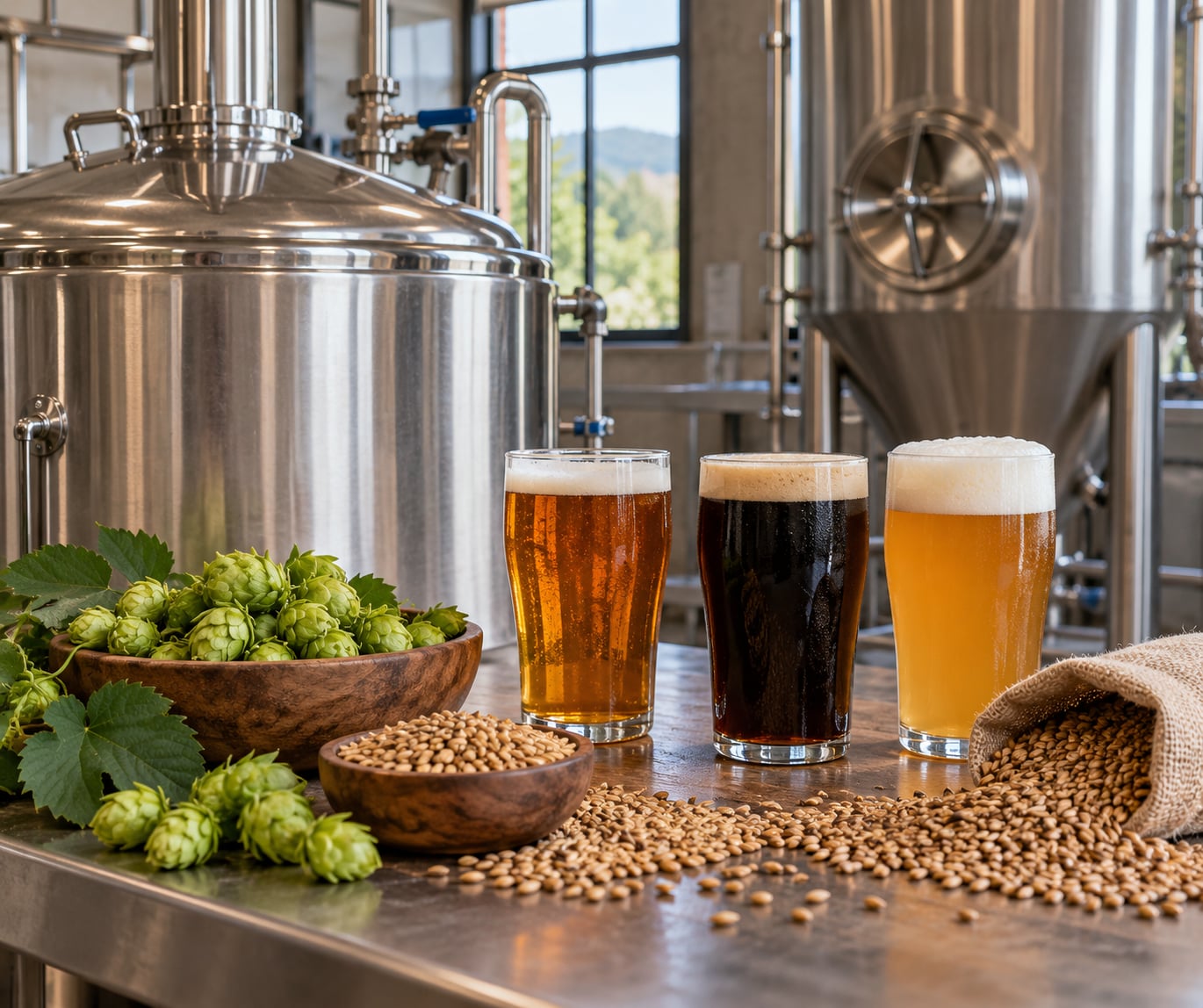
A brewery that makes genuine beer uses the same four ingredients it uses for every other beer. If a product lacks hops or lacks malt, it is not beer under most labeling rules, no matter how beer-shaped it tastes.
- Water makes up the bulk of the volume and carries the mineral profile that shapes malt and hop perception. Adjustment happens before brewing, not after.
- Malted grain supplies fermentable sugar, color, body and the bready, biscuity, caramel notes. Barley malt gives the classic base; wheat, rye and specialty malts change the character.
- Hops provide bitterness, aroma and a share of the flavor compounds people chase. Dry hopping matters more here than in regular brewing, for reasons covered below.
- Yeast ferments sugar into alcohol and carbon dioxide, and leaves behind esters, phenols and higher alcohols. In non-alcoholic brewing those aromatics matter enormously, because they are a bigger share of what remains.
- Processing aids such as stabilizers like potassium sorbate or potassium metabisulfite, and often added sugar or invert sugar for body and roundness.
Think about it as a job description. Water carries. Malt gives body, color and fermentable sugar. Hops give bitterness and aroma. Yeast gives fermentation character and, in a dealcoholized beer, very little else, because the alcohol that yeast produced gets stripped out later.
How Does the Brewing and Fermentation Stage Work?
The first half of how breweries make non-alcoholic beer is completely standard. A brewer mills the malt, mashes it in hot water to convert starches into sugar, lauters to separate the sweet wort from the spent grain, boils the wort with hops, then chills it fast.
Mashing sets up more than fermentability. Temperature choice changes how much body ends up in the beer, and for non-alcoholic brewing that matters more than usual, because body is exactly what alcohol removal tends to strip away.
Boiling does three jobs at once: it sterilizes the wort, it extracts bitterness from hops added at the start of the boil, and it drives off unwanted volatiles. Aroma hops go in late or after the boil, and a brewery planning to dealcoholize has to be careful here, since the same heat and pressure used for stripping alcohol is exactly what strips delicate hop aroma.
Cooling follows immediately, usually on a plate-and-frame heat exchanger or a glycol chiller. Then fermentation. A brewer who wants full-strength beer to dealcoholize runs a normal fermentation to completion and gets a finished alcoholic beer first.
A brewer who wants to prevent alcohol changes the ferment. Cold contact fermentation chills the wort to just above freezing, adds yeast, and lets it sit for days at temperatures too low for meaningful conversion. Limited fermentation uses a maltose-negative or maltotriose-negative yeast that will not touch the complex sugars that make up most of a typical wort.
Either way, the liquid leaving the fermenter is beer. It has color, carbonation, hop bitterness, malt flavor and yeast-derived aromatics. What differs is how much ethanol is dissolved in it.
How Is Alcohol Removed from Beer?
Alcohol and water behave differently under reduced pressure. Water boils at 212 degrees Fahrenheit at sea level and ethanol boils at about 173. Lower the pressure and both boiling points drop, with ethanol dropping faster. That gap is the whole basis of dealcoholization.
Vacuum distillation is the most common industrial method. Full-strength beer enters a column held under partial vacuum, and gentle heat plus the low pressure boils off the ethanol. Vapors rise, condense on a cold surface, and run off as a byproduct. Beer flows out the other end at roughly 0.5% ABV or lower.
Spinning cone columns are the elegant version. Beer flows across a spinning conical surface inside a vacuum chamber, and as a thin film it evaporates very efficiently. The device is expensive, but it processes a lot of liquid per hour and several breweries rent or lease them rather than buy one.
Reverse osmosis uses a membrane instead of heat. Pressure forces water and alcohol through a semi-permeable membrane while most flavor compounds stay on the retained side. The permeate is very low in flavor, so a brewery either blends it back into the concentrated beer or adds it to a second batch as dilution water.
Neither route is free. Heat-based stripping takes volatile aroma compounds along with the ethanol, which is why dealcoholized beer can smell flatter than the same beer at 5% ABV. Membrane processing takes less heat but strips or redistributes some esters and phenolics. Dealcoholized beer also gets waterier, since removing ethanol by volume without replacing body leaves a thinner drink.
How Do Breweries Preserve the Flavor of Beer Without Alcohol?
Getting a beer to taste right below 0.5% ABV is the hard part, because ethanol contributes to body, warmth and carry on the palate. Remove it and the beer needs help in three places.
Hop selection and timing. Bittering hops survive dealcoholization reasonably well. Aroma does not, so breweries loading a non-alcoholic beer will use far more late-hopping than they would in an alcoholic version, and some will dry hop after processing or add hop oil at packaging.
Malt profile and specialty malts. A base of pale malt produces a thin result. Breweries lean on crystal malt, roasted malts and other specialty malts for caramel, toast and darker notes that survive heat better than delicate grain flavors.
Fermentation temperature and yeast choice. Cooler fermentations create fewer esters, which can taste green or raw in a beer that will not age. Breweries that ferment their own non-alcoholic beer often run a clean profile and then blend in nonfermentable carbohydrates for body.
Nonfermentable carbohydrates like depletable sugar syrups or dextrins add viscosity and a rounded mouthfeel without producing alcohol or calories in any meaningful amount. That is often the difference between a thin drink and something that finishes like beer.
Blending does the rest. A brewery can blend dealcoholized base beer with an unfermented wort or a small portion of full-strength beer, calculated so the finished blend lands under the legal limit. It is an old technique and still one of the most effective at hiding the effects of processing.
Do Breweries Make Non-Alcoholic Beer From Scratch?
Sometimes, and the wording on the can usually tells you which kind you have. Genuine non-alcoholic beer goes through mashing, boiling and either fermentation or dealcoholization. If a product was never brewed, labeling rules in most markets say it can’t call itself beer.
Malt-based alcohol-free drinks are the middle ground. They are made from malt extract, water and hops, and they are brewed and pasteurized, but fermentation is managed so aggressively or bypassed entirely that the alcohol content ends up near zero. They taste cleaner and lighter, and they lack the yeast-derived complexity of a fermented beer.
Hop water and sparkling hop drinks sit outside the category entirely. No grain, no fermentation, no alcohol by design. They are refreshing, and for someone who wants hop flavor with nothing else in the glass they work well.
Dealcoholized beer sits at the other end. It was brewed at full strength, complete with the malts, hops and fermentation character of a normal beer, and had the alcohol taken out afterward. When you see that on a label, the beer was real beer for most of its life.
Homebrewers can test any of these approaches, and the homebrewing community has been experimenting with low-alcohol yeast strains for years. One recurring complaint: maltose-negative strains vary a lot in how cleanly they perform, and some strains sold for the purpose behave more like a slow fermenter than a specialist one.
What Quality Checks Come After Dealcoholization?
A beer that loses its alcohol protection has to be handled differently. Alcohol suppresses many microorganisms, so removing it opens the door to contamination that would never bother a 5% beer. This is the part of the process that surprises people most.
Breweries address it in a few ways. Thermal pasteurization kills surviving organisms; tunnel pasteurization runs packaged containers through a hot water spray for a set time, and flash pasteurization heats the product quickly before filling. Some breweries add chemical stabilizers instead of or alongside heat. Filtering removes organisms without adding much heat.
Typical checks after processing cover alcohol by volume, which is measured directly rather than calculated. Sensory panels compare aroma, flavor balance, mouthfeel and overall acceptability against a target profile. Color is checked against a standard because dealcoholization can darken or lighten a beer slightly.
Carbonation gets measured too, along with dissolved oxygen and fill level. Because package integrity matters more without alcohol’s preservative effect, brewers check seal integrity and run shelf-life and stability studies to establish how long the beer holds its flavor before oxidation and packaging stress show up.
For taproom service, the operational consequences are practical too. Non-alcoholic beer lines need more frequent cleaning because the product leaves less residue to inhibit growth, and it does not hold carbonation the way a natural condition package does, so forced carbonation is common. Freezing point also shifts down once the alcohol is gone, so cold serving needs a closer eye.
How Is Non-Alcoholic Beer Labeled?
In the United States, the threshold that matters is 0.5% alcohol by volume. Beer at or below that level may be labeled non-alcoholic, near beer, or dealcoholized depending on state rules. Most states follow the federal model of labeling anything under 0.5% ABV as non-alcoholic, and some reserve the term alcohol-free or zero alcohol for products at 0.0%.
The distinction matters for two reasons. First, a non-alcoholic beer at 0.4% ABV is not the same product as one at 0.0%, and some people avoid alcohol entirely for reasons that make trace amounts unacceptable. Second, labeling rules vary by state, so the same product can be described differently depending on where it is sold.
When you pick one up, three things are worth checking. The stated ABV comes first, because 0.0%, 0.2% and 0.5% are meaningfully different for different reasons. The ingredient list tells you whether it is brewed beer or a malt-based drink. And the style name, like amber ale or lager, tells you what the brewery was trying to make, which helps when two products at the same alcohol level taste nothing alike.
One more detail on the can: shelf life. Without alcohol as a preservative, most non-alcoholic beer carries a shorter best-before date than an alcoholic equivalent. Buy a case for a particular occasion rather than a month of Sundays, unless the date on the box tells you otherwise.
Frequently Asked Questions
Is non-alcoholic beer made from real beer?
Usually yes. Most non-alcoholic beer starts as a full-strength beer brewed with water, malt, hops and yeast, and the alcohol is removed afterward with vacuum distillation or a reverse osmosis membrane. Some breweries instead use special low-alcohol yeast so little alcohol ever forms, and a smaller group make malt-based drinks that never ferment. The label tells you which route was used.
Can non-alcoholic beer be brewed without going through fermentation?
It can be made without fermentation, but the result is not beer under most labeling rules. Products that skip fermentation are usually built from malt extract, hops and water, or they are hop water with no grain at all. These drinks are crisp and light but lack the yeast-derived esters and phenols that make beer taste like beer.
How do breweries keep non-alcoholic beer tasting like regular beer?
By rebuilding what processing removes. Breweries load up on late-hop additions to compensate for lost aroma, use crystal and roasted malts for depth, and add nonfermentable carbohydrates to restore body and mouthfeel. Blending dealcoholized base beer with unfermented wort or a calculated portion of full-strength beer also helps, and everything lands under the legal alcohol limit.
What does 0.0% beer mean, and can it contain alcohol?
A 0.0% label means the brewer tested the finished product and found no measurable alcohol, which is a different claim from below 0.5% ABV. In the United States, most beer under 0.5% ABV can be sold as non-alcoholic, and some states reserve alcohol-free for products at zero. Trace amounts below 0.5% can still register on a sensitive breathalyzer, so check the stated percentage if that matters to you.
Are non-alcoholic beers healthier than alcoholic beer?
Generally yes, because they contain far less alcohol, which is the component linked to most of alcohol’s health effects. But a non-alcoholic beer still carries calories from residual fermentable sugars, and many versions include added sugar for body and balance, so calorie content can surprise you. If you are managing a health condition or limiting alcohol for medical reasons, check with your doctor rather than assuming.
Why do some non-alcoholic beers taste different from alcoholic versions?
Because alcohol contributes to more than intoxication. Ethanol adds body, warmth and a carrying effect on the palate, and it holds volatile aroma compounds together. Strip it out through vacuum or membranes and some of those aromatics go with it, leaving thinner, flatter beer. Breweries compensate with extra hops, specialty malts and added body, which is why styles differ so much between brands.
Conclusion
Non-alcoholic beer begins as real beer. It goes through the same mash, boil and ferment steps as anything else on a brewery’s schedule, and it is made alcohol-light through one of three controlled routes: full-strength brewing followed by vacuum or membrane dealcoholization, arrested fermentation with low-alcohol yeast, or a malt-based process that skips alcohol entirely.
If you’re picking one up for the first time, start by comparing the beer style on the label and the stated alcohol percentage, then taste two or three in a row. That is the fastest way to find which approach you actually enjoy, because the method is the biggest difference between one non-alcoholic beer and the next.