How to tip at a brewery taproom is simpler than most etiquette guides make it sound. Tap a couple of dollars on the counter for a couple of pints and you have done it, or leave a percentage on your tab when you close it out. Neither is required at most taprooms.
The confusion comes from lumping three different businesses under one name. A self-serve taproom with a wall of taps and nobody behind a bar is not a bar at all. A brewpub with a full dining room runs table service and behaves like a restaurant. And a brewery taproom where the person pouring your beer is the person who brewed it sits somewhere in between.
My rule, after enough brewery hops to have seen both extremes: tip when the service felt real, at an amount that feels normal to you, and follow whatever the venue’s own policy says before you go. Here is how that works in practice, updated for 2026.
Table of Contents
- What You Need to Tip at a Brewery Taproom
- Step-by-Step: How to Tip at a Brewery Taproom
- 1. Check the taproom’s tipping policy before you order
- 2. Recognize the service situation you are actually in
- 3. Decide how to tip at a brewery taproom without pressure
- 4. Choose a modest amount that fits the visit
- 5. Deliver the tip simply
- Common Mistakes
- Frequently Asked Questions
- Do brewery taprooms expect a tip?
- How much should I tip at a brewery taproom?
- Can I tip with a card at a brewery taproom?
- Should I tip if there is already a service charge?
- Is it better to tip cash or buy the bartender a drink?
- What if the taproom has no tip jar or tipping policy?
- Conclusion
What You Need to Tip at a Brewery Taproom
Most taprooms have no formal tipping policy at all. You will walk in, order at the counter, pay, and leave. There is often no jar by the register, no table card, and nothing on the receipt to prompt you.
What you might have available depends on the room:
- Cash — a bill or two, handed straight to the person who poured, or dropped in a jar if one exists
- A card at closeout — a tip screen on the terminal where you add a percentage after ordering and before you leave
- A QR self-order app — some taprooms order and tip entirely from your phone
- Nothing at all — which is exactly as valid as any of the above at a bare counter
Two background points matter more than they look. First, taproom staff are frequently paid hourly at a modest wage, and tips pool across everyone working the floor that shift, so a tip on a quiet Tuesday lands differently than the same tip on a packed Friday. Second, some brewers pour their own beer at the bar, which makes the tip land on a person who may also be mashing, cleaning tanks, or answering questions about the saison.
One thing outranks every tip guideline: the venue’s stated policy. If a taproom posts a service charge, runs a required gratuity at closeout, or asks staff to decline tips, that rule wins. Ask the bartender on your first pour if you are unsure — most are happy to tell you, and none of them will think the question is rude.
Step-by-Step: How to Tip at a Brewery Taproom
1. Check the taproom’s tipping policy before you order
Look around for a tip jar near the register, a small card on the table, a line on the menu, or a prompt on the card reader. In cashless taprooms, the tip option is often buried one screen deep in the point-of-sale flow, so it is worth a glance before you pay rather than after.
If the venue adds a service charge automatically, stop and read it before paying. Washington City Paper has reported DC taprooms that add a taproom-only gratuity of around 7 percent on top of the bill, directed at taproom staff rather than servers. That number covers your tip. Taprooms that close your card with a tip screen can also default to 18, 20, or 22 percent, which regulars on Reddit’s r/tipping describe as a de facto service charge.
Either way, an added charge means you do not need to tip twice. If it is unclear whether the charge reaches staff who pour beer, ask one question at closeout: “Does that service charge go to the taproom staff?” You will get a straight answer.
2. Recognize the service situation you are actually in
Judge the context rather than follow a rigid rule. Quick counter service, where you order, pay, and carry your own pint to a stool, is the baseline and the least service-heavy. Table service, where someone seats you, brings drinks, and clears glasses, behaves like a restaurant. Brewery-hosted events, where staff pour samples and walk you through a flight, lean toward table service. And self-serve rooms, where you pour your own beer from a wall of taps, are barely a service transaction at all.
The awkward middle ground is a brewery tour that ends at a bar. If a guide spent twenty minutes explaining the mash schedule and then poured you a taste, a few dollars at the end is a reasonable thank-you. If you grabbed one beer on your own after the tour was over, treat it like counter service.
3. Decide how to tip at a brewery taproom without pressure
Tipping is optional at most brewery taprooms. Bartenders there are usually paid hourly, the drinks arrive in seconds because nobody has to walk them anywhere, and a tip is a gesture rather than a share of a tipped wage.
That said, a voluntary tip is welcome when the service was attentive: someone refilled a water glass without being asked, cleaned up a spilled flight, carried four growlers to your car, or spent real time talking through a beer with you. Nobody in that situation expects money, and most are pleased to get it.
The self-serve case deserves honesty rather than a lecture. If you poured your own pint, you are buying a product off a shelf with a pleasant counter nearby, and a thread on HomeBrewTalk makes the same case about brewery retail — no tip, no offense. Where a taproom has posted a policy asking for one, follow the policy.
4. Choose a modest amount that fits the visit
Concrete numbers beat any percentage rule. Taproom point-of-sale data compiled by Overproof shows a most-common tip of 27.5 percent, with averages drifting downward, which tells you that most people are not mincing coins. A cash convention reported on a BeerAdvocate growler thread is a dollar per pint and two dollars per growler. Taprooms that order by QR code tend to see tab and tip size run about 24 percent higher, according to Arryved, because nobody has to find a wallet at the last second.
| Situation | Reasonable tip |
|---|---|
| Counter pint, no table service | $1 to $2 per drink |
| Beer flight | $2 to $5 for the flight |
| Growler or crowler fill | About $2 |
| Seated table service | 15 to 20 percent of the tab |
| Brewpub meal with a server | 18 to 20 percent |
| Brewery tour ending in a taste | $5 to $10 per person |
| Self-serve, no service | Nothing unless you want to |
| Brewery retail bottle shop | Nothing |
Stay with what feels comfortable for your budget. Ten percent is not disrespectful; it is a smaller gesture, and staff read it as such. Blowing a wad of bills onto a counter in front of a line of people is its own kind of awkward, and the money lands no differently in the pool.
5. Deliver the tip simply
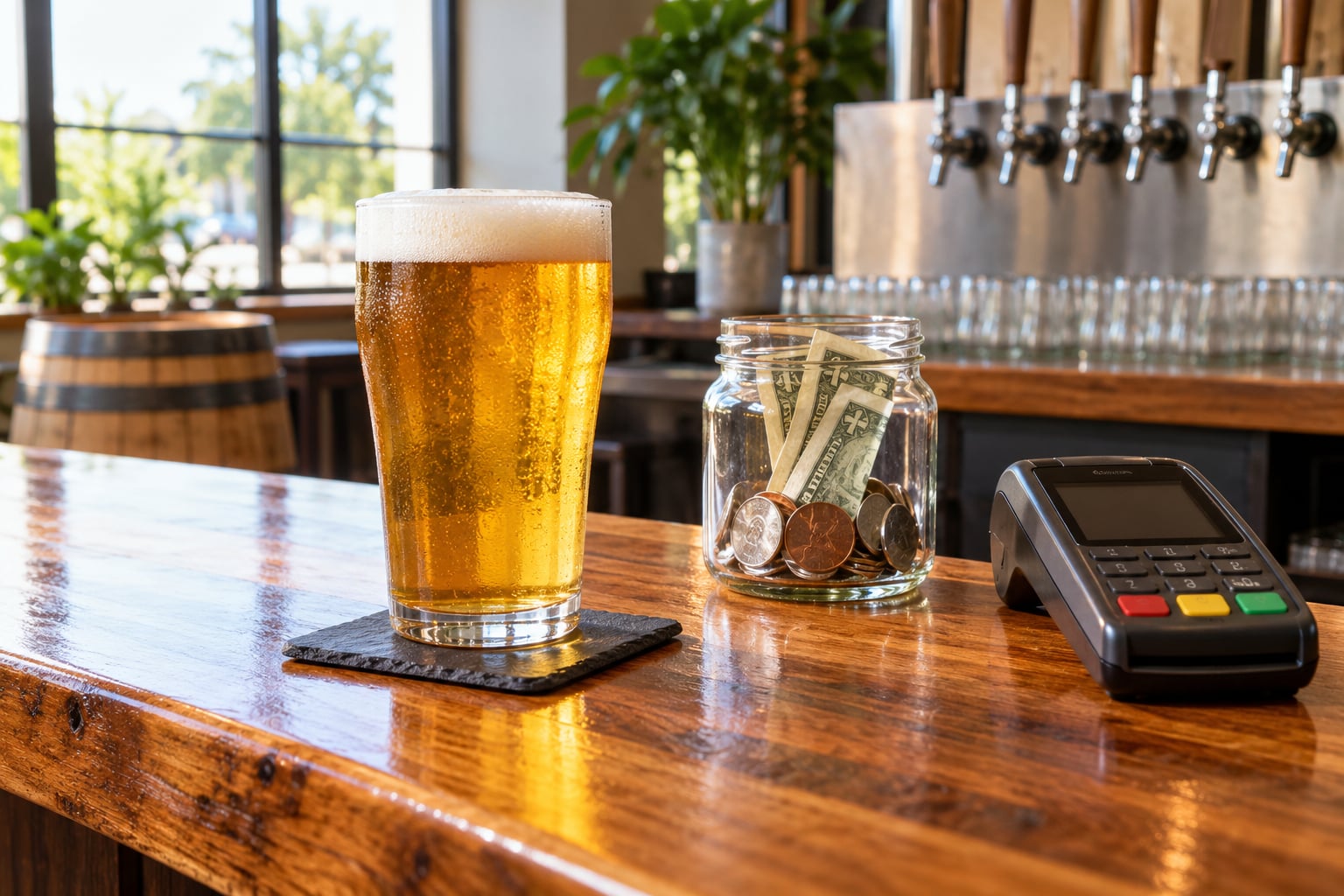
Cash is the easy path: hand it over with the card, say “keep the change, this is for the bar,” and move on. Card is just as fine at closeout, where the tip screen usually lets you type a custom amount instead of picking a percentage. Jar is fine when a jar exists, especially if it is labeled for the staff working that shift.
On a brewery crawl, open a tab at each stop and settle up as you go rather than fumbling with small bills in a crowded room. That tactic comes straight from the Columbus tipping guide, and it works better than trying to remember every beertender’s name two stops later.
Buying a round for the staff on your birthday or your last visit of the night is a good move where the brewery allows it. Keep it modest and do not announce it — a quiet nod to the person who poured last is better than a speech.
Common Mistakes
Almost every taproom tipping argument on the internet comes down to one of a handful of mistakes.
- Assuming every taproom expects a tip. Plenty do not, and treating a retail counter like a dive bar creates real friction for no reason.
- Tipping twice. If an automatic service charge or a default tip prompt already ran, adding cash on top reads as confusion, not generosity.
- Leaving a disproportionate pile of cash in public. Nobody else needs to know what you spent, and large bills rarely buy goodwill the way people think.
- Treating one pay model as universal. A server at a brewpub runs a tipped wage; a beertender on an hourly wage does not; a self-serve customer is closer to a shopper.
- Stressing about to-go purchases. A sealed growler handed across a counter rarely earns a tip, and the people handing it over rarely expect one.
- Fumbling at closeout with a group watching. Pay the tip on the card screen, away from the table, and skip the awkward part.
A few other habits matter as much as the money. Order at the bar when the line is long, refit yourself instead of waving for attention, and clear your glass or ask for water before the next round so the beertender can clean as they pour. Tip before you leave rather than half-standing in the doorway. And if a server goes out of their way, a plain “thanks, this is for you” lands better than any amount you could have written on a receipt line.
Frequently Asked Questions
Do brewery taprooms expect a tip?
Usually not. Most brewery taprooms run counter service with bartenders paid hourly, and there is often no tip jar, no table card, and no tip screen at the register. Tipping stays voluntary there. It becomes expected only when the venue posts a policy, adds an automatic service charge, or when servers actually bring drinks and clear tables.
How much should I tip at a brewery taproom?
Plan on $1 to $2 per drink for straightforward counter service, or 15 to 20 percent of your tab if you opened one and someone served you at a table. A beer flight usually gets one tip for the flight, and a growler fill is commonly a couple of dollars. Follow the venue’s stated policy whenever it has one.
Can I tip with a card at a brewery taproom?
Usually yes. Add the tip when you close out your tab, and plenty of taprooms have a tip screen at the card reader or inside the QR self-order app. Some cashless taprooms have no cash option at all. If the register shows no tip prompt, hand a dollar or two to the beertender instead of assuming the system took it.
Should I tip if there is already a service charge?
No double tip. Once a venue adds a mandatory service charge or gratuity, that counts as the tip, and adding more on top is unusual unless you also received real table service. Read the line item carefully, since a taproom-only charge usually means staff pay already accounts for it. Ask a server if the wording is unclear.
Is it better to tip cash or buy the bartender a drink?
Cash lands directly in the pool that shifts at the end of the night, so it stays the simplest reliable gesture. Buying the bartender a drink is a nice move where local rules allow staff to accept one and the venue is not strict about who can drink on shift. A sincere thank-you costs nothing and is often the part people remember.
What if the taproom has no tip jar or tipping policy?
That usually means a tip is not expected. A quick counter pour with no table clearing is a transaction rather than service, and walking out without leaving money is perfectly normal. If the person who poured went out of their way, hand them a dollar or two and say thanks. No policy is not an invitation to overthink it.
Conclusion
Start with the first step: look for the taproom’s own policy before you order. If there is a service charge or a tip prompt, that is your tip and you are done. If there is nothing, tip only when the service felt real, keep it to a dollar or two per drink or a modest share of your tab, and say thanks while you do it.
Good service at a taproom earns you something better than money anyway. Regulars get remembered, get the first pour of a new release, and get a straight answer about what is actually in the glass. Coming back next week is worth more than any gesture you can make at the register.