A taproom is the tasting room attached to a brewery, where you drink beer brewed on that same site, poured fresh from the tap, usually alongside simple food. A bar is a drinking establishment that serves drinks from many producers plus spirits, cocktails and wine, often with a full kitchen. One is a single brewery showing off its own beer; the other is a general-purpose social venue built around choice.
That is the short version. The confusion is real though, because “taproom” gets used loosely on signage, menus and search results. A place with 40 taps of beer brewed by somebody else across town is not a taproom, no matter what the window lettering says. On the brewing side, the most repeated community definition is simple: brew it yourself, sell it yourself.
Below I break the two formats down piece by piece, then give you a way to tell them apart within seconds of walking in. I have spent enough time in both kinds of rooms to know the difference is obvious once you know what to look for.
Table of Contents
- What Is a Taproom and How Is It Different From a Bar? at a Glance
- Taproom vs bar: the difference in one sentence
- What Is a Taproom?
- The 25% on-premise rule, explained
- Brewpub, beer bar, pub and tavern: where each word fits
- What Is a Bar?
- Why are bars called bars?
- The three types of bars you will actually walk into
- Ownership and Production
- Takeout, crowlers and to-go cans
- Beer Selection and Tap Lists
- Food and Kitchen Options
- Price and Ordering Differences
- Atmosphere and Service
- How to tell you are in a taproom in 10 seconds
- Taproom etiquette: bottle shares and half pours
- Which Should You Choose?
- Frequently Asked Questions
- Can you buy beer to go from a taproom?
- Do taprooms always serve food?
- Is a taproom the same thing as a brewery?
- Can I bring my own bottle to a taproom for a share?
- Is the beer at a taproom always made on site?
- Conclusion
What Is a Taproom and How Is It Different From a Bar? at a Glance
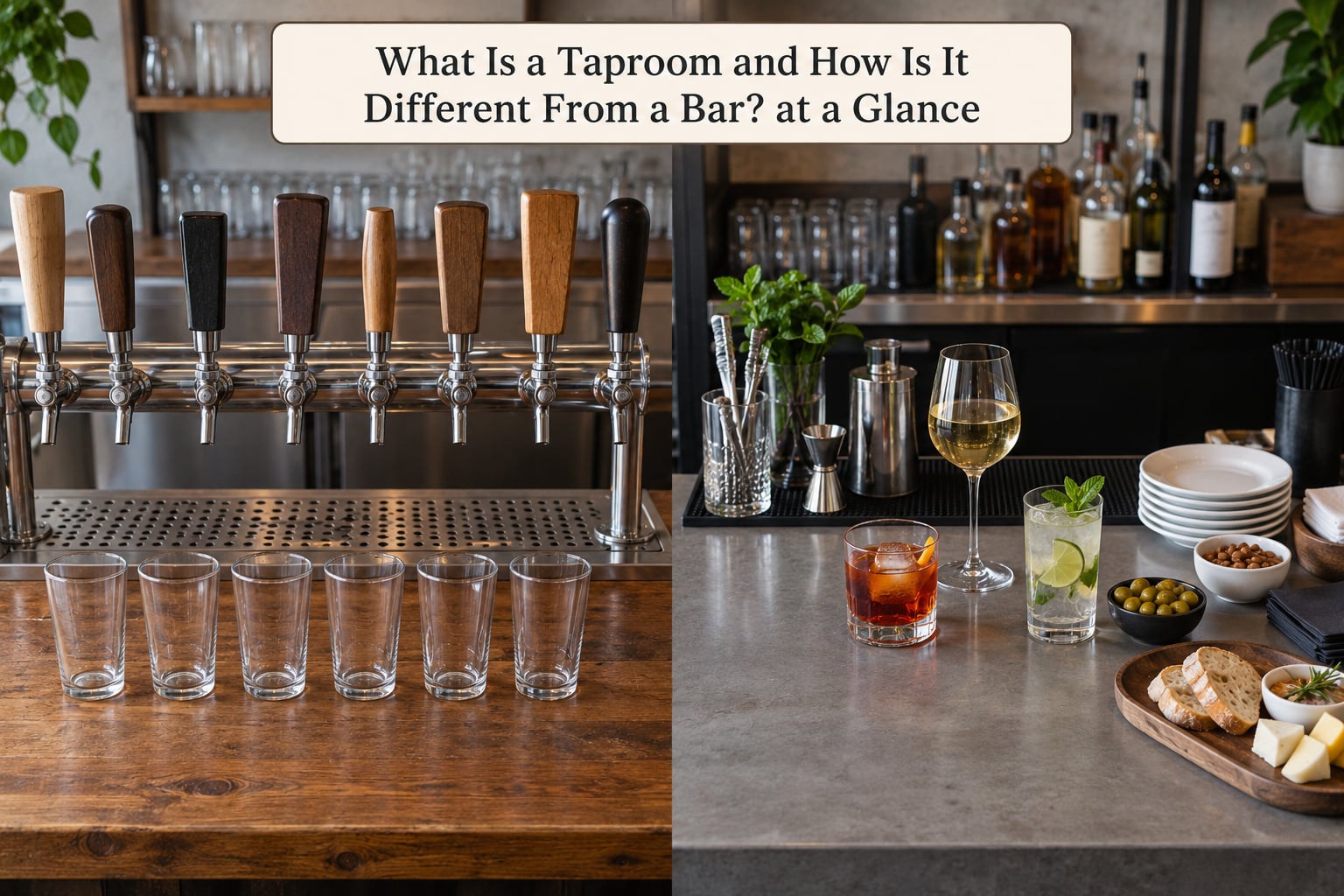
The difference boils down to one question: who made the beer? Everything else follows from that answer. A taproom is a single-producer room built to showcase one brewery’s output. A bar is a multi-brand room built to keep you comfortable, fed and entertained for a few hours.
| Criterion | Taproom | Bar |
|---|---|---|
| Core focus | One brewery’s beer | Choice across many brands and drink types |
| Where the beer is made | On the premises, usually in the back where you can sometimes see the fermenters | Somewhere else entirely, delivered in kegs |
| Tap list | Short, rotating, single-producer, sometimes a couple of guest taps | Wide and stable, often 30 to 60 taps across many breweries |
| Spirits, cocktails and wine | Minimal, sometimes a small back bar of simple drinks and wine | Core of the business, often with a full cocktail program |
| Food | Snacks, simple pub fare, or a food truck parked outside | Full kitchen, or substantial pub food, or both |
| How prices work | Each beer priced on its own, sometimes differently by beer, sometimes plus a tasting surcharge | One price for a standard drink, specials and happy hour discounts, a premium for top-shelf spirits |
| Atmosphere | Casual, brewery-branded, conversation and tasting oriented | Nightlife, sports, music, dancing, late-night crowd |
| Staff knowledge | Bartenders often work for the brewery and know the recipes | Bartenders know a wide menu but usually not how any of it is brewed |
| Best for | Trying fresh releases, flights, learning about beer | Cocktails, wine, dinner, groups with mixed preferences, late nights |
| Beer to take home | Often crowlers, to-go cans, four-packs or growlers | Six-packs and bottles to go, sometimes nothing at all |
Taproom vs bar: the difference in one sentence
A taproom pours beer from a single brewery that brewed it in the same building, while a bar pours a mixed selection of beers, spirits and wine bought from outside suppliers.
What Is a Taproom?
A taproom is a room where a brewery sells its own beer directly to you, fresh, on the day it was brewed or packaged. The beer usually comes from tanks or kegs a few dozen feet from your glass, and the tap list changes as the brewery rotates through what is pouring well and what is about to be fresh.
The format exists because breweries want direct contact with the people drinking their beer. Selling a six-pack means your beer leaves the building and competes on a shelf with everything else. Pouring it yourself keeps the feedback loop short. Bartenders at a taproom work for the brewery, so they can tell you the hop variety in a hoppy pale ale, the actual bitterness figure, or which batch is currently on and which is about to kick.
Two more things usually travel with a taproom. First, the beer-to-food ratio is different. You are there for the beer, so the kitchen tends to be small, outsourced, or optional. Second, taprooms tend to be more casual about who walks in. Families, kids at a table in the afternoon, dogs on a patio, a solo person with a tasting paddle on a Tuesday afternoon. That is normal, not an accident.
The 25% on-premise rule, explained
There is a widely cited benchmark that describes a taproom as a brewery selling at least 25 percent or more of its beer on its own premises, with the beer itself being the main reason people come in. Practitioners treat that figure as a practical shorthand rather than a hard legal line. The idea is simple enough: enough of the beer has to be poured at the brewery that the brewery and the taproom are the same business in practice.
Brewpub, beer bar, pub and tavern: where each word fits
The vocabulary around this gets muddy fast, so here is a clean chain:
- Brewery is the production facility. You might never walk inside one; many breweries sell their beer only through distributors and never have a taproom at all.
- Taproom or tap house is the brewery’s own front room, single-producer, light food.
- Brewpub is the bridge venue. It has a kitchen and a real menu, and it usually brews on site, but food is the bigger business. You can eat a proper dinner there and stay a while.
- Beer bar or craft beer bar serves many breweries’ beer and nothing of its own. This is the venue most people mistake for a taproom, and it is the one the brewing community is most likely to argue with.
- Pub and tavern are older, broader words for an establishment serving drinks and food. A pub is historically a public house, a tavern an inn serving travelers. In practice both are general-purpose rooms with a wide drink list.
- Bierhaus is a German-style hall, big shared tables, pretzels and sausage, often a big stein or a litre glass. Some of them brew on site, many do not.
The test that works anywhere: is the beer brewed here, and is it this business pouring most of it? If yes, taproom. If it is one brewery’s beer in a room full of everybody else’s, beer bar.
What Is a Bar?
A bar is a licensed drinking establishment whose main job is serving alcoholic beverages for consumption on the premises. It buys beer in kegs, cases and bottles from distributors, mixes drinks, serves food where a kitchen exists, and keeps a crowd comfortable for the length of an evening.
What makes a bar a bar is breadth. The tap list might be 40 beers from 15 different breweries, plus a cocktail menu, plus wine, plus a well stocked back bar. Nobody needs to know how the pilsner was brewed for the room to work. The bartender’s job is speed, accuracy and keeping the tab running, not explaining yeast strains.
Why are bars called bars?
The word comes from the physical rail or bar of wood or metal that customers stood at, which itself came from the word for a shelf or a beam. A brass rail along the front of an old saloon served the same purpose. The usage slid from the object to the room over time. For contrast, “tavern” and “pub” carry an inn or public-house history, and “saloon” comes from the Spanish salesa hall, a gathering room that first had nothing to do with drinking.
The three types of bars you will actually walk into
- The neighborhood bar is the default: a dozen taps, a cocktail list, TVs on, and a bartender who knows the regulars’ names. Food ranges from nachos to a full dinner menu.
- The dive is cheaper, darker, quieter and often cash-friendly. Its tap list is short, its pour is generous, and nobody will ask what you are drinking. Food, if any, is simple.
- The cocktail bar or sports bar either leads with a serious drinks program or with screens and volume. A cocktail bar may have a handful of decent beers and an excellent old fashioned. A sports bar does the opposite.
Craft-focused bars blur these lines, which is precisely why the taproom question gets confusing. A well-run craft beer bar can serve better beer than the brewery you drove past, and plenty of drinkers would rather be there. The difference is ownership and focus, not quality.
Ownership and Production
In a taproom the brewer and the bartender are usually the same company, and in a bar they are not. That single fact drives almost every other difference you will notice on a visit.
Because a taproom’s owner wants you to like what they brewed, the beer is as fresh as the packaging allows. Fresh hops, little filtration or none, minimal time sitting in a warehouse. You may be able to see bright tanks through a window or a glass wall, which is not decoration, it is proof of what the room claims.
Your feedback goes somewhere useful. A bartender can tell you a batch skewed hoppy, and the brewer can adjust the next one. In a bar, the keg comes from a distributor and nobody in the room has standing to change it. That is not a knock on bars. It just explains why the beer at a taproom is sometimes an experiment and sometimes the best thing you have had all year.
Because the venue owns the product, exclusivity is easy. A taproom can pour a beer that no one else in the country can buy, because nobody else makes it. A bar can only pour what a distributor offers, so its rarest beer is available at fifty other places in the region.
Takeout, crowlers and to-go cans
This is the question people ask most and the one almost nobody explains. Many taprooms can put beer in your hands to take home, because they already hold a licence that permits off-premises sales. Depending on the brewery and its local licence class, that can mean a crowler filled straight from the tap, a sealed four-pack of cans, bottled releases, or a growler in a few larger formats.
A general bar usually cannot do this. Its licence typically covers consumption on the premises only, so the six-pack you want to take home comes from a package store or a bottle shop instead. Rules vary by state, by licence class and by individual venue, so the honest answer is that you have to ask. Asking is normal and staff are used to it.
Beer Selection and Tap Lists
A taproom’s tap list is short and single-producer, and a bar’s is long and plural. That difference shapes what you can taste, how often the options change, and how much of your evening goes into deciding.
Expect 8 to 20 taps at a taproom, almost all from the brewery attached to the room. Styles cover the range the brewery makes: a pale ale, a lager, an IPA, a stout, a sour, a seasonal release that changed last month. Because production is limited and batches move, the same beer can run out mid-evening and be back a week later.
A bar might have 30 to 60 taps, and the list stays roughly stable from month to month, which means you can build a habit. Broadly, a bar leans toward reliable staples: a domestic lager, a widely distributed pale ale, a widely distributed IPA, plus a rotating handful of imports and locals. It gives you more choice and less novelty.
Guest taps and tap takeovers blur the line deliberately. A taproom with one or two guest taps will pour beer from another brewery, often a local friend, sometimes as a release party. It is a nice gesture and it is still a taproom, because the bulk of the list belongs to the brewery that owns the room. A bar doing the same thing is still a bar.
Flights are the other difference. A tasting paddle or a flight of three to five small pours is routine at a taproom, where ordering three full pints of strong beer would be silly. Most bars will pour you a small taster if you ask, but flights are not part of their identity.
Non-alcoholic beer deserves a mention too. Breweries with a taproom have gotten much better at brewing zero-proof versions of their own recipes, and they pour them on their own taps. A bar may have one or two canned options. If you do not drink, a taproom is now one of the more interesting places to spend an hour.
Food and Kitchen Options
Taprooms serve simpler food than bars, and that gap is the most common source of disappointment. Taproom menus skew toward things you eat with one hand: a pretzel with mustard, a sausage and a side of cabbage, chips and dip, a flatbread, sliders. Some run a food truck in the parking lot, some have a partner kitchen, and some sell nothing but snacks.
Bars are set up for meals. A neighborhood bar might run a short but proper dinner menu. A tavern might do wings, burgers and a brunch on Saturday. A brewpub in between may have a full kitchen and a menu built around its own beer.
That changes the shape of the visit. A taproom is built for standing, sampling and talking, so a table with room for a laptop or a birthday cake is worth checking ahead. A bar is built for sitting, so if you want a two-hour lunch with a proper plate, a tavern or brewpub is the safer pick. If you want to taste ten beers in an hour, food is not the reason you are there either way.
Price and Ordering Differences
A taproom prices each beer individually, and a bar prices drinks by category. That is the underlying rule, and it is why a craft pint at a taproom can cost more than a bar’s cheapest draft, even though neither venue is cheap.
At a taproom, your tab is a running sum of different beers at different prices. A flagship IPA carries one price, a barrel-aged release carries another, and some breweries add a tasting or seasonal surcharge on top. Happy hour, if it exists, is usually a small window of discounted pours early in the evening rather than an all-night institution.
At a bar, one standard drink price covers most drafts and simple cocktails, which makes ordering easy and quietly limits what you are likely to order. Premium spirits, top-shelf wine and single-barrel pours cost more, and well-stirred cocktails cost more than a beer even when they contain less alcohol. Bars lean on discounts: happy hour, two-for-one nights, early-bird specials.
So is a taproom cheaper? Not generally, and it is worth planning for. What you pay for is freshness, exclusivity, and the fact that the venue is trying to keep operating without a distributor taking a cut. What you get for less at a bar is range: cocktails, wine, and the option of a cheap draft when you have already had what you came for.
Atmosphere and Service
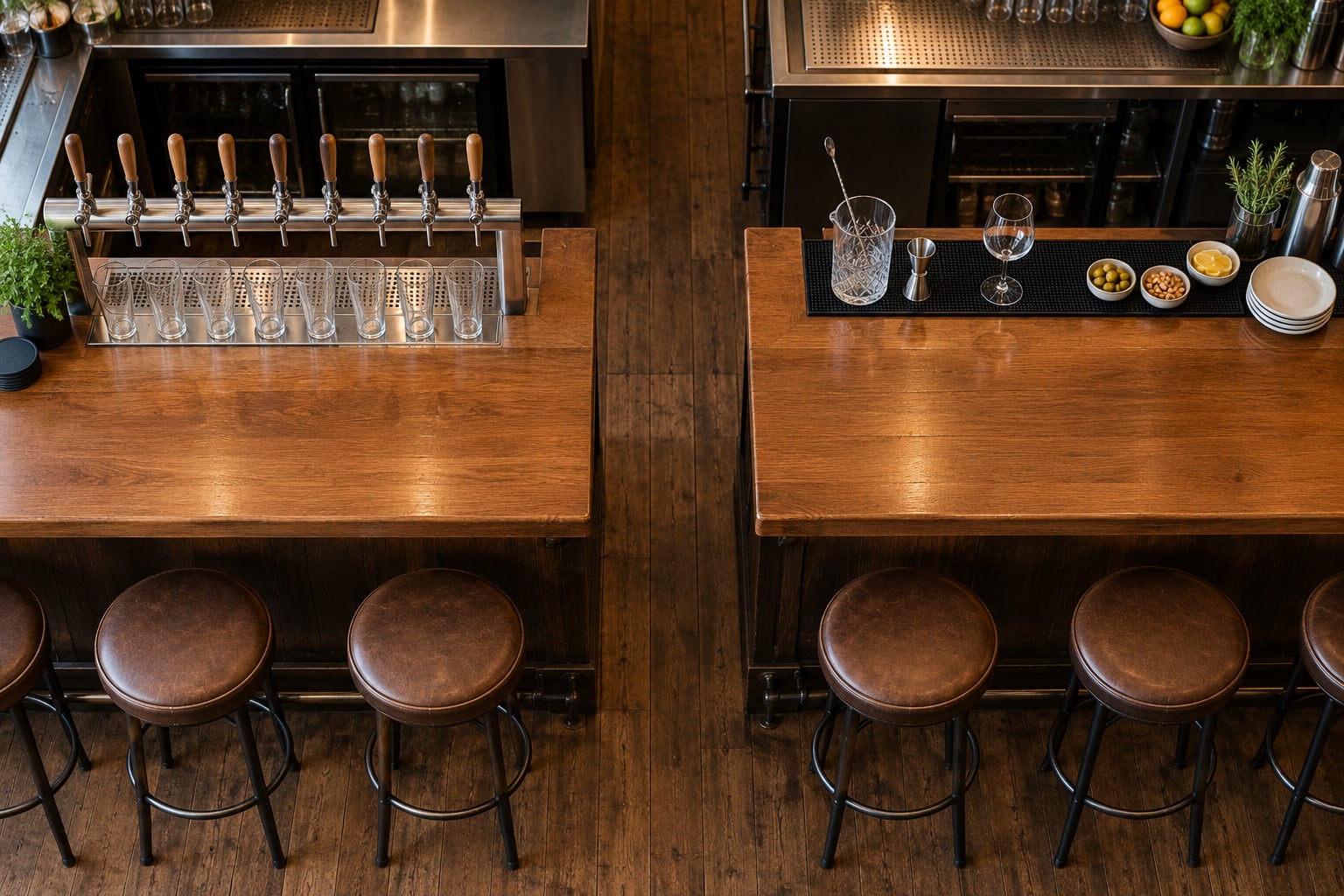
Taprooms feel like a working business that happens to have a bar in it, and bars feel like a bar that also sells things. The decor follows: tap handles all carrying the same brewery logo, branded glassware, chalkboards listing what just came off, and in many cases the production space visible behind the bar.
Service differs in kind. Taproom bartenders pour for a living from one set of recipes, so they can describe a beer accurately and suggest the next one from the same brewery without checking anything. Bar staff are faster and broader. They know a long menu, they handle a busy rush, and they will rarely have an opinion on yeast. Music in a taproom tends to sit underneath the room. In a bar it is usually the point.
How to tell you are in a taproom in 10 seconds
- The tap handles all carry the same logo or brewery name.
- Every beer on the list comes from one brewery, plus maybe one guest tap.
- You can see tanks, kegs, bottles or a production floor from where you are sitting.
- The glassware is branded, or the chalkboard names a fresh batch and its style.
- There is no cocktail list, and the bartender can tell you when a beer was brewed.
- The room smells faintly of grain or hops, and the menu is short.
Turn around and you will usually find the reverse: a wide range of breweries on the board, a bartender reaching for bottles from a well, and a kitchen that has been running since before you walked in.
Taproom etiquette: bottle shares and half pours
Some breweries let you bring in bottles you bought elsewhere to share with friends, and they may charge a small corkage fee or limit it to certain nights. If you plan to do it, ask first. Beer-focused taprooms are usually friendly about it, and it is a normal thing to do there.
Half pours and small tasters are easier to get in a taproom than in a bar, and staff there are used to you wanting to taste before committing. Tables get shared without drama at busy taprooms, particularly on weekends. Bar etiquette is more about tipping, checking whether an event or a reservation is happening, and not ordering a heavy meal at a place that only serves snacks. Nothing about a taproom is formal, which is the point.
Which Should You Choose?
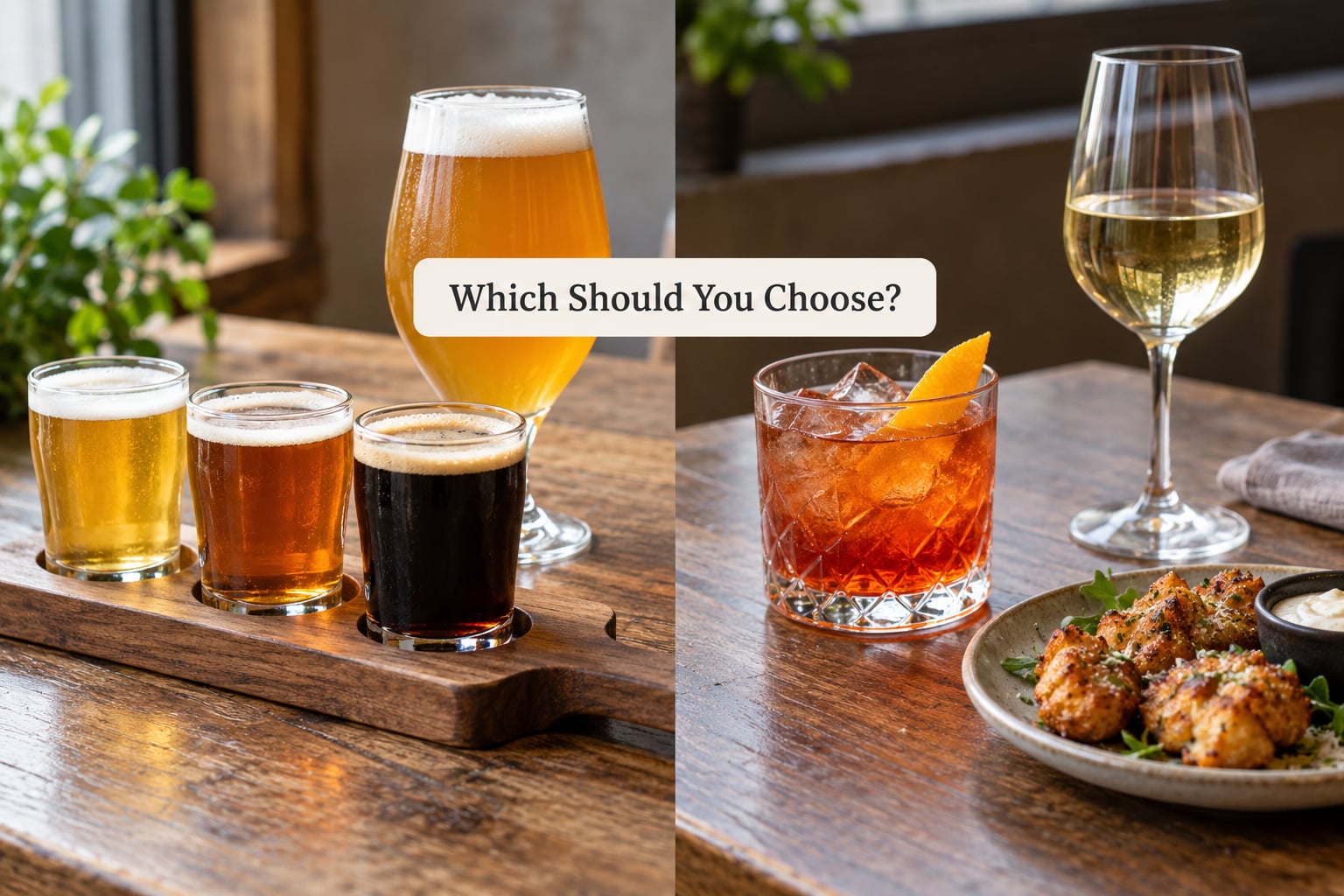
Choose a taproom when the beer is the point of the evening. Choose a bar when the company, the food or the drink variety is the point. Most nights, that is the entire decision.
- You want to try something you have never had. Taproom. Single-producer tap lists are where new releases show up first.
- You want to learn something about beer. Taproom or beer bar. The staff will explain it and the flights make it easy.
- You want dinner. Bar, tavern or brewpub. Confirm the kitchen hours before you go.
- Your group has mixed tastes. Bar. Cocktails, wine, spirits and a safe lager all under one roof.
- You want a night out past midnight. Bar. Taprooms keep shorter hours because they are attached to a production facility.
- You want to watch the game. Bar. Taprooms rarely run a screen wall.
- You want to bring beer home. Taproom. Ask about crowlers, to-go cans or four-packs.
- You are taking the family or the dog. Taproom. Daytime hours, patio space and a relaxed room.
If you can only pick one, pick the taproom. A bar with a good craft list is easier to find, but a taproom gives you the thing a bar structurally cannot give you: the freshest version of one brewer’s work, poured by people who know exactly what is in it.
Frequently Asked Questions
Can you buy beer to go from a taproom?
Often yes, and this is one of the main practical differences between the two. Many taprooms hold a licence that allows off-premises sales, so they can fill a crowler from the tap, hand you sealed to-go cans or a four-pack, or offer bottled releases. General bars usually hold on-premises-only licences and cannot sell beer to take away. Rules differ by state, licence class and venue, so ask the bartender before you order.
Do taprooms always serve food?
No. Many taprooms serve a short menu of pretzels, sausages, flatbreads and sliders, some partner with a food truck out front, and some sell only packaged snacks. That is the biggest gap in expectations for first-time visitors. If you want a full meal, choose a brewpub or a tavern instead, or check the kitchen hours and menu before you leave the house.
Is a taproom the same thing as a brewery?
No. A brewery is the production facility where beer is brewed, and many breweries never open a taproom at all, selling only through distributors. A taproom is the customer-facing room where that brewery’s beer is poured. They are usually attached in the same building, but you can walk into a brewery production area with no customer taps anywhere on the property.
Can I bring my own bottle to a taproom for a share?
Frequently, yes, especially at brewery taprooms where bottle sharing is part of the culture. Some breweries charge a corkage fee, limit it to certain nights, or ask that you keep the share to the table. Beer-focused bars are usually fine with it too. General sports bars and cocktail bars are less likely to be. Either way, ask before you open the bottle rather than after.
Is the beer at a taproom always made on site?
Almost always, with a few guest taps as the exception. A venue that pours only its own brewery’s beer on site is the standard for calling something a taproom. If most of the taps belong to other breweries, you are in a beer bar or a craft bar instead, whatever the sign says. A few guest taps do not change the label, but a tap list spread across a dozen breweries does.
Conclusion
A taproom is a single brewery’s front room, pouring its own fresh beer with light food attached. A bar is a general drinking establishment, serving many brands plus spirits, wine and usually a real kitchen. That ownership difference explains everything else you will notice.
Before you pick a venue, check four things: the current tap list, the food policy and kitchen hours, the closing time, and whether anything special is on the calendar that night. That is a two-minute check that saves a wasted trip.