Breweries switched to cans because aluminum solves three problems at once: it blocks the light that ruins hoppy beer, it weighs a fraction of what glass does, and it survives shipping, stacking and outdoor use without breaking. On top of that, cans seal tighter, cool faster and recycle better than glass. The switch was not universal, but the practical case proved strong enough to reshape the whole craft category.
That is the short version of why breweries switched to cans. The longer version involves freight math, a 2021 supply shock that changed how small breweries buy packaging, and a handful of styles that still belong in glass. Here is how the package became the strategy.
Table of Contents
- Why Breweries Switched to Cans
- How Cans Became Dominant in Craft Beer
- What Breweries Gain from Cans
- How Cans Protect Beer Freshness and Flavor
- Cans vs. Bottles for Breweries
- The Drawbacks of Canning Beer
- Are Cans More Sustainable Than Bottles
- Why Breweries Still Choose Bottles and Kegs
- How Cans Changed Craft Beer Distribution
- What Modern Brewery Cans Do Better
- Frequently Asked Questions
- Do beers in cans taste as good as beers in bottles?
- Are aluminum cans better than glass bottles for keeping beer fresh?
- Why is there a plastic lining inside a beer can?
- Are beer cans more environmentally friendly than bottles?
- How long does beer usually stay fresh in a can compared with a bottle?
- What type of craft beer is best packaged in a bottle instead of a can?
- Conclusion
Why Breweries Switched to Cans
Aluminum cans became the default craft package for a simple reason: they are lighter, tougher, stackable, easier to ship, better at blocking light and oxygen, and built for single-serve distribution. Every one of those attributes cuts a different cost at the same time, which is why the switch moved so fast across the craft sector rather than trickling in one brewery at a time.
Six drivers show up in almost every interview with a brewer who made the change:
- Light protection. A can is opaque. A brown glass bottle filters some ultraviolet light, but not all of it, and the wavelengths that get through are exactly the ones that make hoppy beer taste skunked.
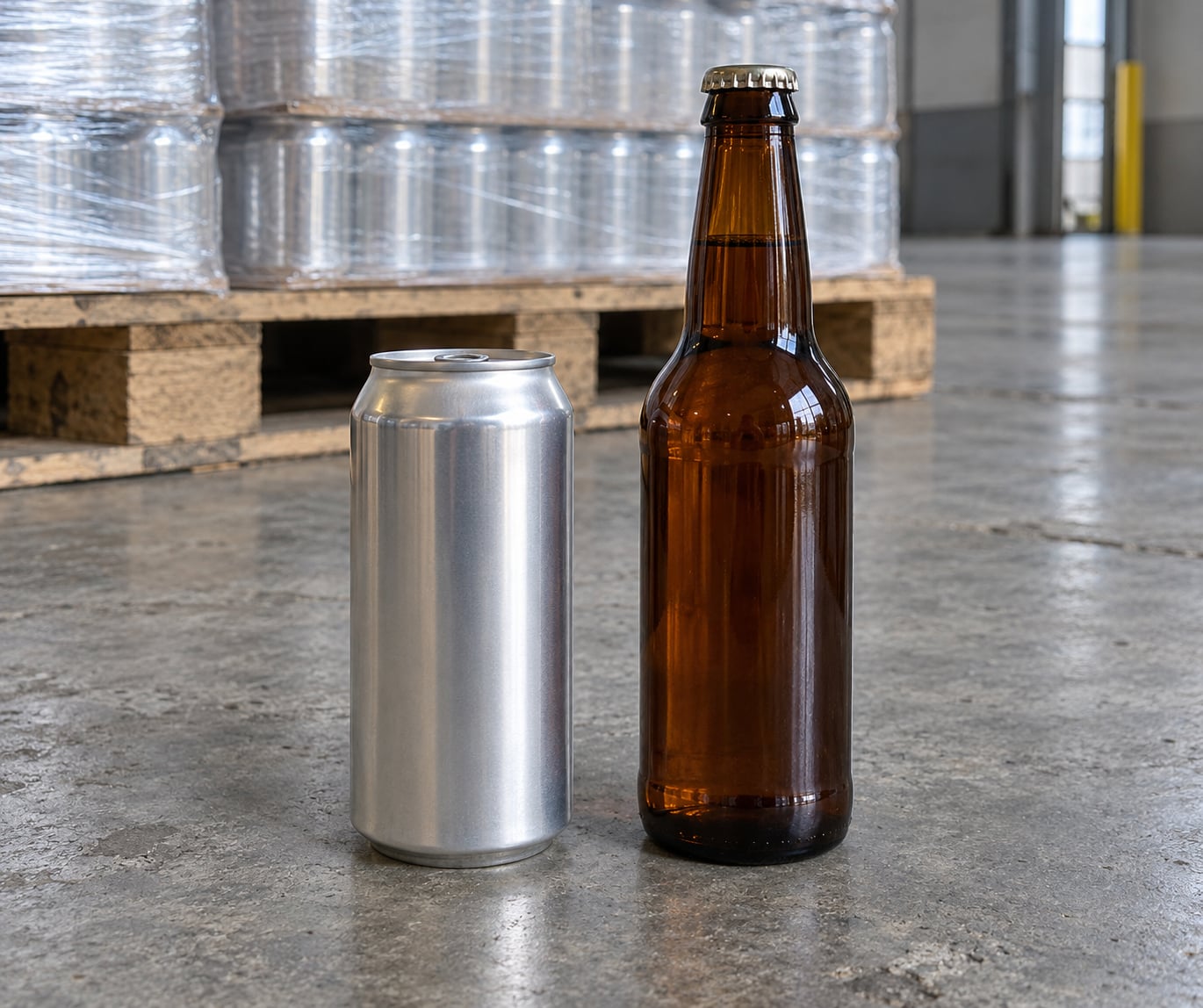
- Freight weight. An empty 12 oz can weighs roughly 10 grams. A comparable glass bottle weighs around 220 grams. That is about a twenty-two-fold difference in empty packaging, and freight is usually the second-largest line in a brewery’s cost of goods.
- Breakage. A pallet of glass that breaks in a truck is a loss of product, a cleanup bill and sometimes a safety issue. A pallet of cans is just a pallet of cans.
- Pallet efficiency. Cans pack into tight rectangular slabs with almost no wasted space, so a brewery can move more beer per truck and pay for fewer trucks.
- Equipment fit. A canning line fits into spaces and budgets a glass line does not, and a small brewery can rent capacity instead of buying it.
- Off-premise access. Retailers, distributors, outfitters and venues that would never take glass will take cans, which opens whole sales channels.
None of these is a romantic reason. They are logistics and packaging reasons, and that is exactly why they stuck.
How Cans Became Dominant in Craft Beer
Beer was sold in steel cans decades before craft existed, and the metal package lost the shelf to glass within a generation. Aluminum reversed that. The dates below are approximate, since can formats and brewery decisions varied by market, but the arc is consistent.
| Approximate date | What changed | Effect on breweries |
|---|---|---|
| 1930s | Beer moves into steel cans | Early adopters prove beer can be canned at all, but steel is heavy and prone to taste taint |
| 1960s | Aluminum cans replace steel | Lighter body, no metallic taste, two-piece can construction becomes standard |
| 1970s to 1980s | Plastic bottles enter soft drinks | Brewers look at plastic and decide beer does not fit the package, largely because of oxygen pickup and flavor loss |
| 1980s to 1990s | Brown glass longnecks and 22 oz bottles define craft | The bottle becomes the symbol of the craft movement, prized for tradition and shelf presence |
| 2013 | Cans reach a critical mass of craft releases, with a dedicated national can show in the industry | Cross-festival sampling and a growing online can database make cans visible to drinkers, not just brewers |
| 2013 to 2016 | Mid-size regional breweries install their own canning lines | Cost per unit drops as volume grows, and cans move from special releases to core lineups |
| 2021 to 2022 | Empty can shortage hits, as Ball, Crown Holdings and Ardagh run at capacity and raise minimum orders | Packaging becomes a business continuity question, and small breweries turn to mobile and contract canning |
| 2023 to 2026 | 16 oz tallboys, 19.2 oz pint cans and stubbies spread, with wrap printing and resealable lids on premium releases | Cans move further into the shareable and specialty end of the shelf |
The 2013 moment matters more than it looks. Until cans had enough variety to compare at a festival, the format was a curiosity. Once drinkers could taste the same brewery in both packages, the argument stopped being about packaging and started being about beer.
What Breweries Gain from Cans
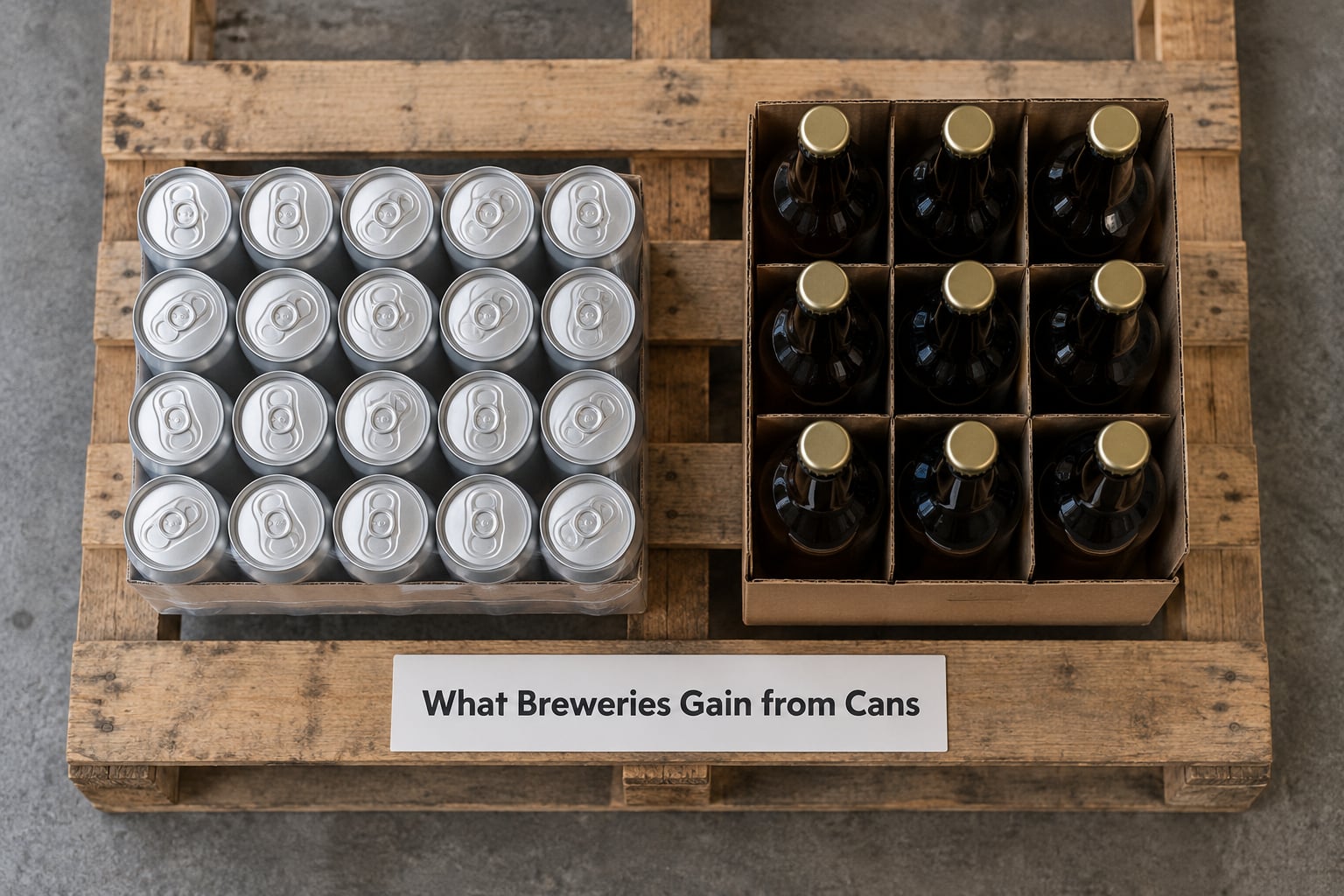
The gains are operational before they are marketing ones. A brewery that moves a finished case from the packaging room to the loading dock is doing the same job with a lighter, denser, less fragile unit, and every one of those three words shows up on a freight invoice.
| Factor | What changes with cans |
|---|---|
| Empty packaging weight | About 10 g for a 12 oz can against roughly 220 g for a comparable glass bottle |
| Volume per pallet | Tight slab packing means substantially more finished beer per pallet than glass |
| Breakage | Near zero in transit versus a real loss rate with glass, especially on long hauls |
| Capital outlay | Lower for a small brewery, and often zero if capacity is rented |
| Chilling | Thinner walls pull from a cooler faster, which matters at festivals and in summer |
| Shelf and cooler space | Compact footprint fits more facings in a single-unit cooler door |
| Labeling | A full wrap prints artwork and a date code on a curved surface rather than a flat paper label |
| Pour control | Tab opening gives a narrow, repeatable pour for IPAs, pils and anything served cold |
| Channel access | Off-premise retail, outfitters, travel retail and many venues will stock cans and refuse glass |
Here is the freight example that makes it concrete. A 12 oz glass beer bottle weighs about 12 ounces empty, so a 24-bottle case of filled beer is roughly 50 pounds before the case itself. Move to a 24-pack of cans and the empty packaging drops to about 10 ounces for the lot, putting the same case near 30 pounds. That is a brewery shipping 40 percent less mass per case, using a smaller box, stacking more cases on each pallet and breaking nothing along the way.
Multiply that across a year of off-premise distribution and the packaging change stops looking like a preference. It looks like a margin decision.
How Cans Protect Beer Freshness and Flavor
Lightstruck beer, sometimes called skunked, happens when ultraviolet light breaks down the hop-derived compounds that give beer its bitterness. The breakdown produces sulfurous off-flavors that taste like rotten eggs or a skunk, and no amount of sealed glass stops it completely. Brown glass filters a meaningful share of UV; a can’s opaque wall filters essentially all of it.
There is a second protection mechanism people rarely think about, and it is the lining. Every beer can interior is coated with a food-grade polymer lacquer so the beer never touches bare metal. Beer is acidic and reactive, and it would attack aluminum and pick up metallic off-flavors on contact. The liner is why the phrase beer tastes like metal is mostly a leftover impression from the steel can era, not a description of what is happening in a modern can.
Oxygen is the third piece. A seamed can has one continuous closure, formed and sterilized at the filling line, and it presents a very small oxygen path compared with a crown cap on a bottle neck. Breweries also purge the headspace with nitrogen or carbon dioxide and sometimes add an oxygen absorber to the headspace. Combined, these steps slow the oxidation that flattens aroma and dulls color.
Worth being honest about the limits: a can does not fix a bad fill or a sloppy seam, and a well-made bottled beer is not worse than a well-made canned beer. The freshness advantage shows up when beer sits in sunlight, in a warm car, on a back porch or on a shelf under fluorescent lighting for months. That is a real scenario in craft distribution, not a hypothetical one.
Cans vs. Bottles for Breweries
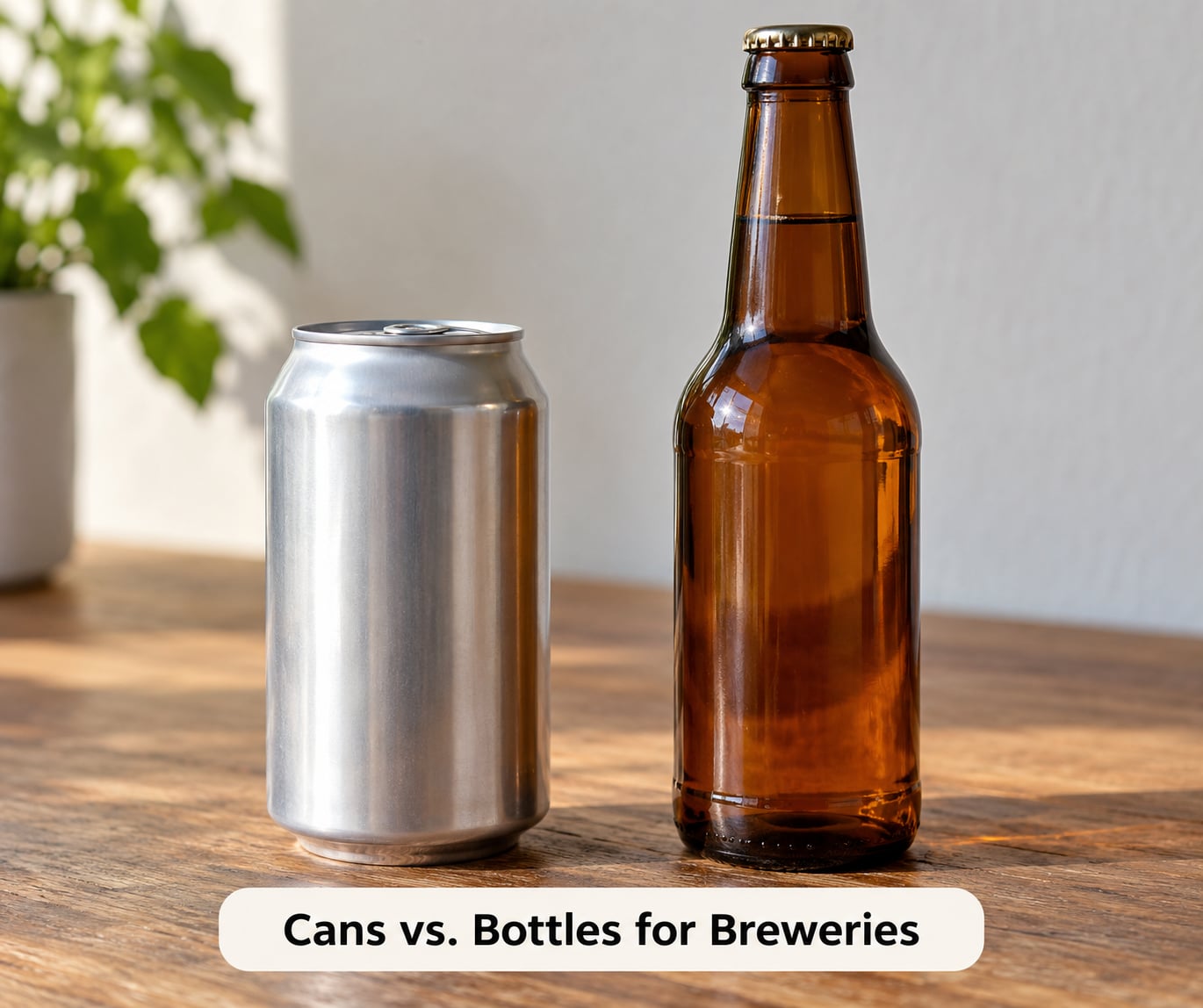
Neither package wins everywhere. The decision table below is the one a brewery actually argues over in a production meeting.
| Attribute | Aluminum can | Glass bottle |
|---|---|---|
| Empty weight | About 10 g for 12 oz | About 220 g for a comparable bottle |
| Light protection | Opaque, blocks effectively all UV | Brown glass filters some UV, not all |
| Breakage in transit | Effectively none | Real loss rate, worse on long routes |
| Pallet efficiency | High, tight rectangular slab packs | Lower, round bottles waste pallet corners |
| Upfront equipment cost | Lower, and rentable through contract or mobile canning | Higher, glass lines are large and fixed |
| Perceived premium | Modern, clean, release-friendly | Traditional, cellar-like, gifting-friendly |
| Shelf presentation | Full wrap, 360 degrees of artwork | Flat paper label, smaller printable area |
| Pour convenience | Tab pour, fast chilling, single unit | Bottle neck, needs an opener, two units for a pour |
| Recycling rate in the US | 43 percent for cans | 40 percent for glass, 20 percent for plastic PET |
| Recycled content in the package | About 71 percent | About 23 percent |
| Best fit | Off-premise retail, festivals, hop-forward beers, mixed packs, direct shipping | Bottle-conditioned and high-ABV releases, share formats, on-premise service, taprooms |
If you are shipping pale lager a long way to a distributor who will stack it cold, cans win on freight. If you are releasing an eight-year barrel-aged stout that will sit in a retailer’s window, the bottle communicates something different and the beer inside may still be conditioning.
The Drawbacks of Canning Beer
None of this means cans are free of downsides. A brewer considering the switch will hit these.
Equipment and setup. A canning line is a real capital project. It needs a place in the building, a trained crew, a parts supply relationship and somewhere to put the output. For a brewery with a few thousand barrels a year, that math does not work in-house.
Minimum order quantities. This is the pain point that small producers complain about most. During the 2021 to 2022 supply crunch, Ball raised the minimum order for small brewers from roughly 200,000 cans to about 1,000,000 per stock keeping unit and passed along an increase of around 28 percent in 12 oz can pricing. A brewery that plans six releases a year suddenly has to buy a year’s worth of empties for each one.
Supplier dependence. A brewery with a glass line owns a depreciating asset it controls. A brewery buying empties owns a relationship, and that relationship can be tight. Bart Watson, chief economist at the Brewers Association, framed the period as three compounding problems at once: general disruption, shortages and a demand spike nobody forecast.
Lining and reactive styles. Lining technology is mature and compliant, but very hoppy, very acidic and barrel-aged releases still get careful evaluation before a brewery commits a whole production run to aluminum.
Size and format limits. Large shareable formats are still awkward. A 32 oz bottle holds a beer that is meant to be shared and aged. A can at that volume is a heavy, ungainly object, and many breweries simply keep those releases in glass.
Consumer perception. Cans still carry a mainstream stigma for some drinkers. Wineries solved this with premium cans over roughly a decade; breweries got there faster, though the shift is not finished. A related packaging complaint shows up in reviews: a paper label wrapped around a can can get torn during recycling and contaminate the load, which hurts the very recyclability the format is credited with.
Are Cans More Sustainable Than Bottles
This is the question where reasonable people disagree, and both camps have real data.
| Material | US recycling rate | Recycled content | Key note |
|---|---|---|---|
| Aluminum can | 43 percent | About 71 percent | Recycling uses about 95 percent less energy than primary smelting; metal recycles indefinitely |
| Glass bottle | 40 percent | About 23 percent | Recyclable indefinitely, but needs cullet sorting and more energy per unit |
| Plastic PET | 20 percent | About 6 percent | Lowest recovery and the shortest useful life of the three |
The can industry, through the Can Manufacturers Institute and the Aluminum Association, points at the numbers above and at per-unit emissions: it puts a 12 oz can about 45 percent below a 12 oz glass bottle. Used beverage cans are also the highest-value material in the single-stream recycling stream, which is why material recovery facilities have an incentive to grab them.
The counter-argument comes from breweries that have run their own life cycle assessments. That method, called a life cycle assessment, traces a package from raw material extraction through disposal. When a brewery like Small Beer ran one, it concluded that bottles were the more environmentally friendly option for its own operation, pointing at bauxite mining impacts and at the reality that aluminum’s advantage depends on recycled content and on collection systems that actually capture cans. The same study notes that a paper label on an aluminum can can make it effectively unrecyclable, and that the can’s internal lacquer is burnt off during remelting, an energy cost the industry rarely foregrounds.
Both studies are defensible because they measure different things. The industry numbers assume a mature collection system with high can recovery. The brewery numbers weigh raw material sourcing. A fair summary: total impact depends on recycled content, transport distance, local reuse infrastructure and what happens to the package after you drink it. Recyclability alone does not settle it, which is why the debate is framed as least unsustainable rather than best.
Why Breweries Still Choose Bottles and Kegs
The switch was never total, and the exceptions are instructive.
Bottle-conditioned and high-alcohol releases are the clearest case. A big stout at 12 percent or a spontaneous-fermentation sour meant to keep evolving in the bottle is doing something a can cannot do. Several breweries release those in glass, sometimes 375 ml, sometimes larger, precisely because the bottle is part of the product.
Share formats are the second. Beer meant for a table needs a bottle, because a bottle is a unit two people can open. Cans made progress at 16 oz and 19.2 oz, but the classic 22 oz and 32 oz bottles remain the better object for sharing.
On-premise service is the third, and it is where draft kegs win outright. A keg pours beer that never saw a package, avoids the cost of filling and sterilizing containers entirely, and gives a taproom perfect control over temperature and pour. Growlers have faded for good reasons, mostly cleaning liability and slow filling speeds, which is why crowlers, a single-use filled-and-sealed can, became the common taproom to-go format instead.
There is also the tradition argument, and it is not a silly one. A long neck in a fridge says something about a Friday night that a can does not. Some drinkers reach for glass for gifting and for occasion drinking, and for everyday drinking they genuinely do not care. Several forum discussions make exactly that point: the container only matters when someone is homebrewing or handing the beer to somebody else.
How Cans Changed Craft Beer Distribution
Packaging and distribution are the same decision when you look at it from a brewery’s side. Cans opened doors that bottles kept shut.
Off-premise retail is the big one. Grocery and liquor stores care about shelf density and breakage, and a compact slab of cans fits more facings and eliminates the risk of a cracked bottle in a case. Single-unit coolers in convenience stores and gas stations were effectively impossible to stock with glass.
Then there are the venues that simply ban glass. Golf courses, lakes, beaches, stadiums, music festivals and many state parks will allow aluminum and prohibit glass, and that single rule turned the can from a preference into the only option. The same applies to air travel and travel retail, where cans are the standard unit.
Formats got better at the same time. Four-packs made single-can variety releases possible for small breweries. Six-packs of mixed styles let a taproom sell a sampler without bottling. And because cans survive shipping, direct-to-consumer fulfillment from a brewery to a customer’s door became a real channel rather than a regional favor.
For a bar or taproom operator, the practical read is straightforward: stocking canned local beer is cheap insurance, because it travels, it holds, and it lets you offer a brewery you could never pour on draft.
What Modern Brewery Cans Do Better
The can has also gotten noticeably better as a product, and several of the improvements are broadly available rather than luxury upgrades.
Full wrap printing. Direct printing across the whole cylinder gives a 360 degree surface with no seam break, which is why small-batch can artwork now often looks more considered than the bottle label it replaced.
Date codes. Inline inkjet printers print a lot code on the can at the moment of filling, typically a line of letters and numbers that includes a best-by date. That is the single most useful thing on the package for judging freshness, and it is also common on bottles, so a claim that only cans are dated is wrong.
Purging and absorbers. Nitrogen purging of the headspace and oxygen absorbers are standard practice on quality-focused lines, and both are cheap relative to the beer they protect.
Improved liners. Barrier and BPA-free interior coatings are widely available now and give a brewery more confidence with hop-forward, sour and high-acid styles.
Size strategy. A 12 oz can is the volume standard, a 16 oz tallboy carries a stronger, more premium read, a 19.2 oz can gives an exact pour where a fifth is expected, and a stub or 8.4 oz can is popular for high-ABV and cold-sensitive releases. Having more than one size in the lineup lets a brewery price a standard beer differently from a limited drop without changing the recipe.
Resealable lids exist but are still on the premium end of the market, mostly applied to larger formats and specialty releases rather than to standard 12 oz cans.
Frequently Asked Questions
Do beers in cans taste as good as beers in bottles?
A properly filled and seamed can protects beer just as well as a good bottle. The can wall is opaque, so no light reaches the beer, and the internal polymer lining means the beer never contacts metal. Research on blind tastings keeps finding that tasters rate heavier glass as higher quality, which tells you a lot about expectation and very little about liquid. If a canned beer tastes off to you, the usual culprits are age, heat exposure or a bad fill, not the format.
Are aluminum cans better than glass bottles for keeping beer fresh?
For light exposure, yes, and the difference is meaningful. Brown glass filters a good share of ultraviolet light but not all of it, and the wavelengths that get through are the ones that trigger lightstruck off-flavors in hoppy beer. An aluminum can blocks essentially all of them. Cans also tend to hold carbonation better over time because of a tighter closure. For beer kept dark and cold, the two are close.
Why is there a plastic lining inside a beer can?
Because beer is acidic and reactive. Without a coating it would react with the aluminum wall and pick up metallic off-flavors, which is exactly the taste people wrongly blame on cans today. The food-grade polymer lacquer, usually an epoxy or acrylic resin, isolates the beer from bare metal. Modern liners are made without bisphenol A, and the lacquer itself is burned off during remelting at the recycler, so it does not carry into recycled metal.
Are beer cans more environmentally friendly than bottles?
It depends on the system. US aluminum cans recycle at about 43 percent versus 40 percent for glass and 20 percent for plastic, and cans carry roughly 71 percent recycled content against about 23 percent for glass. Recycled aluminum also uses about 95 percent less energy than primary smelting. But breweries running their own life cycle assessments point at bauxite mining and at how collection actually performs locally. Neither package is automatically the greener one.
How long does beer usually stay fresh in a can compared with a bottle?
In practice the difference is small, and it is dominated by heat and light rather than by the package. A 3:30 rule circulates among drinkers, meaning beer that sat warm for three days is past its best, and 3:30 is also how long some retailers want beer chilled before sale. The old two-year and six-month figures from the can era came from a period when liners and oxygen control were far less advanced. A modern can stored cold and dark will outlast a warm bottle by a wide margin.
What type of craft beer is best packaged in a bottle instead of a can?
Bottle-conditioned releases and very high alcohol beers are the clearest cases, because the bottle lets the beer keep evolving after it leaves the brewery. Share formats, usually 22 oz and 32 oz, are also better as bottles, since a bottle is a unit two people can open. On-premise draft in a keg beats both, since the beer never gets packaged at all. Very hop-forward IPAs are the opposite case and belong in cans, where light protection matters most.
Conclusion
Breweries switched to cans because the package removes friction everywhere at once. It cuts freight mass, stops breakage, blocks the light that skunks hoppy beer, seals tighter against oxygen, stacks tighter on a pallet and unlocks the off-premise channels that make up most craft beer sales. A decision that improves beer quality, logistics and recycling at the same time explains why the shift happened so quickly.
It still is not a sweep. Bottle-conditioned and high-alcohol releases stay in glass, share formats stay in bottles, and draft in a keg beats both for on-premise service. Before you pick a package for your own brewing, compare four things: the style of beer, how much volume you can commit to a minimum order, how far the beer has to travel, and whether you are selling for drinking now or for keeping.