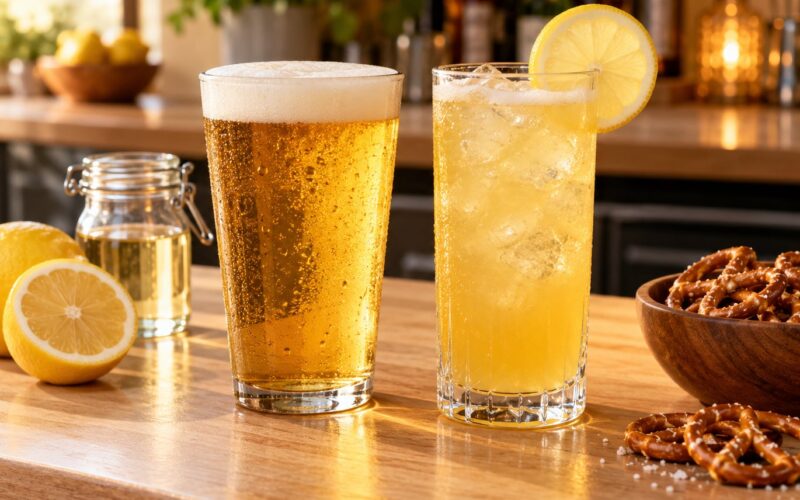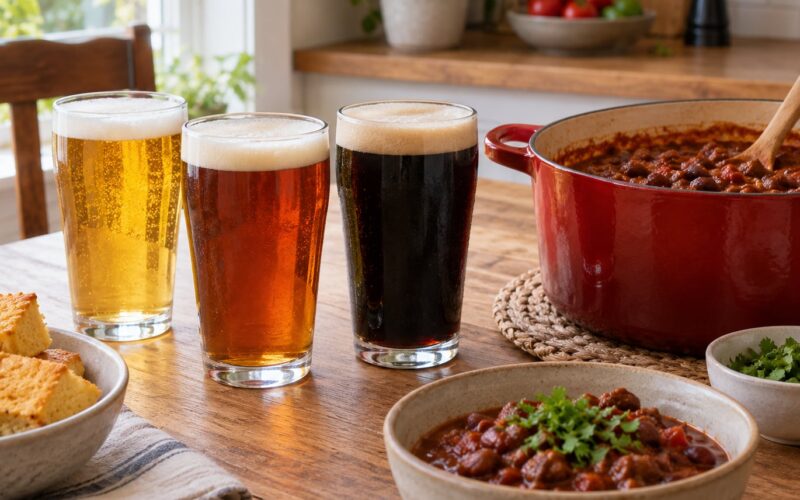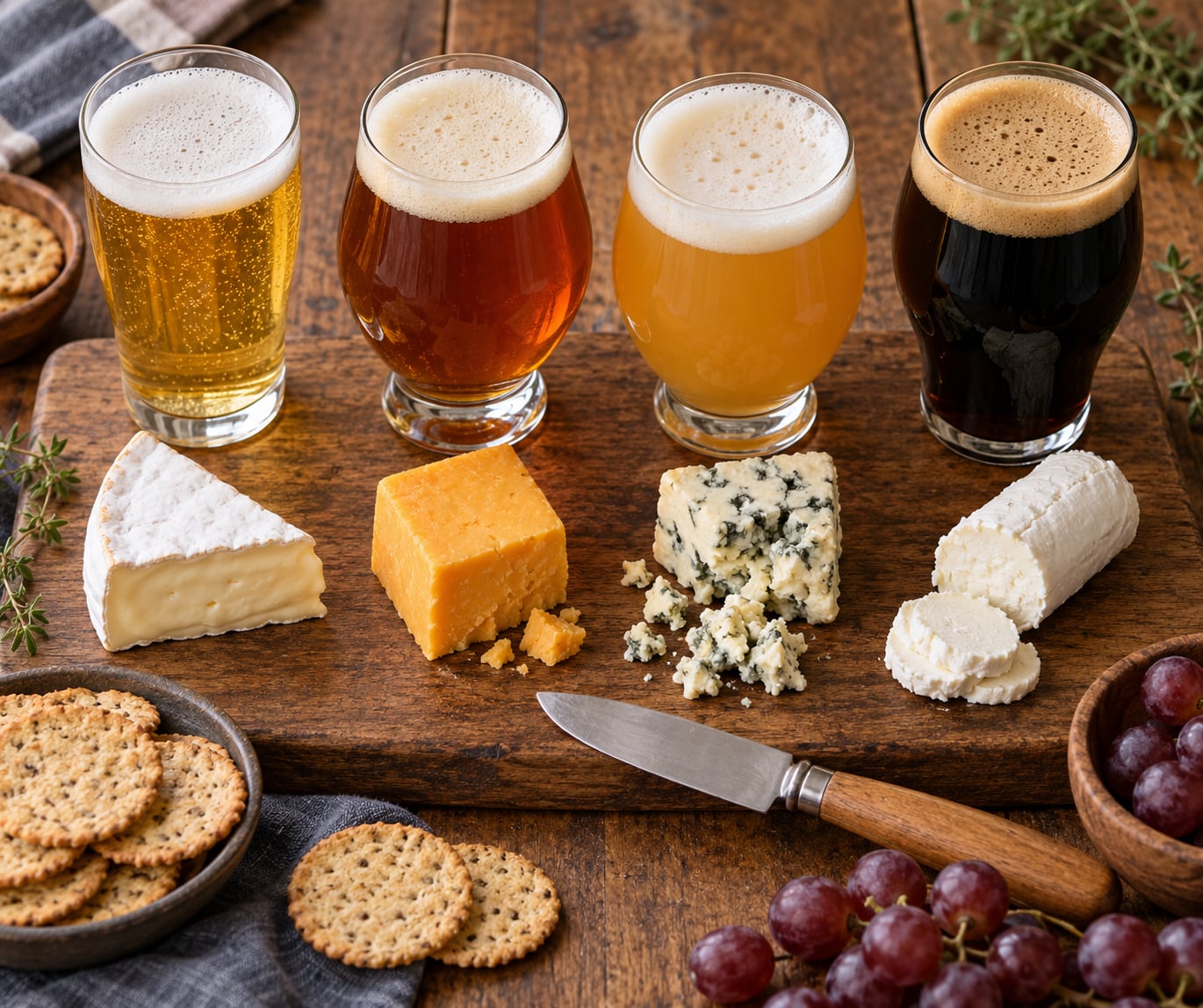
Beer and cheese is one of the most reliable food and drink matches there is, and this beer and cheese pairing guide shows you why. Carbonation scrubs fat off the palate, hop bitterness cuts the sweetness of a young cheese, and both are made from grain and milk that came out of the same kind of ground. Match the two on intensity, then pick a beer that either echoes the cheese or pushes back against it.
Most people default to wine with a cheese board because that is the habit, not because beer is worse for it. Beer is usually cheaper and easier to find, and a hoppy or roasted beer can pull sweetness out of an aged cheddar that a buttery Chardonnay just sits next to.
What follows is the method first, then a reference table you can keep on the counter, then twelve specific combinations that work. There are no hard rules here, only useful starting points, and your palate gets the final vote.
Table of Contents
- What Makes Beer and Cheese Pair Well?
- Carbonation is what beer brings that wine does not
- Bitterness balances sweetness and richness
- Beer and cheese share an agricultural base
- Match intensity first, then choose contrast or echo
- How Do You Pair Beer with Cheese?
- 1. Start with the cheese, not the beer
- 2. Name the cheese’s dominant flavor
- 3. Pick a beer that echoes or contrasts
- 4. Match strength to strength
- 5. Taste in a deliberate order
- Beer and Cheese Pairing Cheat Sheet
- A beer and cheese pairing guide organized by cheese style
- 12 Beer and Cheese Combinations to Try
- Which Beer Style Works Best with Cheese?
- Lagers and pilsners
- Wheat beers
- Pale ales and bitters
- IPAs
- Ambers and brown ales
- Porters and stouts
- Sours and wild beers
- How Do You Taste Beer and Cheese Together?
- What Temperature Should Beer and Cheese Be Served At?
- Common Beer and Cheese Pairing Mistakes
- Pairing a delicate beer with a strongly flavored cheese
- Serving everything too cold
- Reading bitterness as balance
- Choosing a washed rind for a first impression
- Tasting too large a portion
- Serving a flight in the wrong order
- Underestimating how much people eat
- Frequently Asked Questions
- Is beer and cheese a good combination?
- What cheese pairs best with an IPA?
- What cheese should I serve with a stout?
- Can I use a light lager with cheese?
- How do I build a beer and cheese board for a group?
- Does cheese need to be at room temperature for pairing?
- Conclusion
What Makes Beer and Cheese Pair Well?
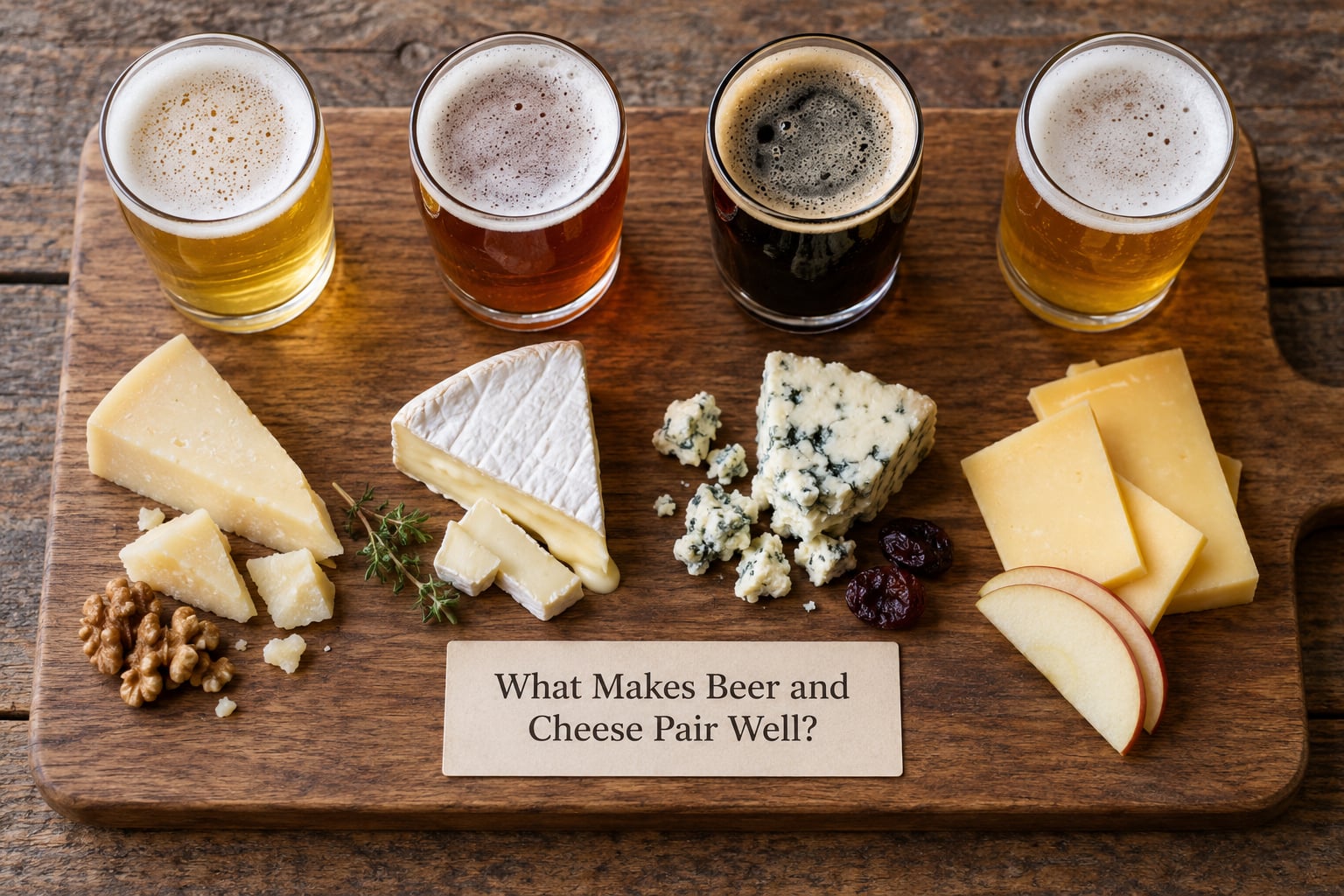
Three things are doing the work, and once you can taste them you stop guessing.
Carbonation is what beer brings that wine does not
Cheese is mostly fat and protein, and fat coats the tongue and dullens everything after it. The bubbles in a beer physically push that film aside and rinse the palate between bites. That single effect is why a crisp pilsner makes a rich, buttery brie taste like brie again by the second bite instead of like a coating.
Sour and sparkling styles carry the same advantage with a different mechanism. Acidity does to dairy what carbonation does to fat, cutting the cloying quality of a triple cream and making a young cheese taste grown-up.
Bitterness balances sweetness and richness
Hop bitterness is a counterweight. A young cheddar has a lot of dairy sweetness to it, and a plain lager either leaves that sweetness sitting there or adds to it. A moderately bitter pale ale cuts straight across it. This is the same reason people put coffee in ice cream.
Roast is the other counterweight. Chocolate, coffee, and char in a porter or stout push against a sweet or fruity cheese the same way hops do, which is why blue cheese and stout have worked as a pair for centuries.
Beer and cheese share an agricultural base
Cheese is made from milk, beer is made from grain and hops, and both come from the same farming economy. A farmhouse saison and a fresh goat cheese both taste grassy and a little barnyardish for the same underlying reason. Chefs call this the what-grows-together principle, and it is the fastest shortcut when you have no time to think.
Match intensity first, then choose contrast or echo
Two pairing philosophies get mixed up constantly, and knowing which one you are using saves a lot of bad bottles.
Echo means the beer repeats what the cheese is already saying. A nutty brown ale with an aged Gouda makes the toasty, caramel notes louder on both sides. This works beautifully when both sides are already strong.
Contrast means the beer argues with the cheese. A sharp, salty, crumbly cheese against a sweet, malty brown ale is a classic example. The contrast works best when one side is gentle and the other is assertive.
Where most people go wrong is a very mild beer next to a very strong cheese. The beer disappears entirely and the pairing tastes like eating cheese with a cold, sad sidecar. Match the weight of the two before you worry about the details.
How Do You Pair Beer with Cheese?
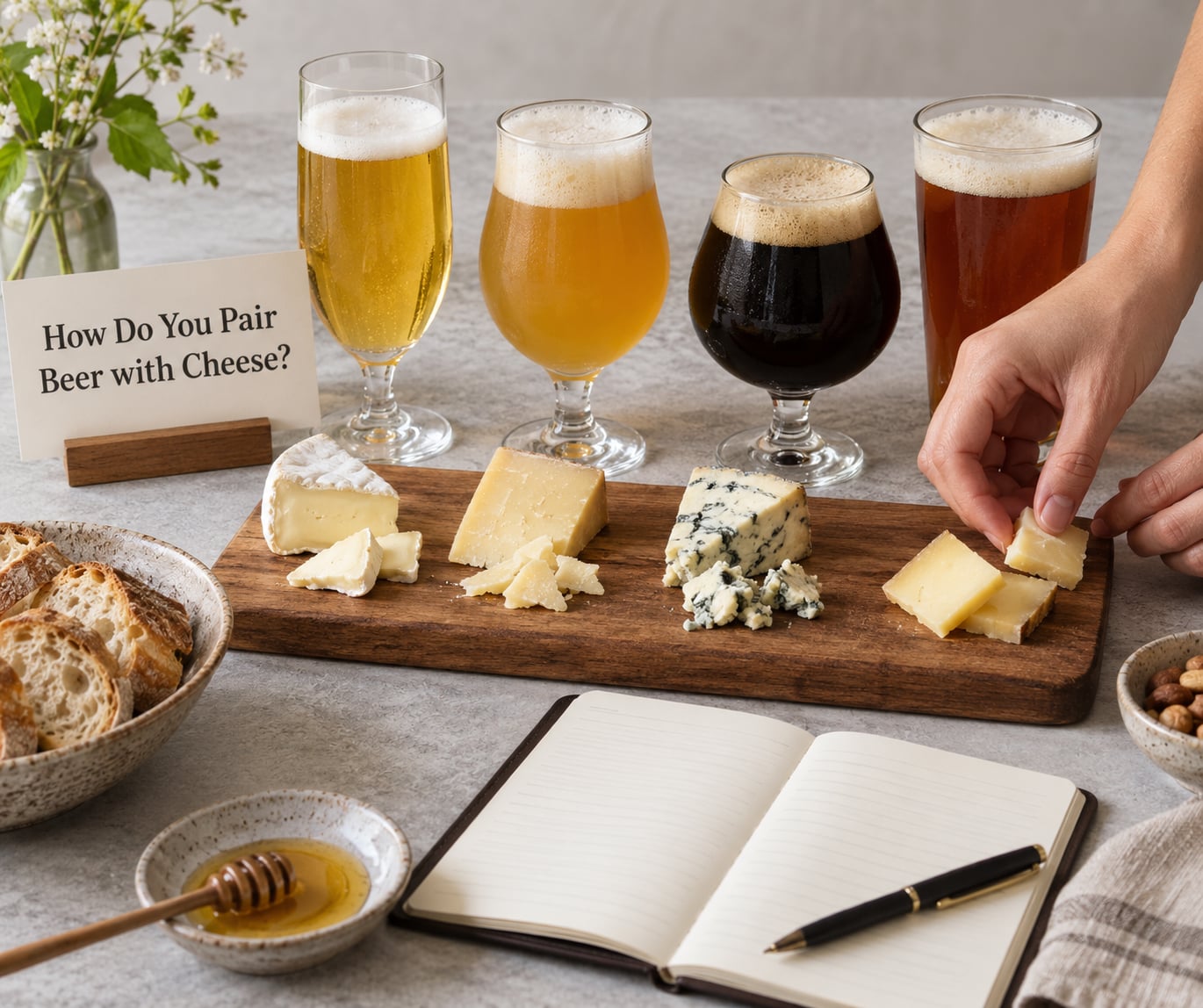
Five steps, and it works with whatever is already in your fridge. It takes about two minutes per pairing once you get used to it.
1. Start with the cheese, not the beer
This is the step people skip. Pick the cheese first, because the cheese is the thing you cannot swap out easily and because your cheese board is usually decided before anyone opens a bottle. Choosing the beer first leads you toward what you have rather than what the cheese needs.
2. Name the cheese’s dominant flavor
Say it out loud in one word. Buttery, nutty, sharp, tangy, salty, sweet, smoky, pungent, earthy, or funky. If you cannot name it, take a bite of the cheese on its own and wait ten seconds before deciding, because the flavor moves after the first bite.
That single word is your whole shopping instruction. Buttery wants a crisp, dry beer. Pungent wants something roasted or funky. Sweet wants bitterness or roast. Salty wants a beer with enough body to answer it.
3. Pick a beer that echoes or contrasts
Ask yourself which one you want. Echo a nutty cheese with a toasty brown ale. Contrast a salty, sharp cheese with something sweet and malty. Both approaches are legitimate, but they produce very different results and mixing them halfway usually gives you neither.
4. Match strength to strength
A 4 percent session lager and a 10 percent imperial stout are not interchangeable partners. A delicate fresh cheese needs a light, clean beer or it tastes like a topping. A dense, aged, salty cheese can handle a big, warming beer or it will taste thin.
Rough rule of thumb: keep the beer at or above the intensity of the cheese, and let the beer be the bigger of the two when in doubt. Nobody complains that a cheese board was too easy to drink.
5. Taste in a deliberate order
Light to heavy, mild to strong, delicate to pungent. Going backward undoes your palate and you will rate every good pairing badly. Put the mild goat cheese at the start of the flight, the washed rind and blue at the end, and take a bite of plain bread or a sip of water in between.
Beer and Cheese Pairing Cheat Sheet
Here is the reference. Find your cheese in the left column, then read across for the beer styles that handle it, the reason it works, and the temperature you want on both sides of the pairing.
| Cheese style | Best beer styles | Why it works | Serve the cheese at |
|---|---|---|---|
| Fresh mozzarella, burrata | Pilsner, light lager, saison | Clean, cold, and delicate enough that the cheese is not muted | 45 to 50 F |
| Fresh goat cheese | Saison, wheat beer, golden ale | Shared grassy, barnyard character, plus acidity for the tang | 50 to 55 F |
| Brie and Camembert | Wheat beer, saison, amber ale | Soft creaminess met by light carbonation and a touch of fruit | 60 to 65 F |
| Sharp aged cheddar | Amber ale, pale ale, brown ale | Hop bitterness and malt sweetness balance the dairy salt | 65 to 70 F |
| Aged Gouda | Brown ale, porter, barley wine | Toasty caramel notes in both, echoed and amplified | 65 to 70 F |
| Blue cheese | Stout, porter, barrel-aged ale | Roast and chocolate stand up to the salt and mold funk | 60 to 65 F |
| Washed rind, Taleggio, Limburger | Saison, Belgian pale ale, sour ale | Yeast character on the beer side answers funk on the cheese side | 60 to 65 F |
| Manchego, Parmesan, Pecorino | Amber ale, pilsner, dry farmhouse ale | Firm, salty, crystalline crumb refreshed by bubbles and dry finish | 65 to 70 F |
| Smoked cheese | Porter, smoked porter, dark lager | Double smoke reads as one flavor instead of two competing ones | 60 to 65 F |
| Cheese curds | Light lager, cream ale | Clean, mild, and bready, with nothing to fight the squeak and salt | Warm, just cooked |
A beer and cheese pairing guide organized by cheese style
Two notes on the table. First, serving temperature is doing more work than most people expect, and cold cheese is the single most common reason a good pairing fails. Second, when a style is listed, it is the family to aim for, not a specific bottle, since a well-made pilsner and a mass-market one behave very differently.
If you only remember three rows, remember these: sharp cheddar with amber ale, goat cheese with saison, and blue cheese with stout. That covers a mild option, a tangy option, and a full-on option for the same table.
12 Beer and Cheese Combinations to Try
Each of these is a real, repeatable pairing rather than a theory. Order them from lightest to heaviest if you are running them as a flight at one sitting.
| Combination | Why it works | Serving suggestion |
|---|---|---|
| 1. Pilsner and fresh mozzarella | The cleanest possible pairing. Nothing in either masks anything, and the bubbles cut the milky richness | Salt the mozzarella an hour ahead, drain it well, serve at 45 F with the pilsner at 38 F |
| 2. Saison and fresh goat cheese | Both sides are grassy, peppery, and faintly barnyardish because of what they are made from | Roll the cheese in cracked pepper and chopped herbs, serve the saison at 45 F |
| 3. Wheat beer and Brie | Soft fruit and citrus in the beer cut the creaminess, and the yeast echoes the mushroomy rind | Brie at 60 to 65 F, wheat beer at 40 F, cut into wedges so the interior is exposed |
| 4. Pilsner and aged Manchego | A dry, bitter finish refreshes a cheese that is salty and crystalline, with no sweetness to fight | Break the cheese by hand rather than slicing, serve at 68 F |
| 5. Dry farmhouse ale and feta with honey | Acidity and carbonation handle the briny salt, and the honey is echoed by the beer’s own fruit | Drizzle honey on the feta just before serving, keep the ale at 45 F |
| 6. Amber ale and sharp cheddar | Toast and caramel from the malt meet the cheese’s dairy sharpness, and the hop bitterness cuts the salt | Aged at least a year for real sharpness, cut thin, served at 70 F |
| 7. Pale ale and smoked cheddar | Two moderate strengths meeting in the middle, which is the most crowd-friendly pairing on this list | Serve both cool rather than cold, around 55 F and 40 F respectively |
| 8. Brown ale and aged Gouda | A pure echo pairing. The toasty, caramel profile in each makes the other taste more like itself | Let the Gouda sit out 30 to 45 minutes, pour the brown ale at 50 F |
| 9. Belgian pale ale and washed rind cheese | Fermented fruit and pepper in the beer answer the funk on the rind | Taleggio at 62 F, ale at 45 F, and expect a stronger aroma than you expect |
| 10. Porter and Gorgonzola or Stilton | Coffee, chocolate, and roast hold their own against salt and mold, where a light beer would vanish | Porter at 55 F, cheese at 62 F, a small bite of dark chocolate alongside |
| 11. Imperial stout and aged cheddar | Roast intensity matches the cheese’s own concentration, and the beer’s bitterness handles the salt head on | Both at their proper temperatures, stout at 55 F, cheese at 70 F, tiny portions |
| 12. Sour ale and Havarti or young Gouda | Lactic acidity in the beer and lactic tang in the cheese mirror each other, and the bubbles cut the cream | Sour at 40 F, cheese at 55 F, add pickled onion or a little hot honey |
Number 6, amber ale and sharp cheddar, is the one to serve first at a party. Tasting groups tend to call brown ale and cheddar the never-fail starting point, and goat cheese gets named most often when the crowd is mixed and you cannot control who shows up. Build outward from those two and you will not lose anybody.
Which Beer Style Works Best with Cheese?
Beer families have different jobs. Knowing the job makes the pairing decision fast.
Lagers and pilsners
Low bitterness, high carbonation, very clean. They are the best partner for mild and delicate cheeses: fresh mozzarella, young Gouda, chèvre, mild cheddar, Parmesan. They handle butter and cream better than anything else.
They get overwhelmed by anything pungent. Put a pilsner next to a washed rind and you will taste only the rind.
Wheat beers
Soft, fruity, slightly citrusy, with a creamy mouthfeel. They are close cousins of Brie and Camembert because the yeast character in the beer mirrors the bloomy rind on the cheese. Wheat also handles feta and tangy fresh cheeses well.
A heavy, wet-hopped wheat beer goes wrong with hard aged cheese because the sweetness piles on top of the saltiness.
Pale ales and bitters
Moderate bitterness with a dry finish and a firm malt backbone. This is the most versatile family on the board. Sharp cheddar, medium Gouda, mild blue, and most English-style hard cheeses sit happily here.
This is the style to reach for when you do not know what to do, because it has enough bitterness to cut richness and enough body to be noticed.
IPAs
High bitterness, strong hop aroma, dry finish. IPAs pair by contrast, and the question is which kind of cheese you are contrasting against.
Sharp and salty aged cheddar is the classic partner, because the bitterness and the salt push each other rather than compete. A mild, creamy cheese vanishes entirely. A very sweet cheese also disappears, because all you taste is hops.
New England IPAs are the exception, because their low bitterness and heavy fruit lean them toward washed rind and funky cheeses rather than sharp ones.
Ambers and brown ales
Medium to high malt, low to moderate bitterness, caramel and toasty notes. These are the echo specialists. They make cheddar taste more like cheddar and Gouda more nutty, and they keep a cheese’s sweetness readable rather than heavy.
Watch the very malty high-alcohol versions. Barley wines are effectively dessert, and they push sweet cheeses into syrup territory.
Porters and stouts
Roast, coffee, chocolate, sometimes smoke, low bitterness, full body. They are built for strong, salty, fermented, or moldy cheeses: blue, Gorgonzola, Stilton, aged cheddar, smoked cheese.
They are a bad match for fresh dairy. A stout next to mozzarella is a glass of coffee beside a puddle.
Sours and wild beers
Sharp acidity, funk, sometimes Brett-derived earthiness. They are the natural answer to the funkiest cheeses on the board, including washed rinds, goat, Havarti, and young Gouda.
The clash to watch for is a sweet cheese with a very tart beer. Pickles and honey with a kettle sour is a fun exception, not a rule.
How Do You Taste Beer and Cheese Together?
Tasting a pairing is a sequence, not a single moment. Doing it in order tells you which side is winning.
Start with aroma. Sniff the beer on its own and note citrus, pine, bread crust, roast, fruit. Then smell the cheese. The aromatic overlap is often where a successful pairing announces itself.
Taste the cheese alone, then the beer alone, on the same piece of something neutral. A small bite of plain bread or a few unsalted crackers between them resets your palate so you are not carrying one flavor into the next.
Then combine. Take a bite of cheese, a sip of beer, and let them sit together rather than chewing and swallowing immediately. Hold it for a few seconds and pay attention to the middle of the palate, which is where fat, bitterness, and carbonation meet.
Go back and take a second bite with no bread. The first bite of a pairing tells you about the first impression, and the second tells you about the balance. Most failed pairings fall apart on the second bite, which is why the second bite is the one that counts.
I keep a notebook on the counter next to the tasting board, and the second-bite column is the one that tells me whether a pairing was genuinely good or just interesting for thirty seconds. Write down four things if you are keeping notes: did the beer disappear or dominate, did the bitterness feel balanced or harsh, did the finish stay long and clean or turn chalky, and would you order this again. That is enough to tell you why a pairing worked later.
What Temperature Should Beer and Cheese Be Served At?
Temperature changes perception more than almost any other variable, and it changes the cheese more than the beer. Cold cheese is firm, chalky, and muted in aroma. Warmed up 20 degrees, the same cheese smells like something and tastes like something else.
For beer, the range is narrower than most people think. Serve lagers and pilsners around 38 F, wheat and pale ales at 40 F, IPAs at 42 to 45 F, sours at 40 F, amber and brown ales at 50 F, and porters and stouts between 52 and 58 F. Serving a stout straight from a cold fridge is the most common temperature mistake people make, and the roast flavors simply do not open up.
For cheese, the guidance splits by type. Soft-ripened cheeses like Brie and Camembert want 60 to 65 F. Washed rinds want about 62 F, since the aroma is the point. Blue cheese works at 60 to 65 F, where the salt and the funk both have something to give. Firm cheeses, which means cheddar, Gouda, Manchego, and Parmesan, want 65 to 70 F.
That means taking firm cheeses out of the fridge 30 to 45 minutes ahead. It sounds like a small thing and it is the single biggest upgrade you can make to a cheese board.
On handling, keep cut cheese refrigerated until shortly before serving and use a separate board for dairy, since a porous wooden board holds moisture and smell and can turn a clean tasting into a muddy one. Follow the same storage guidance you would for any dairy: keep it sealed, keep it cold, and use it within a week of cutting.
Common Beer and Cheese Pairing Mistakes
Every one of these is fixable, and all of them show up at real gatherings.
Pairing a delicate beer with a strongly flavored cheese
A light lager next to a pungent washed rind is the most common failure. The cheese is a fire and the beer is a candle. Fix: either move to a beer with matching body and character, or soften the cheese by serving a milder variety alongside the strong one so people have a way in.
Serving everything too cold
Straight-from-the-fridge cheese dulls the pairing and cold stout suppresses its aroma. Fix: pull firm cheeses out 30 to 45 minutes ahead, and stop refrigerating brown ales, porters, and stouts 20 minutes before you pour them.
Reading bitterness as balance
People expect an IPA to taste harsh with cheese and assume that means it is a bad match. Often the beer is fine and the cheese is too sweet. Fix: try a sharper, more aged, more salty cheese with the same IPA before you blame the beer.
Choosing a washed rind for a first impression
Taleggio and Limburger have no universal pairing, and the aroma can lose you half a room before anyone takes a bite. Fix: keep them for the end of the flight, serve them with something mild nearby so there is an escape, and pair them with a saison or sour rather than a clean lager.
Tasting too large a portion
A big cold bite of cheese and a full mouthful of beer is too much fat and alcohol at once, and you cannot taste anything. Fix: cut cheese smaller than feels reasonable, about the size of a thumbnail, and sip rather than gulp. Small portions are also the right portion for a party anyway.
Serving a flight in the wrong order
Starting with the blue and ending with the goat cheese means the whole second half of the tasting tastes flat. Fix: light and mild first, strong and funky last, always. It takes five seconds to plan and it changes the entire impression of the evening.
Underestimating how much people eat
Hosts consistently run out. For a casual gathering, plan on roughly 2 to 3 ounces of cheese per guest plus a bit extra, and buy one more block than you think you need. A hard cheese lasts; a soft-ripened one will be gone in an hour.
Frequently Asked Questions
Is beer and cheese a good combination?
Yes, and it is arguably more natural than wine with cheese. Carbonation cuts through the fat in almost every cheese, hop bitterness balances the dairy sweetness in aged varieties, and both are made from agricultural products of the same land. Match intensity first: a light lager suits a mild cheese, and a stout or porter suits a strong, salty one.
What cheese pairs best with an IPA?
Sharp, salty, aged cheddar is the best-known match, because its salt and its acidity stand up to hop bitterness instead of being buried by it. Medium-aged Gouda and a hard, crumbly Alpine style also work. Avoid mild, creamy, or very sweet cheeses, which disappear completely under a hoppy beer. Serve the IPA around 42 to 45 F and the cheese near 70 F.
What cheese should I serve with a stout?
Strong, salty, fermented cheeses handle roast best: blue cheese such as Stilton or Gorgonzola, aged cheddar, or a smoked cheese. Coffee, chocolate, and char in the stout stand up to the salt and the mold funk instead of being overwhelmed by it. Keep the stout at 52 to 58 F rather than ice cold, and serve the cheese at 60 to 70 F so the aroma opens up.
Can I use a light lager with cheese?
A light lager is an excellent partner for mild cheeses: fresh mozzarella, young Gouda, chèvre, mild cheddar, feta, or Parmesan. Its clean flavor and lively carbonation refresh the palate without adding anything of its own. The limitation is strength, since a delicate lager gets lost next to a washed rind, a blue, or a long-aged cheddar. Move up to a pale ale or amber if the cheese is assertive.
How do I build a beer and cheese board for a group?
Choose five cheeses in ascending order of intensity, for example fresh goat, Brie, aged Gouda, sharp cheddar, and blue. Buy 2 to 3 ounces of cheese per guest plus a little extra, cut firm cheeses into small cubes, and let everything sit out 30 to 45 minutes before serving. Bring one lighter beer, one amber or brown, and one dark style, and taste from mild to strong.
Does cheese need to be at room temperature for pairing?
It matters more than most people expect. Cold cheese is firm, chalky, and muted in aroma, which flattens the pairing even when the beer is a good match. Take firm cheeses such as cheddar, Gouda, and Manchego out of the fridge 30 to 45 minutes ahead. Soft-ripened and washed rind cheeses need about 20 minutes. Keep everything refrigerated until shortly before serving for food safety.
Conclusion
Start with the cheese, name its dominant flavor, and pick a beer of at least equal intensity. Echo it for nutty and caramel flavors, contrast it for sharp and salty ones, and let temperature do the rest.
Your first night should go light to dark: a crisp lager or a saison with a mild goat cheese, then an amber ale with a sharp cheddar, then a stout with a blue to finish. Write down what you liked, because the next board is a lot of fun to build.