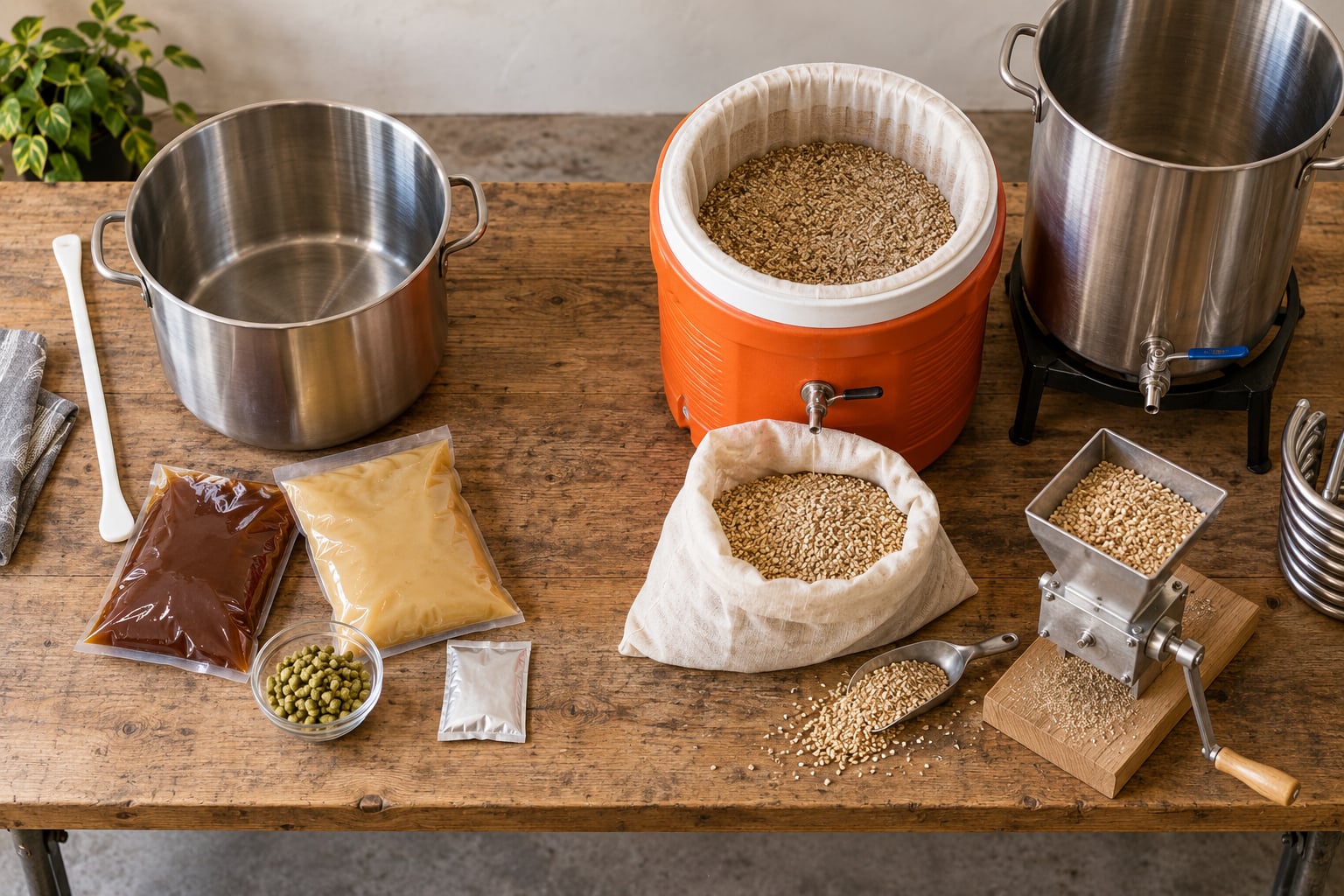
Extract vs all grain brewing is one question, and the whole answer fits in a single sentence: both methods boil wort with hops and ferment it with yeast the same way, and the only real difference is where the fermentable sugar comes from — a bag of malt extract that a commercial maltster made for you, or a mash you convert from crushed grain yourself. Everything after the boil is identical.
That matters more than most first-time brewers expect, because it decides your brew day length, your equipment footprint, your ingredient bill per batch and how much control you have over malt character. It does not decide whether your beer is good.
Here’s the short version before the detail:
- Extract brewing gets a fermentable wort on your stove in about 60 minutes with a pot, a thermometer and a brew kit. It is the fastest, cheapest and most repeatable way to make your first beer.
- All-grain brewing starts from crushed malted grain, so you mash, lauter, sparge and boil. It costs more up front, takes longer, and gives you full control over the malt side of the recipe.
- Neither one makes better beer by default. The honest, repeated consensus on r/Homebrewing and Homebrew Talk is that a well-run extract batch beats a sloppy all-grain batch every time, and plenty of brewers never switch at all.
Table of Contents
- Extract vs All Grain Brewing at a Glance
- What Is Extract Brewing?
- LME vs DME: what extract should you buy?
- How much extract for a five-gallon batch?
- What Is All-Grain Brewing?
- How much grain for a five-gallon batch?
- How hard the switch really is
- Flavor, Control, and Recipe Differences
- What actually changes in the glass
- Consistency, final gravity, and the sweet finish problem
- Partial mash and BIAB: the middle path most beginners skip
- Water chemistry still matters, even without a mash
- Hopping and bitterness behave differently in each method
- What extract cannot replicate
- Can a taster tell extract from all grain?
- Where beginners actually lose beer
- Equipment and Ingredients
- Cost, Time, and Troubleshooting
- Side-by-side brew day timeline
- Common problems and their fixes
- Keep a brew log, whichever method you use
- Which Brewing Method Should You Choose?
- Frequently Asked Questions
- Is all-grain beer better than extract beer?
- What equipment do I need to start extract brewing?
- Can I move from extract brewing to all-grain brewing?
- Is all-grain brewing harder than extract brewing?
- Does extract brewing produce less alcohol than all-grain brewing?
- Which brewing method is cheaper for a beginner?
- Start With the Beer You Want to Drink
Extract vs All Grain Brewing at a Glance
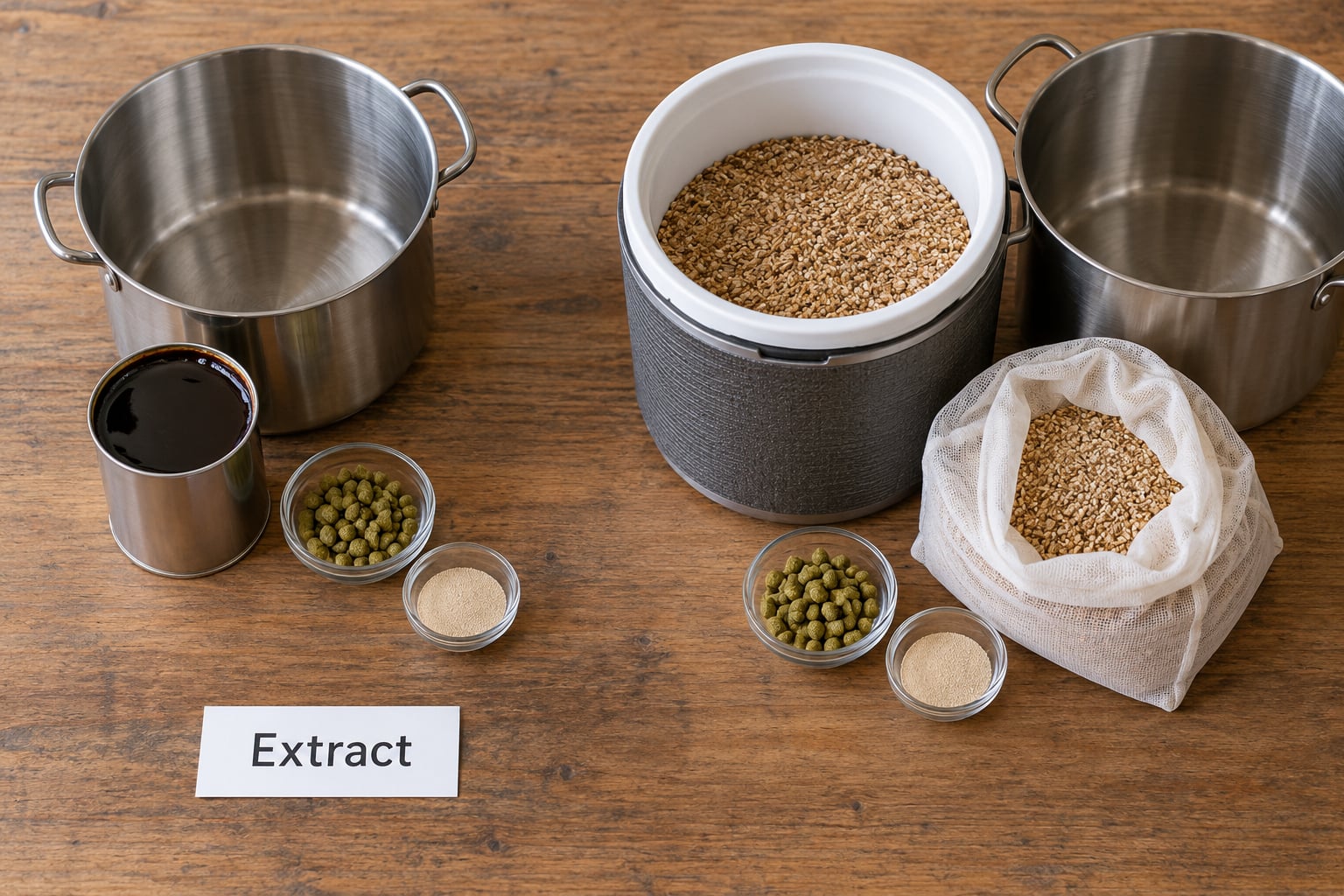
The table below is the fastest way to compare extract vs all grain brewing if you only have a minute. Each row is a criterion beginner brewers actually argue about.
| Criterion | Extract brewing | All-grain brewing |
|---|---|---|
| Source of fermentable sugar | Malt extract (LME or DME) already mashed and dehydrated by a maltster | Crushed malted grain mashed in your own vessel |
| Brew day length | Roughly 2 to 3 hours including cleanup | Roughly 4 to 6 hours for a two-vessel or BIAB batch |
| Startup equipment | Kettle, thermometer, fermenter, Airlock, bottle or keg setup | Everything in extract plus a mash tun or bag, a mill or crush source, and lautering or sparging gear |
| Storage footprint | A few pounds of extract, hops and yeast | Grain sacks, a larger water-heating footprint, more vessels to wash and store |
| Ingredient cost per batch | Higher per batch, and it climbs if extract is old or stored badly | Lower per batch, and it stays lower the more you brew |
| Consistency | Very repeatable if the extract is fresh; the weak link is freshness | Repeatable once your process is dialed in; mash efficiency drives the result |
| Control over malt character | Limited — you pick from base, specialty and pre-hopped extract | Full — mash temperature, grist ratios, specialty grains, step and decoction mashing |
| Learning curve | Shallow. Fermentation, sanitizing and packaging still take practice | Steep for the first three or four batches, then flat |
| Space required | Works in a small apartment or a closet brew cave | Harder in a small space; water and drainage matter more |
| Best use case | First batches, tight schedules, hop-driven beers, brewers in small spaces | Chasing advanced styles, low long-run cost, learning the full process |
One row deserves a nudge: brew day time. Two to three hours for extract versus four to six for all-grain is not a small difference when you have a job and the mash starts heating at six in the morning.
A second row gets debated more than it should: learning curve. Extract is easier to start, not easier to master. All grain adds more variables on day one, then eventually stops surprising you. Extract stays simple forever, which is a real advantage if simple is what you want.
What Is Extract Brewing?
Extract brewing means you skip the mash. A commercial maltster crushes malted grain, runs hot water through it to convert the starches into sugar, strains the liquid, then boils and dehydrates it. What lands in your bucket is a thick, dark, syrupy concentrate of exactly the sugars and flavors that mashing would have produced.
On brew day you heat water in a kettle, add hops, then add the extract late in the boil to limit scorching. You cool the wort, pitch yeast, and the process from there on is the same one an all-grain brewer follows.
Extract earns its reputation as a beginner method for practical reasons. A two-hour brew day, no mash tun, no sparging to learn, and a much lower chance of a ruined first batch. The cost is that you inherit decisions somebody else made for you — the malting, the kilning, the crushing.
LME vs DME: what extract should you buy?
Liquid malt extract is a thick syrup you pour in late in the boil. Dry malt extract is a bag of powder, cheaper per pound, and it will foam and boil over if you dump it into a rolling boil.
| Factor | Dry malt extract (DME) | Liquid malt extract (LME) |
|---|---|---|
| Form | Flakes or powder in a bag | Thick syrup in a jug or pail |
| Cost per pound | Lower | Higher |
| Boil behavior | Foams hard; add it late and cut the heat or whisk it in | Pours in cleanly near the end of the boil |
| Flavor contribution | Clean, very little caramelization risk when added late | Clean when added late; scorching happens fast above a hard boil |
| Best use | Budget batches, high-gravity styles, quick corrections | Batches where you want straightforward, low-risk additions |
If you are new, buy small jugs and add them in the last fifteen minutes with the heat turned down. Scorched dark wort tastes of raw sugar and burnt toast and it does not fade with age.
How much extract for a five-gallon batch?
For a 5-gallon batch targeting an original gravity near 1.050, most recipes call for roughly 10 to 12 pounds of dry malt extract, or a comparable volume of liquid malt extract by weight rather than by jug. Work from your recipe’s gravity target rather than a rule of thumb, and use a hydrometer or refractometer before and after the boil so you know what you actually hit.
What Is All-Grain Brewing?
All-grain brewing means you do the maltster’s job at home, on a much smaller scale. You crush malted grain into a mash tun or a brew bag, heat strike water to temperature, mash it, then lauter and sparge to rinse the sugars out into your kettle. Everything after that — the boil, the chill, the fermentation — matches what an extract brewer does.
The vocabulary is worth learning up front, because these are the terms you will meet in every forum thread and recipe:
- Mashing — soaking crushed grain in hot water at a controlled temperature long enough for enzymes to convert starch into fermentable sugar.
- Mash tun — the vessel that holds grain and wort during mashing. A grain bag in your kettle works the same way at smaller scale.
- Strike water — the hot water you pour into the grain to hit your target mash temperature.
- Lautering — draining the wort off the grain bed, either through the tun’s drain or by lifting the bag.
- Sparging — rinsing the spent grain with more hot water to pull out the sugars still held in the bed.
- Spent grains — what is left in the bag when you are done. Compost them; they make decent garden mulch.
Systems differ mainly in how they handle temperature and lautering. A two-vessel system moves wort by gravity between a mash tun and a kettle, and it needs hot water on tap for sparging. A BIAB setup uses one kettle and a grain bag, stripping and bag-squeezing wort out at the end. A RIMS or HERMS rig recirculates wort through the grain and heats it in the same kettle, which saves energy and keeps temperatures steady.
How much grain for a five-gallon batch?
A standard five-gallon all-grain batch runs about 9 to 11 pounds of grain, usually 80 percent or more of it a base two-row or pale malt with the balance specialty. Same rule as extract: start from your target original gravity and work backwards. A pale ale near 1.050 needs roughly 10 to 11 pounds, and a big imperial needs considerably more, which is harder to hit with grain because you cannot add sugar late the way you can with dry extract.
Mash efficiency is the number that separates good all-grain beer from thin all-grain beer. It describes how much of the grain’s potential sugar you actually pulled into the wort, and a beginner landing around 70 percent is normal. Crush consistency is the biggest single lever you control, so if you buy only one all-grain accessory, make it a mill with an adjustable crush.
For a beginner moving out of extract, BIAB is the shortest path. It teaches you mashing, strike temperature and sparging without asking you to plumb anything.
How hard the switch really is
The honest answer from people who have crossed over: it is more time-consuming than difficult. Your fermentation, packaging and cleaning routine does not change at all, and you already have the single most important skill, which is keeping contamination out.
What is new is temperature management and reading wort. Give yourself three or four batches before you judge the method, keep a written note of every mash temperature and gravity, and resist the urge to upgrade again mid-learning. Most brewers who got stuck were the ones who bought a full three-vessel system before they trusted a bag.
Flavor, Control, and Recipe Differences
Here is where people expect a sermon about quality, so let me be blunt: the difference between a good extract beer and a good all-grain beer is mostly craft, not category.
What actually changes in the glass
Malt flavor in an extract beer was created by the same enzymes at similar temperatures you would use at home. A base pale extract with a clean bittering addition gives you a clean, crisp malt character. A six-year all-grain brewer who tried both forms of extract reported clean, crisp malt flavor from each, with only slight differences between them.
Where all-grain opens doors is composition. You choose the grain bill — a percentage of pale two-row, a portion of Munich for bread crust, wheat for a hazy body, roasted barley for a stout. Mash temperature changes the balance between body and crispness. Specialty and steeping grains that would never survive as a packaged extract can be dosed straight into the mash.
Extract closes those doors. You can build specialty character by steeping a small bag of grain in the kettle before the boil, then diluting that with a light base extract. Several extract brewers report that approach gives them better batch-to-batch consistency than flavored extracts, because the base stays neutral and the color and flavor come from a measured dose.
Consistency, final gravity, and the sweet finish problem
Some extract brewers notice their beer finishing at a higher final gravity than an equivalent all-grain batch, which tastes thin and faintly sweet. The usual causes are extract that has absorbed oxygen or gone stale, hop bitterness that is unbalanced against a thin wort, or a yeast strain that simply ran out of tolerance. A hydrometer reading at bottling settles the argument; a refractometer reads wrong once fermentation starts, so do not trust it at the end.
There is one community trick worth knowing. You can sample wort mid-boil with a refractometer to see where your gravity actually landed, then correct before you cool. That correction is far easier with dry malt extract than with grain, because grain changes have to happen in the mash.
Batch-to-batch inconsistency in extract usually traces back to how the extract was handled before it reached your kitchen — heat, light, age and oxygen are the four culprits on every Homebrew Talk thread about advanced extract. Store sealed jugs and bags cool, dark and dry, and buy quantities you can finish inside a few months.
Partial mash and BIAB: the middle path most beginners skip
There is a third option that gets almost no coverage in beginner guides. A partial mash uses a small amount of steepable or crushable specialty grain — a pound or two — steeped or mashed before you dilute it with a light base extract. You get a real steeping or mashing step, more specialty grain control, and the ability to brew styles that plain extract cannot do.
Partial mash brewers describe it plainly: much of the flexibility of all grain, some of the convenience of extract. If your goal is to move toward all grain without buying a full rig or committing a whole Saturday, this is the step most people skip and regret skipping later.
Water chemistry still matters, even without a mash
The common claim that extract brewers can ignore water is only half true. You have no mash pH to manage, so mineral additions are simpler, but your tap water still shapes the finished beer. High carbonate levels push the pH up and mute hop bitterness in a way that tastes flat, and dark beers are where this shows most because roast character hides less of an alkaline profile than people expect. A small dose of crushed gypsum or calcium chloride in the kettle fixes most municipal water complaints for extract brewing.
Hopping and bitterness behave differently in each method
Bitterness is measured in international bitterness units, and it is calculated from hop weight, alpha acid percentage and boil time. Because the two methods reach the same gravity with similar wort volumes, the calculation itself barely changes. What does change is how aggressively the wort perceives it. A thin extract wort makes the same number of IBUs taste sharper, while a fuller all-grain mash can carry the same bitterness with more roundness, so experienced brewers often use slightly more hops on lighter extract worts than the formula suggests.
Late hopping matters more in extract than anywhere else. Those last ten minutes before the flameout, after the kettle comes off the burner, carry most of the aroma. Adding extract late for the same reason: once the flameout starts, there is no boil left to scorch it.
What extract cannot replicate
Some techniques are out of reach no matter what brand of extract you buy:
- Step mashing, where you raise mash temperature mid-process for better body and fermentability.
- Decoction mashing, common for German lagers and wheat beers, which pulls a portion of the mash out, heats it and returns it.
- Precise specialty grain ratios inside the main fermentable base.
- Water chemistry adjustment tied to a real mash pH, since there is no mash to adjust.
Can a taster tell extract from all grain?
Usually not in a blind test. One brewer reported that his extract beer consistently outshouted his own mini-mash attempts in blind preference, which is about as direct an endorsement as the method gets.
A sloppy all-grain batch with a poor mash is a different story, and so is extract beer made from a stale pre-hopped kit that tastes like the kit. Tasters pick up process errors long before they pick up methods.
Where beginners actually lose beer
Not at the mash step. In both methods, the same things sink first batches: fermentation temperature that runs warm, oxygen pulled in during transfer, packaging at the wrong terminal gravity, and a bottle that tastes like a cardboard box because it sat four weeks too long. None of those problems are specific to one method or the other.
That is the useful thing to take away from comparing methods. Once you can hold a fermentation at temperature and package on time, you are already ahead of most first-year brewers, whichever way you sourced your sugars.
Equipment and Ingredients
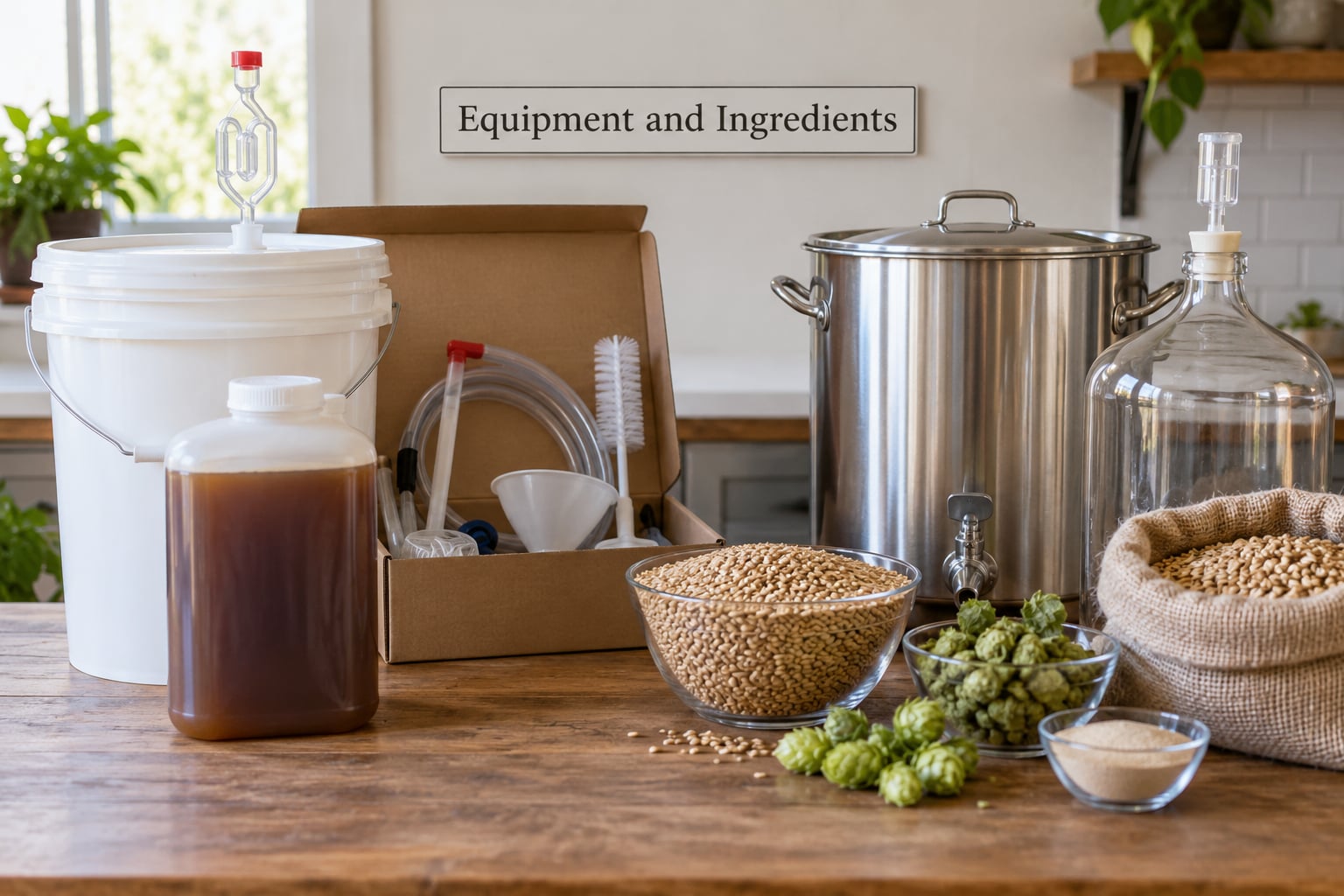
Extract needs very little. A kettle with enough headroom, a thermometer, a fermenter with an Airlock, and a bottling or keg setup is genuinely the whole list. Add a second large pot and a brewing bag and you can make beer in a small apartment with a sink and an outlet.
All grain adds a distinct layer on top: a mash tun or a brew bag, a way to heat strike and sparge water, a grain mill or a crush source, a reliable method of lautering, and somewhere to put the spent grain. Space and drainage become planning problems, and that is where a lot of would-be all-grain brewers quietly stay on extract instead.
Several experienced brewers say outright that they never intend to switch, because extract fits their budget, their time allowance and their brew cave. If yours is an eight-by-twelve corner, that is a legitimate answer rather than a compromise.
On ingredients, keep one rule: freshness beats brand. Grain stored cool and dry keeps for months; extract that has sat in a warm closet for a year will dull your beer no matter who made it.
Storage is where extract brewers lose ground quietly. Seal bags and jugs airtight, keep them away from heat and light, and avoid opening a jug you plan to finish over several months. Dry extract also picks up moisture, which turns lumps that dissolve slowly and can scorch the wort. If your extract came in a pre-hopped kit, the hops are aging too, and hop aroma is the first thing to go stale in the package.
All-grain storage is bulkier but forgiving: sacks of grain in a sealed bin in a cool room last for months, and a grain mill is an inconvenience rather than a requirement. What all-grain does add is cleanup. Spent grain, bag handling and one more vessel to wash add up to more sink time than the four-to-six-hour brew day suggests.
Cost, Time, and Troubleshooting
Here is the honest cost picture, described by relationship rather than by sticker numbers, since retail pricing moves constantly.
- Upfront: extract wins clearly. A first-batch setup is a fraction of what a capable all-grain system costs.
- Per batch: all grain wins, and the gap widens every batch. Homebrewers brewing at volume repeatedly report grains and yeast costing a fraction of the equivalent extract, with hops a smaller variable cost when bought in bulk.
- Break-even: if you brew steadily and would buy grain and yeast anyway, the equipment difference is typically recovered within a year or so of batches. If you brew six batches a year, it may never be recovered.
Side-by-side brew day timeline
| Step | Extract brew day | All-grain brew day |
|---|---|---|
| Heat water | 15 to 20 minutes | 30 to 45 minutes to cover strike and sparge volumes |
| Mash | None | 60 minutes at temperature, plus strike and lautering time |
| Sparge | None | 15 to 30 minutes |
| Boil | 60 minutes, extract added late | 60 to 90 minutes, first hops timed as usual |
| Chill and transfer | 20 to 30 minutes | 30 to 45 minutes, more volume to move |
| Total active time | About 2 to 3 hours | About 4 to 6 hours |
Common problems and their fixes
- Scorched or dark, burnt-tasting wort: you added the full extract amount at the start of a hard boil. Add it late, cut the heat, and whisk it in.
- Boil-over: dry extract hitting a rolling boil. Add it with the burner off or turned down, in small portions.
- Extract beer finishing sweet: check extract age and storage first, then verify your final gravity with a hydrometer, then check yeast temperature and attenuation.
- All-grain beer running high or thin: check mash temperature against your target, check your water, and confirm your mash rested long enough before lautering.
- Inconsistent all-grain results: crush consistency and mash rest length are the two variables most brewers overlook.
- Tasting like a kit: pre-hopped extract is doing exactly what it says. Switch to base extract and add your own hops.
- All-grain beer stuck at a high gravity: mash temperature was low, the crush was too fine and the run-off never sparged. Check all three before blaming the yeast.
- Extract batches that wander from brew to brew: measure the extract rather than trusting the bag, and check that your kettle markings still mean what they used to.
Keep a brew log, whichever method you use
A notebook or a spreadsheet costs nothing and settles most arguments before they become arguments. Record the lot number and date of every bag of extract, your pre-boil and post-boil gravity, the boil time, the fermentation temperature and the packaged gravity.
Do it for five batches and you will have an answer to almost any question about your own beer, including the ones you think are about extract versus all grain. Most inconsistency turns out to be a measurement you skipped rather than a method you chose.
Which Brewing Method Should You Choose?
Pick extract if this is your first batch, your brew space is a closet or a kitchen corner, you need beer on a schedule, you mostly want to drink hop-forward beers, or you would rather spend money on good ingredients than on hardware. Pick all grain if you want the full process, you care about step or decoction mashing, you plan to brew often enough that per-batch cost matters, and you have a place to keep a kettle and a grain vessel.
If you are somewhere in between, take the partial mash route. It gets one sentence in most guides, and it is the honest middle.
The person who brews forty good batches of extract is further along than the person who made one all-grain batch and quit.
Frequently Asked Questions
Is all-grain beer better than extract beer?
No, not automatically. All grain gives you more control over malt character and specialty grains, but a well-made extract batch is indistinguishable from all grain in a blind taste test. The deciding factors are freshness, sanitation and whether you hit your target gravity. A sloppy all-grain batch loses to a careful extract batch every time.
What equipment do I need to start extract brewing?
Less than most people expect: a brew kettle, a thermometer, a fermenter with an Airlock, yeast, hops and extract, plus a bottling or keg setup. A large stockpot works if it leaves headroom for foaming. You do not need a mash tun, a mill or a sparge rig to make excellent extract beer.
Can I move from extract brewing to all-grain brewing?
Yes, and brewers who have made the switch describe it as more time-consuming than difficult. Start with a brew-in-a-bag setup so you only learn one new skill at a time. Keep your fermentation, packaging and sanitation habits, which are already correct, and add mash temperature control and lautering to your routine.
Is all-grain brewing harder than extract brewing?
It is a longer process with more variables, so expect a steeper first month. Mash temperature, crush consistency, sparging and lautering all affect the result, and each takes practice to dial in. Most brewers report the learning curve flattens after three or four batches. Extract brewers already know fermentation and sanitation, which removes much of the fear.
Does extract brewing produce less alcohol than all-grain brewing?
Not inherently. Alcohol comes from fermentable sugar, and if both methods hit the same original gravity, the finished alcohol is the same. Extract brewers whose beer tastes thin usually have a higher final gravity from stale extract, an unbalanced bitterness level, or yeast underperforming. Check your gravity with a hydrometer to find out which it is.
Which brewing method is cheaper for a beginner?
Extract is cheaper to start because the equipment list is far shorter. All grain is cheaper per batch, and that gap grows with volume since grain and yeast cost less than the equivalent extract. If you only brew a few batches a year, extract stays cheaper overall. If you brew steadily, all grain usually pays back the extra equipment within about a year.
Start With the Beer You Want to Drink
Decide what you want in the glass first. If you want a clean pale ale with a hop bite, a fresh can of base extract will get you there this weekend for less money and about a third of the brew day. If you want to understand mashing, chase advanced styles, and brew often enough that per-batch cost matters, buy a bag and start there.
Either way, brew something in the next two weeks. The gap between the two methods is real, but it is much smaller than the gap between a batch you actually make and a batch you keep planning.