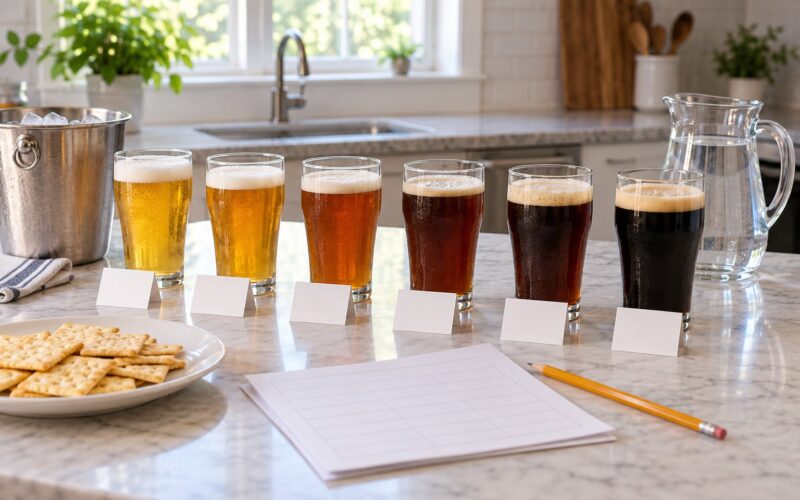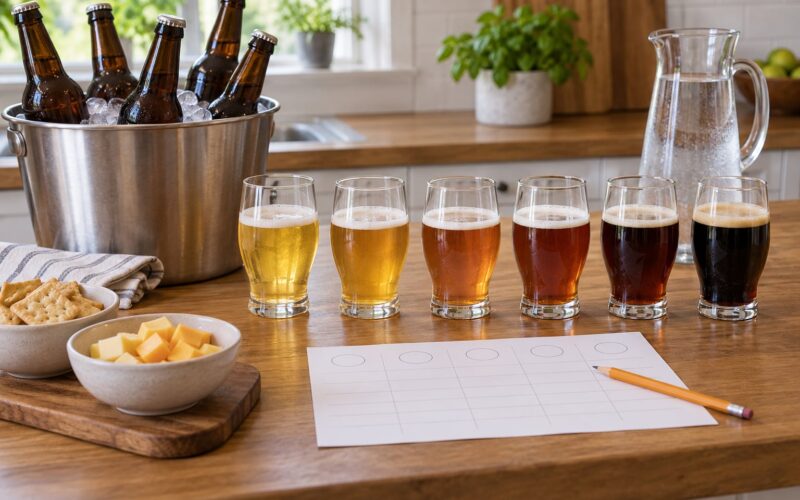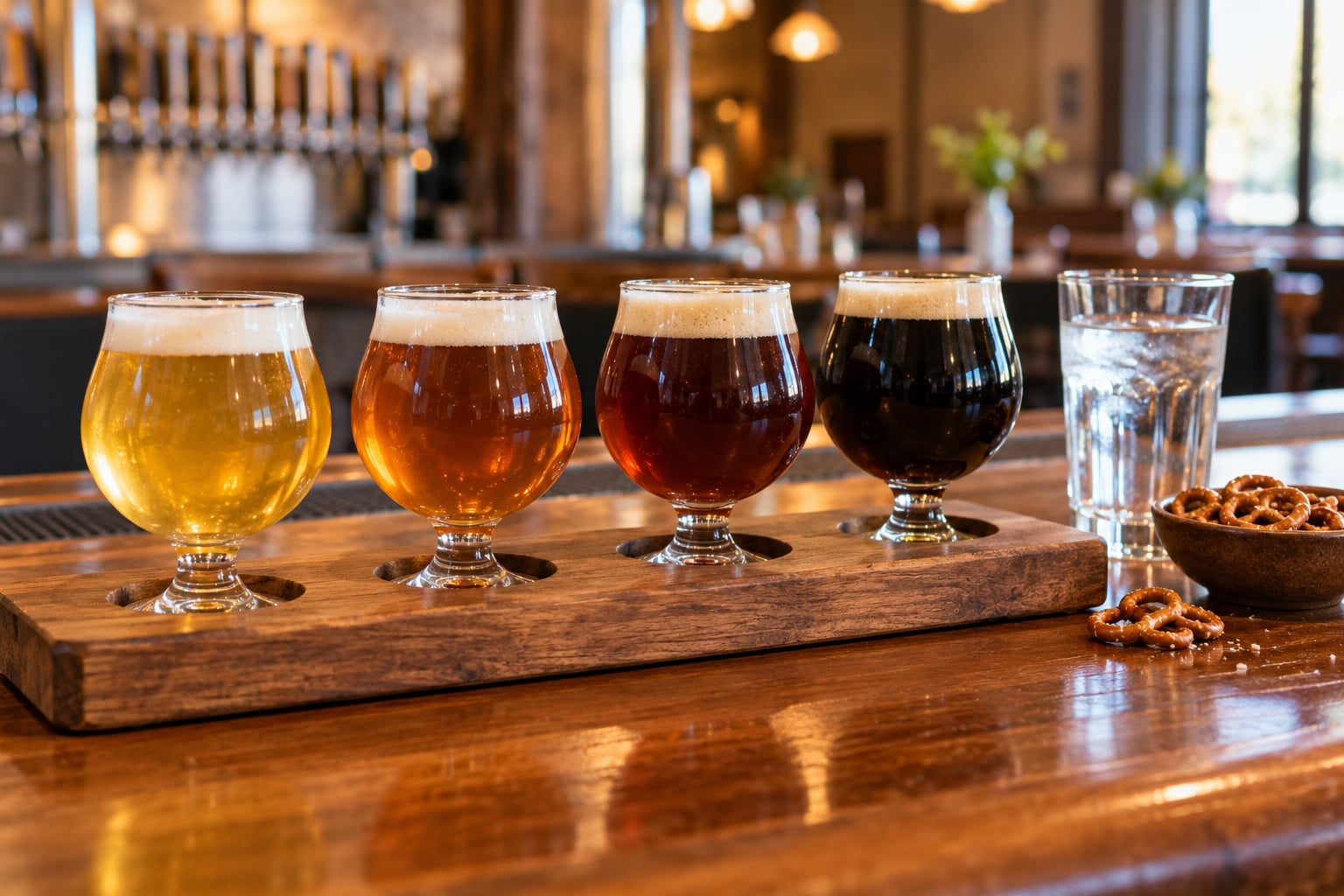
How many beers in a tasting flight? A typical flight comes with four samples, and most flights run somewhere between three and six. Each sample is a taster of about 2 to 6 ounces rather than a full 12-ounce glass, so a standard four-beer flight adds up to roughly a pint of beer in total, not four pints.
The count is not a fixed rule, and that is where most confusion starts. A taproom, a neighborhood bar and a beer festival will each hand you a different amount of beer on the same paddle, so the useful answer is always a count plus a pour size.
Table of Contents
- How Many Beers in a Tasting Flight?
- What Counts as a Beer in a Tasting Flight?
- How Many Ounces Per Beer in a Flight?
- Why Flight Sizes Vary by Brewery and Bar
- Which Tasting Flight Size Should You Choose?
- How to Taste a Flight Without Overdoing It
- Frequently Asked Questions
- How many samples are usually in a beer flight?
- Is a 4-ounce beer flight the same as drinking four beers?
- How many ounces are in a standard beer tasting flight?
- Can you split a beer flight when sharing?
- Are brewery flights stronger than bar flights?
- Conclusion
How Many Beers in a Tasting Flight?
A beer tasting flight holds four samples most of the time. Three samples show up as a quick taster set, five or six samples turn up as an extended or reserve flight, and festival boards run eight to ten tasters in a single sitting.
Bars and breweries count differently because a flight is a fixed volume of glassware filled with smaller pours, not a fixed number of beers. One house pours 4-ounce tasters, the next pours 3, and a festival pours barely more than a sip. Ask how big the tasters are before you order, and the number stops mattering on its own.
| Flight type | Samples | Typical pour | Total ounces | 12 oz pours |
|---|---|---|---|---|
| Mini or taster set | 3 | 2 to 3 oz | 6 to 9 oz | Under 1 |
| Standard flight | 4 | 3 to 4 oz | 12 to 16 oz | 1 to 1.3 |
| Extended or reserve flight | 5 | 4 to 5 oz | 20 to 25 oz | 1.7 to 2 |
| Festival board | 6 to 10 | 1.5 to 3 oz | 12 to 30 oz | 1 to 2.5 |
One BeerAdvocate forum thread on serving preferences put it plainly: four different beers at four or five ounces each is the standard in that reader’s area, and other markets land nearer three. Treat the four-sample figure as the norm you will meet most often, not a law.
What Counts as a Beer in a Tasting Flight?
A 4-ounce taster counts as a beer by style, not by volume. It is one sample of one beer, which is why a four-beer flight gives you four beers to compare and about the volume of a single 16-ounce pour.
Volume has a naming problem too. In the US a standard beer is 12 ounces and a 16-ounce pour is a pint, where a 32-ounce pour is usually just called a 32. In the UK a small is 25 ml, a pint is 568 ml and a 32-ounce pour is a four, which trips up anyone reading an import menu.
Alcohol is where the size difference really shows. A US standard drink holds about 0.6 ounces of pure alcohol, so a 4-ounce taster of a 5 percent beer carries roughly a third of one. Four samples at 4 ounces and 5 percent ABV land near 1.3 standard drinks. Six samples at 6 ounces and 8 percent ABV land close to 4, which is the flight size worth thinking twice about before ordering.
How Many Ounces Per Beer in a Flight?
Two to six ounces is the working range, and most house standards sit at 3 or 4 ounces. Bars tend toward 4 to 5 ounces, brewery taprooms often pour 3 ounces, home setups use 2-ounce samplers, and festival boards drop to 1.5 or 2 ounces so a dozen tasters still fits on the paddle.
Why Flight Sizes Vary by Brewery and Bar
Strength is the biggest driver. A brewery pouring a 12 percent barrel-aged stout at 6 ounces is not offering the same session as a neighborhood bar doing 4-ounce pours of a 4 percent lager, and the house sizes the taster to match what is in the glass.
Style matters just as much. Five pale ales in a row can be tasted at a full 5 ounces, while a flight of imperial stouts and barley wines needs smaller pours because the flavor compounds pile up quickly. Venue pricing and paddle hardware play a role too, since a 3-ounce taster that fits a six-hole board costs the house more in glassware than one poured by the pint. The pace the bar expects rounds out the picture: a flight meant to be savored over an hour is sized far smaller than one thrown at a festival crowd.
Which Tasting Flight Size Should You Choose?
Start with what you already drank, not with what looks interesting on the board. A standard four-sample flight is the safe default for a first visit and for anyone who had a full pint with lunch.
Pick a mini three-sample flight if you are hungry, driving later, splitting the paddle with someone, or planning to order a full beer afterward and want to save room for it. Five or six samples make sense for a dedicated taster on an empty stomach who wants to compare two versions of the same style.
Two things change the calculus. If your real goal is comparing breweries rather than styles, a five or six sample flight gives you more of the same thing to judge against. If you are tasting around a table, one flight per person beats sharing a paddle, since poured samples do not travel well and nobody wants to drink the lukewarm half of someone else’s stout.
Ask for the pour size before you sit down, and check whether the taproom offers a low-alcohol or non-alcoholic board. Plenty of breweries will pour a flight of lagers, kölsches and hop-free beers for drivers or anyone sitting the night out.
How to Taste a Flight Without Overdoing It
Work from the lightest beer to the darkest, and the lowest ABV to the highest, and your tongue will thank you. Start heavy and you will flatten everything that follows, which is the single most common way a good flight gets wasted.
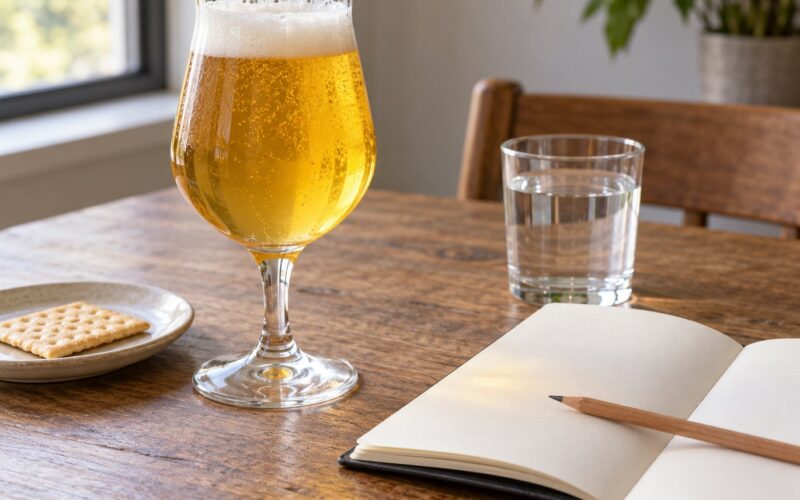
Give each sample a few real minutes. Look at the color, swirl the glass to release the aroma, smell before you sip, then take a small sip and let it sit. Water between samples and a piece of bread or pretzel between styles keep the palate from closing down.
Four samples is roughly where usefulness ends for most people. Beer drinkers on Reddit describe it as losing the palate about four beers in, and on long boards people report that all the hop aromas blend together long before the end. A flight of six with careful pacing beats two flights of six in a row.
Plan the ride home before the first pour. A large flight of strong beer can carry as much alcohol as several full beers, so put the car keys and the phone away, use a rideshare, or hold yourself to the small pours. The 3:30-300 rule from public health guidance says up to two standard drinks in the first hour, one more in the second and one in the third.
Frequently Asked Questions
How many samples are usually in a beer flight?
Four samples is the most common configuration in the United States, with three showing up as a quick taster set and five or six as an extended flight. Festival boards run larger, often eight to ten tasters, but those pour around 1.5 to 2 ounces each so the total volume stays similar.
Is a 4-ounce beer flight the same as drinking four beers?
No. Four 4-ounce tasters total 16 ounces, about one full pour, and at a typical 5 percent ABV that works out to roughly 1.3 US standard drinks. You get the beer equivalent of one drink plus three styles you could not have compared from full glasses without drinking far more.
How many ounces are in a standard beer tasting flight?
A standard four-sample flight comes to 12 to 16 ounces total, depending on whether the house pours 3 or 4 ounces per taster. Larger pours of 5 to 6 ounces push an extended five-sample flight to 20 to 25 ounces. Ask the server how big the tasters are, since that single number decides your total.
Can you split a beer flight when sharing?
You can split a flight, but it is usually a bad idea. Samples poured in advance sit, lose carbonation and warm up, so the last glass on the paddle is the weakest one. A better approach is ordering one mini three-sample flight each and pooling money for a shared appetizer.
Are brewery flights stronger than bar flights?
Not by design, but it happens. Taprooms often pour 3 ounces instead of 4, so a brewery flight of four can carry less total alcohol than a bar flight of four. Barrel-aged and imperial beers are an exception, so check the ABV listed on the board when a brewery flight leans heavy.
Conclusion
How many beers in a tasting flight comes down to four samples as the norm, with three for a quick taste and five or six for a deeper comparison, and each one landing somewhere between 2 and 6 ounces. Order the standard four unless you have a reason not to: you are hungry, sharing the table, driving later or already had a full beer. Then ask the size of the pour, go light to dark, and give each sample a couple of minutes.