Short answer: a buttery note in beer almost always points to diacetyl, a diketone the yeast makes during fermentation. It shows up as a smell and taste of butter, butterscotch, or buttered movie-theater popcorn, and it is one of the few beer faults you can still reverse after the beer is packaged.
If you are troubleshooting your own batch or puzzling over a pint at the bar, the diagnosis starts the same way: smell the beer before you drink it, then work out how recently it was packaged.
Table of Contents
- What Does Buttery Beer Actually Taste Like?
- Why Does My Beer Taste Buttery?
- How Does Diacetyl Get Into Beer?
- What causes diacetyl in the first place?
- The main causes, in the order they usually happen
- Yeast Choices That Can Affect Buttery Flavors
- Styles Where a Buttery Note Is Intentional
- Other Reasons Beer May Taste Creamy or Buttery
- How to Tell Diacetyl Apart from Other Flavors
- Can You Fix Buttery Beer?
- When the Buttery Taste Comes From a Bar Pint
- How to Prevent a Buttery Flavor in the Next Batch
- Is Buttery Beer a Sign of Spoilage?
- Frequently Asked Questions
- Is diacetyl the same thing as butter?
- Why does my beer smell like butter but not taste very buttery?
- Does a butyric flavor mean my yeast is contaminated?
- Will a buttery beer taste better if I leave it in the bottle?
- How much diacetyl is too much in beer?
- Can oxidation make beer taste buttery?
- Conclusion: Start with Aroma and Timing
What Does Buttery Beer Actually Taste Like?
Diacetyl is described most often as butyric or buttery. The comparison that works best for most people is freshly popped corn with butter melted over it, or a soft butterscotch candy rather than sharp caramel.
Other common descriptions include yogurt, sour cream, and a slick, almost oily film on the finish. Aroma is the giveaway. Diacetyl sits right at the back of the nose and often reads much stronger than the taste does, so a beer can smell like a buttered biscuit and taste only mildly creamy.
That gap between smell and taste is normal, and it is one reason people doubt their own palate. If the aroma is clearly buttery and the taste is faint, you are still dealing with the same compound.
Real dairy contamination is a separate thing. Milk, cream, or a badly cleaned dairy vessel leaves a lactose sweetness and a heavier, sour dairy smell, and it does not fade the way a clean butyric note does. If your beer smells like spoiled milk rather than popcorn, treat that as a sanitation problem instead of a diacetyl problem.
Why Does My Beer Taste Buttery?
The reason why does my beer taste buttery questions keep coming back is that the answer is usually a single compound rather than a vague quality problem. Diacetyl is produced in the first days of fermentation, and it can stay above the threshold your nose can pick up if the yeast never gets a chance to clean it up.
The catch is that creaminess is not always diacetyl. A well-carbonated beer, a full-bodied malt profile, warming alcohol, and a little residual sweetness all read as creamy on the palate. If the aroma is clean and only the mouthfeel is slick, you are probably looking at body and carbonation rather than a fault.
There is a third possibility worth naming. Yeast can also make diacetyl later, during packaging, when conditions briefly go sideways. Cold-crashing a lager too early, forcing carbonation before the beer has stopped moving, or jarring up yeast from the bottom of a fermenter are all common triggers.
How Does Diacetyl Get Into Beer?
The mechanism matters, because it explains why the same yeast can produce a clean beer one week and a buttery one the next.
What causes diacetyl in the first place?
Healthy yeast makes alpha-acetolactate early in fermentation. Alpha-acetolactate is harmless in itself, but it slowly converts into diacetyl on its own. That conversion keeps going in the beer whether or not the yeast is doing anything about it.
The cleanup step is the part people miss. A healthy, unstressed yeast cell will take diacetyl back out of the beer and reduce it to acetoin, then to 2,3-butanediol, both of which are close to flavourless. If the yeast is stressed, cold, or barely alive, that reduction never happens and the diacetyl stays put.
So the pattern repeats: yeast makes the precursor, the precursor becomes diacetyl, and the yeast is supposed to erase the evidence. Any step that interrupts yeast activity leaves the butter behind.
The main causes, in the order they usually happen
- Kegged or bottled before terminal gravity. This is the single most common self-inflicted cause. The beer was still dropping, so packaging stopped yeast activity with diacetyl still in suspension.
- A stalled or sluggish fermentation. A slow start, a poor pitch, or a temperature that drifted too low leaves stressed yeast that never gets vigorous enough to finish the cleanup.
- Cold crashing too early. Crashing locks yeast into a dormant state. Diacetyl reduction basically stops while cold, so a beer crashed before it stabilised can smell buttery coming out of the chiller.
- Warm shock and temperature swings. Moving a fermenter from a cold garage straight to a warm kitchen, or pitching cool lager yeast into hot wort, stresses the cells at the exact moment they need to be working.
- Yeast carried into the package. Bottom yeast roused from a sediment layer, or yeast carried over from an under-pitched primary, can start working again in the keg and produce more diacetyl right when you wanted the beer quiet.
- Contamination. Lactobacillus and Pediococcus can add their own creamy and buttery notes alongside acidity and haze. This one comes with other smells, which is how you tell it apart.
Yeast Choices That Can Affect Buttery Flavors
Not every strain behaves the same way, and blaming a yeast for a fault it did not cause is a common dead end.
Malty English ale strains sit at one end of the list. Most of them produce some diacetyl as part of their normal character, and their malt profile partly masks it. That is not a defect; it is what a bitter or a Scottish ale is supposed to smell like.
Clean American ale strains are usually pitched low and fermented relatively cool for a cleaner profile. Cool, slow fermentations also mean the yeast spends longer stressed, which is where the risk of leaving butter behind comes from.
Lager strains are the usual suspects in American light lager examples that taste buttery. They are cold-fermented by design, they are often pitched well below the recommended temperature range, and they are frequently crashed early for clarity. Every one of those three choices stacks up.
Two things that get confused need separating. Attenuation is how completely the yeast ferments available sugars, and it drives dryness and body. Diacetyl production is separate. A highly attenuative strain can still leave butter if the yeast was unhealthy, and a low-attenuation strain can produce almost none if it stayed vigorous.
Yeast nutrient is worth a mention because it gets blamed a lot. It feeds the yeast so the yeast can clean up. If adding nutrient made a beer buttery, that would tell you the yeast was already struggling before the nutrient went in.
Styles Where a Buttery Note Is Intentional
Before you go hunting for a fault, check whether the style wants one. These beers are judged with a low diacetyl tolerance in mind, and a trace of the character is part of the spec:
- Ordinary British bitter
- Extra Special Bitter (ESB)
- Scottish ales, including light and heavy
- Altbier and other German brown ales
- Czech pilsner, which has a low but noticeable diacetyl level
- Old-school cream ale and some Scottish-style ales
What makes these styles interesting is the ceiling. A hint of butter in an ESB is correct; a slick, film-forming puddle in the same beer is not. Ask whether the character sits behind the malt or on top of everything else.
Other Reasons Beer May Taste Creamy or Buttery
Sometimes the answer is not a compound at all. A few alternatives explain creamy impressions, and each has its own evidence.
- High dissolved carbon dioxide. Over-carbonated beer reads as biting and prickly rather than creamy, but combined with body it can sound buttery in the first sip.
- Residual sweetness. An under-attenuated beer or one with a priming sugar problem tastes round and dairy-adjacent. No popcorn aroma, just a sweet finish.
- A full malt profile. Maris Otter, crystal malt, and high mash temperatures build a creamy, almost chewy mouthfeel that people often mistake for butter.
- Warming alcohol. Ethanol at warmer temperatures adds a smooth, oily heat that blurs into creaminess. Warm a pale beer and the impression often strengthens.
- Lactose in a dairy-free product. Lactose-reduced milk-based drinks can carry a soft butter note from the dairy itself. The aroma is milk and cream, not popcorn.
- Bacterial contamination. Lactobacillus and Pediococcus bring creaminess along with acidity, haze, and sometimes a slick mouthfeel. Sourness is the tell.
How to Tell Diacetyl Apart from Other Flavors
Run the tasting in a fixed order so you are comparing the same thing twice. Smell first, taste second, then finish, then let the glass sit.
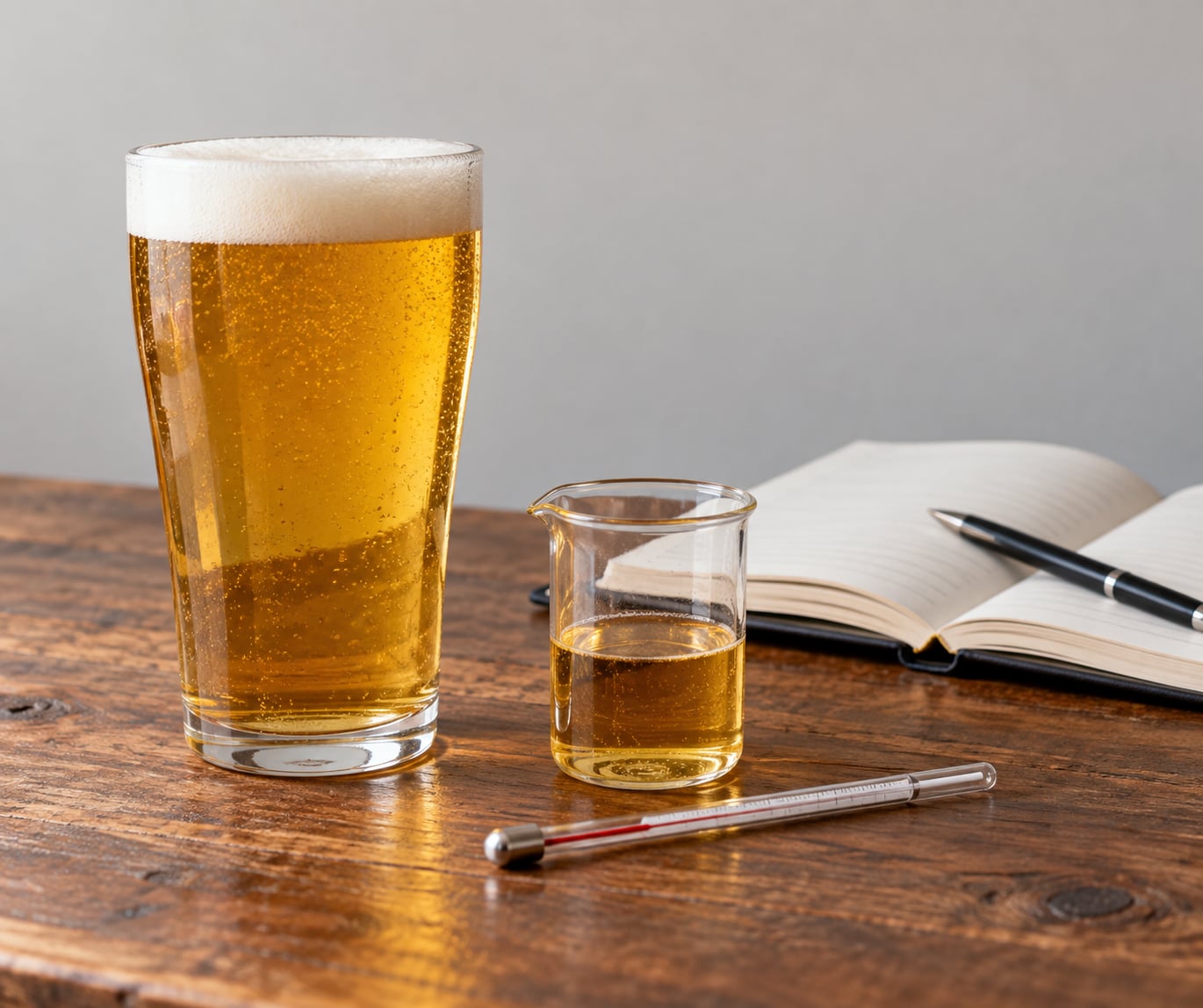
Take a clean sample of about 60 ml in a plain glass with no aroma left in it. Smell it cold, then warm the same sample to room temperature, then to slightly above room temperature. Diacetyl gets louder as the beer warms. Acetaldehyde, which reads as green apple or cut apple, tends to fade instead.
There is a simple check most brewers never run. If you cannot smell butter in the beer at all, warm a fresh sample in a hot-water bath at 60C / 140F for about 20 minutes and smell it again. Diacetyl is volatile and heat releases it. If a buttery aroma appears out of a sample that was clean cold, diacetyl is present and your nose is working fine.
Then describe the note honestly. Popcorn and butterscotch point to diacetyl. Yogurt, sour and thin, with haze, points to bacteria. Green apple points to acetaldehyde from an over-oxidised or badly managed fermentation. Wet cardboard is oxidation, and a hot pepper or solvent note is usually acetaldehyde or a cleaning chemical.
| Symptom | Likely cause | What to do |
|---|---|---|
| Buttery aroma, clean acidity, clear beer | Diacetyl from stressed or inactive yeast | Warm the beer and give healthy yeast time at temperature |
| Butter plus sourness or haze | Lactic bacteria or Pediococcus | Do not attempt to rescue; the acidity will only grow |
| Butter plus a thick, hazy body and sweetness | Fermentation packaged early and never finished | Check your gravity reading against the style target |
| Buttery in the first glass only | Draught system residue, or beer versus line gas | Run a line cleaning and compare the second glass |
| Buttery in every pint at one bar | Old lines, old coupler seals, or stagnant keg | Ask the taproom when the lines were last cleaned |
| Butter in a glass, clean aroma, slick body | Body, carbonation, or residual sugar | Re-taste at a warmer temperature before blaming a fault |
Can You Fix Buttery Beer?
Often yes, and this is the useful part. Diacetyl is unusual among beer faults because the fix is simply time and temperature with live yeast present.
- Confirm it first. Run the warm sample test above so you are not chasing the wrong problem.
- Warm the beer to 65-70F / 18-21C. That range is enough to restart yeast activity without pushing the beer into oxidation territory.
- Hold it there for 1 to 3 days. Taste daily once the beer is back at serving temperature. A mild note usually clears in a day; a heavy load takes longer.
- Make sure yeast is actually there. Warming a keg of beer with no viable yeast in it does very little. HomebrewTalk members put it plainly: the only way to remove diacetyl is to expose the finished beer to living yeast, because the cells take the compound up and reduce it.
- If it is stuck, krausen it. Build a small fermenting batch at the same original gravity and bitterness, pitch a spoonful of the yeast from the original batch, and dump it into the packaging once it is at full krausen, then hold warm for a week. One homebrewer on r/Homebrewing described exactly this rescue on a buttery Altbier and finished with no diacetyl at all.
- Use bottle conditioning as a free window. Residual yeast in the bottle keeps working after packaging, which is why a buttery beer can improve while it sits. That help fades once the bottle has fully conditioned.
One caution before you warm anything. Heat accelerates oxidation, and older package age means less headspace and more oxygen exposure. If the beer is already several months old, a warm rest can trade a buttery note for a papery one.
There is also a point of no return that has nothing to do with temperature. If the beer is sour, hazy, and creamed at once, warming it will only help the bacteria. Fix the process and pour the batch.
When the Buttery Taste Comes From a Bar Pint
If the buttery beer is not yours, the cause list is short and mostly about the draught system rather than the beer.
Old beer lines grow a slime layer of bacteria and yeast that produces its own creamy, buttery, or sour off-notes. The first glass out of a line is usually the most affected, because it carries whatever is sitting in the couplers and the first metre of tubing. The second glass often tastes cleaner, which is why people assume the beer fixed itself.
Other line-related culprits include coupler seals that have gone hard and black, kegs sitting on a coupler without being moved for weeks, and a tower that is warm enough for bacteria to keep working.
Two questions solve most of it. Ask when the lines were last cleaned and how often the kegs get rotated. If the answer is vague, the pint is telling you something about the system, not the brewery.
How to Prevent a Buttery Flavor in the Next Batch
Most buttery batches are preventable with a handful of boring, specific habits.
- Pick the strain for the style, and read its temperature range before you pitch.
- Pitch healthy yeast. Rehydrate lager yeast properly, use a fresh packet if the old one is past its date, and do not under-pitch a large batch with a single small vial.
- Start at the right temperature. Cold-shocking a lager or a pale ale in its first few days buys you a slow, stressed fermentation.
- Confirm terminal gravity before packaging. Take a reading and take it again two or three days later. If it has not moved, the fermentation is not done.
- Cold crash only after the gravity is stable. Crash for clarity, never to force an unfinished fermentation.
- Rack or transfer gently, leaving the yeast behind in the fermenter rather than stirring it up into the package.
- Condition before you package, and store the finished beer cool and dark. Warm storage lets yeast and bacteria keep working.
These steps lower the risk. None of them can take diacetyl out of a badly handled batch that is already in a bottle, and none of them will save a beer that picked up a bacterial infection.
Is Buttery Beer a Sign of Spoilage?
Usually not. A clean butyric note is a fermentation-management issue, not proof that the beer is spoiled, and in several classic styles it is deliberate.
Signs that point elsewhere include unexpected carbonation in a bottle that was not meant to prime, vinegar-like or baby-cheese acidity, a slimy or ropy texture, and a green apple or cut-grass note that shows up in a pale beer. Wet cardboard, wet paper, or sherry-like tones in an old amber ale point to oxidation rather than infection.
If the beer smells like nail polish remover or cleaning fluid, do not taste it to confirm. If you are not sure, keep a sealed sample of a known-good beer from the same batch, if you can, and compare them side by side.
Never force a taste of beer that smells of solvent, is leaking, or has a swollen or ruptured container.
Frequently Asked Questions
Is diacetyl the same thing as butter?
No, it only smells and tastes like it. Diacetyl is a small organic compound, one of a class called vicinal diketones, that yeast produces and reabsorbs during fermentation. Its aroma at low concentration is almost pure butter or butterscotch, which is why brewers use dairy comparisons so often. The compound itself is harmless at beer-level concentrations, but its aroma and slick texture are strong enough to ruin a style in a few parts per trillion.
Why does my beer smell like butter but not taste very buttery?
That gap is normal and it happens because diacetyl is far more aromatic than it is flavourful. Its threshold in the nose is much lower than its threshold on the palate, so you often smell a clear buttery note before you taste anything unusual. Warming the beer makes the aroma stronger still. If the aroma is clearly buttery and the taste is only mildly creamy, you are still looking at diacetyl rather than a different fault.
Does a butyric flavor mean my yeast is contaminated?
Not necessarily. A butyric note on its own usually means stressed or inactive yeast left diacetyl behind, not bacteria. Contamination almost always brings company: sourness, haze, and sometimes a slimy texture. If you have butter plus yogurt acidity and a cloudy beer, it is a bacterial problem and warming the beer will only make it worse. If you have butter plus a clean, clear, sour-free beer, treat it as a yeast problem.
Will a buttery beer taste better if I leave it in the bottle?
Sometimes, and the reason is bottle conditioning. Residual yeast in a bottle keeps working after packaging, which gives it a window to take up diacetyl and reduce it. That window is not infinite. Once the beer has fully conditioned and the yeast has dropped out, the diacetyl will not move again on its own. Leaving the bottle alone helps a lightly buttery beer; it will not rescue a heavy one, and warming a bottle accelerates oxidation.
How much diacetyl is too much in beer?
There is no universal limit, because the acceptable level depends on the style. Most judges look for a beer with no perceptible diacetyl outside the styles that call for it. In an ordinary bitter, a trace is fine and a slick film is not. In an American light lager or a clean pale ale, even a small butyric note will cost you points. The practical test is whether a trained taster can identify it without being prompted.
Can oxidation make beer taste buttery?
Not directly. Oxidation produces wet cardboard, wet paper, sherry-like notes, and a dull, flat finish rather than butter. The two problems often appear in the same batch, though, because a rushed fermentation that leaves diacetyl also tends to pick up extra oxygen. If a beer reads both creamy and papery, treat the butter first, since it is the part you can still fix, and handle the oxidation by drinking the beer sooner next time.
Conclusion: Start with Aroma and Timing
If you want the single most useful step for why does my beer taste buttery, it is this: smell the beer before you sip it, then work out how recently it was packaged. A clear butyric or popcorn aroma with a clean, sour-free body points to diacetyl, and how it tastes after a warm sample at 60C for 20 minutes confirms it.
From there the action is simple. A mild note on a recent beer usually clears with a warm rest at 65-70F / 18-21C for a day or two, or with the free second fermentation you get from bottle conditioning. If it is not improving, and the beer is old or already sour, put that batch aside and fix the next one: pitch healthy yeast, wait for a stable terminal gravity, and crash only after the beer has stopped moving.