Why are some beers skunked? Because light struck them. UV and blue-spectrum light breaks apart the hop-derived bittering compounds in beer, and the fragments recombine into 3-methyl-2-butene-1-thiol (MBT), a sulfur compound so potent that a tiny amount smells exactly like skunk spray.
The frustrating part is that a brewery can bottle a flawless pale ale and a single warm afternoon on a sunny patio can ruin it. Hop intensity, bottle color, time in the sun and how warm the beer got all decide whether you notice anything at all.
Table of Contents
- Why Some Beers Are Skunked
- What Does a Skunked Beer Smell and Taste Like?
- How Does Sunlight Make Beer Taste Skunked?
- Which Beer Styles Are Most Likely to Become Skunked?
- How Light Exposure Changes Beer
- How to Tell If a Beer Is Lightstruck or Just Bad
- How to Prevent Beers From Becoming Skunked
- Can You Fix a Skunked Beer?
- Frequently Asked Questions
- Does sunlight really skunk beer, or is that a myth?
- Is beer in a green bottle safe from skunking?
- Is skunked beer dangerous to drink?
- Does freezing or warming a beer fix the skunked taste?
- Do all hoppy beers get skunked?
- Does beer skunk if it just gets warm?
- Conclusion
Why Some Beers Are Skunked
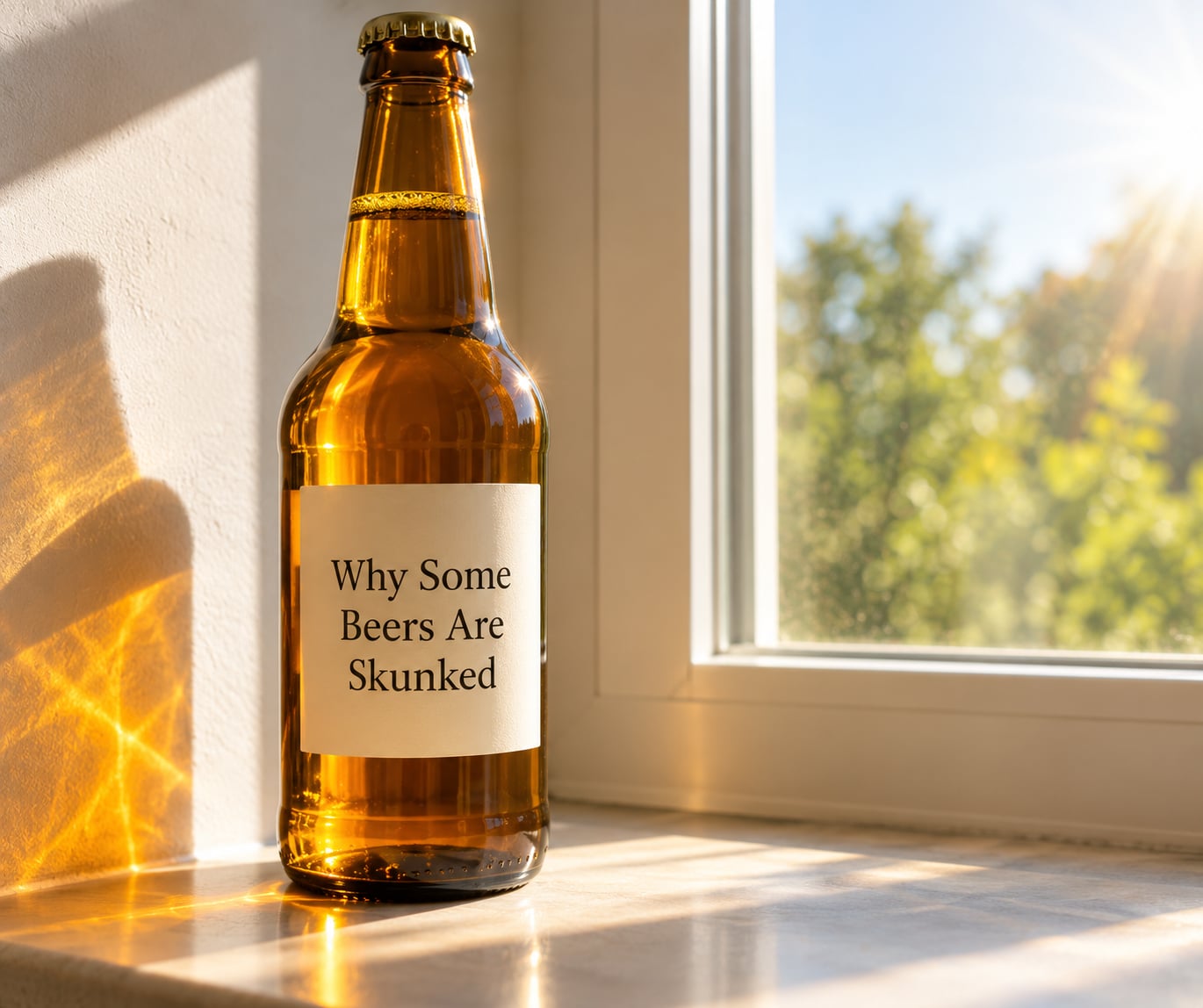
Beer becomes skunked when light reaches the iso-alpha acids that give hops their bitterness and splits them into new molecules. One of those molecules is MBT, and your nose picks it up at concentrations far below anything else you would taste in a beer.
Light exposure is the central cause of skunking. Everything else just changes how obvious the result is:
- Hop bitterness. More bittering compounds means more raw material for the reaction, so hoppy beers skunk harder.
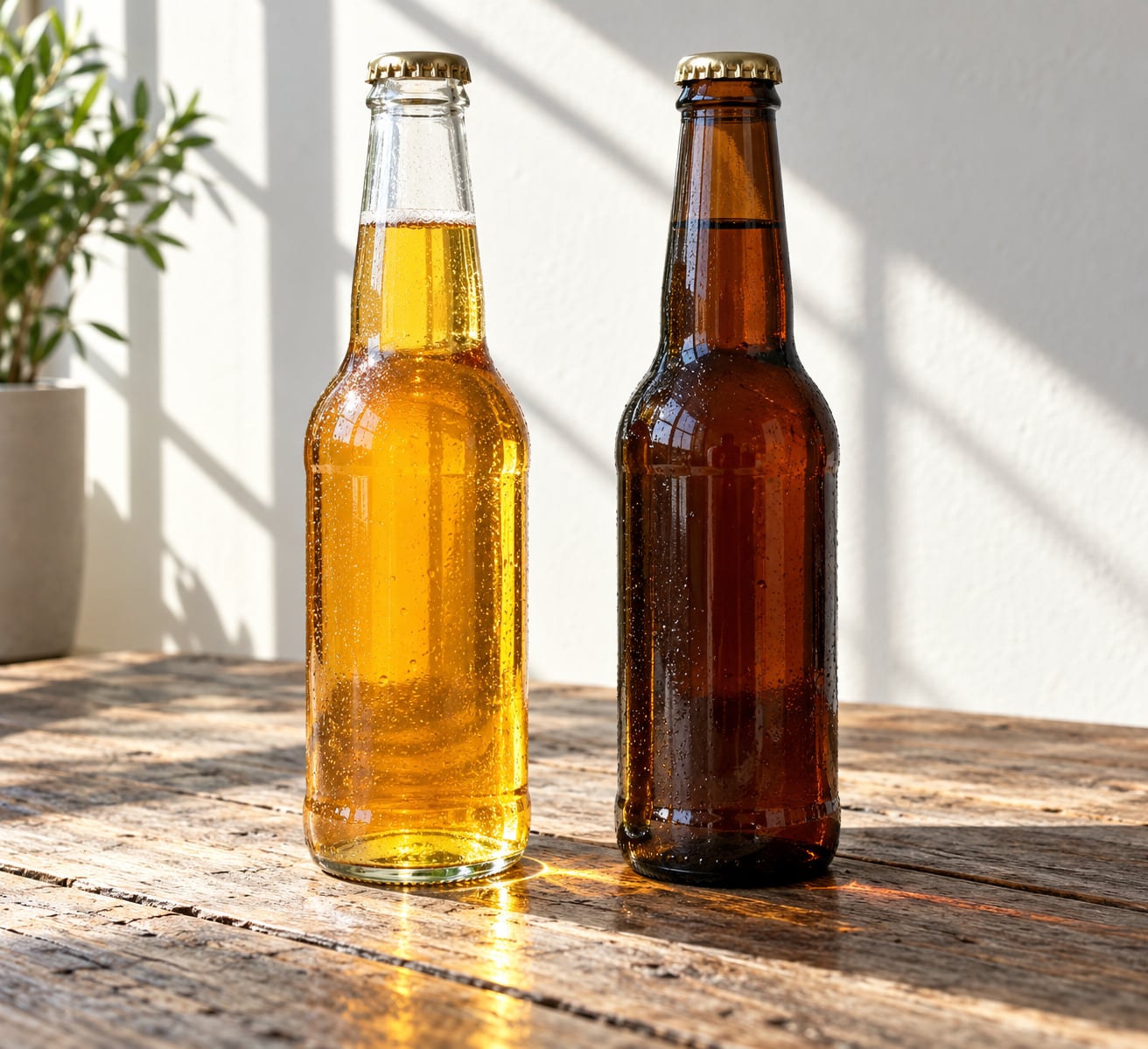
- Packaging. A clear bottle lets nearly all light through. A can or keg blocks almost all of it.
- Color. Pale beer shows the damage because there is nothing darker to hide it.
- Time and intensity. Direct sun does it in seconds. A dim bar fridge takes months.
- Temperature. Warm beer reacts faster, and warmth alone can produce skunky compounds even with no light involved.
One thing people get wrong: hops are the fuel, but hops are not what you are smelling. A beer can use heavy hopping and stay clean in a can, and a light lager can go skunky on a sunny shelf.
What Does a Skunked Beer Smell and Taste Like?
Skunked beer smells like skunk spray, which is not a figure of speech. The odor is sulfur-heavy and musky, and it tends to hit the back of the nose first, like burnt rubber or a struck match.
Common descriptors people use:
- Skunk spray or skunk musk
- Burnt rubber or hot tar
- Rotten eggs or struck match
- Musty, damp basement
- Dank, marijuana-like edge
- Onion or garlic, especially with light-stable hops
In the mouth, expect harsh, lingering bitterness, crushed or dulled hop aroma, and a flat, papery finish. The hop flavor does not just get weaker. It gets replaced.
That is what separates skunking from other faults. Ordinary hop bitterness tastes bitter but keeps its citrus, pine, or floral notes. A buttery, slick aroma means diacetyl. Vinegar or nail-polish-remover sharpness means oxidation or contamination. Skunking is distinctive because the harshness arrives wrapped in sulfur.
How Does Sunlight Make Beer Taste Skunked?
Here is the chemistry without the jargon overload. Hop cones contain alpha acids, and during brewing those convert into iso-alpha acids, the molecules that make beer bitter.
When light in the blue part of the visible spectrum hits those molecules, the bond holding a small side chain breaks off. Riboflavin, a vitamin B2-like compound that naturally occurs in beer, acts as a photosensitizer, meaning it absorbs the light energy and passes it to the iso-alpha acid.
The freed fragment, a dimethyl allyl radical, then latches onto sulfur compounds already dissolved in the beer. That reaction produces MBT, also written 3MBT. Human noses are absurdly sensitive to this class of compound. One widely cited figure says a single drop of MBT diluted in an Olympic swimming pool would still be detectable.
So when someone asks why does my beer smell skunky, the short answer is that sunlight performed a chemical reaction inside the bottle while you were not looking.
Two details worth keeping straight. Wavelength matters: light around 350 to 500 nanometers does the most damage, which is why a cloudy afternoon still skunks a beer and why fluorescent-lit shelves are a slow but real culprit.
And warmth matters more than most articles admit. A 2009 study in the Journal of the American Society of Brewing Chemists found skunky aroma compounds forming in canned beer during thermal aging, with no light involved at all. Heat accelerates the light reaction, and heat can push a beer part of the way there on its own.
Which Beer Styles Are Most Likely to Become Skunked?
Hop intensity and pale color are what matter, which puts IPAs, pale ales, pilsners, wheat beers and hoppy lagers at the front of the line. Dark styles have more color to hide behind and often use fewer hops.
A pale IPA sitting in direct sun can taste distinctly skunky within a single afternoon. The same beer from a can at the same temperature will not. That contrast, same beer, different packaging, is the cleanest demonstration of the effect.
That said, no style is immune. A macro lager in a clear bottle will skunk too, it just tastes worse rather than better, because the skunk note has no bright hop aroma sitting next to it for contrast. Anyone who has ever chilled a green-bottle lager on a windowsill knows exactly what that means.
Green glass is worth a second look, because it is often blamed for crimes it did not commit. Green bottles block more light than clear ones, and a properly brewed and stored green-bottle lager should taste clean. That some people prefer the faint skunk note in those lagers says more about habit and expectation than about the glass.
How Light Exposure Changes Beer
The difference between a few seconds in the sun and a month on a shelf is enormous. Exposure time and light intensity compound each other, and so does heat.
| Light source | Typical time to noticeable skunk character | What it looks like in practice |
|---|---|---|
| Direct sunlight | Under 10 seconds, sometimes instantly | A bottle on a patio table at a sunny tailgate |
| Diffuse daylight | A few hours | A bottle near an open door or in a bright kitchen |
| Fluorescent or LED shelf lighting | A few days to weeks of steady exposure | Refrigerated retail display cases |
| Dark refrigerator or shaded cellar | Effectively prevented | Beer stays clean for months |
These figures come from brewing-industry guidance including the Master Brewers Association of the Americas reference material, and they describe when a trained panel detects the character, not when every drinker will.
Exposure also stacks. A bottle that spends an afternoon in the sun, a week in a car, and a month on a warm shelf is not the same as one that got a single dose of afternoon sun, even though the lightstruck flavor compounds do not fade once formed.
How to Tell If a Beer Is Lightstruck or Just Bad
Appearance alone cannot prove the cause. A skunked beer can look perfectly clear and clean, and oxidation can leave a beer looking fine. You need the aroma, the taste, and the storage history together.
| What you notice | Most likely cause | Usual history |
|---|---|---|
| Skunk spray, burnt rubber, rotten eggs | Lightstruck | Sun, patio, car, or lit shelf exposure |
| Cardboard, wet paper, bruised apple, red wine | Oxidation | Headspace oxygen in a bottle that sat too long |
| Buttery slickness, like yogurt or crayons | Diacetyl | Fermentation or packaging problem |
| Vinegar, nail polish remover, sourness | Contamination or acetification | Seal failure, wild yeast, or bacteria |
| Flat, dull, papery, no aroma at all | Age or oxidation | Long storage, temperature cycling |
| Skunk note plus sour or vinegary tang | Both, plus a seal problem | Heat, light, and a compromised closure |
The most persuasive evidence is a timeline. If the bottle was in the sun and developed a sulfur smell afterward, skunking is the working theory. On beer forums the standard heuristic is exactly that: someone asks whether the beer came in a green bottle, and the room answers that it was probably lightstruck.
One personal check I trust: open it, smell it, then drink straight from the bottle for a few sips. Drinking from the bottle sends aroma back up the neck, which makes skunk character louder, not quieter.
How to Prevent Beers From Becoming Skunked
Prevention is straightforward and almost entirely about light and heat. None of it is complicated; it just has to happen before the bottle opens.
| Packaging | Light protection | Practical note |
|---|---|---|
| Keg | Complete | Draft in a cool, dim room is the safest pour there is |
| Aluminum can | Near complete | Still avoid leaving a warm can in direct sun |
| Brown bottle | Good | Traditional protection, still not sunproof |
| Green bottle | Moderate | Blocks less light than brown, far more than clear |
| Clear bottle | Minimal | Treat as a display item, not something to leave out |
Concrete habits that work:
- Buy cans or brown-bottled beer when you know the beer will sit in the sun for a few hours.
- Keep bottles and cans out of a parked car, even for an afternoon. A car interior combines sunlight, heat, and hours of exposure.
- Ask for a paper bag or cardboard sleeve at a bottle shop if you are walking more than a few blocks in daylight.
- Use an opaque cup or a koozie at outdoor events instead of a clear plastic cup on a sunny table.
- Store beer upright in a dark, cool place and follow whatever the brewery or distributor lists on the carton.
- Buy from shops that keep stock refrigerated and shaded rather than in a lit window display.
- Serve beer cold and finish it promptly. Cold beer is more aromatic and fresher tasting, though cold does not undo skunking.
Homebrewers should treat this as a bottling problem first. Brown glass or an opaque can liner matters far more than hop variety, and a batch that sits in a clear carboy during conditioning has no protection at all.
Can You Fix a Skunked Beer?
No, not really. MBT forms during light exposure and does not break down again when you put the bottle back in the cold. Chilling a skunked beer reduces volatility and makes it more drinkable, but the sulfur note comes right back at room temperature.
What you can do depends on how much beer is involved. A single bottle might be worth finishing if the character is faint and the beer is otherwise good.
A larger amount can be used for cooking, where a strong hop character is covered by caramelized onions, barbecue sauce, chili, or bread. Beer used in a stew or a barbecue glaze mostly stops being beer anyway.
If the whole pack arrived skunked from a single source, that is a conversation with the retailer or the brewery rather than with your own fridge. Otherwise, accept that the bottle is finished and pour it out. Warm, flat, and skunky is not worth saving.
Frequently Asked Questions
Does sunlight really skunk beer, or is that a myth?
Sunlight really does skunk beer. Light in the blue end of the visible spectrum breaks hop-derived bittering compounds apart, and the fragments form 3-methyl-2-butene-1-thiol, the sulfur compound that smells like skunk spray. Beers with more bitterness, paler color, and clearer packaging develop the character fastest.
Is beer in a green bottle safe from skunking?
Green glass blocks more light than clear glass but far less than brown glass or an aluminum can. A green-bottle beer stored in a dark fridge is usually fine. The same beer sitting on a sunny patio table can develop a skunky character in an afternoon, so packaging reduces the risk without removing it.
Is skunked beer dangerous to drink?
No. Skunking changes aroma and flavor, not safety. The reaction does not produce harmful compounds, does not add alcohol, and does not change the strength of the beer. If a bottle also smells sour, vinegary, or fizzy in a strange way, that points to a separate contamination problem, and in that case discard it.
Does freezing or warming a beer fix the skunked taste?
Neither one fixes it. The skunky compound forms during light exposure and does not reverse when the beer is chilled or heated. Chilling makes a beer easier to drink because cold suppresses aroma volatility, but as soon as it warms up the sulfur character returns. Warming a beer actually speeds up light-driven reactions.
Do all hoppy beers get skunked?
No. Hoppy beers are more vulnerable because they contain more of the bittering compounds that react, but packaging and storage decide the outcome. A hoppy beer from a can that stayed cold will not skunk, while a light lager in a clear bottle will. Hop intensity raises the risk without guaranteeing the result.
Does beer skunk if it just gets warm?
Heat speeds up the light reaction, and warmth can also push a beer part of the way toward skunky compounds on its own. Research published in 2009 in the Journal of the American Society of Brewing Chemists found skunky aroma compounds forming in canned beer during thermal aging with no light involved. Cold storage is a real part of prevention.
Conclusion
If a beer developed a sulfur or skunk smell after sitting in sun, treat it as lightstruck. Nothing in the brewing went wrong, the packaging simply did not do its job, and the taste will not come back on its own.
Going forward, keep beer shaded, cool, and in protective packaging whenever you can, and stop blaming the brewery for a bottle that sat in a car. And keep tasting for yourself: skunk character is unmistakable once you know it, but it is not the only strange aroma beer can produce, and a sour or vinegary bottle is a different problem entirely.
Updated for 2026.