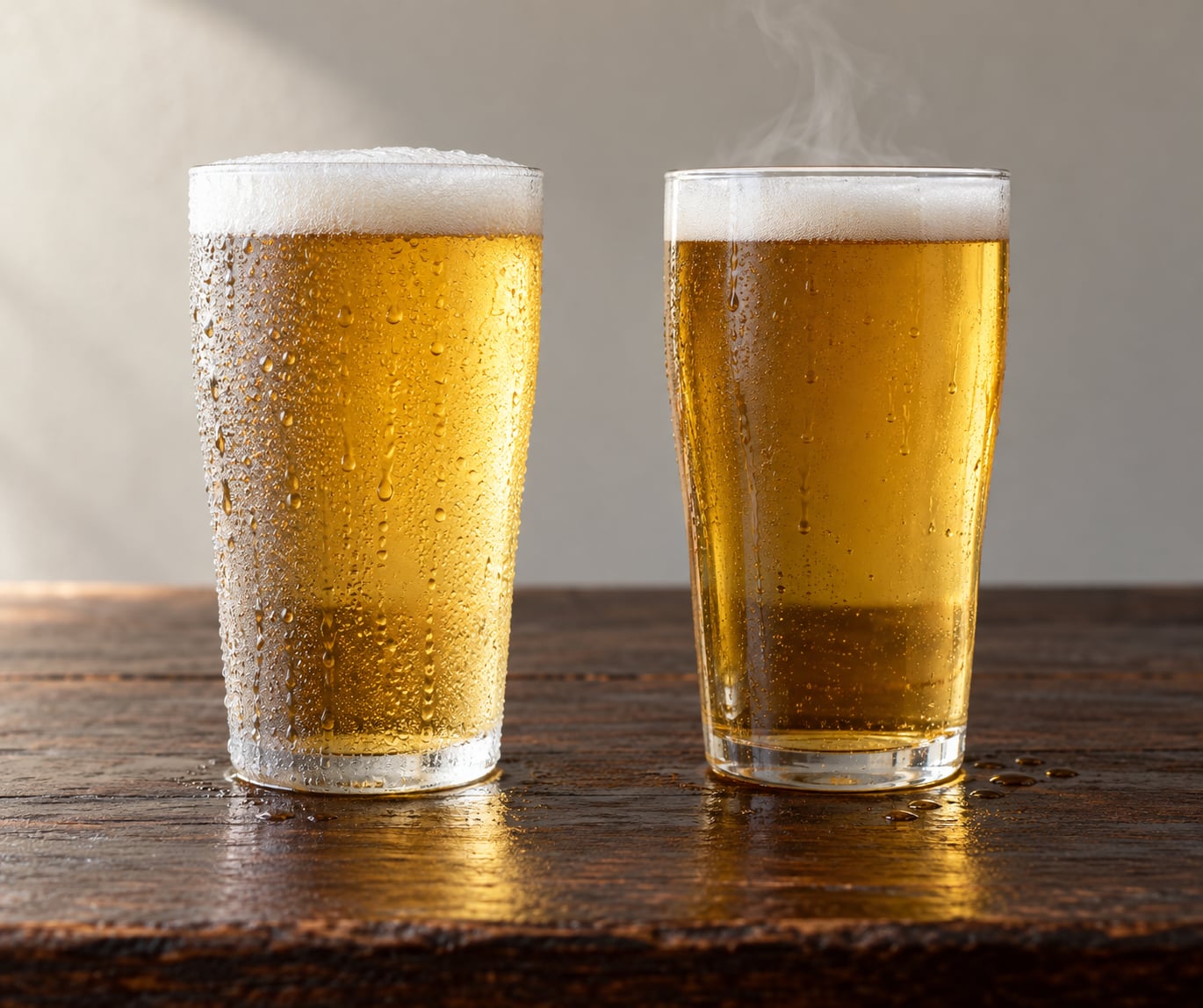
Cold beer tastes less flavorful for one main reason: beer flavor is carried by volatile compounds that need warmth to escape the liquid, and cold liquid holds them in. Serve the same beer at 38°F instead of 50°F and you get less aroma, a less responsive palate, weaker carbonation bite and thinner body, all at once.
Plenty of writing on this topic goes the other way, explaining why cold beer tastes good. That is a different question, and it is not the one you asked. This one is worth answering properly, because the difference between a flat pint and a brilliant one is usually only a few degrees and a technique nobody tells you about.
Table of Contents
- Does Cold Beer Really Taste Less Flavorful?
- Why Cold Beer Tastes Less Flavorful at the Molecular Level
- How Beer Temperature Changes Aroma, Sweetness, and Bitterness
- Aroma is the first thing to go
- Sweetness flattens and then rebalances
- Bitterness shifts rather than simply rising
- Carbonation and mouthfeel both decline
- When cold is the right call anyway
- How Much Does Serving Temperature Change Flavor?
- Which Beer Styles Taste Best When Cold?
- Does Glassware Change the Way Cold Beer Tastes?
- How to Taste More Flavor from Cold Beer
- Frequently Asked Questions
- Is cold beer actually less flavorful, or does it just taste different?
- Why does cold beer seem to have less aroma?
- Is warm beer more flavorful than cold beer?
- What temperature is best for tasting an IPA?
- Should lager be served colder than an IPA?
- How long should beer sit out before tasting its full flavor?
- Conclusion: Start With the Right Serving Temperature
Does Cold Beer Really Taste Less Flavorful?
Yes, in the way that matters to your tongue: cold beer genuinely delivers less sensory information. It is not that the cold beer contains fewer flavor compounds, since the molecules are all still in the glass. Cold simply keeps them from reaching your nose, softens your ability to register them, and flattens the carbonation and body that frame everything else.
Five things happen at once, and they compound each other:
- Aroma volatility drops. Cold liquid holds volatile flavor compounds in solution instead of letting them evaporate into the air above the glass, so you have less raw material to smell.
- Taste receptor response softens. Your tongue is less sensitive overall at low temperature, and the cold-activated channels that fire on menthol and on fizzing carbonation are the ones going quiet.
- The ethanol-water structure changes. The way water and alcohol molecules organize themselves shifts with temperature, which changes mouthfeel and how much ethanol aroma you perceive.
- Carbonation bite fades. Dissolved CO₂ is what gives beer its sharp, prickling edge, and that edge is part of what your brain reads as flavor intensity.
- Body and warmth vanish. Ethanol contributes its own warmth and a heavy, oily mouthfeel that carries flavor. Cold suppresses both.
Why Cold Beer Tastes Less Flavorful at the Molecular Level
Start with aroma, because roughly two-thirds of what people call beer flavor actually arrives through the nose, not the tongue. Aroma molecules need a certain vapor pressure to escape the liquid, and vapor pressure rises with temperature. A hop oil like linalool or a yeast ester like isoamyl acetate is far more willing to leave a 50°F beer than a 34°F one.
That is the whole mechanism behind why cold beer tastes less flavorful in one sentence: cold keeps the aroma in the glass, and what you cannot smell, you cannot taste.
The 2024 Matter paper on ethanol-water mixtures (doi:10.1016/j-matt.2024.03017), from the Technical Institute of Physics and Chemistry at the Chinese Academy of Sciences with the China Wuliangye Technology Research Center, looked at how the liquid itself is organized. Using contact-angle measurements from 5°C to 40°C plus high-resolution nuclear magnetic resonance spectroscopy, the team led by Lei Jiang found that cold liquid leans toward more chain-like molecular structures, which strengthen the alcohol aroma and the refreshing snap, while warmer liquid around 25°C leans toward more tetrahedral structures, which produce a smoother, rounder, less sharp character.
One correction worth making, because the version circulating widely online has it backwards. Several popular write-ups describe cold beer as pyramid-shaped and warm beer as chain-like. The primary study reports the opposite. Cold equals more chain-like, warm equals more tetrahedral. If you have read the inverted version, mentally swap the two and everything else in that study still holds.
How Beer Temperature Changes Aroma, Sweetness, and Bitterness
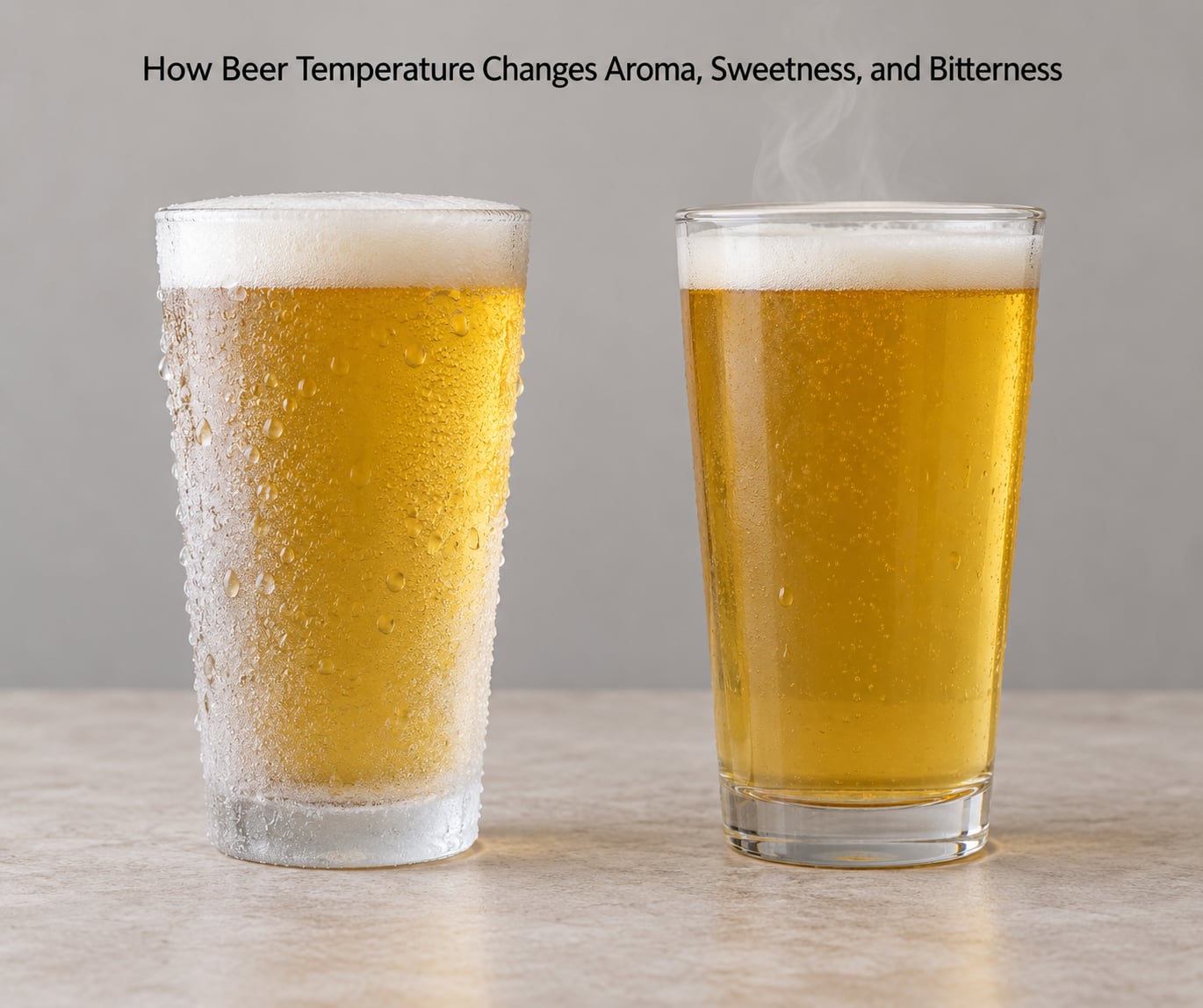
Temperature does not scale flavor up and down evenly. It changes each sensory channel by a different amount, and in a few cases in the opposite direction, which is why a cold lager can taste crisper than a warm one even while tasting less complex.
Aroma is the first thing to go
Volatile aroma release falls steadily as beer cools, and it falls hardest for the most delicate compounds. A hazy IPA at 50°F smells like grapefruit and pine; the same IPA at 36°F smells like a clean, faintly bitter drink with a grassy hint and nothing else. Floral and citrus notes disappear first because those molecules are fragile and highly volatile. Darker, roasted styles lose less, because chocolate and roasted malt character comes partly from non-volatile compounds that heat cannot change.
Sweetness flattens and then rebalances
Sweetness perception actually works against you at low temperature. Cold dulls the taste response, so a malty beer reads as drier and thinner than it is. A chocolate porter warmed to 55°F tastes rounder and sweeter for the same reason a glass of room-temperature cola does. The exception is carbonation: as a beer warms, dissolved CO₂ comes out of solution, carbonic acid perception drops, and the bite that reads as sharp sweetness fades. That is why many people find a warm beer unpleasant even when its malt is more expressive.
Bitterness shifts rather than simply rising
Warmth makes hop bitterness more assertive because hop resins soften into the liquid as it heats, and warmth raises overall taste intensity so the same bitterness reads stronger. Cold suppresses that perception and can make a bitter beer seem to have no bitterness at all. The result is that a really bitter IPA tastes almost gentle straight from the fridge, then suddenly asserts itself by the bottom of the glass.
Carbonation and mouthfeel both decline
Beer starts freezing somewhere in the upper 20s of Fahrenheit, so ice-cold beer is close to the point where the liquid turns slushy and the CO₂ headspace collapses. A very cold glass also has a thick, rigid thermal mass, so a small sip warms the liquid in your mouth far less than a room-temperature sip would, and the fizz mostly stays trapped. You get less prickling, less headspace aroma and less of the light, oily body that ethanol contributes.
When cold is the right call anyway
Cold is genuinely the better serving temperature for a flawed beer, and that is not a marketing line. Diacetyl, the compound behind butter or butterscotch notes above its sensory threshold of a fraction of a milligram per liter, and hydrogen sulfide, which smells like rotten eggs, both read as stronger and more unpleasant as a beer warms. Oxidation is the same story: the cardboard, bruised-apple and sherry notes that come from stale beer are muted by coldness. Cold also makes a heavy, boozy high-alcohol beer far easier to drink, which is exactly why strong ales and imperial stouts are often served cooler than their flavor profile suggests.
This is also why a beer sometimes seems to change character mid-glass. It may not be improving. It may be a beer with a defect that cold was hiding, and warm beer is the reveal. The distinction matters: cold masking a defect is not the same as cold ruining the beer, and the second one mostly comes from freezing the glass rather than from the temperature itself.
Regional habit plays a role too, and it is part of why this question comes up at all. German taprooms traditionally serve lagers and ales in the 45 to 55°F range rather than near freezing, and the same pint that a US drinker considers warm is the temperature a German drinker considers normal. Drinkers who grew up with near-ice-cold lagers genuinely prefer them that way, and beer forum threads are full of people making exactly that point. Preference is a real variable, not a failure of science.
How Much Does Serving Temperature Change Flavor?
Serving temperature changes flavor perception a great deal, roughly on the scale of a whole aroma category, and the effect is not subtle. A useful mental model is that each step of about 5°F buys or loses a layer of what you can taste.
| Serving temperature | What you notice | Best suited to |
|---|---|---|
| 33 to 38°F (1 to 3°C) | Very crisp, almost flat aroma, sharp carbonation bite, thin body, heavy refreshment | Light lagers, a hot-day drink, or hiding a defect |
| 40 to 45°F (4 to 7°C) | Balanced, clean malt, carbonation still lively, malt and hop readable but muted | Pilsner, helles, wheat beer, session lager |
| 45 to 50°F (7 to 10°C) | Malt rounds out, hop aroma opens, carbonation still present but less pinprickly | Pale ales, amber lagers, cream ales, most everyday craft beer |
| 50 to 55°F (10 to 13°C) | Full aroma, expressive hops, viscous body, warming ethanol, softer carbonation | IPAs, stouts, porters, barrel-aged and high-alcohol beers |
Anything below about 35°F buys you almost nothing except refreshment, and the increasingly watery texture people describe is real. Most beer also drops fast once it leaves that band: from 55°F to room temperature in a few minutes on a warm bar top, the carbonation that was softening then collapses, and the beer goes genuinely flat.
Which Beer Styles Taste Best When Cold?
Style matters more than almost anyone admits, and the ranges below are a starting point rather than a rulebook. The flavor trait named in each row is the one that survives at that temperature.
| Beer style | Suggested range | Why that range works |
|---|---|---|
| Light lager, pilsner adjunct lager | 35 to 38°F (2 to 3°C) | Cold sharpens the clean, crisp bite that defines the style |
| Pilsner, helles, wheat beer | 40 to 45°F (4 to 7°C) | Spicy and banana esters need a little warmth to register |
| Amber and red lager | 45 to 50°F (7 to 10°C) | Caramel and toast notes are almost invisible when ice cold |
| Pale ale, cream ale | 45 to 50°F (7 to 10°C) | Hops read as bitterness only; the fruit and floral notes come out warm |
| IPA, double IPA | 50 to 55°F (10 to 13°C) | Citrus, pine and tropical hop oils need vapor pressure to escape the glass |
| Stout, porter | 50 to 55°F (10 to 13°C) | Roast, coffee and chocolate character is muted by cold |
| Barrel-aged, imperial, high-ABV | 55 to 65°F (13 to 18°C) | Thick body and high alcohol are punishingly heavy when cold |
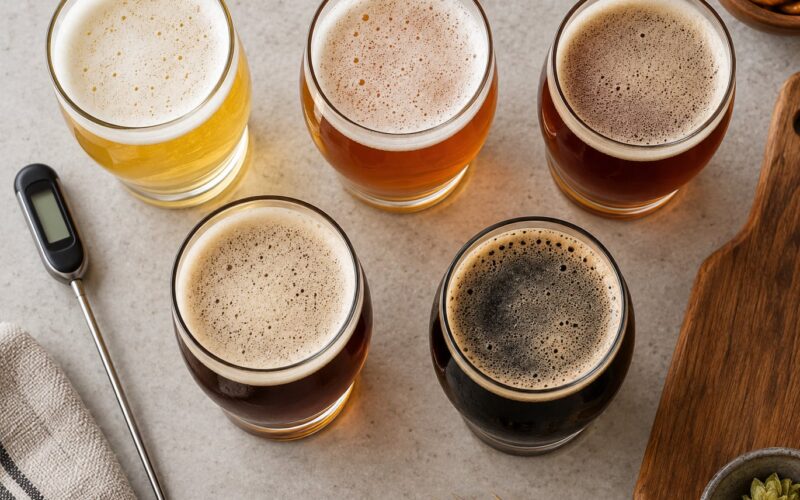
Where a taproom pours a flight, the pour itself often decides the temperature. Fresh lines run colder than the beer is meant to be served, and the glass warms fast, so the last few sips of a flight taste warmer and fuller than the first. Experienced drinkers often start at the top of the glass and work down for that reason.
Does Glassware Change the Way Cold Beer Tastes?
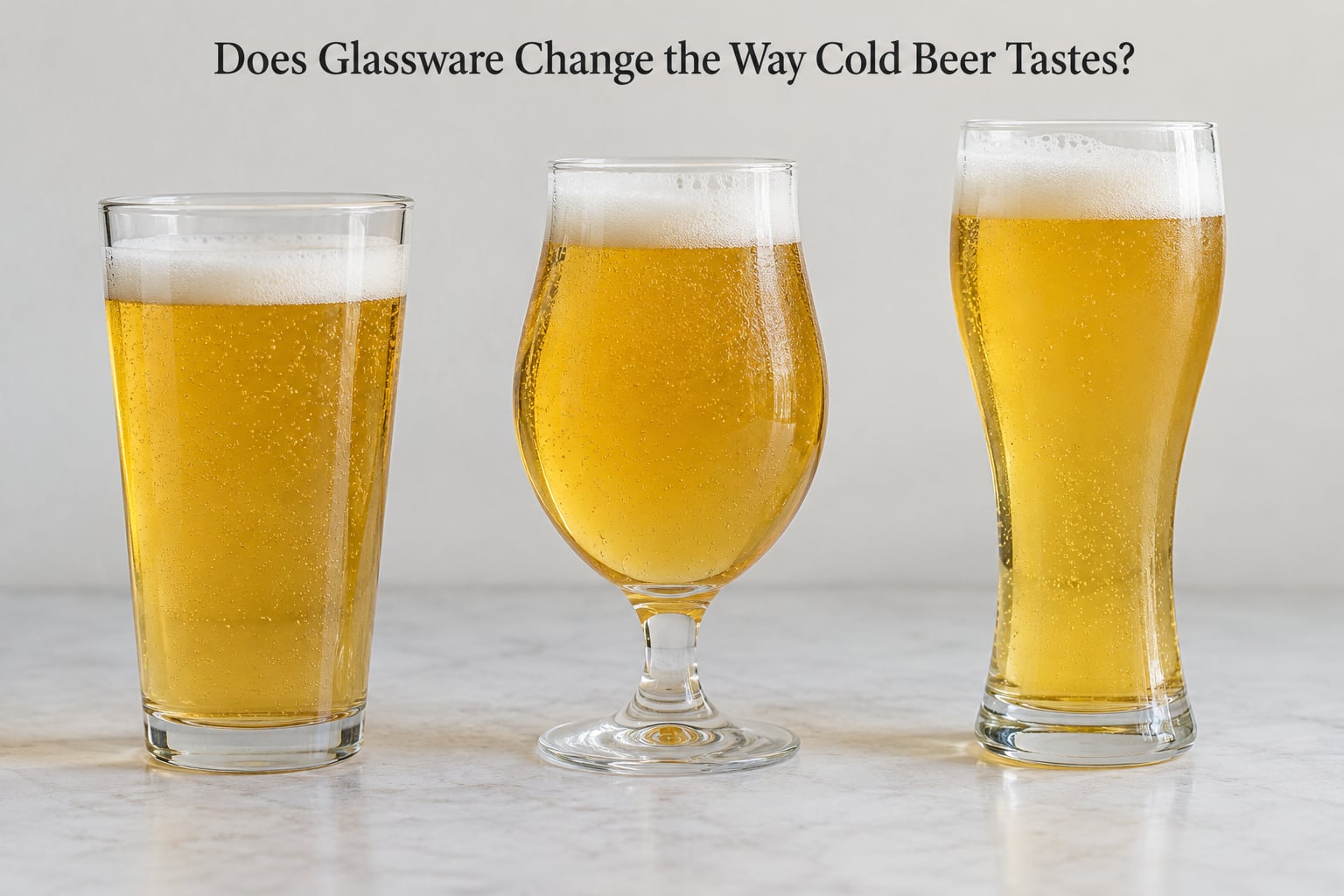
Yes, and mostly through aroma concentration rather than anything to do with the brand of glass. Shape controls the surface area of exposed beer, the volume of headspace above it, and how aroma compounds funnel toward your nose as you drink.
A narrow, tulip-shaped glass concentrates aroma toward the rim and slows the release, which is why IPAs and barrel-aged beers get that glass. A wide-mouthed pilsner glass opens up a large surface area that releases CO₂ and aroma fast, which suits a beer you want to drink immediately. Snifter-shaped glassware is a way of holding a small pour of something strong and expensive while it warms, not a way of making cheap beer better. A frosted mug is the opposite of useful: the thick ice layer holds the beer near freezing far longer than a thin glass does, and the insulation keeps the aroma in rather than letting it rise.
How to Taste More Flavor from Cold Beer
You do not need a thermometer or a special glass. You need about ninety seconds of attention to what is already in front of you.
- Smell before you sip. Put your nose in the glass and take one long sniff. That is where the aroma is, and it is a much richer signal than anything your tongue gets.
- Hold the glass in both hands. Body heat alone will move a cellar-temperature beer a few degrees in a minute or two. This is the single most effective thing you can do.
- Let the pour sit. Five to ten minutes settles agitation and lets the beer warm toward the temperature it was poured at.
- Swirl gently, not hard. A slow swirl wets the glass walls so aroma compounds ride the film up and out. Shaking splashes aroma into the air instead of into your nose.
- Taste the top of the glass first, then the bottom. The top is the most exposed to headspace aroma, and the bottom has collected the sediment of yeast, hops and the heavier flavor compounds that have settled out.
- Cover all your taste receptors. Take a real sip and let it sit in your mouth for a couple of seconds instead of swallowing. A long sip is the single most repeated piece of advice on beer tasting forums, and it works because cold, fast swallows are the main reason people think a beer has no flavor.
- Know the cost of warming. Every extra degree accelerates oxidation for the rest of the glass, so warming a flawed beer exposes it. Warming a well-made one just reveals what was already there.
Frequently Asked Questions
Is cold beer actually less flavorful, or does it just taste different?
Less flavorful, in the way that matters to your senses. The flavor compounds are all still in the glass when it is cold; they just stay in solution instead of evaporating into the air you smell, and your tongue registers them less strongly at low temperature. Cold beer also loses carbonation bite and body, so the total sensory information available is genuinely lower.
Why does cold beer seem to have less aroma?
Because aroma compounds need heat to leave the liquid. Vapor pressure rises with temperature, so at 34 degrees Fahrenheit a hop oil like linalool or a yeast ester like isoamyl acetate barely escapes, while the same compound in a 50 degree beer moves into the air readily. Warm beer also releases carbon dioxide from solution, which carries additional volatile compounds upward with it.
Is warm beer more flavorful than cold beer?
Warmer beer is usually more flavorful in aroma, malt and hop expression, but it is not simply better. Warmth also amplifies defects like diacetyl, rotten egg hydrogen sulfide and oxidation notes, and it makes carbonation fade faster, which many drinkers read as flat. The sweet spot for most ales sits well below room temperature and well above refrigerator temperature.
What temperature is best for tasting an IPA?
Serve an IPA between 50 and 55 degrees Fahrenheit, which is 10 to 13 degrees Celsius. Cold suppresses citrus, pine and tropical hop oils, and the first sip of a fridge-cold IPA can taste almost like plain bitter water. Served warmer it will taste more bitter as well as more aromatic, so if bitterness is your problem, taste it cold first and then warm it.
Should lager be served colder than an IPA?
Usually yes. Light lagers and pilsners are built around a crisp, sharp bite that cold emphasizes, so 35 to 45 degrees Fahrenheit suits them. IPAs, stouts, porters and barrel-aged beers depend on aroma compounds that need warmth, so 50 to 55 degrees Fahrenheit serves them better. Refrigerator temperature is not wrong for lager; it is wrong for most everything else.
How long should beer sit out before tasting its full flavor?
Give it five to ten minutes, and more if it came straight from a fridge. A pour that has been agitated loses CO2 quickly, and sitting lets the beer move toward the temperature it was actually dispensed at. Holding the glass with both hands for a minute or two is often enough to open a hazy IPA. Very cold glassware can hold a beer at near freezing for far longer than a thin one.
Conclusion: Start With the Right Serving Temperature
Cold beer tastes less flavorful because low temperature holds volatile aroma compounds in the liquid, softens your taste receptors, flattens carbonation and body, and shifts the ethanol-water structure in ways that reduce perceived intensity. The beer did not lose anything chemically. Your senses just have less to work with.
So do one thing first: next time you pour an IPA, a stout or anything barrel-aged, hold the glass in both hands for a minute, smell it, then taste. If you are serving guests or setting up a flight, keep the pale lagers cold and let the ales come up a few degrees. That single adjustment explains more flat pints than any glassware upgrade will.