Amber ale vs red ale is mostly a question of how far a brewer pushes the malt. Amber ale is the copper-colored, evenly balanced member of the family; red ale is that same beer walked a few steps darker and redder, with more caramel and toasted grain. In the US the two names overlap so heavily that plenty of breweries sell one beer under both labels.
That overlap is the main reason the comparison confuses people. Untappd files both under one combined category, the BJCP splits them across two separate style families, and taproom menus invent their own wording in between. Once you know what actually creates the difference, which is the grain bill, you can read a menu in a few seconds.
Updated for October 2026. Style figures quoted throughout come from the BJCP style guidelines.
This guide covers color, malt, hops, body, and food, then ends with the question people actually have at the bar: which one should I order?
Table of Contents
- Amber Ale vs Red Ale at a Glance
- Amber ale vs red ale in one line each
- What Is the Difference Between Amber Ale and Red Ale?
- Where the naming confusion comes from
- How Do the Malt Flavors Compare?
- Why amber ale tastes sweet in the first place
- What the color malts actually do
- Homebrew note: walking a beer from amber to red
- How Do Hop and Bitterness Levels Compare?
- Which Ale Has a Fuller or Cleaner Taste?
- Which Beer Pairs Better with Food?
- Amber Ale vs Red Ale: Common Misconceptions
- Which Should You Choose?
- Frequently Asked Questions
- Is red ale darker and more bitter than amber ale?
- Are amber ale and red ale the same style?
- Which ale is usually stronger, amber ale or red ale?
- What foods pair best with amber ale and red ale?
- Should amber ale or red ale be served cold?
- How do I choose between them at a beer bar?
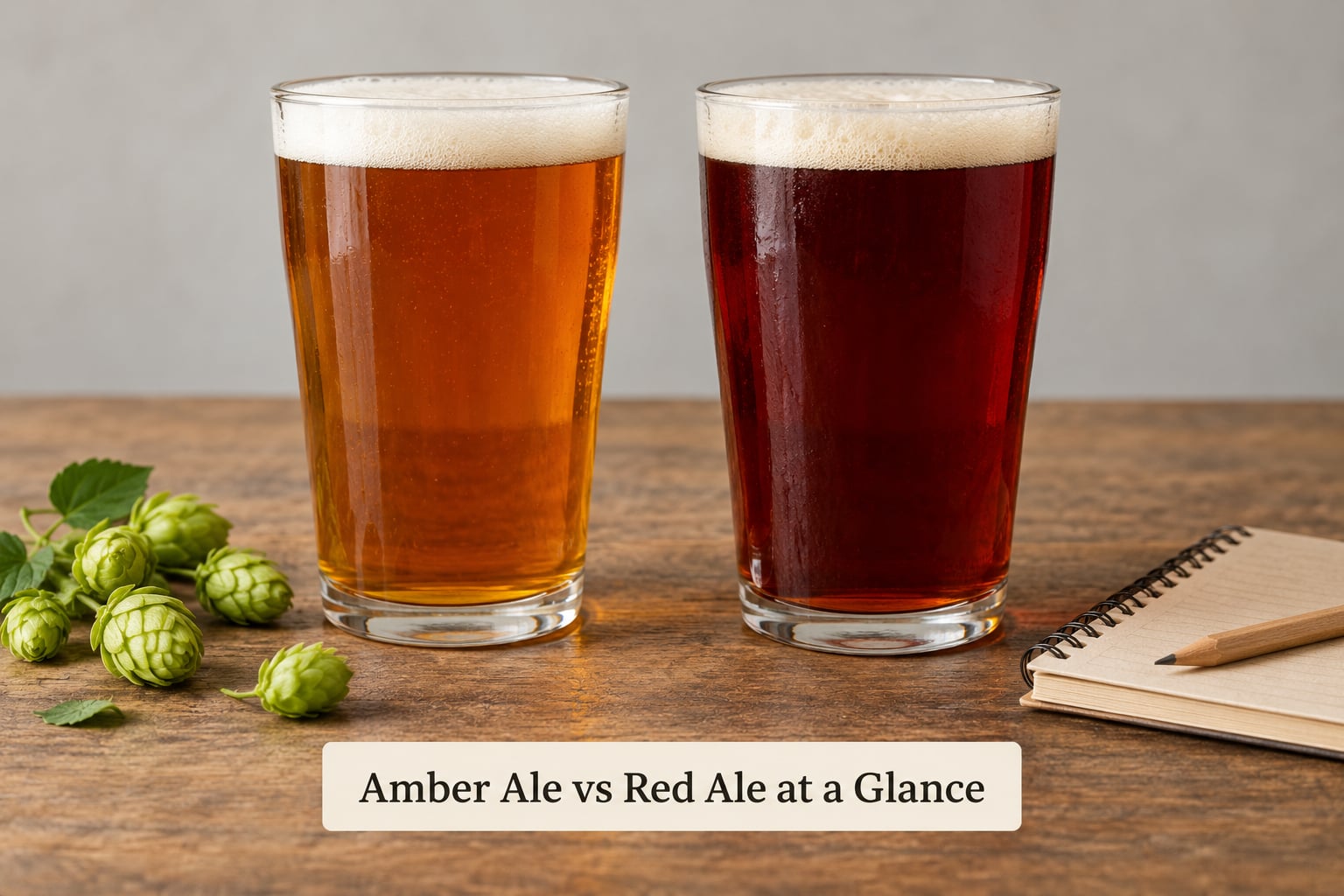
Amber Ale vs Red Ale at a Glance
| Characteristic | Amber Ale | Red Ale |
|---|---|---|
| Color | Copper to light amber | Deep copper to ruby-brown |
| Approximate color range (SRM) | 6 to 14 SRM | 12 to 25 SRM |
| Base grain | Two-row pale malt | Two-row pale malt |
| Color-building malts | Crystal Light, Crystal 60/80, Caramunich, small share of Munich or amber malt | Higher share of Crystal 80 and Crystal 120, Caramunich, sometimes a touch of roasted barley |
| Hop bitterness (IBU) | Typically 25 to 40 IBU in American examples | 10 to 25 IBU (Irish red) up to 25 to 50 IBU (American red) |
| Original gravity | About 1.045 to 1.060 | About 1.044 to 1.060 |
| Final gravity | About 1.010 to 1.015 | About 1.008 to 1.015 |
| Alcohol by volume | Roughly 4.5% to 6.2% | Roughly 4.0% to 6.2% in standard examples |
| Body | Medium to medium-full | Medium-full, sometimes chewy with strong versions |
| Aroma | Biscuit, toast, caramel, toffee, light fruit, moderate hop presence | Deeper caramel, toffee, nutty, raisin, plum, fig, sometimes coffee-adjacent roast |
| Finish | Clean, lightly sweet or dry | Dry and malty in American reds, distinctly sweet in Irish reds |
| Lineage | English pale ale and bitter tradition, Americanized | Same family plus Irish and Scottish malt-forward influence |
| Serving temperature | 45 to 55 F, cool but not ice cold | 50 to 60 F, a touch warmer for the malt to open up |
| Glassware | Pint or nonic | Tulip or imperial pint |
| Best with | Roast chicken, burgers, sausages, mild cheeses, fries | Barbecue, grilled meats, pizza, roasted mushrooms, spiced dishes |
Amber ale vs red ale in one line each
- Color: amber pours copper, red pours ruby to russet. The color comes from the same malts that add the flavor, so it is a real difference rather than a cosmetic one.
- Ingredients: both are built on pale malt plus crystal and caramel malts. Reds simply carry a larger share of darker crystal malt.
- Flavor: amber leans biscuit, toast, and light caramel. Red adds toffee, nutty toast, and dark fruit such as raisin, plum, or fig.
- Hops: this is where popular descriptions get it wrong. Hop levels vary by brewery and sub-style far more than they vary between the two names.
- Strength: both usually sit between 4.5% and 6.2% ABV. Red ale is not automatically the stronger beer.
Read that table as a map rather than a rulebook. Any individual beer can break every row in it, and plenty do.
What Is the Difference Between Amber Ale and Red Ale?
The practical difference is malt depth, expressed through color. Amber ale is the more restrained, better-balanced version; red ale is the same family pushed further toward caramel and toasted grain, and sometimes beyond into the hop-forward end.
Both are top-fermented ales with medium to medium-full bodies, both built on a base of pale malt, and both finished with some crystal or caramel malt. Neither has roasted coffee character the way a stout or porter does, unless a brewer deliberately pushes it there.
Where the naming confusion comes from
Here is the part almost nobody explains. In American craft brewing, red ale does double duty. It is a catch-all label for the whole amber-to-red-brown family, and it is also a specific style in its own right.
You can see the catch-all usage in action on Untappd, where Camba Bavaria Amber Ale, a beer named for amber, is filed under the combined category Red Ale – American Amber/Red. Review sites do the same, with category headings like Amber/Red Ale. If you have ever wondered whether a beer described that way is a distinct style or just a synonym, that is your answer: on those listings it is a synonym.
The BJCP takes a stricter view and splits the family across two categories. American Amber Ale is style 19A. Irish Red Ale is 21A and American Red Ale is 21B. Judges care about the difference, and so should you if you ever enter beer.
There is a genuine historical split underneath the naming mess too. Amber descends from English pale ale and bitter tradition, filtered into something rounder and more caramel-forward in American breweries. Red ale absorbs Irish and Scottish malt-forward brewing, which is why the Irish sub-style is sweeter and far lower in hops.
Homebrewers tend to land somewhere in the middle of this, which is exactly why the styles blur in practice. One DIYBeer community brewer described their red ale as a bit of a hybrid of both, seeing red ale as the American-hop version of the style. That is an honest description of what most modern red ales actually are.
How Do the Malt Flavors Compare?
Amber ale is the more caramel and toast profile, while red ale runs deeper into toffee, nuttiness, and dark fruit. Neither is dramatically sweeter than the other, and that is the part that surprises people.
In an amber ale you will taste biscuit and fresh-baked bread from a small share of Munich or amber malt, a clean caramel edge from crystal malt, and enough hop bitterness in the background to keep the malt honest. The finish is usually clean, sometimes a touch dry.
A red ale walks that same path further. More Crystal 80, more Crystal 120, and more Caramunich push the hue toward ruby and add notes that read as raisin, plum, fig, nutty toast, and occasionally a whisper of coffee. Traditional Irish red ales stay sweet to the finish, while American red ales are usually fermented drier so the malt reads as bready and toasted rather than sugary.
Why amber ale tastes sweet in the first place
Crystal and caramel malts do not add sugar to the finished beer. They add unfermentable dextrins that stay in solution and give the impression of sweetness. On the Homebrewers Association forum, brewers describe crystal as the defining ingredient for an amber ale, one that brings a delicate sweetness with reduced astringency.
That is also why a beer can taste sweet without feeling heavy. Residual sugar from an under-attenuated ferment is a different mechanism entirely, and it is the mechanism behind most sweet Irish red ales.
What the color malts actually do
- Crystal Light and Crystal 60: pale gold to deep gold, light caramel sweetness, minimal color contribution at the low end.
- Crystal 80: the workhorse for amber and the starting point for most reds. Adds caramel and a real jump in body.
- Crystal 120: deep amber to reddish, adds dark fruit and burnt caramel. This is the malt homebrewers reach for when a beer needs to look red.
- Caramunich: powerful. Deep reddish color, strong toffee and roasted character, and easy to make harsh above roughly a tenth of the bill.
- Amber malt: biscuity and grainy, adds color too, but far less than its name suggests.
- Roasted barley: the fastest route to a dark hue, and the fastest way to make an ale taste like a porter. A small percentage, used carefully.
Homebrew note: walking a beer from amber to red
If you are brewing, the move is straightforward. Take 5 to 10% of your pale malt and swap it for Crystal 80, then add 3 to 5% Crystal 120 on top. That shifts color and flavor toward red without rebuilding the recipe.
The fear about Crystal 120 is mostly unfounded. HomebrewTalk brewers report that going heavier on it does not make a beer much sweeter; it mostly adds burnt caramel, fig, and plum depth. The color arrives long before the sweetness does, and you can stop at any point along the way.
On mash technique, brewers argue endlessly and mostly overdo it. A single mash of the full grain bill is simpler and produces a cleaner, more fermentable wort. Mashing the base malts and steeping the specialty crystal malts raises your gravity more than a full mash does, which is useful if you are chasing body and color, and it also leaves more unfermentable character behind.
How Do Hop and Bitterness Levels Compare?
Hop levels vary more by sub-style than by color, and popular write-ups tend to get this backwards. An American amber ale can be as hoppy as an American red ale, and an Irish red ale can be nearly hop-free.
The BJCP numbers tell the story. American Amber Ale sits at 25 to 40 IBU. Irish Red Ale sits much lower, at 10 to 25 IBU, where hops are only a background seasoning. American Red Ale climbs to 25 to 50 IBU with a distinctly American hop aroma of pine, citrus, or resin.
So what actually separates the two names when it comes to hops? Very little. What changes going from amber to red is almost always the malt, and the bitterness level stays wherever the brewery wants it. An amber ale that finishes dry and bitter is a normal, well-made beer. A red ale at 18 IBU is also normal, just in a different direction.
Where you will notice hops most is at the strong end of both families. Imperial ambers and imperial reds, plus the red IPAs, are the outliers people are arguing about on the BeerAdvocate community forum, where the complaint is that ambers and reds are treated as the same beer when a classic amber and an imperial red are nowhere near each other.
Are amber ales hoppy? Sometimes. The style tolerates American hop flavor; it just does not require it.
Which Ale Has a Fuller or Cleaner Taste?
Red ale usually feels fuller and amber ale usually finishes cleaner, because red ales carry more unfermentable dextrins from heavier crystal use, and amber ales are more often fermented to a drier finish.
If you want a soft, rounded, sessionable beer that will not tire you out over a couple of pints, look for an amber ale with a moderate body and a restrained grain bill. HomebrewTalk users describe the amber and red range as running from very sessionable examples up through much stronger, hoppier beers, and the sessionable end of that range is almost always amber.
If you want layered, malt-forward character, you want red. The extra crystal and caramel malt gives more texture, more flavor intensity, and a longer finish, at the cost of some sessionability.
Cleanliness comes from fermentation, not from the color. A well-attenuated American red ale finishes dry and crisp with no cloying finish. A sweet Irish red ale is not dirty, it is fermented cool with a less attenuative yeast, which is a deliberate choice.
One warning when ordering: a beer called a red ale is not automatically a clean malt-forward ale. Flanders red and oud bruin beers, which include Rodenbach and other famous examples, belong to the sour end of the red spectrum. They taste radically different, and they are not what most people mean when they search for a red ale.
Which Beer Pairs Better with Food?
Both styles handle meat and fried food well, but amber ale is the more flexible pairing and red ale is the more flavorful one with heavier, spicier food.
Amber ale pairs best with roast chicken, burgers, sausages, mild cheeses like cheddar or gouda, and fries. Its moderate bitterness and light caramel cut through fat without overpowering a delicate protein.
Red ale pairs best with barbecue, grilled meats, pizza, roasted mushrooms, and slightly spiced dishes. The deeper toffee and nuttiness stands up to char and smoke, and the darker fruit notes work with caramelized sauces.
A few pairings that work especially well: an amber ale with smoked gouda and pretzels, a red ale with pulled pork or a burnt-end sandwich, either one with roasted root vegetables, and either one with a hearty winter stew.
Cured meats and aged cheeses suit both styles, since the salt and umami echo the toasted malt character. Very hop-forward reds, meaning the red IPAs, tolerate hotter curries and spice-heavy food better than a sweet Irish red would.
Amber Ale vs Red Ale: Common Misconceptions
Five assumptions come up constantly, and all five are wrong.
Red ale is always stronger. No. Standard versions of both styles cluster around 4.5% to 6.2% ABV, which overlaps heavily with pale ales. Strength shows up in the imperial versions, where alcohol climbs into the 8 to 10 percent range, and that happens on both sides of the color line.
Darker color means more bitterness. Color comes from caramel and roasted malts. Bitterness comes from hops. A dark red ale can be mellow and a pale amber ale can be sharp, because the two variables are set independently.
All red ales taste malty and sweet. Only the Irish sub-style does that reliably. American red ales are frequently drier and more bitter than the amber ale sitting next to them on the same tap list.
Amber ales are always light on alcohol. Imperial ambers exist and they are not shy. Reading the ABV beats guessing from the style name every time.
Amber malt, amber ale, and amber lager are the same thing. They are not. Amber malt is an ingredient. Amber ale is a style of top-fermented ale. Amber lager is a bottom-fermented lager that shares only the color word.
One more worth naming, because it is the most common homebrew mistake: amber malt does not make a beer look amber by itself. It contributes some color, but the hue on a glass of pale ale comes almost entirely from crystal and caramel malts.
Which Should You Choose?
Choose by the beer in front of you rather than the label, and here is how I would read a tap list.
- If you want the easy drink with a burger or a plate of wings: pick the amber ale. Look for something in the 4.5% to 5.5% range with a clean finish.
- If you want richer malt and you are ordering barbecue or grilled meat: pick the red ale, ideally something under American Red Ale or Irish Red Ale rather than a sour.
- If you are a malt-first drinker: go red, and go for the darker examples. That is where raisin, plum, and nutty toast actually show up.
- If you are a hop fan: amber and red are not your styles. Look for a red IPA or a hoppier American red ale, and check that the IBU is somewhere above 40.
- If you are new to craft beer: start with an amber ale. It is the most balanced member of the family and the easiest to understand.
- If the menu says Red Ale – American Amber/Red on a beer database: that tells you the family, not the sub-style. Read the tasting notes or the ABV instead.
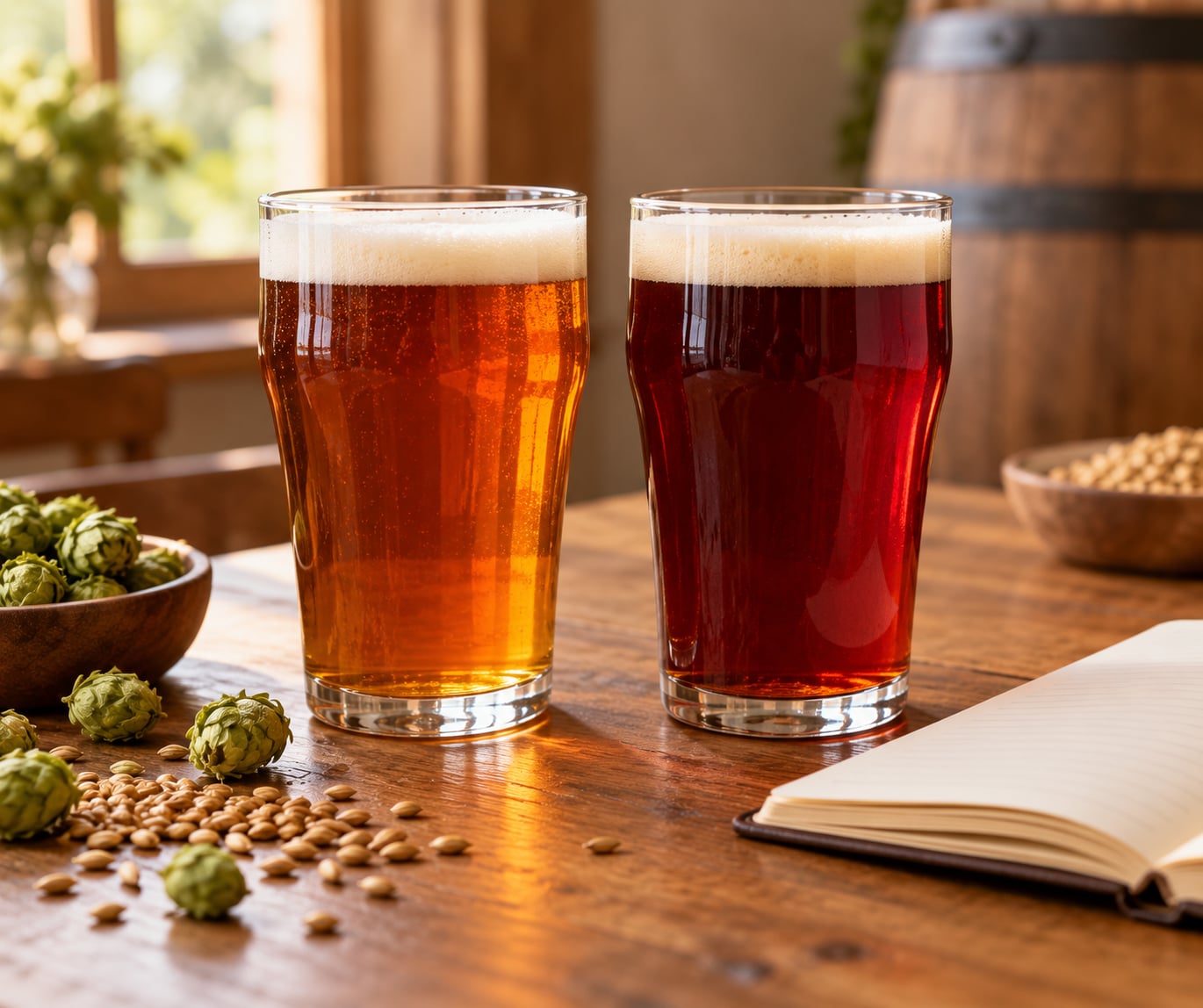
- If you want to compare them properly: pour two glasses side by side, drink the amber first, then the red, and take a sip of something plain between them. The color difference is obvious; the flavor difference is much smaller than the names suggest.
Serve amber ale around 45 to 55 F in a pint or nonic. Serve red ale a little warmer, around 50 to 60 F, in a tulip or imperial pint so the aroma has somewhere to go. Neither one wants to come out of the fridge at freezer-cold temperatures.
Frequently Asked Questions
Is red ale darker and more bitter than amber ale?
Red ale is usually darker, but darker does not mean more bitter. Color comes from caramel and roasted malts while bitterness comes from hops. Most American amber ales sit around 25 to 40 IBU, American red ales run slightly higher, and Irish red ales can be as low as 10 to 25 IBU.
Are amber ale and red ale the same style?
Often enough that the naming is confusing. Untappd files both under Red Ale – American Amber/Red, and many breweries cross-list one beer under both names. The BJCP keeps them apart: American Amber Ale is style 19A, while Irish Red Ale (21A) and American Red Ale (21B) sit in category 21.
Which ale is usually stronger, amber ale or red ale?
Neither one reliably. Most examples of both land between 4.5% and 6.2% ABV, overlapping heavily with pale ales and lagers. Strength shows up in the imperial versions on either side of the color line, where alcohol climbs into the 8 to 10 percent range.
What foods pair best with amber ale and red ale?
Amber ale takes roast chicken, burgers, sausages, mild cheeses and fries with equal ease. Red ale suits barbecue, grilled meats, pizza, roasted mushrooms and dishes with a little heat. Cured meats and aged cheeses work with both, since the salt and umami echo the toasted malt character.
Should amber ale or red ale be served cold?
Cool, but not ice cold. Amber ale is best around 45 to 55 F, and red ale a touch warmer at 50 to 60 F so the deeper caramel and fruit notes open up. Serve amber in a pint or nonic and red in a tulip or imperial pint to give the aroma room.
How do I choose between them at a beer bar?
Check the ABV and the style sub-label before you check the color. A Red Ale – American Amber/Red listing on a beer database only tells you the family. Watch for two traps: red IPAs, which are hop-forward, and Flanders red ales, which are sour and nothing like the clean malt-forward beer most people are after.
The honest summary is that amber ale and red ale are closer than the names suggest. Pick amber for balance, sessionability, and a burger. Pick red for deeper caramel and toasted malt, a heavier body, and something that can stand up to smoke and spice.
Then stop reading the label and taste the beer.