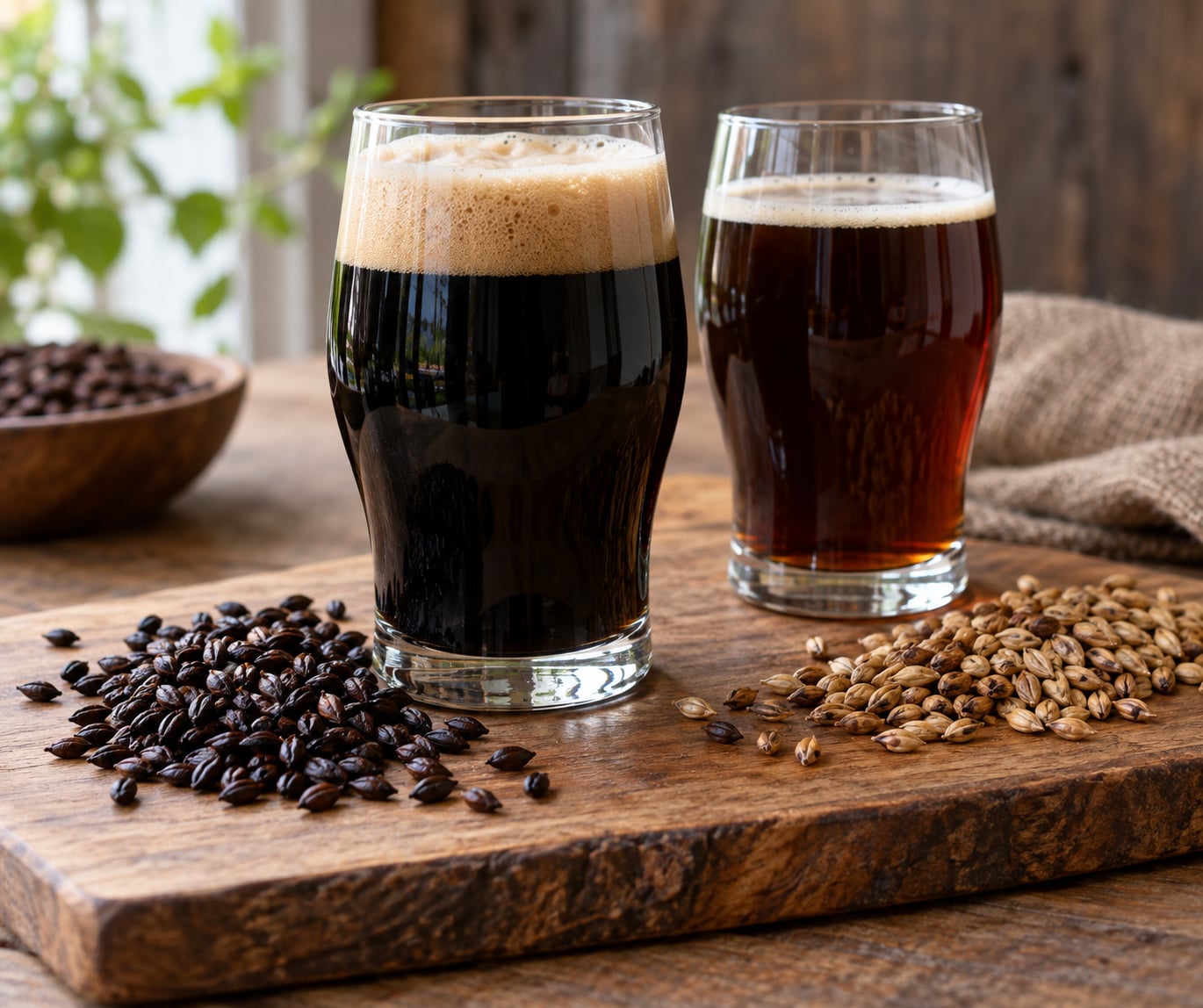
Stout vs porter comes down to one ingredient: stouts are brewed with roasted unmalted barley, which gives them a dry, coffee-like bite and a heavier body, while porters are built on malted dark malts such as chocolate and brown malt, which taste sweeter, toastier and a little lighter. Everything else about the two styles overlaps more than the labels suggest.
Both are dark top-fermented ales with centuries of London in their family tree, and a dry Irish stout can be lighter on your palate than a rich American porter. So “stout vs porter explained” is less about a rigid rulebook and more about knowing what to expect in the glass.
Table of Contents
- Stout vs Porter Explained at a Glance
- What Is the Difference Between a Stout and a Porter?
- Flavor and Roast: Which Beer Tastes More Roast-Heavy?
- Is Guinness a stout or a porter?
- Body, Mouthfeel, and Carbonation
- Stout vs Porter Examples: Familiar Beers and Style Traits
- Which Stout or Porter Is Best for Beginners?
- A simple two-week plan
- Which One Wins for Food Pairings?
- Stout vs Porter: Which Should You Choose?
- Frequently Asked Questions
- Is a stout stronger than a porter?
- Are stouts and porters the same type of beer?
- Which is more bitter, stout or porter?
- Is porter always lighter than stout?
- What should beginners drink first: stout or porter?
- Does stout or porter pair better with burgers and barbecue?
- What to Do First
Stout vs Porter Explained at a Glance
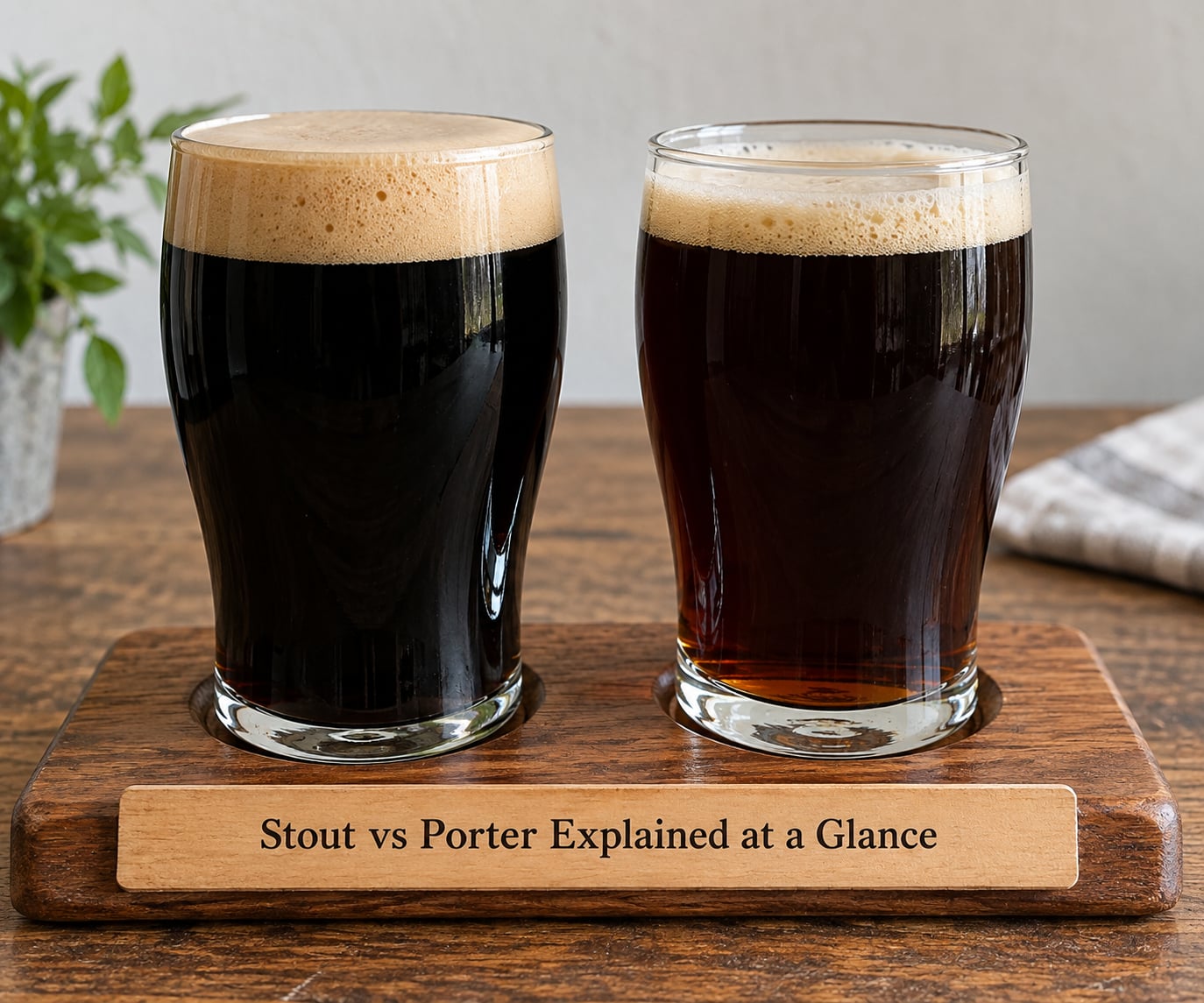
| Criterion | Stout | Porter |
|---|---|---|
| Roast source | Roasted unmalted barley | Malted dark malts (chocolate, brown, crystal) |
| Typical flavor | Coffee, espresso, cocoa, charcoal, dry ash | Toffee, caramel, toast, dried fruit, soft chocolate |
| Finish | Dry, faintly astringent | Smoother, often slightly sweet |
| Body | Medium to very heavy, silky when oats or lactose are used | Light brown-ale weight up to medium-full |
| Color | Jet black, usually opaque | Deep brown, sometimes with garnet edges |
| Approximate ABV | About 4% to 12% depending on substyle | About 4.5% to 6.5% for most modern examples |
| Bitterness source | Roast-dominant, sometimes with hop edge | Malt and caramel, light hop aroma |
| Food match | Barbecue, oysters, dark chocolate, aged cheese | Burgers, sausages, roast chicken, mushroom dishes |
| Known examples | Guinness Draught, Murphy’s Irish Stout | Founders Porter, Samuel Smith’s Taddy Porter, Fuller’s London Porter |
What Is the Difference Between a Stout and a Porter?
Both styles came out of the same place. Porter was born in early 1700s London, a dark, strong, heavily hopped brown ale blended to survive long shifts on the docks and rails, and it was eventually named after the porters who drank it. It was deliberately built by blending three threads of beer, a technique London brewers refined for decades.
The word “stout” arrived as a synonym for “strong.” Stout porter meant a higher-alcohol porter, and shortened over time to just stout. That origin is the source of the most common misunderstanding in the style’s history, since stout today describes a family of beers and says nothing about strength.
The technical split is the grain bill. A traditional porter uses no roasted barley at all: its color and flavor come from kilned, malted grains like chocolate malt, brown malt and dark crystal malt. A stout includes roasted unmalted barley, which is never malted, and that single addition delivers a deeper, drier, more intense roast than a porter’s malted dark grains can.
Stouts also add adjuncts more freely. Oats, wheat, rye, lactose and occasionally coffee or vanilla change the mouthfeel and flavor well beyond the base style, which is why a milk stout tastes nothing like a dry Irish stout despite sharing a name.
Flavor and Roast: Which Beer Tastes More Roast-Heavy?
Stouts are generally the roast-heavier of the two, tasting of espresso, dark cocoa, charcoal or cold ash. The finish usually dries out and leaves a faint bitterness that isn’t hop-derived. A dry Irish stout is the cleanest example of that profile, while an imperial stout pushes it into dessert territory with added sweetness and alcohol warmth.
Porters lean sweet and bready instead, with burnt sugar, toffee, caramel and a dusting of cocoa powder. They can still be bitter, but that bitterness is usually roast-adjacent rather than hoppy, which is a distinction that trips up a lot of newcomers. If a dark beer tastes aggressively bitter and grassy rather than smooth and malty, you’re probably tasting hops.
That said, individual recipes cross the line constantly. Plenty of American craft porters include a few percent roasted barley for color, and plenty of stouts are brewed light enough to be gentle. The style guides describe intent, not a police state.
Is Guinness a stout or a porter?
Guinness Draught is an Irish dry stout, brewed with roasted unmalted barley, which is why it tastes dry and coffee-like. Guinness also sells a separate Guinness Porter, a different beer built on malted dark malts. The label tells you which one you are holding, and a bar that pours stout for a porter order is mislabelling the pour, not describing a secret style quirk.
Body, Mouthfeel, and Carbonation
Stouts usually feel denser and more lingering on the palate, especially when oats or lactose are in the mix, which is what makes oatmeal and milk stouts read as creamy. Straight dry stouts are the exception: they can be light in body and highly carbonated while still tasting like roasted coffee.
Porters cover a much wider weight range. A brown porter can sit close to an English brown ale in weight while a robust or imperial-weight porter fills the glass like a stout. Carbonation is where the two genuinely meet in the middle, since many modern examples are poured at exactly the same nitrogen ratio.
The practical test is the finish. If your cheeks feel dry and your tongue feels tight, you’re probably in stout territory. If the last sip is warm, sweet and malty, it’s more likely a porter.
Stout vs Porter Examples: Familiar Beers and Style Traits
Reading a label is easier once you know which substyle you are holding. The porter family runs from English brown-porter territory through American porter to the old-school robust and brown porter labels still sitting on some older bottles. The stout family runs from dry Irish and Irish stout through oatmeal, milk and imperial stout.
Porter beers worth knowing start with Samuel Smith’s Taddy Porter, a textbook English porter with a dry, nutty character, and Founders Porter, a chocolate-heavy American example that shows how far the style drifts in craft brewing. Fuller’s London Porter is the darker, more bitter end of the English tradition, closer to a brown ale than a stout.
Stout beers worth knowing span the range too. Guinness Draught and Murphy’s Irish Stout are the dry, carbonated, roast-forward reference points. An oatmeal stout is silkier and sweeter with a cushioned body, a milk stout adds lactose for dessert character, and an imperial stout is the strong, warming, high-alcohol end of the family.
One bit of label archaeology: robust porter and brown porter were separate categories in an American Homebrewers Association judging framework introduced in 1991, and both terms later disappeared from the official style guidelines. If a bottle lists one, it is usually an older beer or an older recipe, not a separate modern style you need to hunt for.
Which Stout or Porter Is Best for Beginners?
Start with a porter. Most people who assume they dislike dark beer dislike heaviness rather than roast flavor, and a porter gives you coffee, chocolate and toast notes with less weight and no punishing finish. An English porter or a chocolate-forward American porter is the least risky first glass.
Once that lands, move toward a dry Irish stout. It shares the roast character people enjoy without the oiliness of an imperial or the sweetness of a milk stout. Save imperial stouts, pastry stouts and barrel-aged versions for later, since they are intensity experiences rather than easy drinking.
A simple two-week plan
Week one: one English porter and one dry Irish stout, same glass, same temperature. Week two: repeat, but taste them side by side and take notes. That pairing is enough to make the roasted-barley difference obvious on your own palate, which matters far more than any definition.
Which One Wins for Food Pairings?
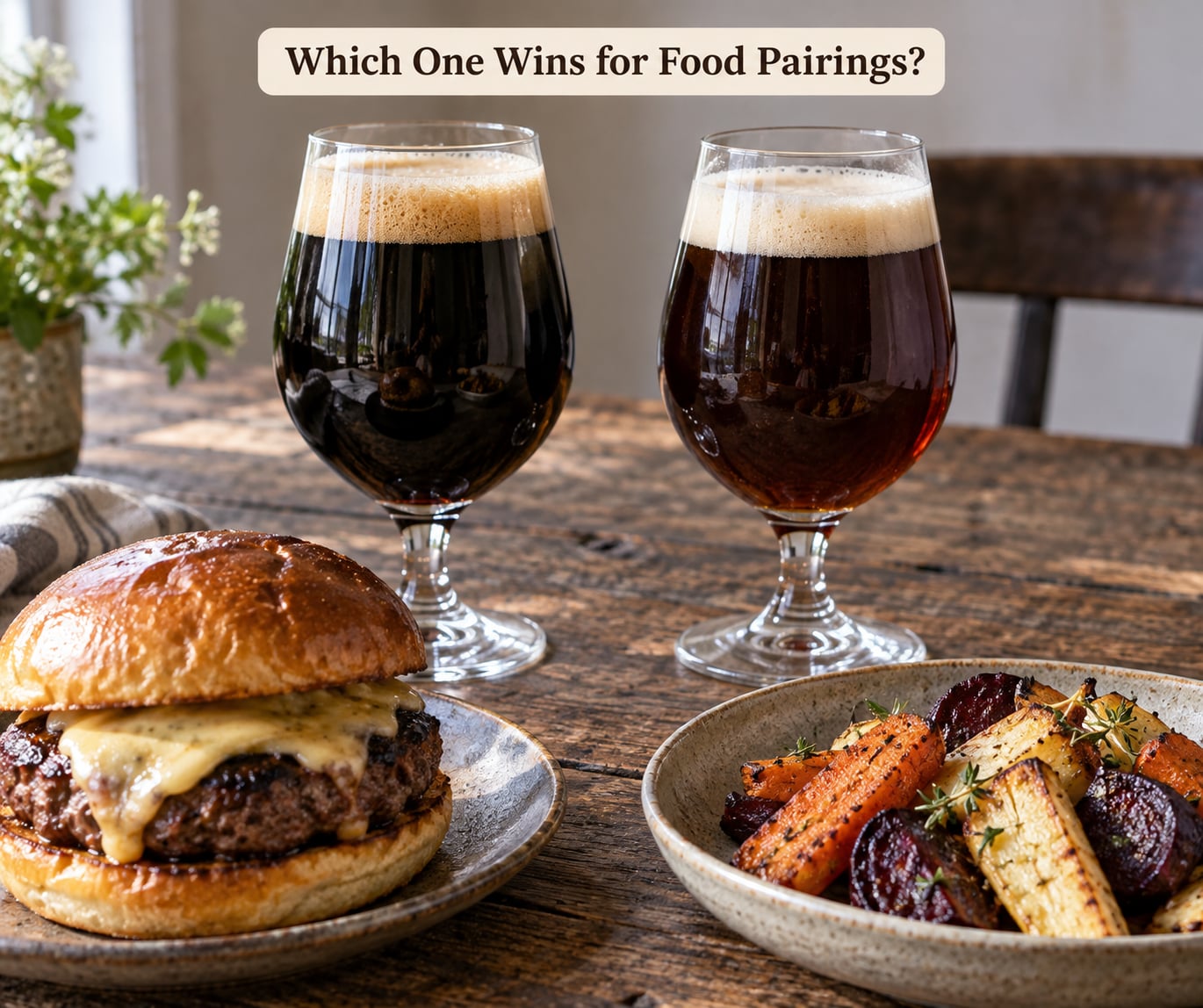
Porters win the savory half of the table. Their caramel and toffee sweetness handles burgers, sausage, roast chicken and charcuterie without fighting the meat, and the mild bitterness cuts fat. A stout’s dryness is less useful against a seared patty, though it works fine with anything already roasted or charred.
Stouts take the sweet and briny courses. Oysters, mussels and other shellfish highlight a dry stout’s mineral, coffee-like character. Dark chocolate, brownies and desserts are the other sweet spot, and an imperial or milk stout handles strong blue cheese or a rich dark dessert without losing the pairing.
Grilled vegetables and roasted roots sit somewhere in the middle, where a porter’s caramel warmth rounds out the char and a stout’s bitterness echoes it. Nobody will stop you either way, which is honestly the point of a comparison like this.
Stout vs Porter: Which Should You Choose?
- Want coffee, charcoal and a dry finish you can sip slowly? Choose a stout.
- Want chocolate and caramel with a lighter, easier-drinking body? Choose a porter.
- Pairing with a burger, sausage or roast chicken? Porter.
- Pairing with barbecue, oysters or dessert? Stout.
- New to dark beer? Porter first, dry Irish stout second.
- Sipping by a fire on a cold night? An imperial stout earns its place.
- Reading a tap list with no descriptions? Order whatever says porter if you want the easy drink, stout if you want the roast.
Read the ABV before you commit either way. People routinely order an imperial stout expecting a Guinness and get something closer to a small dessert, and no style name on the menu is going to warn them.
Frequently Asked Questions
Is a stout stronger than a porter?
Not by definition. Stout originally meant a strong porter, which is where the myth started, but today the word describes a roast style rather than an alcohol level. Most porters sit around 4.5% to 6.5% ABV, dry stouts often run 4% to 5%, and imperial stouts climb to 10% or more. Check the ABV rather than guessing from the style name.
Are stouts and porters the same type of beer?
They are both dark top-fermented ales, so yes, they belong to the same family. The working difference is the grain bill: porters are built on malted dark malts, while stouts include roasted unmalted barley for a deeper, drier roast. Add oats, lactose or coffee to a stout and it can taste nothing like a clean dry Irish stout, so the families are related rather than identical.
Which is more bitter, stout or porter?
Stouts usually present more bitterness, and it comes mostly from roasted barley rather than hops, which is why it tastes dry and astringent instead of grassy. Porters are gentler on that front, with caramel and toffee malt sweetness carrying the finish. The exception is the darker end of the English porter tradition, such as a London porter, which can be noticeably bitter and is one reason people confuse the styles.
Is porter always lighter than stout?
No, and this is where labels mislead. A brown porter can weigh almost nothing next to a thin dry stout, while a robust or imperial-strength porter fills the glass as heavily as many stouts. Feel the finish instead of trusting the style name: a drying, tight mouthfeel points to roast-forward stout, while a warm, sweet, malty last sip points to porter.
What should beginners drink first: stout or porter?
Start with a porter, usually an English porter or a chocolate-forward American one. It delivers the coffee and cocoa notes people expect from dark beer with a lighter body and a forgiving finish, so it is a much lower-risk first glass. Once you like that, move to a dry Irish stout for more roast intensity, and leave imperial and pastry stouts for later.
Does stout or porter pair better with burgers and barbecue?
For burgers, sausages and roast chicken, porter is the safer pick, because its caramel and toffee sweetness handles seared meat and cuts through fat without adding dryness. Barbecue is closer, since char and smoke meet either style well; a dry stout echoes the char while a porter rounds it out. Both are widely available and both work, so let the rest of the menu decide.
What to Do First
Next time you are at a bar, order one porter and one stout and drink them in the same session. The roasted-barley difference is obvious within three sips, and after that you will never have to guess again.