If you want the short version of hazy IPA vs West Coast IPA: a West Coast IPA is clear, dry and sharply bitter with pine and grapefruit hop flavor, while a hazy IPA is cloudy, soft and low in bitterness with ripe tropical fruit aroma. Neither is stronger or weaker. Pick the one that matches how you like beer to taste, and the table below breaks down the difference.
IPA stands for India Pale Ale, a style built around hop aroma and bitterness. That original recipe came out of nineteenth-century British brewing, where pale ales shipped to India picked up extra hops meant to survive the voyage. American brewers later pushed the hops even further, and what followed split into two very different camps.
Most tap lists now say only “IPA,” which is why people get burned ordering a pint expecting grapefruit and getting peach juice instead. Knowing the two families makes the menu easier to read.
Table of Contents
- Hazy IPA vs West Coast IPA at a Glance
- Hazy IPA vs West Coast IPA: Flavor and Aroma
- Hop Variety and Brewing Style
- West Coast hopping: bitterness first, aroma second
- Hazy hopping: aroma first, bitterness almost absent
- Where the two styles are converging
- Appearance, Mouthfeel, and Drinkability
- Bitterness: Which Style Tastes More Bitter?
- Which IPA Pairs Better with Food?
- West Coast IPA pairings
- Hazy IPA pairings
- Hazy IPA or West Coast IPA for Beginners?
- Which Should You Choose?
- How to taste both styles in one sitting
- Is an American IPA the same as a West Coast IPA?
- Frequently Asked Questions
- What is the main difference between a Hazy IPA and a West Coast IPA?
- Is a Hazy IPA just a West Coast IPA with haze?
- Which IPA is more bitter: Hazy IPA or West Coast IPA?
- Can a West Coast IPA be hazy or use modern hops?
- How do I choose between these IPA styles on a beer menu?
- Does hop freshness change the difference between the styles?
- Conclusion
Hazy IPA vs West Coast IPA at a Glance
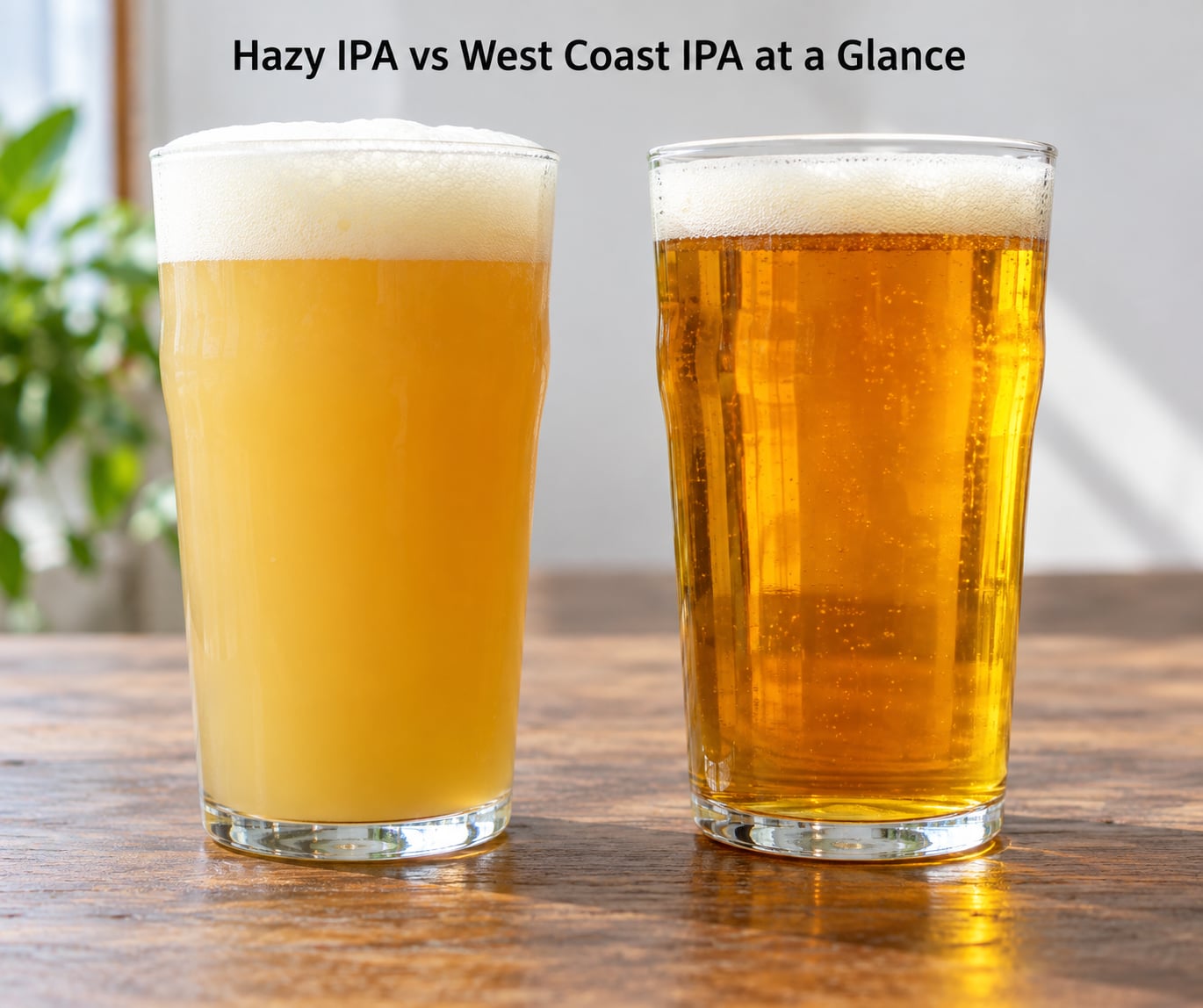
The fastest way to see the difference is to compare them attribute by attribute. West Coast IPAs pour crystal clear and land bitter in the first sip, while hazy IPAs pour opaque and deliver their hop character through aroma instead.
| Attribute | Hazy IPA (New England IPA) | West Coast IPA |
|---|---|---|
| Appearance and clarity | Opaque, milky, permanent haze | Crystal clear, bright, filtered |
| Color | Pale gold to deep orange, sometimes with a juice-like glow | Deep gold to amber |
| Bitterness (IBU) | Low measured and low perceived, roughly 10 to 30 IBU | Assertive, roughly 40 to 70+ IBU |
| Hop aroma | Tropical fruit, mango, peach, passionfruit, lychee, citrus | Pine, resin, grapefruit peel, herb, sometimes dank or spicy |
| Hop flavor | Fruit-forward, juicy, sweet-adjacent | Resinous, bitter, layered |
| Malt presence | Nearly invisible, sometimes a hint of biscuit or wheat | Clean caramel-free backbone with light bread crust |
| Mouthfeel | Soft, pillowy, velvety | Light to medium, snappy, drying |
| Finish | Soft and lingering with fruit | Dry and brisk with a bitter edge |
| Sweetness | Low residual sugar that reads as fruit, not caramel | Bone dry, attenuation-forward |
| Typical ABV | About 6 to 7.5 percent | About 6 to 7.5 percent |
| Grain bill | High-protein wheat and oats alongside pale malt | Pale two-row or barley, low protein |
| Hop addition timing | Little kettle hopping, heavy whirlpool and dry hop | Heavy kettle hopping, some dry hop for aroma |
| Clarifying agents | Usually none, yeast left suspended | Often filtered or fined bright |
| Best food pairings | Sushi, salads, spicy curries, tropical desserts, fried chicken | Burgers, grilled steaks, sharp cheese, onion rings, hot wings |
| Best for | Drinkers who want aroma and soft texture over bite | Drinkers who want crisp dryness and clear hop bitterness |
Read that table once and a menu stops being a puzzle. Anything described as juicy, soft or fruit-forward is hazy. Anything described as dry, resinous or bitter is West Coast.
Hazy IPA vs West Coast IPA: Flavor and Aroma
A hazy IPA tastes like cold fruit juice with hops in it, while a West Coast IPA tastes like a bitter botanical field with citrus in it. Put them nose-first and you can tell them apart with your eyes closed.
In a hazy IPA, the aroma arrives first and does most of the work. Mango, ripe peach, passionfruit, papaya and lychee come off the glass in waves, often with a soft orange note underneath. Homebrewers describe it as everything a juicer would leave behind after making fruit juice.
A West Coast IPA leads with the taste buds instead of the nose. The first sip brings grapefruit peel, pine resin, herbal green notes and a firm bitter bite that dries the mouth. Some versions add dank, spicy or even cannabis-like character depending on the hop variety and how old it is.
The finish tells you which camp you are in. Hazy IPAs end soft and fruit-sweet, sometimes slightly sticky. West Coast IPAs end clean, dry and faintly bitter, leaving the palate ready for another sip.
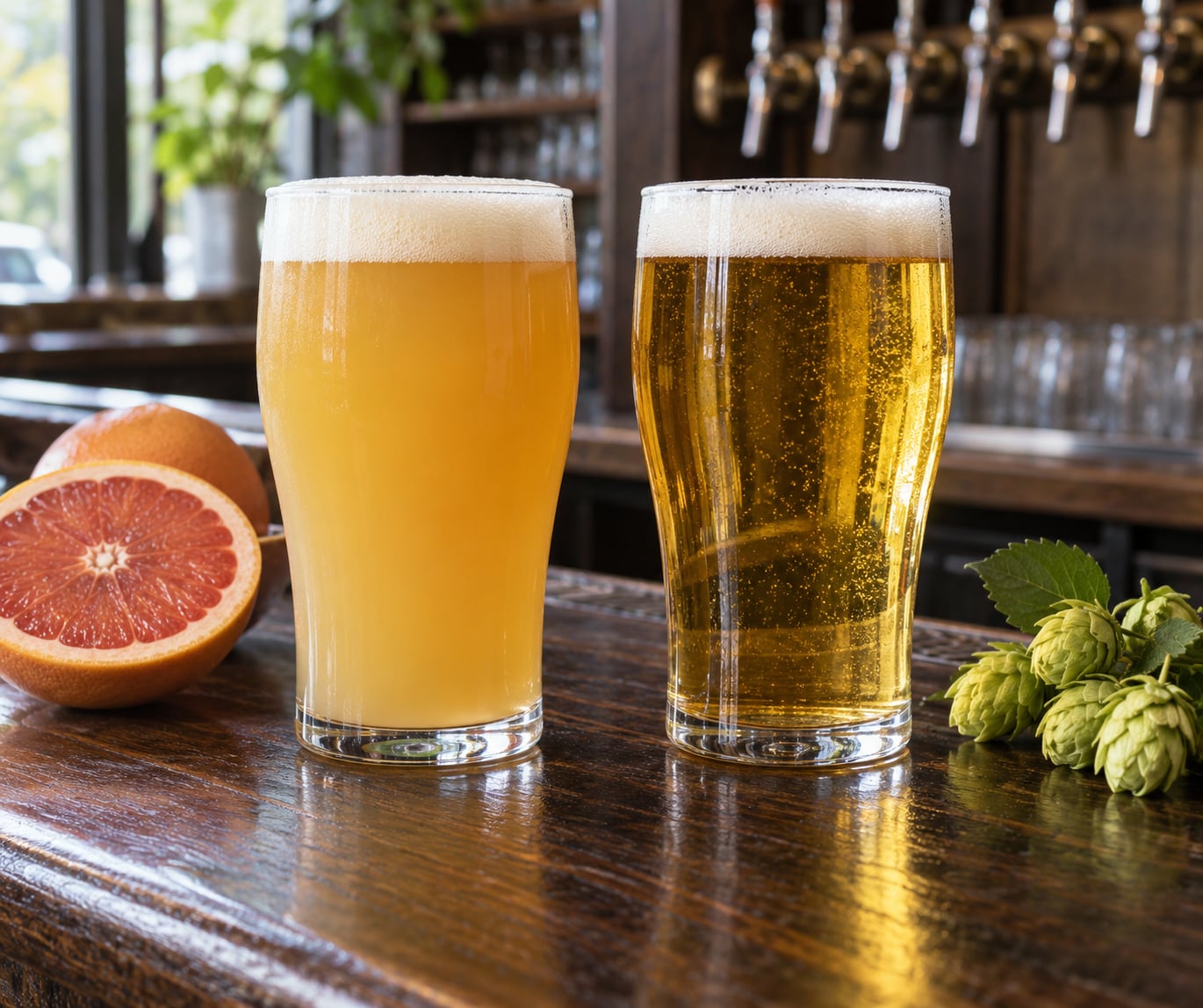
Color reinforces it. Hazy IPAs range from pale straw to a deep orange that looks like fresh-squeezed peach nectar. West Coast IPAs sit in the deeper gold-to-amber range with light showing through.
Hop Variety and Brewing Style
The flavor gap comes from two choices: which hops go in, and when they go in. West Coast brewers put most of their hops in the kettle, where the boil extracts bitter compounds. Hazy brewers keep the kettle addition light and move nearly everything to the whirlpool and the fermenter.
West Coast hopping: bitterness first, aroma second
West Coast recipes are built around traditional American hops with a long history: Cascade and Centennial for floral and grapefruit character, Chinook for pine and resin, Simcoe for a heavier dank edge, Amarillo for bright citrus. The kettle boil pulls bitterness forward, and the dry hop on top adds aroma without softening the bite.
That process is why a classic West Coast IPA tastes so much like hops and so little like malt. The grain bill stays lean, usually just pale malt, so nothing competes with the bitterness.
Hazy hopping: aroma first, bitterness almost absent
Hazy brewers work with high-alpha modern varieties grown for tropical fruit: Citra, Mosaic, Strata, Galaxy, Nelson Sauvin and Amarillo among them. Because these varieties are potent enough to flavor a beer post-fermentation, brewers can skip aggressive kettle hopping entirely and dump most of the charge in as a dry hop or a whirlpool addition.
The grain bill changes too. Adding wheat and oats raises the protein content, and those proteins bind with hop polyphenols to form a suspended haze. Some hazy brewers also skip clarifying agents and leave the yeast in suspension, which keeps the beer looking cloudy and thick. Homebrewers who brew the identical hop bill both ways routinely report that the hazy version tastes noticeably fruitier even with the same hops, which is the clearest proof that timing and grain bill matter more than variety.
Where the two styles are converging
The split is less clean than it was a decade ago. Hazy IPAs are getting drier and less sweet, while several modern West Coast IPAs are coming out hazy while keeping a dry, bitter finish. If you have ever ordered a hazy-looking beer that ended bitter, or a clear beer that tasted like juice, you tasted the overlap. Ask a bartender whether the beer was brewed with a wheat-heavy grain bill, and that usually settles it.
Appearance, Mouthfeel, and Drinkability
Hazy IPAs are opaque and thick, with a soft, pillowy body that sits coating the tongue, while West Coast IPAs are light to medium in body with a brisk carbonation and a drying finish.
The haze is intentional and permanent, which surprises people who assume cloudy beer means old or spoiled. It forms from protein and polyphenols suspended in the liquid, and it will not clear as the beer ages. Chill haze is different: that is a temporary cloudiness that fades when the beer warms, and it happens in clear beers too.
Head retention follows the same pattern. Hazy IPAs hold a thick, creamy foam because of the suspended proteins and yeast. West Coast IPAs typically show a lighter head that dissipates faster.
Drinkability is close. Hazy drinkers describe them as easy to keep drinking because the bitterness never accumulates, and West Coast drinkers report drinking several without noticing because the dryness resets the palate. The honest difference is fatigue: hazy IPAs can get tiring on aroma, while West Coast IPAs can get tiring on bitterness. Different ceiling, same size.
Bitterness: Which Style Tastes More Bitter?
West Coast IPAs taste more bitter, and it is not subtle. They usually measure in the 40 to 70 IBU range, sometimes higher, and the bitterness is designed to be the point of the beer.
Hazy IPAs usually measure far lower, often in the 10 to 30 IBU range, because brewers add few or no hops during the boil. The goal is to keep bitterness low enough that aroma and fruit character come through instead.
One wrinkle worth knowing: IBU is a calculated estimate, not a measurement of what you taste. It is least reliable in the hazy camp, where suspended proteins and polyphenols can carry bitter compounds into the drink in a way the math does not predict. So a hazy IPA labeled at a low IBU can still make you wince, and a West Coast IPA measured high can taste smoother than the number suggests. Trust your palate over the label.
Which IPA Pairs Better with Food?
Pick West Coast IPAs with rich, fatty and savory food, and pick hazy IPAs with bright, delicate and spicy food. Bitterness cuts fat, while soft fruit aromatics get overwhelmed by anything heavy.
West Coast IPA pairings
- Burgers and grilled steaks: the bitterness and dryness cut through fat and char.
- Fried sides: onion rings, fries and hot wings get cut by grapefruit and pine.
- Sharp cheese: aged cheddar, gouda and blue all stand up to a bitter finish.
- Roast poultry: the herbal hop character echoes herbs in the skin.
- Bar snacks: pretzels with mustard, pickles and spicy sausages.
Hazy IPA pairings
- Spicy food: curries, chili and buffalo wings, because the fruit sweetness cools the heat.
- Shellfish and sushi: soft texture and clean citrus work better than resin here.
- Salads and light sandwiches: nothing heavy enough to bury the aroma.
- Tropical desserts: coconut, mango and key lime pies echo the fruit profile.
- Fried chicken: malt sweetness and a juicy middle handle the crunch.
One pairing rule beats any chart: if the beer is the loudest thing on the plate, choose the style that answers it. Bitty hops against a rich plate, fruity hops against a hot or delicate one.
Hazy IPA or West Coast IPA for Beginners?
Beginners usually start with the hazy IPA, because low bitterness makes it approachable without tasting like soap. It reads as fruity and refreshing rather than aggressively bitter.
Start with West Coast if you already like pale ales, lagers or anything with piney, herbal or citrus character. The bitterness is a feature, and once you accept it, the whole classic American IPA category opens up.
Ordering tips when the list just says “IPA”:
- Ask for something juicy, soft or New England style. That is your hazy.
- Ask for something dry, bitter or classic American. That is your West Coast.
- Ask the bartender for the most recent local IPA. Local taps are the least likely to be mislabeled by style.
- Order a half pour if a flight is available. A half pour is the cheapest way to test a whole style.
Nobody’s palate is wrong here. Regular drinkers report happily drinking both styles in one session without fatigue, which is the real answer to the debate.
Which Should You Choose?
Choose the hazy IPA if you want maximum aroma, soft texture and zero bitter bite. Choose the West Coast IPA if you want dryness, resin, grapefruit and a clear, snappy finish.
Simple matchups:
- Juicy hops over bitterness: hazy IPA.
- Haze over clarity: hazy IPA.
- Aromatic intensity over dryness: hazy IPA.
- Spicy or delicate dishes: hazy IPA.
- Bitterness and structure: West Coast IPA.
- Clarity over haze: West Coast IPA.
- Rich, fatty, char-grilled food: West Coast IPA.
How to taste both styles in one sitting
You can taste them properly in about ten minutes. Start with the clearer beer first, because your palate is freshest at the beginning.
- Look: hold both to a window. Note color and clarity.
- Smell: swirl, then smell each several times in a row before drinking.
- Taste: take a full sip, let it sit, then note where the flavor lands.
- Mouthfeel: check body and any lingering stickiness on the lips.
- Finish: note dryness and bitterness after the swallow.
Between beers, reset your palate with a few crackers, a sip of water or a bite of plain bread. Without a reset, the second beer always tastes blander than it is.
Is an American IPA the same as a West Coast IPA?
Not exactly. Style guidelines group IPAs under American IPA and place West Coast IPA as a market label rather than a separate official style, so two beers sold as “American IPA” can taste nothing alike. The West Coast label describes a recognizable flavor profile, not a distinct category in the guidelines.
The practical takeaway: read the ABV and IBU on the tap list, and trust the descriptive words more than the category name.
Frequently Asked Questions
What is the main difference between a Hazy IPA and a West Coast IPA?
A Hazy IPA is cloudy, soft, low in bitterness and heavy on tropical fruit aroma, built on a wheat and oat grain bill with hops added mostly after fermentation. A West Coast IPA is crystal clear, dry and assertively bitter with pine, resin and grapefruit hop flavor, built on lean pale malt with most hops added during the boil. The difference is less about the hops used and more about timing, grain bill and how much bitterness you want on the finish.
Is a Hazy IPA just a West Coast IPA with haze?
No. The haze is the visible part of a much larger change. Hazy brewers use a high-protein grain bill, keep the kettle hopping low, load up on whirlpool and dry hop additions, and skip clarifying agents so yeast stays suspended. That combination delivers low bitterness, a soft body and fruit-forward aroma. A West Coast IPA that was simply left cloudy would still taste dry and bitter, because those choices come from the recipe rather than the appearance.
Which IPA is more bitter: Hazy IPA or West Coast IPA?
The West Coast IPA, by a wide margin. West Coast IPAs commonly measure in the 40 to 70 IBU range and deliver a firm, drying bitter bite from the first sip. Hazy IPAs usually measure much lower, often in the 10 to 30 IBU range, because brewers add few or no hops during the boil. IBU is an estimate rather than a measurement, so in hazy beers treat the number as a rough guide and trust your palate.
Can a West Coast IPA be hazy or use modern hops?
Yes, and increasingly common. Modern American varieties such as Citra, Mosaic and Strata started as high-alpha hops for New England IPAs, but plenty of West Coast brewers now use them to build pine, resin and grapefruit character. Some breweries also brew hazy beers with a dry, bitter West Coast finish. When a beer is hazy and bitter, grain bill and hop timing tell you which side it leans toward.
How do I choose between these IPA styles on a beer menu?
Read the description rather than the category. Words like juicy, soft, hazy, tropical or New England point to a Hazy IPA. Words like dry, bitter, resinous, piney or classic point to a West Coast IPA. If the list still says only IPA, ask the bartender what the most popular local pour is, or order a half pour in a flight so you can sample both before committing to a full pint.
Does hop freshness change the difference between the styles?
It changes how much of the difference you notice. Old hops lose their aroma fast, so a stale West Coast IPA tastes mostly bitter with little pine or grapefruit, while a stale hazy IPA just tastes flat and sweet. Fresh hops keep both styles expressive, but the contrast is sharper in West Coast IPAs, where aroma and bitterness are separate signals. Buy hazy IPAs fresh and drink them young; most are at their best within weeks.
Conclusion
There is no winner in hazy IPA vs West Coast IPA. One is loud aroma and soft texture with almost no bitter edge, the other is dry, clear and built on bitterness and hop resin, and both landed on purpose.
Start by ordering one of each side by side, ideally as half pours in a flight. Taste the clear one first, reset with a cracker between them, and then decide which flavor balance you want to keep drinking. Once you know which side you prefer, the tap list gets much easier to read.