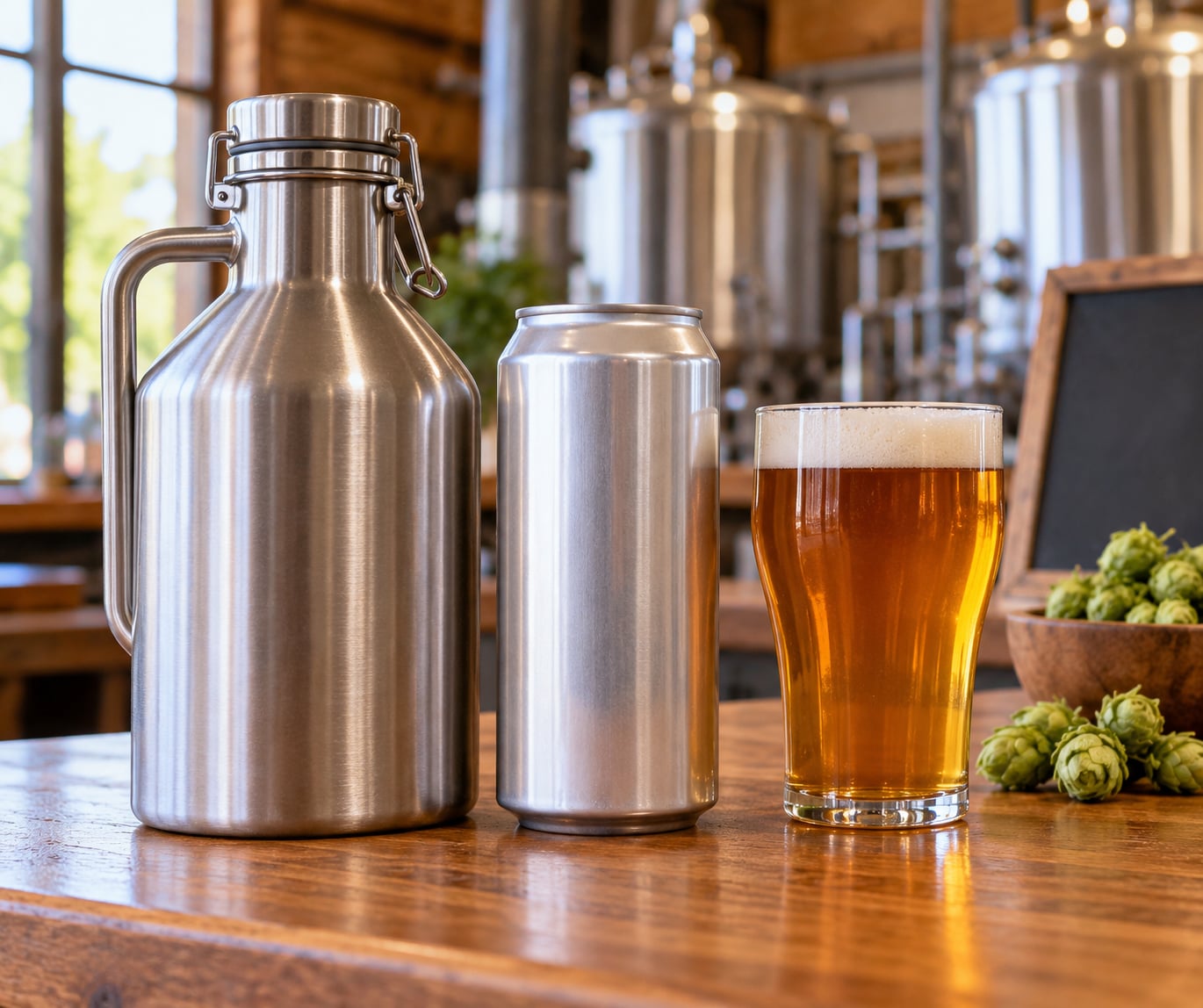
A growler is a 64 ounce jug, usually glass or stainless steel, that a bartender fills from a tap and caps for you to take home. A crowler is a 32 ounce aluminum can that gets filled and sealed on the spot. The short version of growler vs crowler explained: take the crowler when the beer is traveling, going to a pool, or meant to last more than a few days, and take the growler when you want the most beer for a gathering and plan to drink it fresh.
Neither container is filled in a factory. Both go straight from the tap into whatever you are holding, which is why freshness is a countdown rather than a shelf life. What changes between them is size, how well the beer is protected on the way home, and what happens to the empty container afterward.
Here is the honest version of growler vs crowler explained, including the parts where the crowler is not automatically the better choice.
Table of Contents
- Growler vs Crowler Explained at a Glance
- What Is a Growler?
- Why the name, and where the word “growlery” comes from
- What Is a Crowler?
- How Do Growlers and Crowlers Compare?
- Size and value per ounce
- Sealing, carbonation and flatness
- Durability and portability
- Refillability and waste
- Where they sit among other containers
- Growler vs Crowler: Which One Keeps Beer Fresher?
- Growler vs Crowler: Which Is Easier to Carry and Reuse?
- Which Should You Choose?
- Frequently Asked Questions
- How long does beer last in a crowler?
- How long does beer last in a growler?
- How many beers are in a crowler?
- What is the difference between a crowler and a growler?
- What is the difference between a growler and a howler?
- Can I drink beer 2 years out of date?
Growler vs Crowler Explained at a Glance
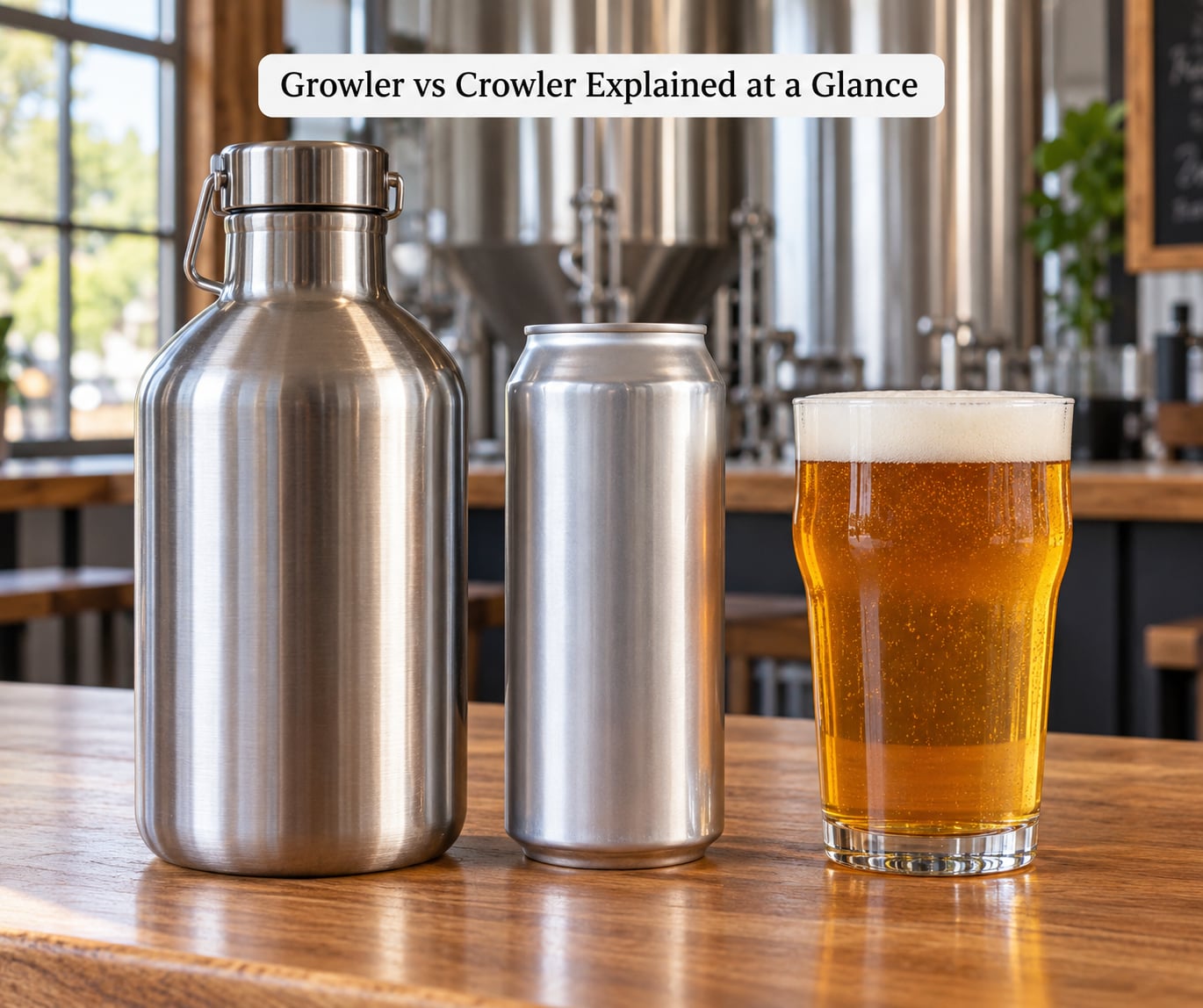
The table below is the whole comparison in one place. Every row is something you can actually check when you walk up to the taproom counter.
| Attribute | Growler | Crowler |
|---|---|---|
| Standard size | 64 oz, a full half gallon jug | 32 oz, a quart |
| Pours | About 13 twelve-ounce pours | Two pints, or eight four-ounce pours |
| Material | Glass, or stainless steel and plastic in insulated versions | Aluminum can with a plastic lid |
| Sealed with | Screw-on cap or hinged gasket cap | Lid crimped on by a countertop can seamer |
| Carbonation | Drops fast, and every opening costs more | Holds longer once the lid is crimped |
| Refillable | Yes, wash it and bring it back | No, single use |
| Light exposure | Full exposure unless the jug is amber or steel | Blocked by the can body |
| Drinking window after filling | About 1 to 3 days refrigerated | About 3 to 7 days refrigerated |
| Typical fill price in the US | Often $10 to $16 for a 64 oz fill | Often $7 to $11 for a 32 oz fill |
| Portability | Heavy, fragile, two hands and a crate | Stacks, survives a cooler, allowed where glass is banned |
| Impact risk | Breaks if dropped | Survives a tailgate cooler |
| Waste | Reused over many fills | One recyclable can per fill |
| Best for | Home sharing, keg-only releases, a full evening | Travel, outdoor days, split the cost with friends |
Last updated 2026. Crowlers are the default takeaway format in most taprooms today, so you will rarely have to ask for one by name.
What Is a Growler?
A growler is a 64 ounce reusable jug you fill from a draft tap, seal with a cap, and carry home. The standard size is a half gallon, and quarter-size 32 ounce versions exist, but those are usually just called a crowler instead.
Most growlers are glass. The better ones are amber or lined so beer does not sit in direct light, and a few taprooms use stainless steel or double-walled insulated versions that keep cold beer cold for a full day. Caps are either screw-on plastic or a hinged gasket cap that clamps down over a rubber seal.
Why the name, and where the word “growlery” comes from
The word predates beer containers. “Growler” and “growlery” are nineteenth-century terms for a speaker who growls at a meeting and the room where the speech happens, so if you searched for the meaning of “growlery” and got dictionary results, that is the right answer for the word and the wrong one for your beer.
Reuse is the growler’s whole appeal. Many taprooms run a deposit you get back when you return the jug, and homebrewers turn empties into fermentation vessels, yeast starters and storage bottles. A growler is a tool, not packaging.
What Is a Crowler?
A crowler is a 32 ounce aluminum can, about the size of a tall boy, that a bartender fills from a tap and seals on the spot with a countertop canning machine. It is single use and goes in the recycling. Oskar Blues introduced the format in 2014 with Ball Corporation, naming it one letter away from growler.
The fill is a four-step process worth understanding, because it explains both the advantages and the limits of the can:
- The bartender purges the empty can with carbon dioxide to push oxygen out.
- The can is filled from the tap, usually at a slow pour.
- A small foam head is left behind to keep the lid area clear.
- A lid is placed on and crimped down by the seaming machine.
Step four is why a crowler cannot be refilled. The lid is factory-sealed onto a single-use can body, so the container is finished the moment it leaves the machine.
How Do Growlers and Crowlers Compare?
They compare best one criterion at a time, because each wins on a different thing and loses on another.
Size and value per ounce
A 64 ounce growler is double a 32 oz crowler, and a growler fill usually costs more in total, but not twice as much, so the ounce cost usually favors the growler. Whether it feels worth it depends on what you compare it to: divide the fill price by 64 and then by the ounces in a six-pack of the same beer from the shelf. If the fill is several times the shelf cost per ounce, you are paying for the novelty, and regulars who bring a jug home every weekend tend to say the same thing about it.
There is one exception worth naming. When the beer is keg-only or a seasonal release that was never canned, a crowler is still the cheapest way to drink it at home next week. The same logic shows up in the other direction: for those beers the fill is not measured against a six-pack, because there is no six-pack.
Sealing, carbonation and flatness
Neither container keeps beer fizzy forever. Once the cap or lid comes off, carbonation starts leaving, and a half gallon loses noticeably more than a quart because you open and close it more. The honest fix is timing, not equipment: drink a crowler inside a week and a growler inside a day or two.
Durability and portability
Aluminum wins this one outright. Crowlers stack, survive being tossed in a cooler, and are allowed where glass is banned, which covers most pools, beaches and sometimes stadiums. A 64 ounce glass growler is heavy and fragile, and dropping it in a parking lot means starting over.
Refillability and waste
A growler you wash and return costs nothing after the first few fills, so it settles to almost zero waste per beer. A crowler is one recyclable can every time. Over a year of weekly fills, a reusable steel jug is the lighter footprint.
Where they sit among other containers
For context, a standard can is 12 oz, a pint can is 16 oz, a bomber is a 22 oz dark glass bottle built for cellaring, a crowler is 32 oz, a growler is 64 oz, and a sixtel is a small keg. Cans and bombers travel and cellar best. Growlers win on volume at the freshest possible moment.
Growler vs Crowler: Which One Keeps Beer Fresher?
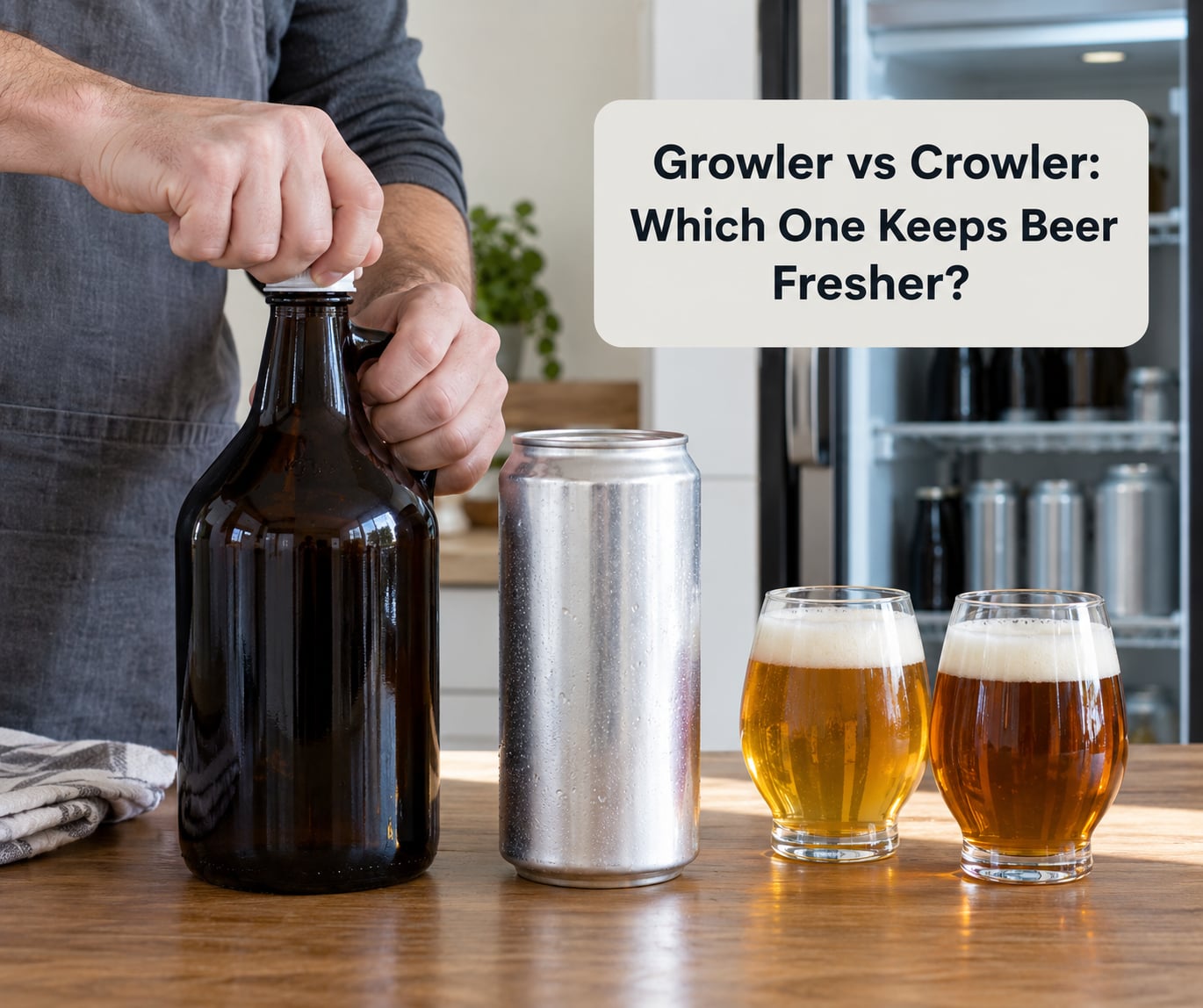
The crowler keeps beer fresher longer, mainly because its sealed aluminum body blocks light and holds carbonation better as the days pass. The growler tastes better on the day it is filled, especially if it is amber glass or stainless steel, but it fades faster after that.
Three things drive freshness: oxygen, light and heat. Oxygen creeps in through a loose gasket, and once it oxidizes the beer it also strips carbonation. Light hits hop compounds and produces the skunky flavor people associate with old beer. Heat speeds both problems up.
Here is what actually helps a growler hold up:
- Screw the cap down properly and check the gasket still seals before you leave the bar.
- Get it into a refrigerator the same night, not the next morning.
- Keep it out of sunlight and out of a hot car, both of which are faster than people expect.
- Drink the larger volume early rather than saving it, because every opening costs carbonation.
One note on the crowler, since the internet treats it as magic. It is not a factory-canned beer. The fill is still pushed through a tap into a container that a person put a lid on, so the same oxygen suspicion some homebrewers have about crowlers is not pure superstition. The can simply gives you more days of grace once it is closed.
Growler vs Crowler: Which Is Easier to Carry and Reuse?
The crowler is easier to carry and the growler is easier to reuse, so your answer depends on which task you do more often. A filled 32 oz can fits a backpack side pocket and a cooler, while a 64 ounce jug is a two-handed carry and needs a crate in a car.
For travel, the can is the easier answer by a wide margin. Glass is fragile and glass growlers are not permitted in carry-on bags, so a crowler is what you can actually fly with. Same story for hiking, tailgating, and anywhere with rules about glass.
Reuse tips for a glass growler are short: swish hot water and dish soap inside, soak it if anything is stuck to the glass, air dry it with the cap off, and store it uncapped so nothing stays trapped. Stainless steel versions need no special care beyond a rinse.
For homebrewers, empties are useful rather than trash. People use them as fermenters, blow-off vessels, yeast starters and mead bottles. Do not ferment directly in a growler unless it is rated for it, and do not fill an empty jug with homebrew and assume it is safe to pressurize, because a standard jug is not built for pressure.
Which Should You Choose?
Pick a growler when you are splitting a beer between a few friends at home, when the beer is keg-only or never canned, or when you want the most volume per fill and will drink it within a day or two. Pick a crowler when the beer is leaving the house, when you will not finish it quickly, or when glass is banned.
A few specific situations:
- Party at home: growler, finished the same night. Nothing beats a half gallon on the table.
- Tailgate or cookout: crowler. Aluminum handles the cooler and the parking lot.
- Flight, campsite or beach: crowler, and keep it cold the whole way.
- Rare keg-only release: crowler if you want it next week, growler if you are drinking it tonight.
- Buying beer to store: neither. Cans and bottles keep for months; an unfilled growler keeps for nothing.
Frequently Asked Questions
How long does beer last in a crowler?
Refrigerated and left unopened, a crowler usually stays good for about three to seven days, though a hoppy beer will fade faster than a simple pale ale. The aluminum blocks light, which protects flavor, but carbonation still drops as the days pass. Drink it inside a week and it will taste close to the tap.
How long does beer last in a growler?
A 64 oz growler is best within about 24 to 72 hours when it has been refrigerated and kept out of sunlight. Amber glass or stainless steel buys you a little more time because it blocks light, but the gasket is a mechanical seal rather than a factory one. Many drinkers simply finish the jug in one sitting, which is the most reliable way to keep the carbonation.
How many beers are in a crowler?
A 32 oz crowler holds two 16 oz pints, which is eight 4 oz samples or roughly two and a half twelve-ounce pours. A 64 oz growler holds four 16 oz pints. If you are tasting several beers with friends, a crowler split into eight pours is the practical size.
What is the difference between a crowler and a growler?
Size is the headline: a growler is 64 oz and a crowler is 32 oz. The growler is usually glass or steel, sealed with a screw-on or gasket cap, and refillable. The crowler is aluminum, sealed by a can seaming machine, single use and recyclable. The crowler blocks light and travels better, while the growler is better for sharing and reuse.
What is the difference between a growler and a howler?
Howler is usually a misspelling of growler, and some breweries use it as a brand name for their own large jug. No standard container in the beer trade is called a howler. If you see howler on a taproom chalkboard, ask whether it means a 64 oz jug, because the word on its own tells you nothing about the size.
Can I drink beer 2 years out of date?
Two years past a printed date is not automatically dangerous in a sealed can or bottle, but the flavor will be poor and the alcohol lower than the label says. A printed date reflects quality, not a safety cutoff, and beer does not support the growth that would make spoiled beer risky. Smell it first and dump anything that smells solvent-like or acrid.
Decide before you reach the counter. If the beer is staying home and being drunk tonight, ask for the 64 oz growler, and if it is leaving with you, ask for the 32 oz crowler. Everything else in this guide is a detail on top of that one choice.