Here is the short answer to how long does beer stay fresh in a growler: an unopened jug kept continuously cold tastes its best within 1 to 3 days and stays drinkable for up to a week. Once you crack it open, you have roughly 12 to 24 hours before the carbonation drops and the beer picks up a stale, cardboard flavor. Cold storage is the whole game.
The reason the numbers swing so wildly across the internet is that people are comparing different things: a counter-pressure fill at a brewery, a poured fill from a taproom with a screw-top jug, and a crowler sealed by a machine are not the same package. Nobody is wrong exactly, they are answering for different conditions.
Updated for October 2026. The short version below, then the details that explain it.
| Container and condition | Best window | Drinkable up to |
|---|---|---|
| Growler, unopened, refrigerated 35-40°F | 1-3 days | About 1 week |
| Growler, unopened, counter-pressure fill, refrigerated | 3-5 days | 10-14 days |
| Growler, unopened, at room temperature | Same day | 2-3 days |
| Growler, unopened, hot car or warm garage | A few hours | Under 24 hours |
| Growler, opened | Immediately | 12-24 hours |
| Crowler, unopened, refrigerated | 2-3 weeks | 2-6 weeks |
| Standard can, unopened, cool dark storage | Months | Well past its date |
| Bottle, unopened, cool dark storage | Months | Past its date, often a year |
That table is the honest version of the answer. Peak quality and safety are two different things here, and I will come back to that, because flat beer and bad beer are not synonyms.
Table of Contents
- How Long Does Beer Stay Fresh in a Growler?
- Counter-pressure growlers
- Standard poured growlers
- Crowlers
- What Determines How Long Growler Beer Stays Fresh?
- How full the growler is
- Type of closure
- Fill method
- Temperature
- Light
- Beer style
- Opened or unopened
- How to Store a Growler to Keep Beer Fresh
- Can You Freeze Beer in a Growler?
- What Does Spoiled Growler Beer Taste and Smell Like?
- Frequently Asked Questions
- How long does an unopened growler of beer stay good?
- How long does a growler last after you open it?
- Does beer go bad in the fridge?
- Does a growler lose carbonation faster than a bottle or can?
- Can a growler be refilled or reused after opening?
- How much growler should I order for one person?
- Conclusion
How Long Does Beer Stay Fresh in a Growler?
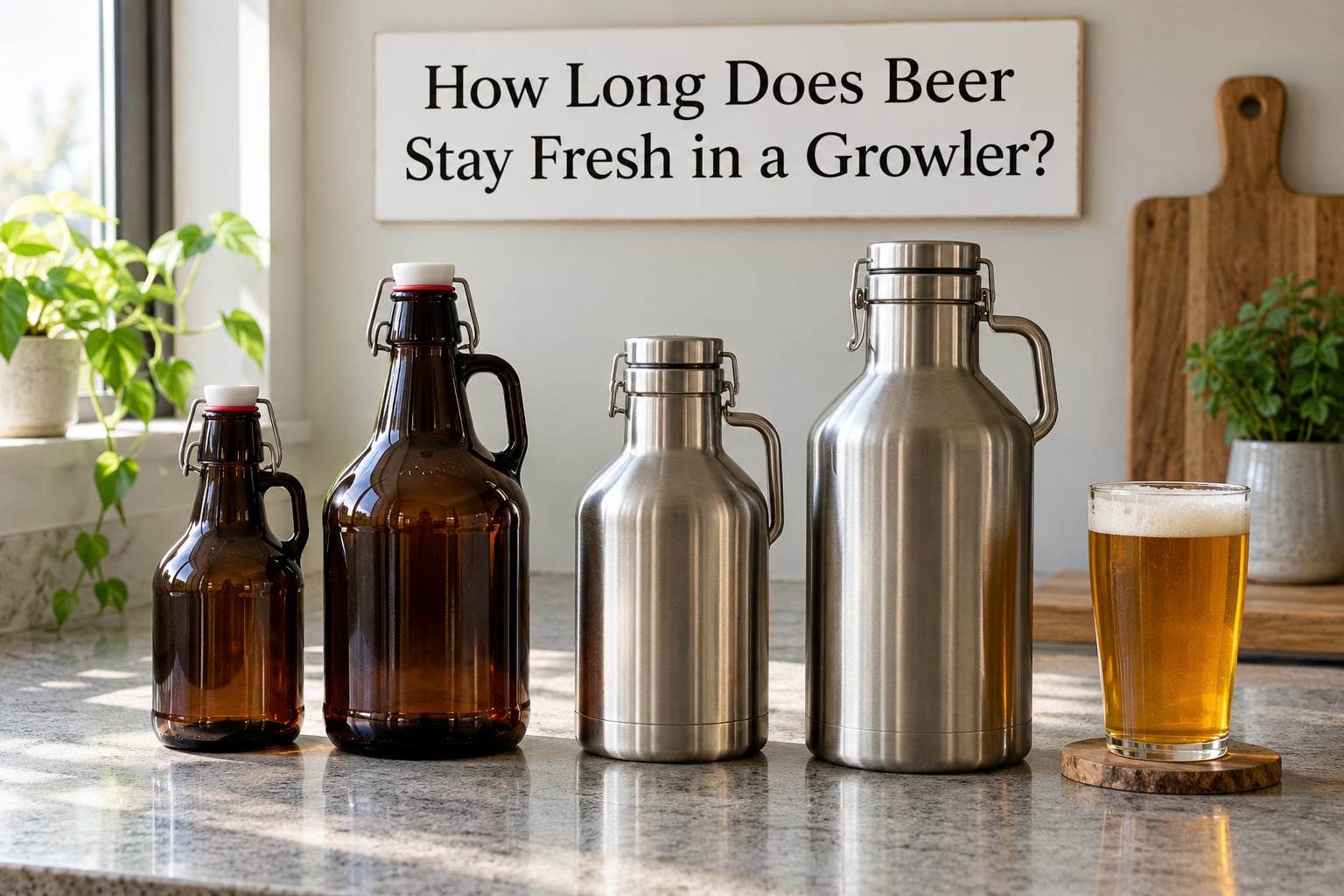
How long beer stays fresh in a growler comes down to three categories, and each one has a real range behind it.
Counter-pressure growlers
A counter-pressure filler pushes CO2 into the jug while beer comes out of the bottom, so the container never holds a pocket of air. Filled that way and kept cold, these usually taste tap-fresh for 3 to 5 days and are still drinkable at 10 to 14 days. Breweries that bottle at bottling time and then fill growlers off the same line can stretch that further still, because the packaging is sanitized and sealed the way a bottle is.
Standard poured growlers
This is the common taproom fill: a jug, a screw cap or a flip-top, and a hose straight from the tap. There is no pressure behind the beer, so whatever CO2 is dissolved in the liquid is all you have. Peak freshness is 24 to 72 hours cold, and by day four or five most people describe it as flat, dull, or papery. Some drinkers genuinely do not notice on a hoppy IPA, while anyone chasing aroma in a saison or a pale ale will.
Crowlers
A crowler is a 32-ounce aluminum can filled and sealed on demand. Because it is a can, it holds pressure and blocks light, which is why people report crowlers lasting 2 to 6 weeks in the fridge with no complaints. Forum drinkers often say there is not much difference between a crowler and a canned beer, and that is closer to the truth than the marketing on either side.
What Determines How Long Growler Beer Stays Fresh?
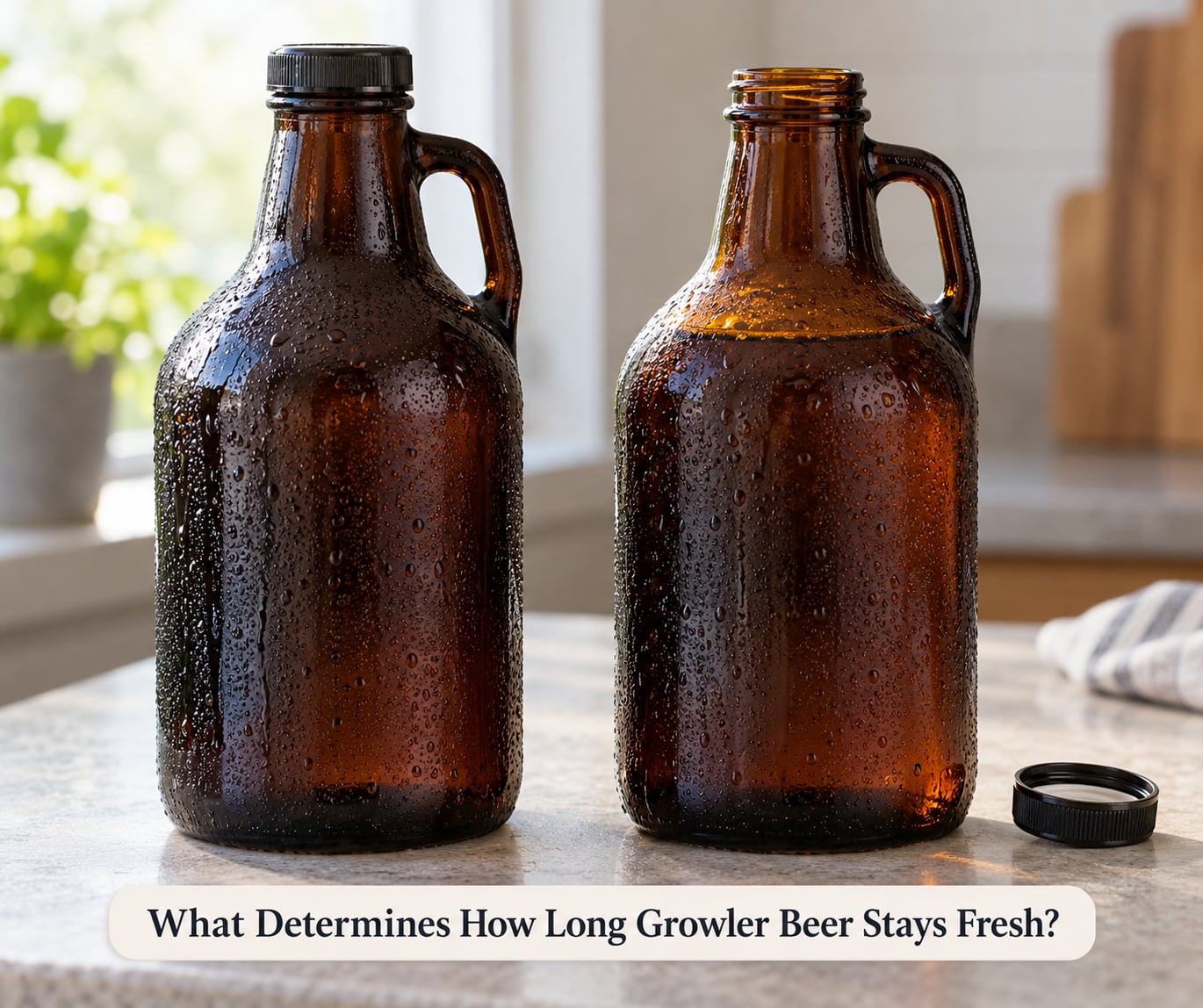
Fill level and seal quality explain most of the variance between two growlers filled on the same night from the same tap.
How full the growler is
Beer contracts when it gets cold. A growler filled to the brim leaves no room to expand, and the pressure can force the lid to leak or pop. A growler filled to about 80 percent, upright, keeps a small headspace and survives temperature changes. HomebrewTalk users with heavy ceramic flip-tops report beer that holds up as long as a bottle, while their screw-top jugs leak, and the gap between those two containers is mostly seal and headspace.
Type of closure
Order matters: ceramic or stainless flip-top, then a threaded lid with a proper gasket, then a basic plastic screw-top. A screw-top you can tighten by feel will lose pressure in days. If you own your container, replacing a worn cap is the single highest-return fix for freshness.
Fill method
A counter-pressure or CO2-purged fill keeps oxygen out at the moment it matters most. A straight pour from a tap pulls air into the headspace, and oxygen is what turns into stale, cardboard, and vinegary flavors over the following days. The Brewers Association and brewery guidance both point to dissolved oxygen as the enemy, not temperature alone.
Temperature
Cold slows oxidation dramatically. A warm garage or a parked car is the fastest way to ruin a growler, sometimes within hours, because warmth raises the pressure in the jug and pushes gas through the seal while accelerating staling at the same time. A home refrigerator set between 35 and 40°F is the target range.
Light
Clear glass lets UV light through, and UV-struck hops produce the skunky flavor people associate with cheap beer. A hoppy IPA shows it first, which is why pale ales and lagers seem to hold up longer in a clear growler.
Beer style
Hoppy beers fade fastest because the aroma is the first thing to go. Stouts, porters, and browns tolerate oxidation better, and wild or sour beers are already acidic enough to mask a little oxidation. Reddit r/beer users regularly note breweries putting 90-day limits on IPAs and much longer windows on stouts, and the pattern holds in a growler too.
Opened or unopened
Everything above applies to sealed beer. The moment the seal breaks, the headspace air and your glass both start stripping carbonation, and the clock drops to 12 to 24 hours. A growler is not shelf-stable packaging. It is a small keg with a fragile seal.
How to Store a Growler to Keep Beer Fresh
Storage is simple enough that most spoiled growlers are a storage mistake rather than a bad fill.
- Refrigerate it the same hour. Put the jug in a fridge between 35 and 40°F, on a shelf rather than in the door, and keep it out of the fridge’s coldest zone where it could partially freeze.
- Store it upright. A sealed growler on its side works for a day or two, but upright storage limits the seal area exposed to liquid and reduces leak risk.
- Keep it dark and stable. Inside a closed fridge is ideal. A window ledge or a shelf that swings between warm afternoon and cool night is the worst spot in the house.
- Do not jostle it. Agitation knocks CO2 out of solution. Carry it upright, set it down gently, and do not transport it loose in a car trunk.
- Drink it inside the window. Plan for one to three days, and treat day five as a cook’s beer rather than a fresh one.
For a homebrew fill, sanitize the container first: rinse it with hot water, skip the soap, mix a no-rinse brewery sanitizer in a bucket, soak the parts, and air-dry upside down. A sanitized, filled growler stored cold behaves much more like a bottle than a taproom pour does.
And for the common problem, a partly finished 64-ounce jug: pour what you can drink into smaller sealed containers such as swing-top bottles or a Party Pump-style pressure bottle, and refrigerate the rest promptly. A 32-ounce jug is much easier to finish than a 64-ounce one, which is the simplest freshness strategy there is.
Can You Freeze Beer in a Growler?
You can put a growler in a freezer, but do not. Beer expands as it freezes, and a full glass jug under rising pressure can crack or shatter, and an aluminum crowler can bulge or split at the seam. The alcohol content of draft beer is well below what prevents freezing, so 32°F is enough to start the problem.
Freezing also wrecks the texture and dulls the aroma even when the container survives, and refreezing makes the separation worse. Cold storage at refrigerator temperature is the safe option. Freezing is not a preservation method for beer.
What Does Spoiled Growler Beer Taste and Smell Like?
Flat is the first and most common complaint. The beer pours with no foam, feels thin in the mouth, and lacks the bite you expect. That is a carbonation problem, not a safety problem.
Oxidized beer smells like wet cardboard, bruised apple, or sherry-like nuttiness, and tastes papery. Hazy or cloudy beer, especially a clear style that was never cloudy to begin with, points to contamination or a bad seal. Sourness, nail-polish solvents, or a fruity cidery note in a style that should not have them is a reason to skip the glass.
Watch the container too. A leaking or swollen lid, a bulging crowler seam, or a jug that rocks oddly on the counter all mean the seal failed, and the beer inside has had weeks to pick up whatever was around it.
Here is the important part: beer is acidic, around pH 4 to 4.5, and full of alcohol, so it is a hostile place for the bacteria that actually make food dangerous. A day-old or week-old growler going flat or cardboard is a quality problem. A strange film, visible mold on the liquid surface, a container that swells and pops, or a beer that tastes like nail polish or vinegar is the point where you stop guessing and pour it out. When in doubt, throw it out.
Frequently Asked Questions
How long does an unopened growler of beer stay good?
An unopened growler kept continuously refrigerated tastes best within 1 to 3 days and stays drinkable for about a week. A counter-pressure fill from a brewery usually holds 3 to 5 days at peak and can reach 10 to 14 days, while a simple taproom pour into a screw-top jug falls off faster. At room temperature, treat it as a same-day or next-day beer.
How long does a growler last after you open it?
Once the seal is broken, the headspace air and your glass both start pulling CO2 out of solution. Drink it within 12 to 24 hours, keep the jug cold and upright, and screw the lid back on if you must. Two or three days is where most people notice a real drop in carbonation, even in a well-sealed container.
Does beer go bad in the fridge?
No. Cold storage is the safest place for beer, and refrigeration slows oxidation dramatically. Sealed in a fridge between 35 and 40 degrees, most beer stays drinkable well past the point where it is good. Beer does not spoil in a refrigerator, so you will not find a mold problem there. A growler that goes flat in the fridge lost pressure, not safety.
Does a growler lose carbonation faster than a bottle or can?
Yes, considerably. A bottle and a can hold pressure and exclude light, while a growler is an open container with a friction seal and, if it is glass, lets UV through. That is why a canned version of the same beer lasts months and the growler of the same beer is a three-day proposition. A crowler is the exception, because it is sealed like a can.
Can a growler be refilled or reused after opening?
Yes, growlers are built to be reused, with a few caveats. Rinse out the old beer, clean with hot water and no soap, sanitize the parts in a no-rinse brewery sanitizer solution, and air-dry them upside down. A flip-top or threaded lid with a replaceable gasket will keep working; a cheap plastic screw-top is usually the first thing to fail and is worth replacing.
How much growler should I order for one person?
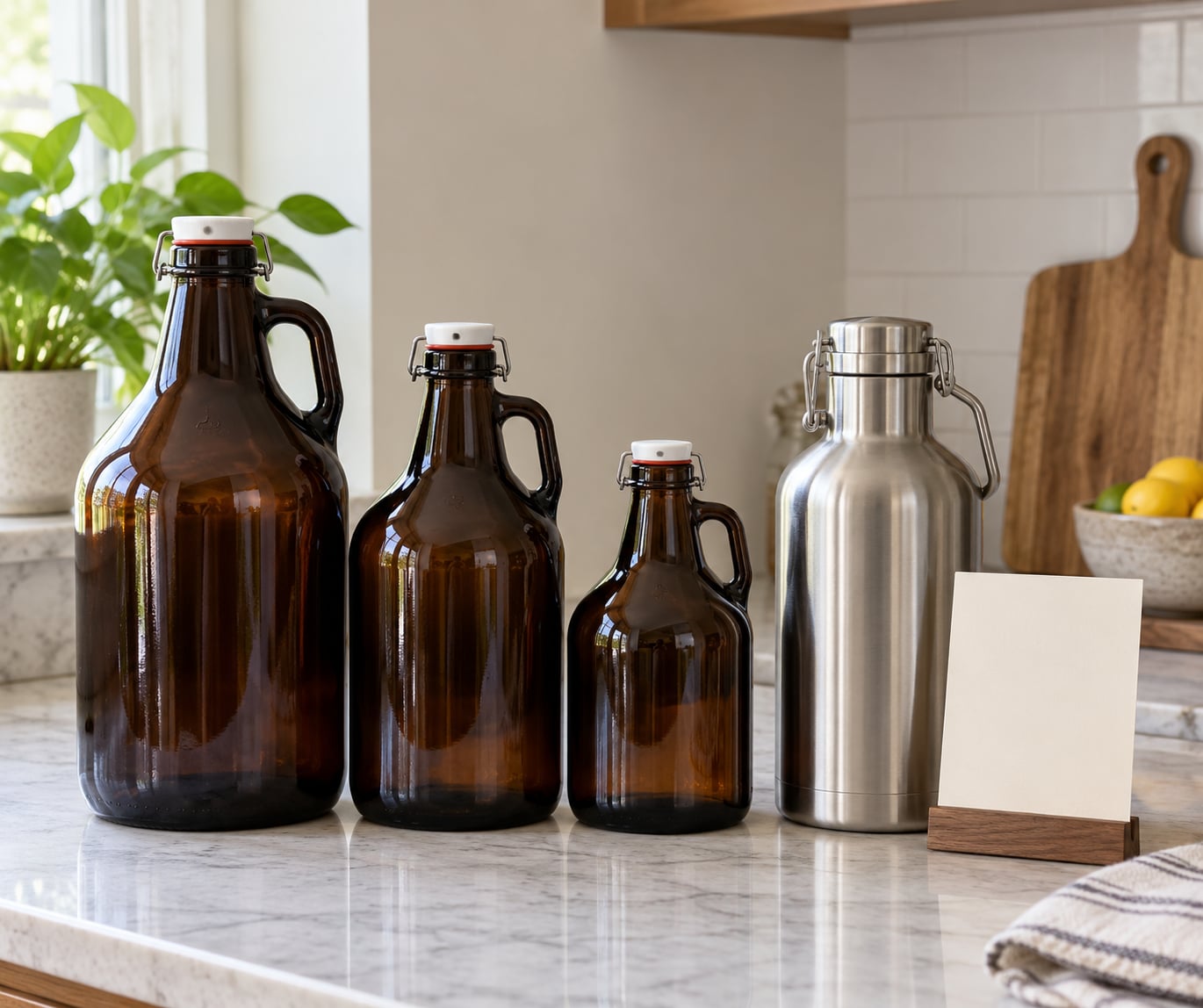
A 32-ounce howler is the right call for one person, and it is easier to finish in a sitting than a 64-ounce jug. A 64-ounce growler works well for two to three people over an afternoon. Ordering smaller and refilling beats ordering large and wasting half a jug of flat beer, which is the most common way people lose a growler.
Conclusion
Put the growler in the fridge right away, keep it upright, dark, and as full as the headspace allows, and drink it inside one to three days of the fill. Do not wait for the taste to change to decide it is time to pour it out.