Yes, but not in the way the marketing suggests. Beer is brewed from barley, wheat, hops and yeast, so a 355 ml serving carries roughly 13 g of carbohydrate, about 2 g of protein, trace B vitamins, silicon, magnesium and potassium, and essentially no fat. Those amounts are real but tiny. Ethanol supplies most of the calories and most of the risk, so beer is not a health food and no medical body recommends it as a nutrient source.
The honest summary is technically yes, practically no. I have gone through the published analyses and label data for beer so you can see exactly what a serving contains, where the calories come from, and which of the widely repeated health claims actually survive a careful look as of 2026.
Table of Contents
- What does beer have nutritional value?
- Where beer’s nutrients come from
- What fermentation removes and what it concentrates
- What nutrients are naturally present in beer?
- How many calories are in a beer?
- Where the calories come from
- Serving sizes change everything
- Calories and ABV by style
- How beer compares with wine and spirits
- Which types of beer contain the most nutrients?
- Lager
- Wheat beer
- Stout and porter
- Unfiltered and unpasteurised beer
- Non-alcoholic beer
- Does beer contain antioxidants or prebiotic fiber?
- About prebiotic fibre
- How beer fits into a balanced diet
- How to read a beer nutrition label
- What are the main health drawbacks of drinking beer?
- Myths worth clearing out
- How to choose a lower-calorie or alcohol-free beer
- Frequently Asked Questions
- Is beer healthy to drink every day?
- Does beer help you lose weight or improve sleep?
- Is nonalcoholic beer as nutritious as regular beer?
- Does beer have more calories than wine?
- Can pregnant adults or people taking medication drink beer?
- Does the type of beer change its health effects?
- So what should you do first?
What does beer have nutritional value?
Beer has nutritional value in trace amounts. It supplies a little carbohydrate, a little protein, a handful of B vitamins, and some minerals, plus a modest quantity of plant polyphenols. It also supplies alcohol, which is a toxin the body has to metabolise rather than a nutrient, and that is where the real nutritional story sits.
Nobody is going to design a diet around beer. To get the vitamin B6 in a 355 ml serving, for example, you would need to drink about eight servings to reach the daily intake that a single salmon fillet delivers in one meal.
Where beer’s nutrients come from
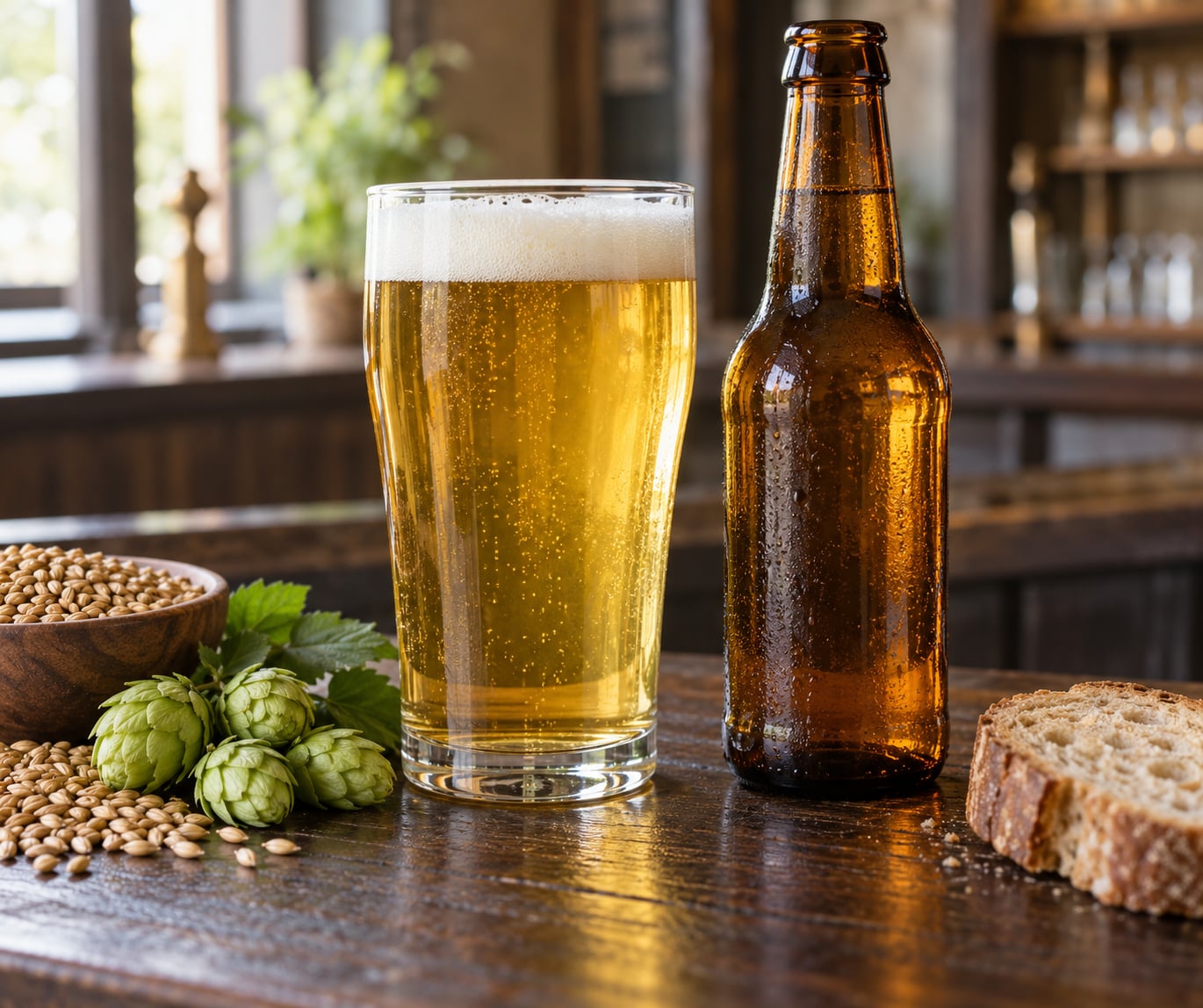
Malted barley is the engine room. Malting converts the grain’s starches into fermentable sugars, and the mineral layer of the grain kernel dissolves into the mash water during brewing. That is where silicon, magnesium, potassium and phosphorus come from, and why darker, more heavily kilned malts tend to carry more of them.
Hops contribute almost no macronutrients. What they do contribute is xanthohumol, a polyphenol concentrated in the hop flower bracts, along with related flavonoids. Brewer’s yeast is where B vitamins mostly end up, which is why unfiltered and unpasteurised beers come out ahead of filtered ones on a nutrition label.
What fermentation removes and what it concentrates
This is the part brewery marketing leaves out. Yeast consumes the fermentable sugars and leaves behind a small quantity of unfermented residual extract. Protein drops too, because the grain’s proteins are broken down during mashing and fermentation and only a fraction survives into the glass.
What fermentation concentrates is ethanol. That single conversion explains nearly everything people get wrong about beer nutrition: the calories you feel in a strong beer are mostly alcohol calories, not carbohydrate calories.
What nutrients are naturally present in beer?
Here is what a 355 ml serving of standard lager, roughly 5% ABV, typically delivers. These are representative published ranges rather than figures from one brand, because recipe and strength move the numbers more than most people expect.
| Nutrient | Typical amount per 355 ml | What it actually contributes |
|---|---|---|
| Energy | 140-170 kcal | Mostly from ethanol and residual carbohydrate |
| Carbohydrate | 10-15 g | A small share of a day’s carbs, mostly residual sugars |
| Sugars | 0-4 g | Varies hugely by style; near zero in bone-dry beers |
| Protein | 1-3 g | Small, and reduced further by a long ferment |
| Fat | 0 g | Effectively none |
| Sodium | 0-12 mg | Negligible against a 2,300 mg daily limit |
| Niacin (B3) | Around 1-2 mg | Trace; barley-derived |
| Folate (B9) | Around 10-20 micrograms | Trace; more in unfiltered beer |
| Vitamin B6 | Around 0.2-0.4 mg | Roughly 10-12% of a daily intake in one serving |
| Silicon | 0.2-2 mg | Present in barley; associated with bone and collagen studies |
| Magnesium | Around 5-10 mg | About 1-2% of a daily intake |
| Potassium | Around 20-40 mg | Well under 1% of a daily intake |
| Phosphorus | Around 10-20 mg | Trace |
| Iron | Under 0.5 mg | Present but not a meaningful source |
| Cholesterol | 0 mg | Beer contains no cholesterol |
| Fibre | 0-1.5 g | Minimal; some beta-glucan survives in unfiltered beer |
Read that last column carefully. Every line is a fraction of what one normal meal delivers. That is the whole verdict on nutritional value in a single table.
Amounts also swing with the recipe. Unfiltered and unpasteurised beers retain more yeast and therefore more B vitamins. Beers brewed with oats, wheat or lactose add carbohydrate. Beers with added sugar or fruit syrup push the sugar figure up sharply.
How many calories are in a beer?
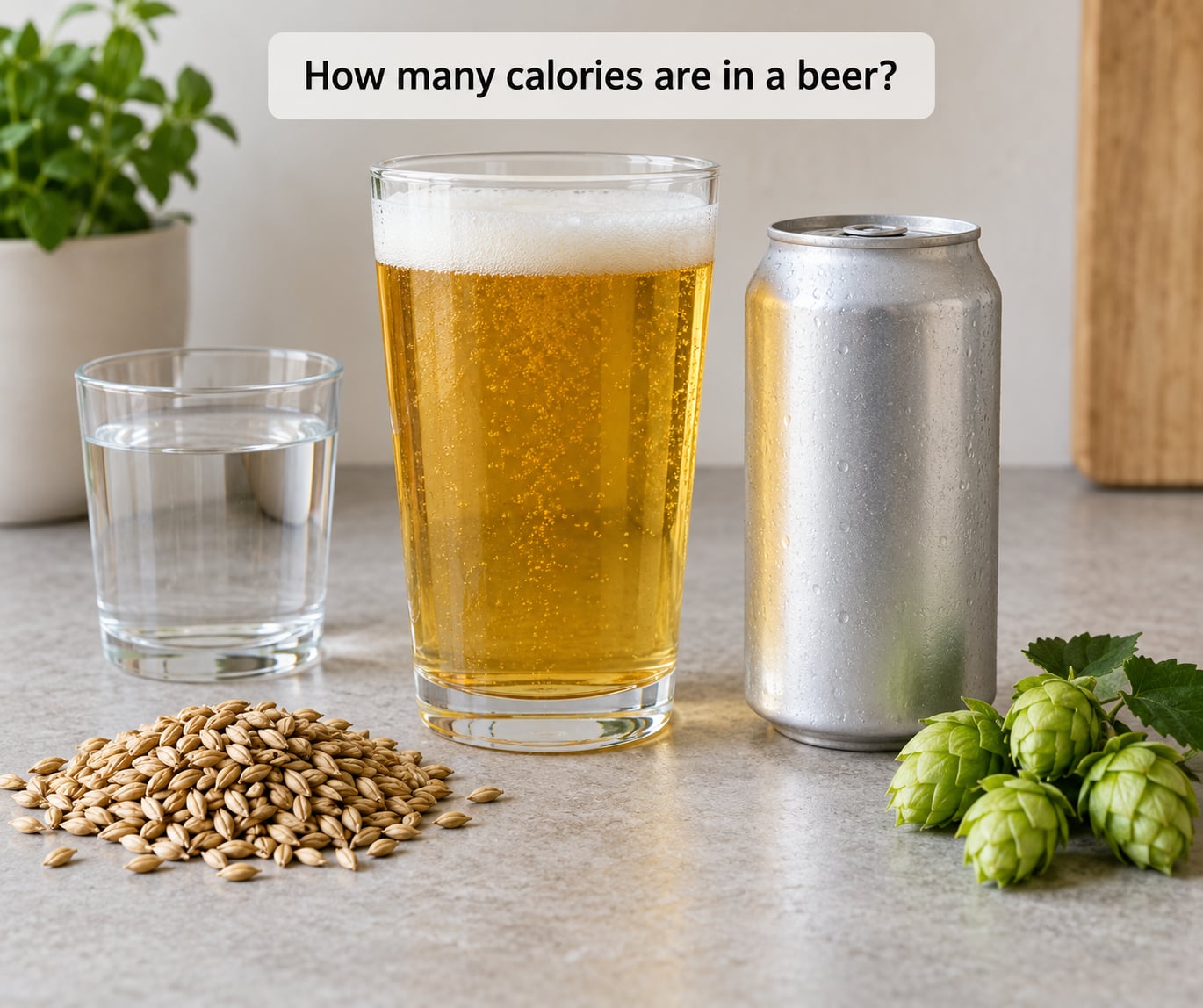
A standard 355 ml lager at 5% ABV runs about 150 calories. A 568 ml UK pint of the same beer runs closer to 240. The number comes from three sources, and only one of them is obvious: ethanol at 7 kilocalories per gram, carbohydrate at 4, and protein at 4.
Ethanol typically accounts for 60 to 80% of the calories in a normal beer. That single fact explains the most common surprise among drinkers, which is that a pale lager and a rich stout of equal strength carry similar calories despite tasting nothing alike.
Where the calories come from
Here is a worked example for a 355 ml serving of 5% ABV lager. The maths is approximate because residual sugar varies, but the ratios hold across most beers.
| Component | Approximate amount | Energy at 7 or 4 kcal/g |
|---|---|---|
| Ethanol (14 g) | 14 g | 98 kcal |
| Residual carbohydrate | 13 g | 52 kcal |
| Protein | 2 g | 8 kcal |
| Fat | 0 g | 0 kcal |
| Total | — | About 155 kcal |
A standard drink in US guidance is 14 g of pure ethanol. That means a 12 oz can of 5% beer is exactly one standard drink, and a 568 ml UK pint at 4.5% is close to two.
Serving sizes change everything
Two articles quoting different calories for the same beer are usually quoting different serving sizes. This is the single biggest reason beer calorie figures appear to contradict each other.
| Serving | Volume | Calories at 5% ABV | Standard drinks |
|---|---|---|---|
| US standard drink | 14 g ethanol (about 355 ml at 5%) | About 150 | 1.0 |
| 12 oz can | 355 ml | About 150 | 1.0 |
| US pint | 473 ml | About 200 | 1.3 |
| EU serving | 500 ml | About 210 | 1.4 |
| UK pint | 568 ml | About 240 | 1.6 |
| Two UK pints | 1,136 ml | About 480 | 3.2 |
European labels usually print energy per 100 ml and show both kilojoules and kilocalories. Multiply by 3.55 for a 12 oz serving. If a bottle says 45 kcal per 100 ml, the can in your hand holds about 160.
Calories and ABV by style
Strength is the best calorie predictor you have without reading a label. These ranges cover a 355 ml serving of typical commercial examples.
| Style | ABV | Calories per 355 ml | Typical sugar level |
|---|---|---|---|
| Light lager | 4.0-4.5% | 95-115 | Very low |
| Standard lager | 4.8-5.2% | 140-165 | Low |
| Wheat beer | 4.5-5.5% | 150-180 | Moderate, unfiltered |
| Pale ale | 5.0-6.2% | 160-210 | Low to moderate |
| IPA | 6.0-7.5% | 200-260 | Low |
| Porter | 4.5-6.0% | 150-210 | Moderate |
| Stout | 5.0-7.0% | 180-260 | Moderate |
| Radler or shandy | 2.0-3.5% | 60-110 | Added sugar or lemonade |
| Barley wine | 9-12% | 330-450 | High |
| Imperial stout | 9-12% | 300-420 | Moderate to high |
| Alcohol-free beer | 0.0-0.5% | 20-70 | Can be moderate |
Notice the stout rows. A 7% imperial stout is calorie-dense because of the alcohol, not because it is sweeter than a lager. Drinkers consistently overestimate the sweetness and underestimate the strength.
How beer compares with wine and spirits
Beer is not the fattest alcoholic drink, but it is the easiest to over-consume because of the serving format. A neat 25 ml shot of spirits is a controlled volume; a pint is not.
| Drink | Typical serving | ABV | Calories | Carbohydrate |
|---|---|---|---|---|
| Lager | 355 ml | 5% | About 150 | About 13 g |
| Red wine | 150 ml | 12-13% | About 125 | About 4 g |
| White wine | 150 ml | 12% | About 120 | About 4 g |
| Spirit, 40% | 25 ml | 40% | About 70 | 0 g |
| Sweet cider | 500 ml | 5.5% | About 250 | About 30 g |
| Hard seltzer | 355 ml | 5% | About 100-140 | About 2-5 g |
Spirits are the most calorie-dense per millilitre and the least likely to carry carbohydrate. Wine sits in the middle. Beer per serving sits in the middle too, but the serving size is roughly twice as large.
Which types of beer contain the most nutrients?
Style changes the nutrient profile, but not in a direction that makes any style a health choice. Here is what differs and why.
Lager
Clean, pale and heavily filtered, which means less yeast and therefore less B vitamin content. A standard lager is the baseline against which everything else compares, at roughly 150 calories and about 2 g of protein per serving.
Wheat beer
Wheat adds protein and a higher soluble fibre content, and the beer is usually left unfiltered to preserve the hazy yeast character. The result is a little more B vitamin and a little more carbohydrate than a lager of the same strength.
Stout and porter
Roasted barley and kilned malts bring the highest silicon and melanoidin levels of any common style, along with the darkest colour and most pronounced antioxidant activity in lab tests. Calories run from moderate to high depending entirely on ABV.
Unfiltered and unpasteurised beer
These styles retain live yeast in the bottle, which means more B vitamins, more amino acids and more unfermented carbohydrate than filtered beer. This is the single processing choice that shifts beer’s nutrient numbers most, in either direction.
Non-alcoholic beer
Most alcohol-free beer is fermented normally and then stripped of alcohol, which leaves the carbohydrate and protein largely intact. Some products dealcoholise at high temperature, and a few add fibre or protein fortification. None of that makes them a nutrient delivery system worth planning a diet around.
Across every style, the honest ranking is the same: beer contains nutrients, and no beer style contains enough of them to matter.
Does beer contain antioxidants or prebiotic fiber?
Beer does contain polyphenols and a small amount of fibre, and the research on both is genuinely interesting. It is also routinely overstated in popular writing. Here is how the individual claims hold up.
| Claim | What the evidence shows | Strength |
|---|---|---|
| Beer provides antioxidants from hops | Hops contribute xanthohumol and flavonoids; dark beers show measurable antioxidant capacity in laboratory testing | Real but unproven in humans at drinking doses |
| Beer aids digestion | Observational associations only; no clear causal mechanism established | Weak |
| Beer supports gut bacteria | Yeast and beta-glucan reach the gut; early small trials show short-lived microbiome shifts | Weak to moderate |
| Beer protects the heart | Several observational cohorts link low intake to slightly lower cardiovascular risk, with clear confounding by lifestyle | Contested |
| Beer is a source of silicon for bones | Silicon content is measurable; one notable study linked beer intake to bone density, with participation confounded by diet and activity | Weak |
| Beer is liquid bread | A medieval origin myth with no modern nutritional basis | Myth |
| Beer hydrates you | Alcohol suppresses vasopressin; fluid loss outweighs the fluid gained for most servings | Myth |
The recurring problem with these studies is that they are observational. People who drink one beer a day differ systematically from people who do not drink, in diet, activity, income and health awareness. When researchers separate those factors out, a large share of the benefit shrinks.
About prebiotic fibre
Beta-glucans from barley do survive into beer to some degree, particularly in unfiltered styles, and fibre feeds beneficial gut bacteria. The total quantity is 0 to 1.5 g per serving, well below the 25 to 38 g of daily fibre that nutrition guidelines recommend.
How beer fits into a balanced diet
The useful question is not whether beer is healthy. It is whether a given serving fits the pattern you are already eating and drinking, and alcohol fits into any genuinely balanced diet only in small amounts or not at all.
Calories from drinks are the part people underestimate most. Alcohol suppresses satiety signalling and lowers inhibitive control, so a second and third serving goes down more easily than the equivalent in food. Research on self-administration consistently shows alcohol calories get consumed with less compensation than food calories elsewhere in the day.
Carbohydrate matters if you are managing blood sugar. Ten to fifteen grams per serving is moderate on its own, but a radler, a beer with added liqueur, or a high-gravity craft beer can carry considerably more.
Sodium is not a beer problem. Beer is unusually low in salt compared with most processed foods, and that is not a point in its favour so much as an absence of a normal drawback.
How to read a beer nutrition label
- Check the basis. European labels give energy per 100 ml with kJ and kcal side by side. US labels generally give per serving, and the serving is often not the bottle.
- Multiply per 100 ml figures by 3.55 for a 12 oz can, or by 5.68 for a UK pint.
- Read ABV first. It predicts calories better than any other number on the label.
- Treat calories as an estimate. Published values come from the brewer’s own laboratory and vary by a few percent between production runs.
- Check the added-sugar line for anything described as a spritzer, radler, fruit beer or gose with syrup.
- Look for sodium and gluten declarations if you have a relevant condition or sensitivity, and note that wheat and barley malts contain gluten unless the product is certified gluten-free.
If you are managing a medical condition, taking medication or counting macros for a clinical reason, ask a doctor or registered dietitian rather than working it out from a label. Alcohol interacts with a long list of prescriptions, and the interaction is not something a nutrition panel will tell you about.
What are the main health drawbacks of drinking beer?
Alcohol is the drawback, and it is a large one. Beer is a delivery vehicle for ethanol, and ethanol carries risks that its trace nutrients do not offset.
- Cancer risk. The WHO International Agency for Research on Cancer classifies ethanol in alcoholic beverages as a Group 1 carcinogen, the same category as tobacco smoke and asbestos. There is no safe level of alcohol consumption with respect to cancer risk.
- Liver load. The liver prioritises metabolising ethanol, which interrupts normal fat processing and contributes to fatty liver and, over years, to alcoholic liver disease.
- Sleep quality. Alcohol shortens time to sleep onset and then suppresses REM sleep later in the night, so you wake less rested even when you sleep longer.
- Blood pressure. Regular intake raises blood pressure in many regular drinkers, and the effect is reversible when intake stops.
- Weight. The extra calories arrive without much satiety. A 568 ml pint at 240 calories, three nights a week, is over 37,000 calories a year before any food changes.
- Judgement and reaction time. Alcohol impairs both, which is why it shows up in drink-driving statistics rather than in nutrition panels.
- Nutrient deficiency at high intake. People who drink heavily often eat poorly, and folate deficiency in particular is common in that group.
Public health guidance in most countries now frames alcohol as having no safe level rather than as a healthy habit within a limit. Where lower limits are given, they sit around two standard drinks a week for adults, well below an average weekend session.
Myths worth clearing out
Liquid bread. Beer shares ancestry with the grain-based drinks that fed pre-agricultural communities, but the nutritional comparison does not survive. Modern beer is roughly 3% carbohydrate by volume and heavily attenuated, with no meaningful protein or fibre left.
Beer as a protein source. At 1 to 3 g per serving, beer supplies less protein than a slice of bread, and a large fraction of that is high-quality amino acid fragments that do not add up to a serving of protein.
Beer as a hydration tool. Alcohol inhibits vasopressin release and increases urinary output. Studies comparing beer with water after exercise find equal fluid retention, not superior, and only at low intakes. It is not an electrolyte replacement either.
Dark beer as unhealthy and light beer as a loophole. Colour tracks roasted malt, which brings silicon and melanoidins, not sugar. Calories track ABV. A dark 5% lager and a pale 5% lager sit within a few calories of each other.
How to choose a lower-calorie or alcohol-free beer
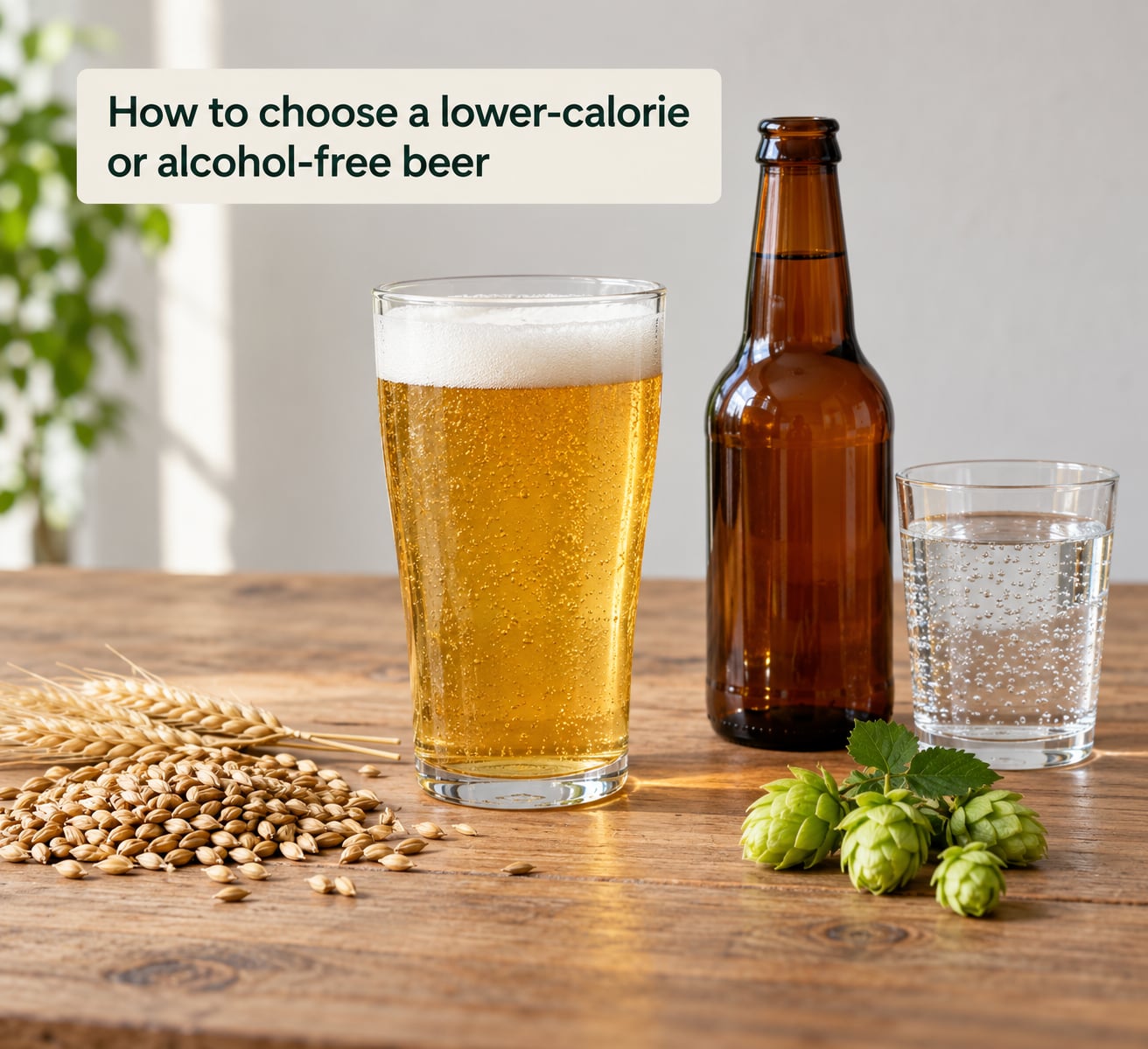
Cutting beer calories is mostly an ABV exercise. Lower the strength and the ethanol calories fall proportionally. If you want to keep the flavour and the volume, you have more options than a decade ago, but read the label because the category is inconsistent.
| Category | ABV | Calories per 355 ml | Carbohydrate | Best for |
|---|---|---|---|---|
| Session lager | 3.0-3.9% | 85-120 | Low | Longer sessions without heavy intake |
| Light lager | 4.0-4.5% | 95-115 | Very low | Lowest-calorie alcoholic option |
| Radler | 2.0-3.5% | 60-110 | Added sugar | Volume plus refreshment |
| Low-alcohol beer | 0.5-1.2% | 25-55 | Low to moderate | Cut volume, keep some flavour |
| Alcohol-free beer | 0.0-0.5% | 20-70 | Moderate in many products | Cutting the ethanol load |
An alcohol-free label is not the same as a calorie-free one. Many products start life as ordinary wort, so they keep 10 to 30 g of carbohydrate per serving and land in the 40 to 70 calorie range. Some newer products dealcoholise more aggressively and land under 25 calories. Both exist on shelves at the same time.
Session beers and radlers reduce calories per serving but extend the drinking occasion, so total intake can stay flat. The honest lever is not the glass, it is the ABV and the number of glasses.
One more practical point. Rotating in a non-alcoholic or low-alcohol beer does cut ethanol intake, and that is its real benefit. It does not make a drinking session healthy, and it does not replace water, which remains the only genuinely zero-calorie option at the bar.
Frequently Asked Questions
Is beer healthy to drink every day?
Daily drinking is not recommended by any public health body, even at one serving. One 355 ml beer is roughly 150 calories and one standard drink of ethanol, and the risks that build with regular intake, including blood pressure, sleep disruption and cancer risk, do not switch off on weekends. If you want alcohol in your routine, less frequent is safer than smaller amounts every day.
Does beer help you lose weight or improve sleep?
No to both. Alcohol adds calories without much satiety, so daily servings quietly raise total energy intake, and beer drinks are associated with higher body weight in observational studies. On sleep, alcohol shortens the time to fall asleep but suppresses REM sleep afterwards, so you wake less rested. Any improvement in falling asleep is a short-term sedative effect, not a recovery or weight-loss strategy.
Is nonalcoholic beer as nutritious as regular beer?
Partly. Most alcohol-free beer is fermented normally then stripped of ethanol, so it keeps much of the carbohydrate, protein and B vitamins of regular beer while removing the alcohol calories. That makes it lower in calories than its alcoholic equivalent, often 20 to 70 per 355 ml. It still contains alcohol at trace levels under labelling rules, and it is not a water substitute.
Does beer have more calories than wine?
A 355 ml lager at 5% ABV holds about 150 calories, while a 150 ml glass of red wine at 12.5% holds about 125. Per serving beer is slightly higher, but the comparison depends heavily on glass size. Wine is usually poured at roughly half the volume of a beer serving, and spirits at about a quarter, so a neat 25 ml shot carries around 70 calories.
Can pregnant adults or people taking medication drink beer?
No alcohol at all is the guidance during pregnancy, and beer is not an exception. People taking medication should check with a doctor or pharmacist first, because alcohol interacts with a wide range of prescriptions including sedatives, antihistamines, blood pressure medicines and metronidazole. The interaction is not something a beer nutrition label will warn you about, so ask before you assume it is fine.
Does the type of beer change its health effects?
Style changes the numbers but not the conclusion. A stronger beer delivers more ethanol and therefore more calories, a stout carries more silicon and melanoidins but no health advantage, and an alcohol-free beer removes the ethanol entirely. Since the central risks come from alcohol rather than from malt or hops, no style turns beer into a healthy drink.
So what should you do first?
Start with the label, not the marketing. Check the ABV, multiply any per 100 ml calorie figure by 3.55 for a 12 oz can, and treat beer’s trace vitamins as a curiosity rather than a nutritional plan.
If beer is part of how you drink socially, the practical levers are strength, serving size and spacing. Lower ABV, alternating with water, and fewer occasions will move the numbers further than anything else on the label.