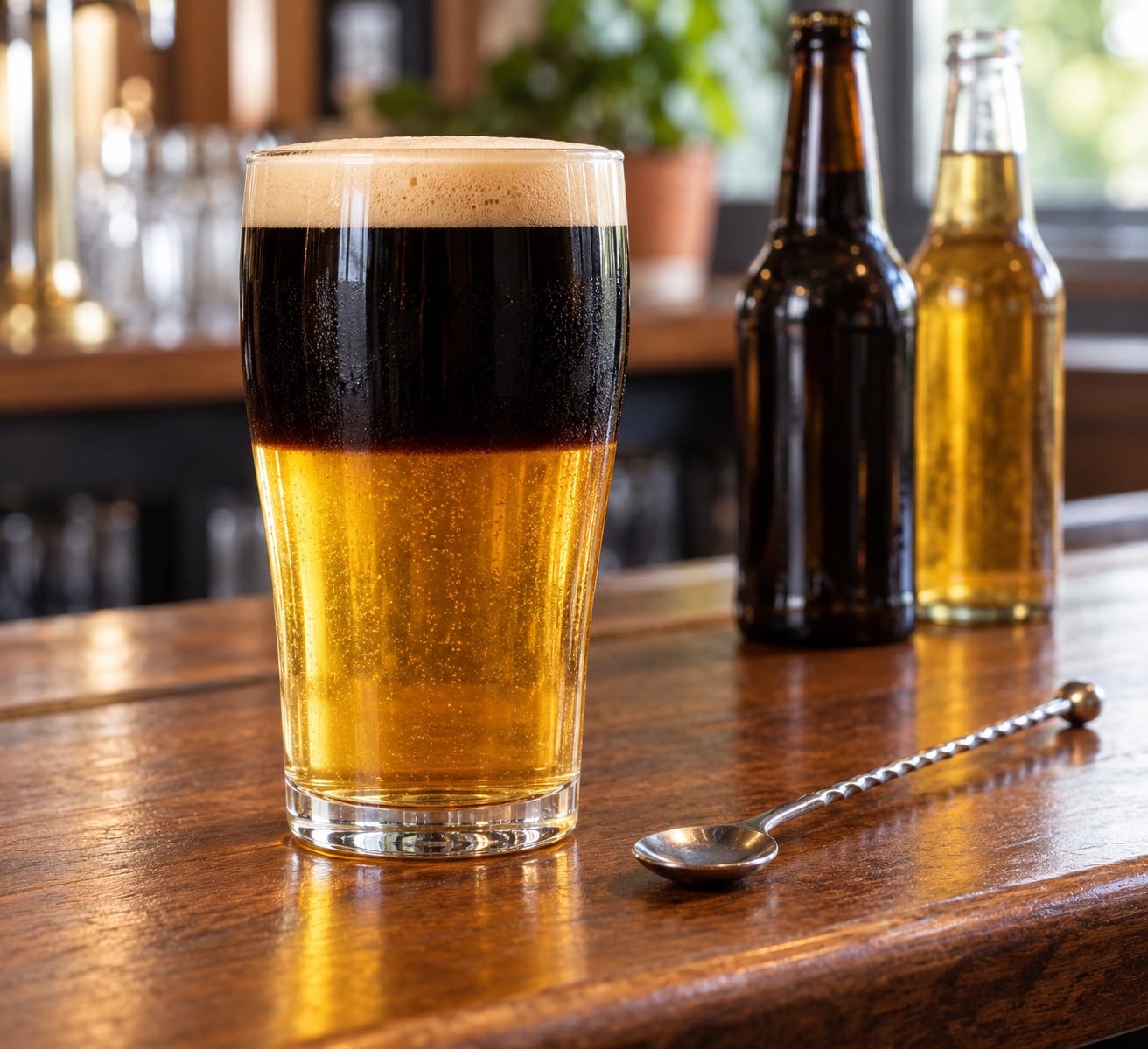
A black and tan is a layered beer drink made by floating a dark stout on top of a pale ale or lager in a pint glass, so you get two clean bands — black over tan — in one glass. You pour the tan beer first, fill the glass about halfway, let the bubbles settle, then pour the stout very slowly over the back of an inverted bar spoon held just above the surface.
That single sentence is the whole drink, and getting it wrong is why so many pints arrive as one muddy brown glass. Pour the stout into the empty glass first and it sinks straight to the bottom, which is the most common version people see online and it is backwards. Order, temperature and pour speed decide everything else. The method takes about five minutes and needs one pint glass and one bar spoon, both of which you can improvise around.
Pouring for friends on a St. Patrick’s Day afternoon, working a bar shift where the pour has to be repeatable, or photographing a layered beer that still looks right ten minutes later — the technique is identical in all three. Here is what to buy, the exact pour, and what to change when the layers refuse to separate.
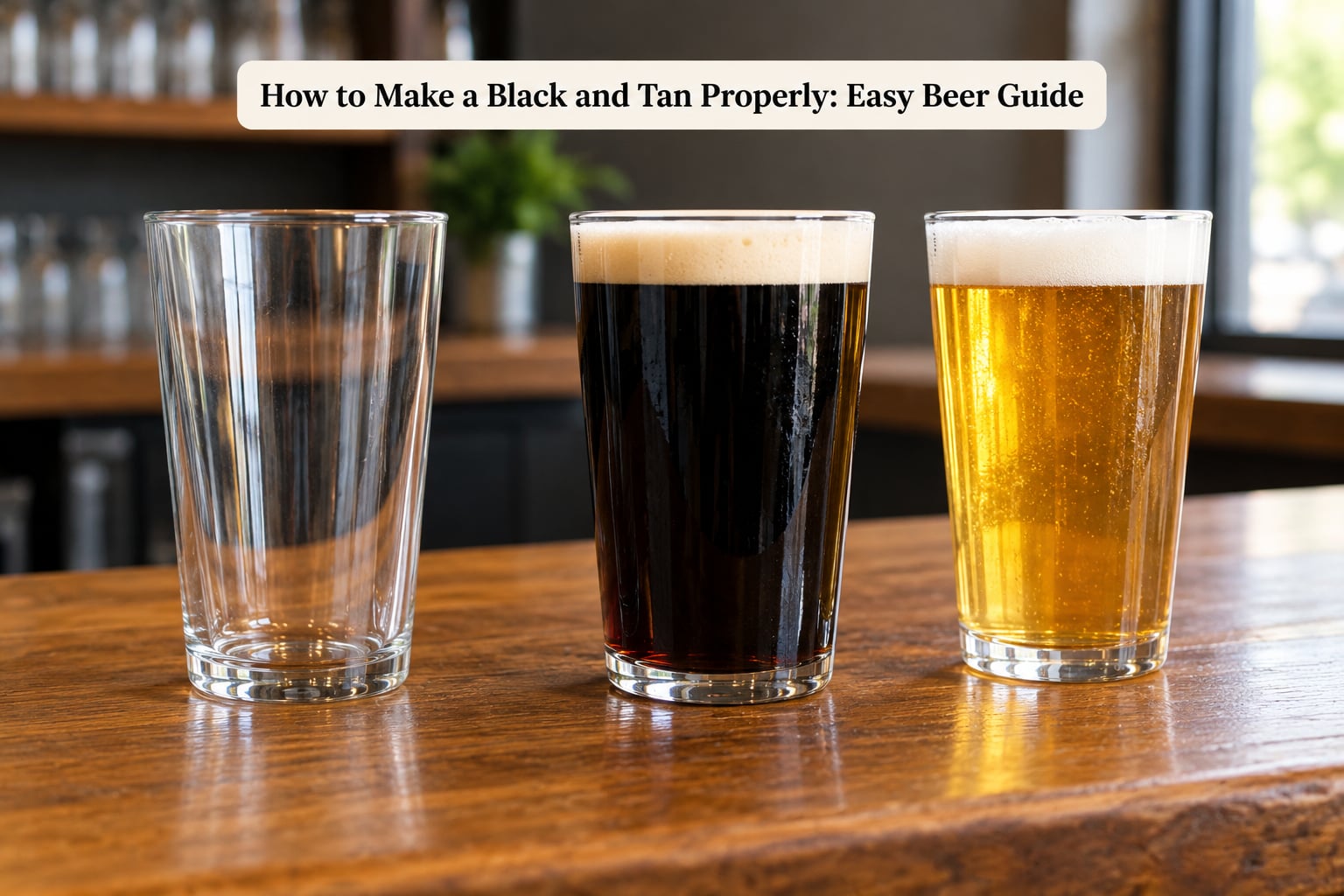
Table of Contents
- What You Need
- Choosing the base beer, the tan half
- Choosing the top beer, the black half
- How much of each beer to pour
- Glass, spoon and temperature
- A non-alcoholic version
- Step-by-Step: How to Make a Black and Tan at Home
- How to Make a Black and Tan Properly: Get the Beer Order Right
- Why the two layers stay separate
- Float the dark beer over the spoon and let it settle
- Serve it straight away
- Common Mistakes: Why Your Black and Tan Doesn’t Layer
- Bent spoon up or bent spoon down
- Is it better to pour fast or slow
- Should you mix it, and what about the other names
- Frequently Asked Questions
- What kind of beer is used for a Black and Tan?
- Should the dark beer or the light beer be poured first?
- Do I need a bar spoon to make a Black and Tan?
- How do I keep the two beers from mixing together?
- Can I use Guinness for a Black and Tan?
- Can you make a Black and Tan ahead of time?
- Conclusion
What You Need
You need two beers of opposite colour and a glass tall enough to show the layers off. A taller glass gives the bands more room and makes a mediocre pour look deliberate, while a short tumbler gives you almost nothing to look at. Beyond that, everything else is preference.
Choosing the base beer, the tan half
The base goes in first, filling roughly half the glass, so it needs enough body to stay put and enough carbonation that bubbles rise to the top and push anything poured later upward. A pale ale, a blonde lager or a light-bodied amber all work. Bass and Yuengling are reliable, widely available lagers that layer without any tricks. A pale ale such as a domestic blonde pours a touch brighter, which makes the dividing line between the two halves easier to see through the glass.
What you want to avoid is a heavy or highly hopped base. An imperial IPA or a strong barleywine has enough alcohol and malt to fight the layer, and hop bitterness reads as muddiness once the stout goes over it. A clean, moderate-strength ale or lager is the reliable choice.
Choosing the top beer, the black half
The dark beer floats, so it must be lighter than it looks. That is the part almost every recipe page leaves unexplained, and it explains why some stouts layer beautifully while others sink and stain the glass.
Guinness is the classic choice and it layers more reliably than its colour suggests, because a dry Irish stout has an unusually low specific gravity for a beer that dark. Smithwick’s and Murphy’s behave the same way and give you a slightly different roast profile. Milk stouts and imperial stouts are a gamble: the creamier and stronger they are, the more likely they are to punch through the layer and blend downward. Porter-style beers sit in a workable middle ground, and nitrogen widget beers are worth avoiding because the widget pushes extra gas through the pour and roughs up the surface.
If you want a reliable result on a first attempt, a nitrogen-free dry stout over a clean lager is the pairing that has worked behind bars for a century.
How much of each beer to pour
The classic split is 50/50 by volume, which means about 8 ounces of pale ale and 8 ounces of stout in a 16-ounce imperial pint. Everything else is a house variation, and each one changes the result in a specific way.
| Ratio (base to top) | What it looks like | When to use it |
|---|---|---|
| 60/40 | A thin dark cap over a deep tan base | You want the pale beer to dominate, or you are serving a stout that pours heavy |
| 50/50 | Two bands of equal height, the restaurant standard | Default choice for a first pour and for guests who have not seen one before |
| 40/60 | A thick dark layer with a narrow tan line beneath | You are pouring for the visual effect, or photographing it |
Pour the base to the ratio you want before you start pouring the stout. Adjusting the ratio halfway through means disturbing the layer you already built.
Glass, spoon and temperature
Use a nonic pint or an imperial pint glass. The slight bulge in a nonic is not decoration — it gives the stout somewhere to gather as it comes down, and it makes the head sit tighter on top. A 20-ounce imperial pint gives you the layers more vertical space, which makes a slightly imperfect pour far more forgiving.
Rinse the glass with cold water and leave it wet. Skip the soap and the dishwasher if you can, because a trace of grease or detergent film on the wall lets the dark beer streak downward instead of settling. Do not dry the sides of the glass with a towel, since that is where the film ends up.
A bar spoon helps but is not essential. Hold it by the handle with the bowl facing down, resting the bowl just above the surface of the base beer. The bowl spreads the incoming stream so the stout spreads sideways across the surface instead of driving a hole straight through it. A teaspoon works. So does the back of a butter knife, in a pinch.
Chill both beers to the same temperature before you start, ideally around 40 to 45 degrees Fahrenheit. This is the step most home pours skip and the reason most home pours fail. A cold stout landing on a warm ale makes the ale release its carbonation all at once, which churns the surface and drags dark beer downward. Matching temperatures keeps the base calm and lets the stout sit on top.
A non-alcoholic version
A layered drink works the same way without alcohol, and the technique transfers exactly. Use a non-alcoholic stout over a non-alcoholic lager, both at the same fridge temperature. Zero-alcohol stouts tend to be thinner than their alcoholic counterparts, which usually helps the layering rather than hurting it. The one adjustment worth making is to pour the base beer with less foam, since there is no alcohol to slow the bubble rise.
Step-by-Step: How to Make a Black and Tan at Home
This is the method that works at home, in a home bar or behind a real bar, and it takes about five minutes from fridge to first sip. Read the order once before you start pouring.
How to Make a Black and Tan Properly: Get the Beer Order Right
Pour the tan beer into the empty glass first, then float the black beer over it. The pale ale fills the bottom half of the glass and stays there; the stout goes in second and rides on top because it is lighter by specific gravity. Pouring the stout into the empty glass is the backwards version that circulates widely online, and it sinks to the bottom the moment it lands.
The order matters more than any other variable in this drink. Nothing about the physics changes if you reverse it — the dark beer still ends up on the bottom, it just arrives there by falling instead of floating, and it stains the pale layer on the way down.
- Chill both beers to the same temperature, around 40 to 45 degrees Fahrenheit, and rinse a cold pint glass with plain water.
- Pour the pale ale or lager into the glass slowly, filling it halfway, then stop and wait 10 to 15 seconds for the bubbles to settle into a flat surface.
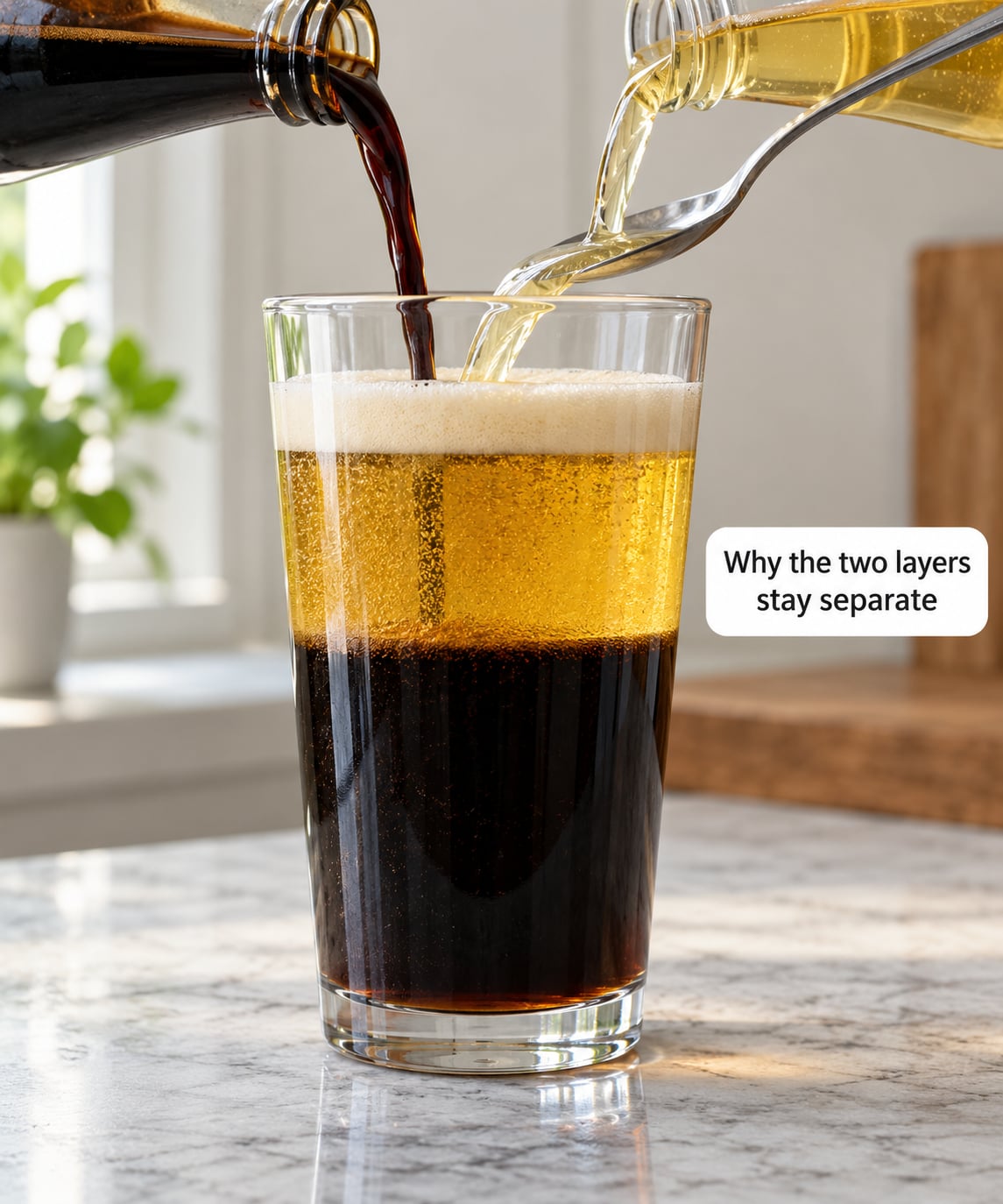
- Hold a bar spoon by the handle with the bowl facing down, resting it just above the surface of the base beer without touching it.
- Pour the stout very slowly over the back of the spoon, letting it spread sideways across the surface. Give it roughly half the volume of the base pour and keep the stream unbroken.
- Stop when the dark layer reaches the top of the glass, then drink it within 10 to 15 minutes before the layers start to blur.
Why the two layers stay separate
Specific gravity is how much a liquid weighs compared to water. Water sits at 1.000. A pale lager lands somewhere around 1.010 to 1.020, and a dry stout like Guinness sits closer to 1.015 than its colour suggests, so it is very close to a light lager and very slightly lighter than most pale ales.
That small difference is the entire mechanism. The stout is less dense, so it rises to the surface and stops there. Add a thicker pour, a warmer base, or a spoon dragging through the bottom layer and you destroy that balance, and the two beers become one drink with a slightly darker top.
When the gap in specific gravity is small, no technique saves the pour. A strong imperial stout over a strong imperial IPA will merge even when you layer it carefully over the back of a spoon. Check the gravity gap before you blame your pour.
Float the dark beer over the spoon and let it settle
Hold the spoon so the bowl sits a fraction above the base beer. If it touches the liquid, you are scooping dark beer up into the next pour, and that streak is the line you will see running through your tan layer. Pour the stout directly onto the bowl and let it run off the far edge in a thin sheet rather than falling straight down.
There is a refinement worth knowing: pour to the foam, let the top layer ride up over the lower one, stop, press the head back down into the layer beneath it, then resume after about ten seconds. It costs nothing and it flattens the domed cap that sits on the pour otherwise.
Serve it straight away
A black and tan has a short shelf life. Drink it within 10 to 15 minutes of pouring. As the glass warms, the carbonation in the base beer comes out of solution and rises, and the boundary between the two layers starts to blur from the bottom up.
If you need to hold it for a few minutes while guests arrive, keep both beers in the fridge rather than leaving them on the counter, and pour last. Do not pre-pour. There is no way to restore a separation once it has gone.
Common Mistakes: Why Your Black and Tan Doesn’t Layer
Almost every failed black and tan comes down to one of six causes: wrong order, temperature mismatch, pour speed, a contaminated glass, or two beers whose specific gravities are too close together. Work down this list and one of them will be your problem.
| What you see | Likely cause | Fix |
|---|---|---|
| The dark beer sinks to the bottom | Stout poured into an empty glass first | Pour the pale ale first, then float the stout over the back of the spoon |
| Both layers turn streaky and marbled | Base beer was warm, so carbonation churned the surface | Chill both beers to the same temperature before pouring |
| The dark layer punched through into the tan | Pouring too fast or too close to the surface | Slow the stream down and use the spoon to spread it sideways |
| A thin brown ribbon runs up the glass wall | Spoon bowl dipped into the base beer | Hold the bowl just above the surface, never in it |
| Layers slide downward in streaks | Grease or soap film on the glass | Rinse with cold water only and leave the glass wet |
| No line at all, just one brown pint | Specific gravities too close together | Swap in a dry Irish stout over a clean lager, and increase the gravity gap |
Bent spoon up or bent spoon down
Face down, and this is the settled answer. Plenty of bartenders argue the bowl of the bar spoon should face up, but the mechanics decide it. A bowl facing down spreads the incoming stout sideways across the surface of the base beer, which slows the stream and stops it driving through. Flipping it bowl-up gives you a narrow stream that punches a hole in the layer.
If you have no spoon at all, you can still layer it. Pour the base beer to halfway, let it settle, then pour the stout from as high above the surface as you can manage while keeping the stream as thin as possible. A thin falling stream spreads on impact and floats. Expect a slightly softer line than the spoon version.
Is it better to pour fast or slow
Slow for the top beer, firmer at the very end. The stout needs a slow, dispersed pour to preserve the separation, but the final pour down the middle of the glass can be more assertive, because at that point you are topping up the head rather than laying the layer. A common bar habit is to finish by pushing the foam back down into the top layer once the glass is half to three-quarters full.
Do not confuse that with pouring the whole thing fast. A fast first pour ruins the drink no matter how controlled the finish is.
Should you mix it, and what about the other names
A proper black and tan is layered, not mixed. There are times when a mixed version is fine — a crowded bar with no time to pour, no spoon at hand, or simply a matter of taste — but mixing it is not the technique, it is the fallback. Several named drinks sit alongside it.
- Half and Half is the same drink, and it is the name used in Irish pubs rather than the American Black and Tan. Worth knowing if you are ordering in Dublin.
- Arf an’ Arf (also spelled Half arf Half) splits the glass down the middle, one half dark and one half pale, poured side by side rather than layered.
- Snakebite is a lager and an Irish red ale mixed together, usually with a shot of whiskey.
- Black and Black is two dark beers in layers, a stout over a porter or a mild.
- Yin and Yang is the same construction flipped, with the pale beer floated on top of the dark one.
Frequently Asked Questions
What kind of beer is used for a Black and Tan?
The classic pairing is a pale ale or lager as the base, floated with an Irish dry stout on top. Bass or Yuengling over Guinness is the version most bars serve, with Smithwick’s and Murphy’s as equally reliable stout choices. What matters is that the stout is lighter than it looks and the base beer is not heavy or overly hopped. Strong imperial stouts and imperial ales have specific gravities that are too close together to layer cleanly.
Should the dark beer or the light beer be poured first?
Pour the light beer first. Fill the glass halfway with the pale ale or lager, let the bubbles settle for 10 to 15 seconds, then pour the dark stout slowly over the back of an inverted bar spoon held just above the surface. Pouring the stout into an empty glass is the backwards version and is the most common mistake people make. The stout sinks straight to the bottom and stains the pale layer on the way down.
Do I need a bar spoon to make a Black and Tan?
No, but it makes a noticeably cleaner line. The spoon bowl, held facing down just above the surface, spreads the incoming stout sideways so it floats instead of punching through the layer. Without one, pour the stout from as high as you can while keeping the stream as thin as possible and let it spread on impact. You will get the layers, just a softer dividing line and a heavier head.
How do I keep the two beers from mixing together?
Match the temperatures, slow the pour, and keep the glass clean. Chill both beers to the same temperature, around 40 to 45 degrees Fahrenheit, because a cold stout landing on warm ale releases a burst of carbonation that drags dark beer downward. Pour the top beer slowly over the back of a spoon held just above the surface without touching it, and rinse the glass with cold water only so no grease or soap film causes streaking.
Can I use Guinness for a Black and Tan?
Yes, and it is the traditional choice. A dry Irish stout has an unusually low specific gravity for a beer that dark, which is why it sits on top of a pale ale instead of sinking through it. That makes Guinness, Smithwick’s and Murphy’s the most reliable dark beers for layering. Stronger styles like imperial stouts and milk stouts are heavier and are more likely to punch through the layer and blend into the base.
Can you make a Black and Tan ahead of time?
No. A layered black and tan collapses as it warms, because the carbonation in the base beer comes out of solution and rises, blurring the boundary from the bottom up. Drink it within 10 to 15 minutes of pouring. If you are hosting, keep both beers in the fridge and pour last, as each guest arrives. Once the layers have merged there is no technique that will bring them back.
Conclusion
Pour the tan beer first and let it settle. Fill the glass halfway with a pale ale or lager chilled to the same temperature as the stout, hold an inverted bar spoon just above the surface, then float the dark beer over the back of it as slowly as you can manage. Those three things — order, temperature, pour speed — account for nearly every failure. Get them right and the layers hold on their own.