Calories in different beer styles explained comes down to two ingredients: alcohol at roughly 7 calories per gram, and the carbohydrate left over from malted grain after fermentation. Alcohol by volume predicts calories far better than colour, hop intensity or the name on the can. A 12 oz beer typically lands somewhere between about 60 and 350 calories, and most styles sit in the middle of that band.
I have pulled the figures below into a single 12 oz baseline so they can be compared honestly. Nothing here is a laboratory measurement, though. Published calorie numbers are brewery or database estimates derived from ABV and residual extract, and two beers of the same style can differ by 40 calories without either one being unusual.
Table of Contents
- Calories in Different Beer Styles at a Glance
- What Makes Beer Contain Calories?
- Calories in Different Beer Styles: How the Estimates Are Calculated
- Which Beer Styles Usually Have the Fewest Calories?
- Which Beer Styles Usually Have the Most Calories?
- How Does ABV Change a Beer’s Calories?
- How Do Hops, Yeast, and Grain Change the Calories?
- How Can You Compare Beer Labels and Taps?
- Frequently Asked Questions
- Which beer style has the fewest calories?
- Does a 4% ABV beer always have the same number of calories?
- Are dark beers like stout or porter higher in calories?
- How many calories come from alcohol versus residual sugar?
- Are brewery-listed beer calorie counts accurate?
- How do I compare calories between a 12-ounce bottle and a 16-ounce pint?
- What to Do First
Calories in Different Beer Styles at a Glance
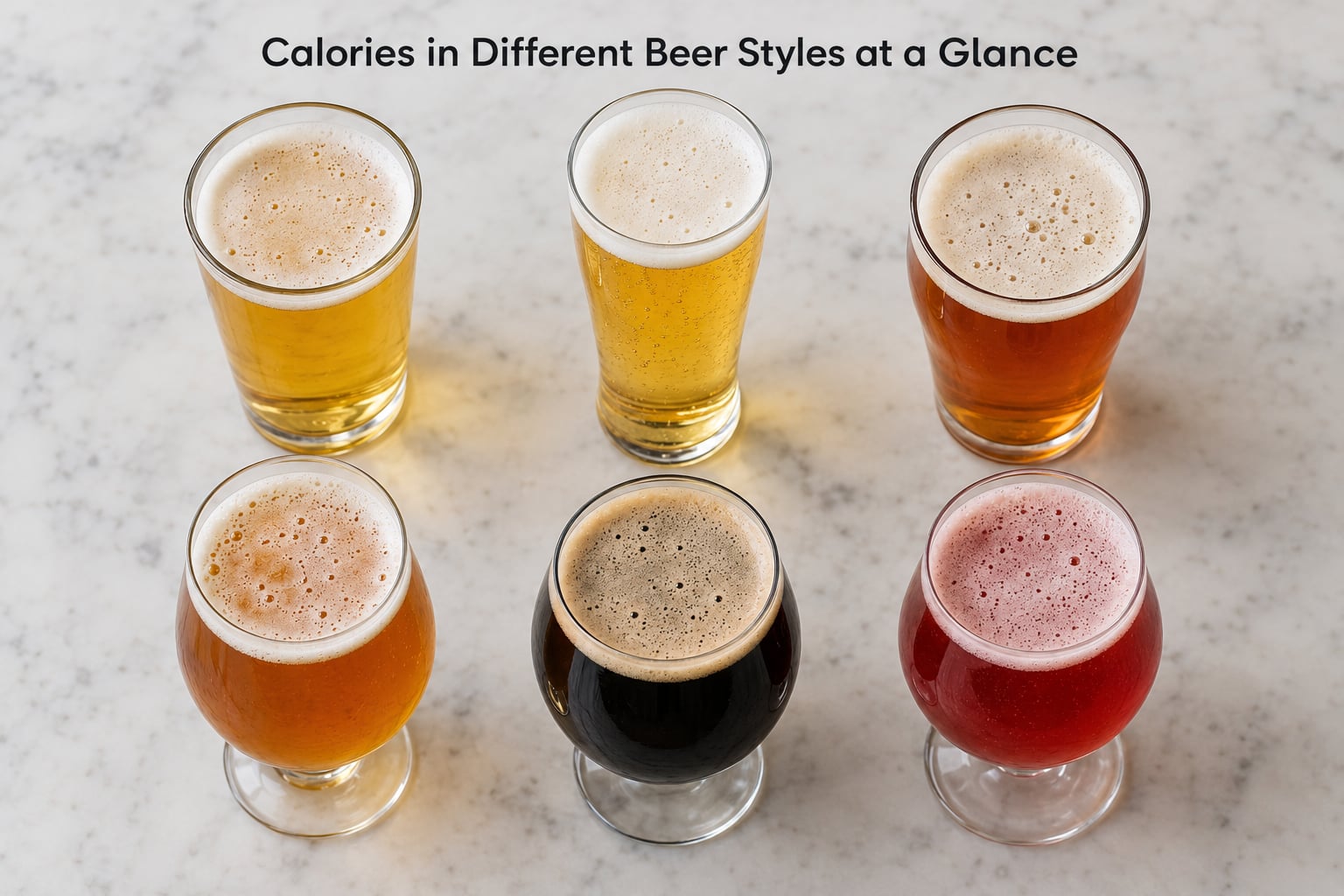
Everything in this table is per 12 oz (355 ml). Treat the calorie column as a typical range rather than a promise, since recipes, package sizes and serving formats vary a lot between breweries.
| Style | Family | Typical ABV | Calories per 12 oz | Carbs per 12 oz | Calorie density |
|---|---|---|---|---|---|
| Pale lager | Lager | 4.0-5.0% | 140-160 | 10-13 g | Medium |
| Pilsner | Lager | 4.0-5.0% | 140-160 | 10-14 g | Medium |
| Helles | Lager | 4.8-5.5% | 150-170 | 12-16 g | Medium |
| Vienna lager | Lager | 4.8-5.5% | 150-175 | 12-16 g | Medium |
| Marzen | Lager | 5.0-6.0% | 170-200 | 15-20 g | Medium-high |
| Amber lager | Lager | 4.0-6.0% | 150-190 | 12-20 g | Medium |
| Dark lager | Lager | 4.0-6.0% | 150-190 | 12-20 g | Medium |
| Bock | Lager | 5.0-8.0% | 180-260 | 15-25 g | High |
| Pale ale | Ale | 4.5-6.0% | 150-180 | 10-16 g | Medium |
| Golden ale | Ale | 4.0-5.5% | 140-170 | 10-15 g | Medium |
| English bitter | Ale | 4.0-5.5% | 130-170 | 8-14 g | Low-medium |
| Brown ale | Ale | 4.0-6.0% | 150-200 | 12-20 g | Medium |
| Porter | Ale | 4.0-6.5% | 160-220 | 13-25 g | Medium-high |
| Stout | Ale | 4.0-7.0% | 170-250 | 15-30 g | High |
| Milky stout | Ale | 4.0-6.0% | 200-280 | 20-35 g | High |
| Imperial stout | Ale | 8.0-12.0% | 250-400 | 20-40 g | Very high |
| Wheat beer | Ale | 4.0-5.5% | 150-180 | 12-18 g | Medium |
| Witbier | Ale | 4.5-5.5% | 150-180 | 12-18 g | Medium |
| Hefeweizen | Ale | 4.8-5.5% | 160-190 | 14-20 g | Medium |
| Session IPA | Ale | 3.0-5.0% | 100-140 | 6-12 g | Low |
| IPA | Ale | 5.5-7.5% | 170-220 | 12-20 g | Medium-high |
| Hazy IPA | Ale | 6.0-8.0% | 200-250 | 18-30 g | High |
| Double IPA | Ale | 7.0-9.0% | 220-300 | 15-25 g | High |
| Imperial IPA | Ale | 8.0-12.0% | 280-400 | 20-35 g | Very high |
| Sour ale | Ale | 4.0-7.0% | 90-180 | 5-15 g | Low-medium |
| Lambic | Ale | 5.0-6.5% | 100-170 | 5-15 g | Low-medium |
| Belgian blonde | Ale | 6.0-8.0% | 180-240 | 15-25 g | Medium-high |
| Belgian tripel | Ale | 7.5-9.5% | 220-300 | 18-30 g | High |
| Belgian quadrupel | Ale | 9.0-12.0% | 280-400 | 20-40 g | Very high |
| Barley wine | Strong ale | 9.0-13.0% | 280-420 | 25-45 g | Very high |
| Non-alcoholic beer | Any | 0.0-0.5% | 10-60 | 1-10 g | Very low |
What Makes Beer Contain Calories?
Alcohol is the dominant source in most beers. Ethanol carries about 7 calories per gram, and a 5% ABV 12 oz beer contains roughly 14 g of alcohol, which works out to about 98 calories on its own.
Fermentable carbohydrate is the second source. Grain and adjunct sugars are converted by yeast into alcohol and carbon dioxide, and whatever sugar or unfermented dextrin remains in the glass is what shows up on a nutrition label as carbohydrates. That residual material usually adds 40 to 90 calories in a standard-strength beer.
Protein and minerals make up a rounding error, generally under 15 calories per 12 oz. A few other sugars, most of them unfermented and derived from adjuncts rather than malt, sit alongside the residual carbohydrate.
Brewers shape the final number in four ways: the amount of malt and sugar they add, how completely the yeast ferments it, how much alcohol is left in the finished beer, and how large a serving they package it in. So a lighter lager and a strong stout are not built differently in principle, only along that spectrum.
Calories in Different Beer Styles: How the Estimates Are Calculated
You can get close enough to a real number for personal tracking in about a minute.
- Find the ABV. It appears on the can, the taproom menu, or the brewery’s site. Without it there is no reliable way to estimate calories.
- Convert ABV to alcohol by weight. Multiply the ABV by 0.789, since alcohol is slightly lighter than water. A 5.0% ABV beer is about 3.9% alcohol by weight.
- Get the alcohol calories. Multiply ABW by the weight of the serving in ounces, then by 7. For 12 oz at 5.0% ABV: 3.9% x 12 oz gives roughly 0.47 oz of alcohol, and 0.47 x 7 lands near 98 calories.
- Add the residual carbohydrate. Find the carb grams on the label and multiply by 4.
- Scale to your actual pour. Multiply everything by the ratio of your serving to 12 oz.
Brewers use a more formal version of the same arithmetic, usually written as roughly 6.9 multiplied by alcohol by weight, plus 4 multiplied by real extract minus ash. Real extract, sometimes listed in degrees Plato, is the dissolved material still in the beer after fermentation.
A worked example makes this concrete. Take a hypothetical beer at 5.0% ABV with 3 g of residual carbohydrate. The alcohol contributes about 98 calories and the carbohydrate adds 12, for roughly 110 calories per 12 oz.
That figure is an estimate, not a lab reading. A laboratory measurement burns a sample and counts the energy directly. Most figures printed on labels and menus come from the formula, so they carry a real margin of error, sometimes plus or minus 20 calories.
The 12 oz baseline exists because it is the smallest common denominator across bottle, can and tap formats. Once everything is expressed per 12 oz, a 16 oz pour and a 12 oz bottle become directly comparable.
Which Beer Styles Usually Have the Fewest Calories?
Light lager sits at the bottom of the pile, typically 90 to 110 calories per 12 oz, and it is the style most people mean when they ask for a low-calorie beer. There is no federal ceiling on the term light, but roughly 110 calories per 12 oz has become the working convention, and many mainstream light beers sit just under it.
Dry pilsner and other highly fermentable lagers follow closely. When the yeast eats nearly all the available sugar, what remains is alcohol plus a trace of residual carbohydrate, and that combination keeps the total low.
Session IPA changed the craft side of this category. Built for a 3% to 5% ABV range, session IPAs typically land between 100 and 140 calories per 12 oz, and drinkers regularly cite them as the rare low-calorie option that still tastes like hop-forward beer rather than fizzy water.
Sour ale and lambic land low for a different reason. Their acidity and roasted character come from fermentation and blending rather than from a heavy malt bill, so many examples stay between 90 and 180 calories.
Non-alcoholic beer sits at the very bottom at roughly 10 to 60 calories per 12 oz, because there is almost no ethanol to count. That gap is the single largest practical lever available: swapping one standard IPA for a non-alcoholic IPA removes well over 150 calories from a single serving.
The trade-off is real, though. Low-alcohol styles have less of the warmth and fullness that comes from ethanol, and a 9 oz craft pour of a 7% double IPA can carry more total calories than three 12 oz light lagers. Strength and portion size interact, so the bottle in your hand is not the only variable.
Which Beer Styles Usually Have the Most Calories?
Imperial stout tops the list, usually running between 250 and 400 calories per 12 oz. It combines high ABV with a substantial malt bill, so alcohol calories and residual carbohydrate stack on top of each other.
Belgian quadrupels and barley wines are close behind. A barley wine at 9% to 13% ABV with sweet residual extract can reach 420 calories per 12 oz, which is the highest figure on the whole table.
Imperial IPAs sit in the same band at 280 to 400 calories, and trips at 220 to 300. Double IPAs and hazy IPAs land slightly lower because brewers often ferment them drier, though hazy styles usually carry more residual carbohydrate and a fuller body.
Milk stouts and dessert-focused styles add lactose, fruit puree or syrup, which pushes carbohydrate without adding alcohol. A milk stout in the 4% to 6% range can reach 280 calories purely on sugar and unfermented solids.
One myth deserves clearing up. A dark beer is not automatically heavier than a pale one. Roasted malt creates colour, coffee notes and bitterness with relatively few calories, so a dry 4.5% ABV porter can land close to, or even under, a 5% ABV pale lager. Colour tells you almost nothing; ABV tells you most of what you need.
Heaviness of mouthfeel is a separate signal from calories. A beer can taste thick and oily while sitting near 200 calories, and another can taste thin and watery at 320. Body is not a measurement.
How Does ABV Change a Beer’s Calories?
Alcohol is fixed at about 7 calories per gram, so calories from ethanol scale almost linearly with ABV. The figures below count alcohol only and exclude carbohydrate.
| ABV | Grams of alcohol in 12 oz | Calories from alcohol | Typical total with carbs |
|---|---|---|---|
| 2.0% | 5.6 g | about 40 | 60-80 |
| 4.0% | 11.2 g | about 78 | 110-140 |
| 5.0% | 14.0 g | about 98 | 140-180 |
| 6.0% | 16.8 g | about 118 | 170-220 |
| 8.0% | 22.4 g | about 157 | 240-300 |
| 10.0% | 28.0 g | about 196 | 300-400 |
Going from 4% to 8% ABV nearly doubles alcohol calories, from about 78 to about 157. That gap is why a high-ABV style is almost always the heavier choice, whatever the brewery’s marketing says about sessionability.
How Do Hops, Yeast, and Grain Change the Calories?
Malt supplies the fermentable sugar that becomes alcohol and the residual dextrin that does not get used, so it is the main lever a brewer pulls. Pale malt produces sugar the yeast converts efficiently. Munich, caramel and roasted malts add unfermentable character and leave more residual sweetness behind, which pushes the calorie count up as well as the flavour.
Wheat is highly fermentable, so beers built on a wheat-heavy grist, such as hefeweizen or witbier, tend to be dry and lean despite a hazy, full-looking body. Specialty grains like rye, oats and spelt add protein and beta-glucan. They contribute few calories and thicken mouthfeel.
Adjunct sugars behave differently. Candied sugar, honey and corn syrup ferment cleanly and add alcohol calories with little residual sweetness, while dextrose can be used by some brewers to lighten body and reduce final calories.
Yeast decides how much of that sugar becomes alcohol. High-attenuating strains such as many German lager yeasts leave a thin, dry finish and fewer leftover calories, while a deliberately under-attenuated or high-temperature fermentation preserves more unfermented sugar and a sweeter, heavier result.
Hops barely move the calorie needle at all. They add bitterness and aroma with almost no energy, which is why heavily hopped IPAs run their calories almost entirely through alcohol.
How Can You Compare Beer Labels and Taps?
Start by forcing everything onto the same serving size, because that is where most conflicting numbers online come from. Multiply the per 12 oz figure by the ratio of your pour.
| Serving format | Multiple of 12 oz | A 150-calorie beer becomes |
|---|---|---|
| 12 oz bottle or can | 1.00 | 150 calories |
| 16 oz can | 1.33 | 200 calories |
| 16 oz US pint | 1.33 | 200 calories |
| 20 oz UK pint | 1.67 | 250 calories |
| 24 oz can or bomber | 2.00 | 300 calories |
On a taproom menu, read the ABV first and the style second. Ask whether the listed ABV applies to the full pour or a smaller taste size, because a 4% beer poured at 6 oz is a completely different calculation from a 4% beer poured at 16 oz.
On a retail shelf, check the nutrition panel for carb grams if it is printed. A 5% IPA with 3 g of carbs sits near 110 calories, while the same ABV with 20 g of carbs sits near 180.
At home, a refractometer gives you original gravity and a hydrometer gives you final gravity, and the two together let you derive calories for a homebrew. The same calculation works in a spreadsheet using the numbers printed on a can.
Community databases and untappd-style records are useful for finding a brewery’s figures but often incomplete. Treat any figure you did not see printed or computed as provisional.
Frequently Asked Questions
Which beer style has the fewest calories?
Light lager usually has the fewest calories of any alcoholic style, typically 90 to 110 per 12 oz. Dry pilsner and other highly fermentable lagers sit in the same range, and session IPA runs about 100 to 140. Non-alcoholic beer is lower still at roughly 10 to 60 calories per 12 oz. In every case, ABV is the number that predicts the total.
Does a 4% ABV beer always have the same number of calories?
No. A 4% beer carries about 78 calories from alcohol, but the total depends on what the yeast left behind. A dry 4% session ale might land near 110 calories, while a 4% milk stout with 30 g of residual sugar can reach 200. Always read the carb figure when it appears, because ABV alone sets only a floor.
Are dark beers like stout or porter higher in calories?
Not necessarily. Roasted malt adds dark colour, coffee notes and bitterness for very few calories. A dry 4.5% ABV porter commonly sits around 160 to 220 calories per 12 oz, which can land close to, or below, a 5% pale lager at 140 to 160. Dark beers become high in calories when they are also strong or sweet, not because they are dark.
How many calories come from alcohol versus residual sugar?
Alcohol dominates in most standard beers. A 5% ABV beer gets about 98 of its calories from ethanol, with the remainder coming from carbohydrate at 4 calories per gram. Very sweet or adjunct-heavy styles are the exception, where residual sugar can contribute as much as alcohol does. Hop bitterness contributes essentially nothing.
Are brewery-listed beer calorie counts accurate?
Usually close, rarely exact. Most published figures come from a formula based on ABV and residual extract rather than a laboratory burn test, and databases often add their own rounding. A reasonable margin of error is plus or minus 10 to 20 calories. Figures vary between batches too, since a single brewery’s stout can differ across production runs.
How do I compare calories between a 12-ounce bottle and a 16-ounce pint?
Convert the bottle figure to the pour size by multiplying it by the ratio of the servings. A 150-calorie 12 oz bottle becomes about 200 calories in a 16 oz pint and about 250 in a 20 oz UK pint. Most confusion in published comparisons comes from quoting different serving sizes without saying so, so always check which format a number refers to.
What to Do First
Put every beer you are considering onto a 12 oz baseline before comparing anything. Then read the ABV, use the 7 calories per gram rule for the alcohol portion, add carbohydrate at 4 calories per gram, and treat the result as an estimate rather than a measurement.
If you want the practical short version: ABV is the number that matters, colour and hop intensity are close to useless as signals, and a small craft pour of something strong can outweigh several light lagers.
Nutrition needs differ from person to person, and anyone tracking intake for a specific medical reason should talk to a registered dietitian or their healthcare provider rather than relying on style averages.