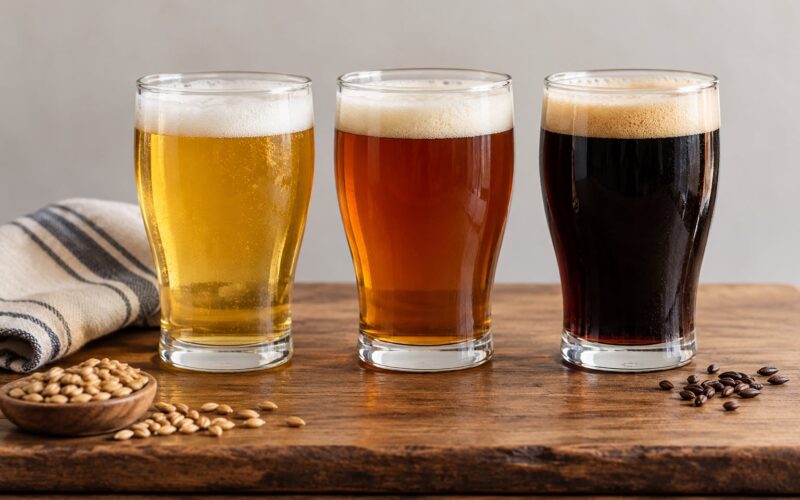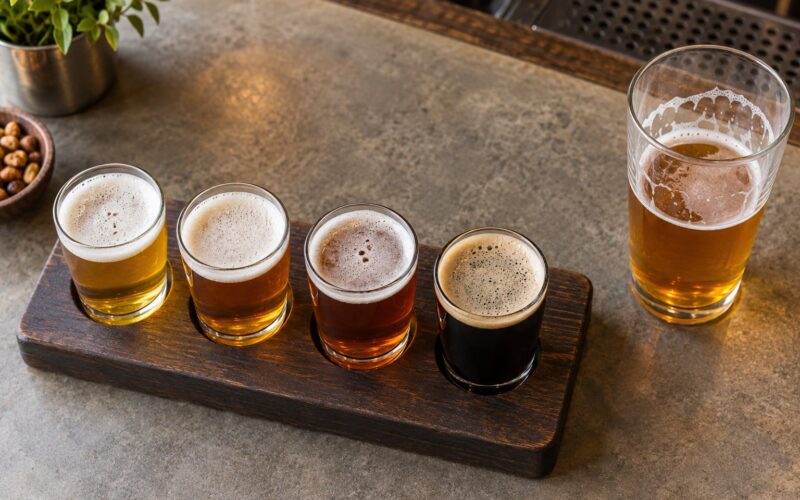
A low ABV session beer is one brewed low enough in alcohol, usually somewhere between 2% and 4.9% ABV, that you can drink several over a few hours and still be social, sharp and able to drive home. What makes it sessionable is not weakness. It is balance: enough malt and hops to taste like real beer, enough body to feel substantial, and enough alcohol restraint to keep the drinker in the conversation. Updated for 2026.
Table of Contents
- Low ABV Session Beer Explained: What Makes It Sessionable?
- Low ABV Session Beer Explained: ABV, Gravity, and Serving Size
- What ABV Range Counts as a Low-Alcohol Session Beer?
- Which Beer Styles Are Usually Easiest to Drink Slowly?
- Why Does a Low ABV Beer Taste More or Less Alcoholic?
- How Do You Choose a Session Beer at a Bar or Festival?
- Can You Drink Low ABV Beer All Night?
- Frequently Asked Questions
- Are low-ABV beers always lower in calories?
- Does a beer with 4% ABV count as a session beer?
- Can nonalcoholic or alcohol-free beer be considered sessionable?
- Why does a low-ABV beer sometimes taste sweet or strongly flavored?
- Does the size of the beer glass change how much alcohol you consume?
- How can I tell whether a craft beer will be easy to drink over several hours?
- Conclusion: Start with ABV and Serving Size
Low ABV Session Beer Explained: What Makes It Sessionable?
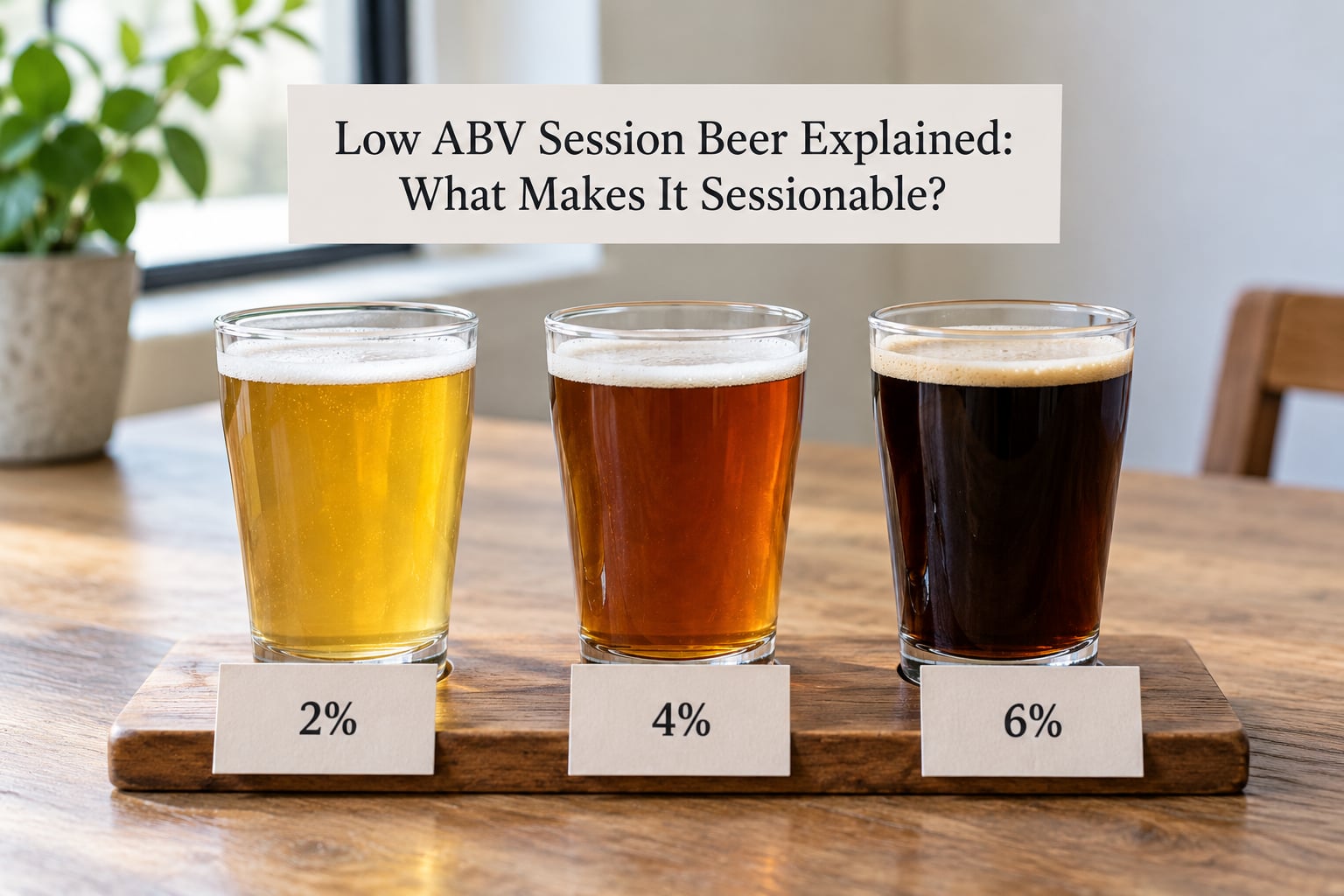
Low ABV session beer explained properly, it is a question of function rather than style. Sessionable means a beer holds its shape over a long drinking window: it does not fatigue your palate, it does not make you sleepy after two, and it does not dominate the conversation the way a 7% double IPA does.
Sessionable is not a synonym for weak. Plenty of thin, watery light lagers sit under 4% and are hard to get through even a second pint. The good ones have a dry finish, a clear malt backbone and enough bitterness to keep you reaching for the next one. Alcohol strength, flavor intensity, carbonation and serving size all shape how a beer drinks over time.
The last one gets overlooked most. A 4% beer in a 16-ounce pint delivers more alcohol than a 5% beer in a 12-ounce glass. Same label, different night.
Low ABV Session Beer Explained: ABV, Gravity, and Serving Size
ABV simply means the percentage of the finished beer that is alcohol. A brewer sets it by controlling the original gravity, the density of wort before fermentation, and how much of that sugar the yeast actually converts. Ferment the wort down further and alcohol goes up. Stop earlier and it stays lower.
You cannot reverse the process by diluting a finished beer, which is why brewers plan low-alcohol recipes from the start rather than watering down a strong batch.
| ABV | Alcohol in a 12 oz serving | US standard drinks (0.6 oz) | Approx. calories from alcohol alone |
|---|---|---|---|
| 2.0% | 0.24 oz | 0.4 | ~40 |
| 3.0% | 0.36 oz | 0.6 | ~59 |
| 4.0% | 0.48 oz | 0.8 | ~78 |
| 4.5% | 0.54 oz | 0.9 | ~88 |
| 5.0% | 0.60 oz | 1.0 | ~98 |
| 6.0% | 0.72 oz | 1.2 | ~118 |
Alcohol contributes roughly 20 calories per percentage point of ABV in a 12-ounce serving. Residual sugars add to the total, so a sweet beer at 4% can carry more calories than a dry one at 5%.
Now the serving size. A 16-ounce pour of a 4% beer holds 0.64 oz of alcohol, a little more than a 12-ounce glass of 5.5% beer. That single fact explains a lot of people who order a session beer and still feel unsteady after two.
These are arithmetic estimates, not a prediction of how you will feel. Weight, food, pace, sleep and the rest of your evening all matter more than the number on the chalkboard.
What ABV Range Counts as a Low-Alcohol Session Beer?
There is no legal or universal cutoff, and that is the honest answer. Style guidelines and brewers all draw the line in a slightly different place. The Beer Judge Certification Program guidelines place session strength under 4%. The Session Beer Project, which pushed the idea hardest in American craft, used 4.5% or less. British drinkers have long treated anything under about 4% as ordinary session territory. Most American drinkers will call a 4.8% beer sessionable if it tastes right.
| ABV band | Trade name | Representative styles | What it drinks like |
|---|---|---|---|
| Under 3% | Super session | Light lagers, session gose, alcohol-reduced lagers | Very crisp and quick to drink, but thin ones disappear without satisfying. Watch for hollow or watery finishes. |
| 3.0% to 3.9% | Mid-strength | British milds, dry Irish stout, 3.x session IPAs, lighter pilsners | The sweet spot. Clearly beer, full enough flavor, and the band most drinkers actually mean by session. |
| 4.0% to 4.9% | Session strength | American pale ales, pilsners, amber ales, wheat beers, upper-end session IPAs | Two or three are easy. Four start to register, especially in larger pours. |
| 5% or higher | Standard strength | Mainstream lagers, IPAs, stouts, Belgian styles | Not session beer. Anything marketed as a session IPA above 5% is stretching the word. |
If you take one number from this guide, take 4%. Stay under it and you have room for a genuine session. Sit just above it and the math starts working against you fast.
Which Beer Styles Are Usually Easiest to Drink Slowly?
Style does not guarantee ABV, and plenty of 6% ales drink like session beer to the first two pints. Still, certain families are built for repetition.
Light lagers and pilsners. Clean, carbonated, dry at the finish. Pilsner malt gives a faint bread-crust softness that keeps them from tasting like soda, and the bitterness stays low. The classic sessionable shape, and the easiest place to start.
Session IPAs. Hop aroma and flavor without the heavy, oily body that comes with a full-strength IPA. The good ones dry out completely, so you never notice how much you have had. The trouble is that the label has been stretched: plenty marketed as session IPAs land between 4.5% and 6%.
Pale ales and bitters. A British bitter at 3.5% with restrained English hops is the benchmark for what sessionable is meant to be. Nutty malt, gentle bitterness, and a body that stays consistent from pint one to pint four.
Wheat beers. Hefeweizen, witbier and gose all drink lightly despite the fruit and spice notes, because a portion of the wheat is left unfermented and unconverted. They are sweet, though, and sweetness hides alcohol well enough that a 5% hefeweizen can catch you off guard.
Amber ales and milds. Toasted and caramel malt flavors register as substantial even when the body is light. Milds, at 3% to 4%, were built for exactly this purpose.
Low-ABV dark beers. A dry Irish stout around 4% tastes heavier than it measures, because roasted barley adds flavor without adding sugar. The catch is that darkness reads as strength, so people order these faster than they should.
Why Does a Low ABV Beer Taste More or Less Alcoholic?
Taste is not a readout of ABV. A crisp pilsner at 4.5% tastes almost weightless because fermentation converted nearly all the sugar, leaving a dry finish. A sweet amber ale at 4% can taste boozy, because unfermented sugar reads as warmth and richness in the mouth.
Residual sweetness is the biggest single factor. The more sugar the brewer leaves in, the more the beer tastes like it has alcohol in it, and the less your palate warns you. Bitterness pushes the other way, drying the finish and cutting the impression of heat.
Esters matter too. Fermentation produces fruity compounds, and a warm fermentation or an expressive yeast strain loads them up. Those esters suggest alcohol even when the number is low, which is exactly how a 3.8% hefeweizen manages to feel stronger than a 4.5% pilsner.
Then there is service. A beer poured from a shaker tastes thinner than the same beer poured gently, because agitation drives off carbonation and warms the liquid. Cold, gently poured beer at around 38 to 40 degrees reads as lower in alcohol and stays crisp longer. A narrow glass concentrates aroma and makes a beer feel more potent. A wide tulip opens it up. Glassware changes perception more than most drinkers expect.
How Do You Choose a Session Beer at a Bar or Festival?
Ask for the current tap list and look for the number, not the beer name. Session is a marketing word far more often than it is a specification.
1. Find the ABV before you order. Most taprooms list it, and plenty do not. Ask directly if it is missing. A style name alone tells you nothing about strength.
2. Confirm the pour size. A 4% beer in a 16-ounce pint carries more alcohol than a 5% beer in a 12-ounce glass. Ask what size the glass is if the pour looks generous.
3. Start with a style you already enjoy. A pilsner, a wheat beer or a mild gives you a familiar baseline before you try something unusual.
4. Watch flavor intensity, not just the number. A 4.2% beer loaded with citrus and tropical hops can feel bigger than a 5% English mild. Heavy, resinous or boozy flavors are a signal to slow down.
5. Pace the order. At a festival, a first round of something light leaves room to taste something else later. Back-heavy drinking catches up faster than front-heavy drinking.
ABV can also shift between batches, and a brewery may adjust a recipe year to year. If a beer you liked last visit seems stronger, that is often why.
Can You Drink Low ABV Beer All Night?
Low ABV beer still contains alcohol, and servings still add up. A 4% beer carries roughly 0.48 oz of pure alcohol in a 12-ounce serving, so three of them is about one and a half US standard drinks. Ten is not a moderation exercise by any measure.
Lower alcohol does lower total intake for the same volume drunk, and that is a real benefit. It is not a benefit that makes the evening risk-free, and it is never a substitute for a plan around driving. If you are driving, do not drink, at any ABV.
Food slows absorption, water between drinks slows pace, and time does most of the work. Alternating with a non-alcoholic option helps for exactly the same reason. Following local alcohol guidance, and the limits your doctor sets for you personally, beats any rule of thumb in this article.
Frequently Asked Questions
Are low-ABV beers always lower in calories?
Usually, and the gap widens as ABV drops. Alcohol carries about 7 calories per gram, and a 12-ounce serving at 4% gets roughly 78 calories from alcohol alone versus close to 98 at 5%. But residual sugars matter. A sweet 4% amber ale can carry more total calories than a dry 5% pilsner, so check the label rather than assuming.
Does a beer with 4% ABV count as a session beer?
It sits right at the top of the band most drinkers use. Under 4% is broadly agreed session strength, 4% to 4.9% is session strength with a bit less room, and 5% or higher is ordinary standard strength. A 4% beer works well for a few servings in a 12-ounce pour. In a 16-ounce pint, that same beer is closer to a full standard drink.
Can nonalcoholic or alcohol-free beer be considered sessionable?
It is not beer in the brewing sense, so it does not answer the same question. Alcohol-free beer is brewed with little or no fermentable sugar, or dealcoholized afterward, and it is genuinely useful for pacing across a long afternoon. It simply cannot carry the flavors session beer exists to deliver, and you should never assume a label means zero alcohol without checking it.
Why does a low-ABV beer sometimes taste sweet or strongly flavored?
Because brewers recover what fermentation removed. A 3% beer cannot rely on residual sugar for body, so brewers add specialty malts, fruit, spices, coffee or hops to build flavor instead. Extra hops and expressive yeast strains bring esters that suggest alcohol. The result can taste rich and boozy while measuring far below the strength of a standard beer.
Does the size of the beer glass change how much alcohol you consume?
Yes, directly. Alcohol content scales with volume, so a 16-ounce pour of a 4% beer holds about 0.64 oz of alcohol, more than a 12-ounce glass of 5.5% beer. A large-format glass also makes the beer disappear faster, which is the part people forget. Glass shape matters more for flavor than for intake.
How can I tell whether a craft beer will be easy to drink over several hours?
Check three things: the stated ABV, the body, and the finish. Under 4% is the safest signal. A beer that feels thin, watery or harsh as it goes will not improve with the fourth serving. A dry, balanced finish is the better indicator, because a beer that cleanses your palate keeps inviting the next one without hiding how much you have had.
Conclusion: Start with ABV and Serving Size
Start with the two numbers. Read the ABV, confirm the pour size, and stay under 4% if you want genuine room to drink. Then pick a flavor and body that suit the occasion: something dry and clean for an afternoon, something hoppy and dry for an evening, something dark and roasted if that is your taste.
Alternate with water or a non-alcoholic drink, eat something, and give the evening a pace. Sessionable means slower and more mindful, not unlimited. That is a good trade, and it is the whole point of the style.