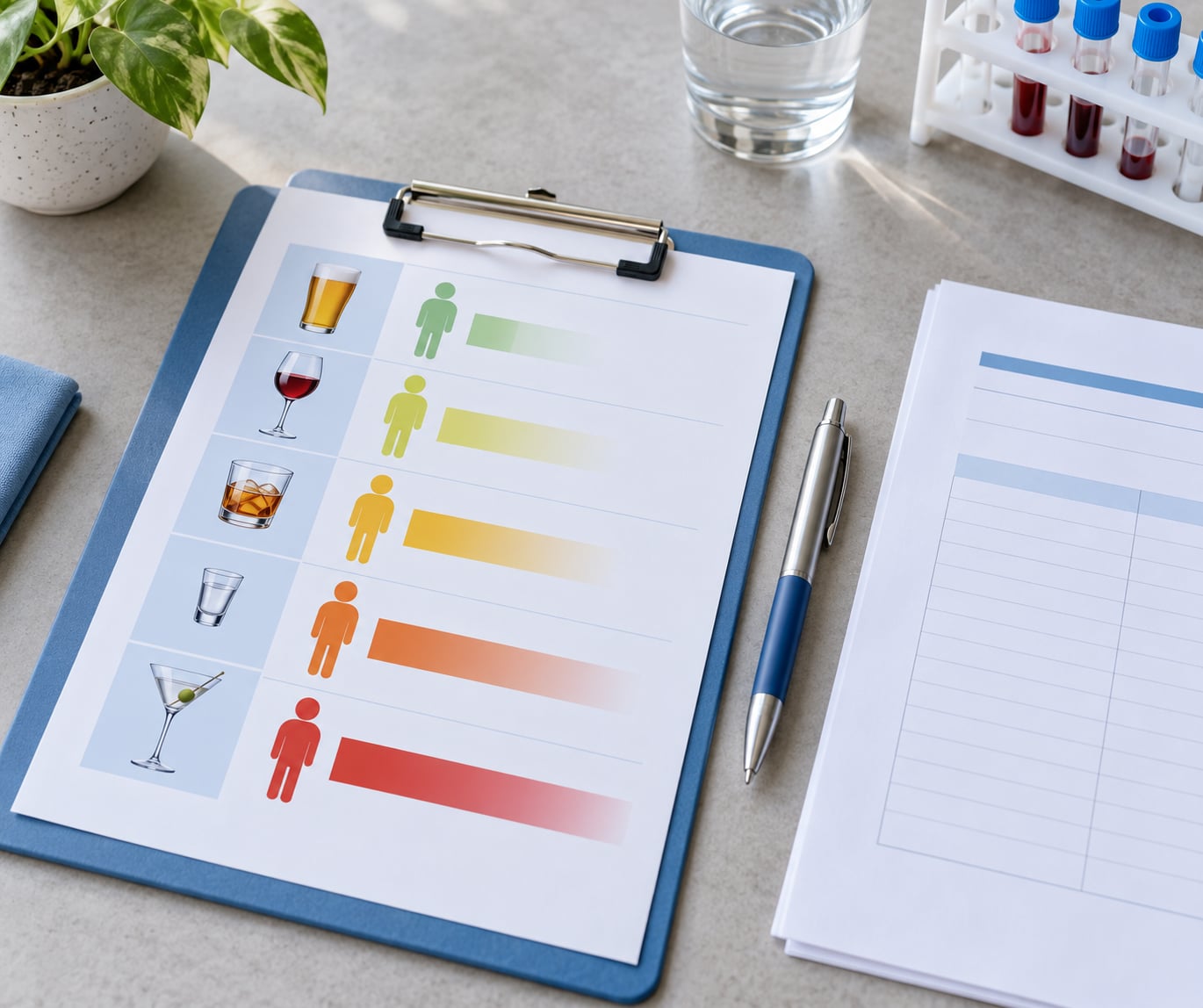
A blood alcohol chart is a reference table that maps ranges of blood alcohol concentration, written as a percentage such as 0.08%, to the physical, mental, and driving effects commonly reported at that level. To read one, find your number, find its band, then read across the effect columns.
Last updated October 2026. This guide covers how to read a blood alcohol chart in five steps, what the common numbers mean in practice, and when a reading points to a medical problem rather than a legal one. It is general education, not medical or legal advice.
Table of Contents
- What You Need Before You Read the Number
- How to Read a Blood Alcohol Chart, Step by Step
- Step 1: Confirm the unit before anything else
- Step 2: Identify which test produced the number
- Step 3: Find your band and read both effect columns
- Step 4: Check whether the chart means health reference points or a legal limit
- Step 5: Know when a number means call for help
- What Each Number Means in Practice
- Common Mistakes When Reading a BAC Chart
- Frequently Asked Questions
- How many drinks is 0.08 BAC?
- Is a 0.07 alcohol level considered high?
- Can you be impaired below 0.08?
- How long does alcohol stay in your system?
- What is a high BAC?
- How many beers does it take to raise your BAC?
- What to Do First
What You Need Before You Read the Number
Four things have to be in front of you, and most misreadings come from skipping one of them.
- The result itself, as printed on a breathalyzer ticket, a police report, a lab toxicology sheet, an employer screening, or your own home device.
- The unit, either percent or milligrams of alcohol per 100 milliliters of blood.
- The test type, which tells you what body sample the number came from.
- The collection time, ideally noted on the report, because a reading taken while BAC was still climbing means something different from the same number taken later.
One caution up front: a chart describes average patterns reported in research and public-health guidance, including benchmarks from the National Highway Traffic Safety Administration and the National Institute on Alcohol Abuse and Alcoholism. It cannot tell you whether a specific person is safe to drive, and it cannot diagnose anything. Do not try to estimate your own impairment by reading a chart after drinking.
How to Read a Blood Alcohol Chart, Step by Step
Step 1: Confirm the unit before anything else
Most US charts are written as a percentage, where 0.08% means 0.08 grams of alcohol per 100 milliliters of blood. The same value written the other way is 80 milligrams per 100 milliliters. So a report showing 80 mg/100 mL and a ticket showing 0.08% are the same reading in different notation, not two different results.
Some laboratory reports use grams per deciliter, which matches the percent format numerically, and some print the number without a unit at all. If the unit is missing, treat the reading as unconfirmed until you can confirm it from the original paperwork.
Step 2: Identify which test produced the number
Breath, blood, urine, and saliva or oral-fluid tests all measure alcohol, but they do not measure it in the same sample, and they are not perfectly interchangeable. A breath device estimates blood alcohol from deep lung air, and its readings carry a calibration margin that can push the printed number higher or lower than the true value.
| Sample | What it measures | Where you see it | Notes on accuracy |
|---|---|---|---|
| Breath | Alcohol in deep lung air, converted to an estimated blood value | Roadside stops, home breathalyzers | Fast, but carries a device margin of error; mouth alcohol and recent drinking can affect the result |
| Blood | Alcohol actually present in the blood sample | Hospital draws, post-arrest blood draws | Generally treated as the most reliable of the common methods |
| Urine | Alcohol excreted in urine | Workplace and school screening | Reflects exposure over a longer window rather than a point in time |
| Saliva or oral fluid | Alcohol in oral fluid | Some workplace and field programs | Quick screening tool; not a substitute for a confirmatory test |
Never take a breath number and convert it into a blood number by hand to see if it clears a legal threshold. Do the same in reverse if a report arrives in different notation: check the unit, not the arithmetic.
Step 3: Find your band and read both effect columns
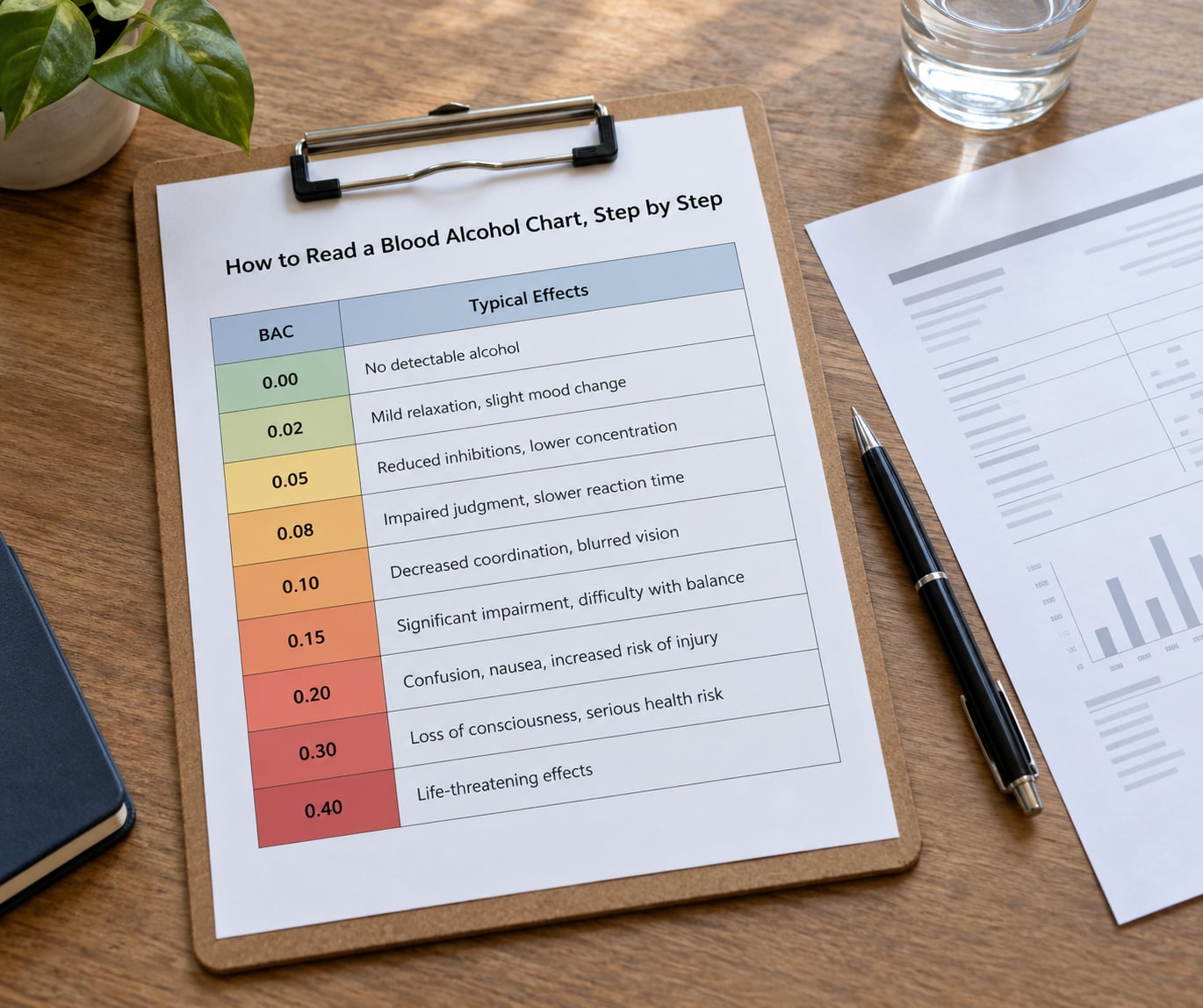
Charts group readings into ranges rather than listing every hundredth of a percent. Find the range containing your number, then read across. Reading both columns matters, because the cognitive and physical picture do not always move together, and people notice the physical part more than the mental part.
| BAC range | What people notice | Driving impairment |
|---|---|---|
| 0.00 to 0.02 | Little or nothing; most people feel baseline | Driving generally unaffected |
| 0.02 to 0.05 | Relaxation, warmth, a looser mood, slightly reduced fine motor control | Attention shifts; more than one drink per hour begins to show in reaction time |
| 0.05 to 0.08 | Reduced judgment, slowed reaction, narrowed peripheral vision | Crash risk climbing; impairment is measurable well below the legal limit in many drivers |
| 0.08 | Divided attention breaks down; risk assessment and self-control suffer | The per se limit in most US states, meaning the number alone can support a charge |
| 0.10 to 0.15 | Marked impairment of judgment and coordination, slurred speech, unsteady gait, memory gaps | Unsafe by any measure; severe impairment |
| 0.20 to 0.30 | Stupor, confusion, limited response to pain | Profoundly impaired |
| 0.35 and above | Coma risk, suppressed breathing and gag reflex, possible fatality | Not a driving question at this point. This is a medical emergency |
Read across slowly. A person at 0.07 can sound articulate and still show degraded divided attention, which is the ability to hold one thought while tracking another, such as watching traffic while reacting to a light change.
Step 4: Check whether the chart means health reference points or a legal limit
Plenty of charts mix three different things: general health reference bands, a testing threshold such as the point where a screening is positive, and a legal driving limit. They are not the same number in every state.
In the US, the per se limit is 0.08 in most states, 0.05 in Utah, 0.04 for commercial motor vehicle drivers, and near zero tolerance for drivers under 21, who face administrative consequences at 0.02 or lower depending on the state. Limits vary by jurisdiction and change over time, so check your own state or local official source for any legal question, and treat a chart’s number as context rather than as a legal conclusion.
Step 5: Know when a number means call for help
Contact emergency services right away if a person who has been drinking cannot be awakened, is breathing slowly or irregularly, has a seizure, has blue or pale skin, has a pulse that is slow or irregular, or is confused and cannot be roused. Do not leave an impaired person alone, do not let them drive, and do not put them in a cold shower or make them walk it off. Position them on their side and wait for help.
If you are the one who drank, calling for help early is the right call. Nobody has ever been in trouble for getting medics there before it was necessary.
What Each Number Means in Practice
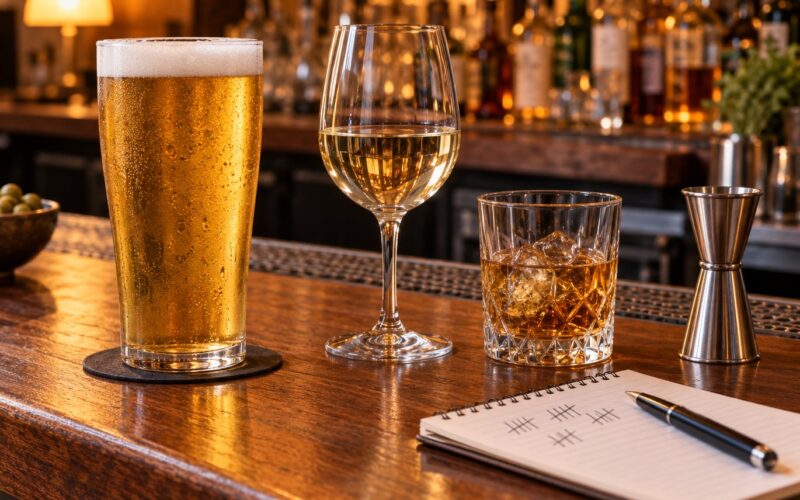
The mapping people actually want is drinks to bands. The chart below uses standard drink sizes as defined by NIAAA: 12 ounces of 5% beer, 5 ounces of 12% wine, or 1.5 ounces of 40% spirits. Treat these as planning estimates, not a promise about your own result.
| Body weight | About 0.05 | About 0.08 | About 0.15 |
|---|---|---|---|
| 100 lb | 2 drinks | 3 drinks | 6 drinks |
| 140 lb | 3 drinks | 4 drinks | 8 drinks |
| 180 lb | 4 drinks | 5 drinks | 11 drinks |
| 220 lb | 5 drinks | 7 drinks | 14 drinks |
These figures vary with sex, food, drinking pace, and how quickly the liver clears alcohol, so they are rough bands rather than a personal prediction. A calculator online is the same kind of estimate with more decimals.
Body of beer changes the arithmetic fast. A 16-ounce imperial IPA at 10% ABV carries roughly as much alcohol as three standard drinks, so two of them lands you where six light beers would not. That gap is why drink counts and BAC readings disagree so often at beer events, where high-ABV pours get counted as one.
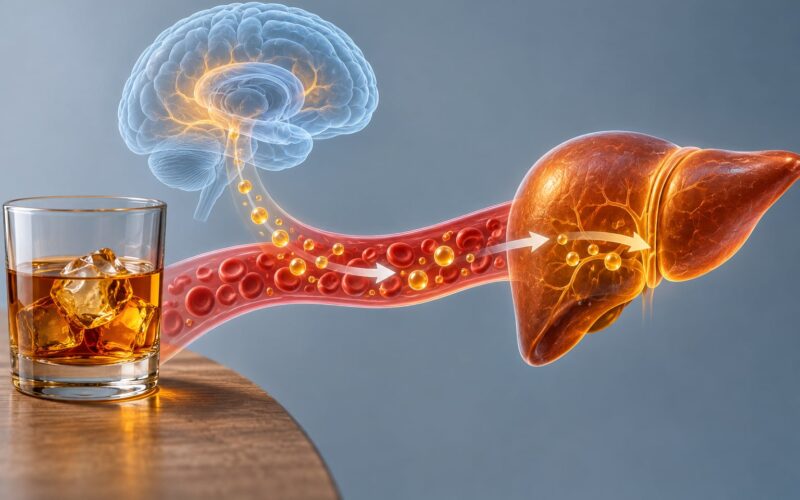
Time is the other half of the number. The commonly cited NIAAA estimate is roughly 0.015% cleared per hour, so a 0.08 reading does not return to zero in an hour, and waiting an hour before driving is not a plan. Coffee, a shower, food, or a walk do not move the number either.
Rising versus falling BAC changes how the same number feels. On the way up, you may still feel sharp while your attention is already degrading. On the way down, a falling reading can feel worse than a slightly higher rising one, which is why a number taken late in the night is not a green light. On the way down, the person is metabolizing alcohol they already absorbed, and none of it has left yet.
Common Mistakes When Reading a BAC Chart
Mixing up percent and mg/dL. Seeing 80 on a lab report and treating it as a percentage reading overstates the result by a thousand times. Check the unit before you interpret anything else.
Treating every test type as identical. A breath estimate and a lab blood result can differ without either one being wrong, because they sample different materials and carry different margins.
Reading a general reference chart as a legal limit. A 0.08 row on a health chart describes reported impairment. Only your state’s official source defines your legal limit.
Ignoring the collection time. A number recorded before your last drink is not the peak, and a number recorded hours later is not the peak either.
Believing tolerance protects you. Tolerance changes how a number feels to you. It does not lower the amount of alcohol in your blood, and it does not reduce crash risk.
Using a BAC number to decide whether to drive. No chart, calculator, or home device can clear you to drive. If you drank and are wondering, the answer is to arrange a ride, a cab, or a call to someone who can drive.
A few practical habits help: keep the original report, note the date and time printed on it, and ask a doctor or pharmacist to explain a result in the context of your medications and health history. For anything with legal consequences, talk to a lawyer rather than to a chart.
Frequently Asked Questions
How many drinks is 0.08 BAC?
For most adults, roughly three to seven standard drinks over one to two hours will reach 0.08, with body weight doing most of the work. A standard drink is 12 ounces of 5% beer, 5 ounces of 12% wine, or 1.5 ounces of 40% spirits. These are estimates from public-health references, not predictions about your own result.
Is a 0.07 alcohol level considered high?
Below the 0.08 per se limit, but not harmless. Research cited by NHTSA shows measurable impairment in divided attention, reaction time, and risk assessment at 0.05 and lower in a large share of drivers. A 0.07 reading can support a charge in some states on impairment evidence even without reaching 0.08.
Can you be impaired below 0.08?
Yes. The 0.08 limit is a legal threshold, not a safety threshold. Skills such as divided attention, eye movement, and braking response can degrade at 0.05 and lower, and NHTSA research attributes a meaningful share of crashes to readings under the limit. Feeling fine is not evidence of being fine.
How long does alcohol stay in your system?
The widely cited NIAAA estimate is about 0.015% cleared per hour, so a 0.08 reading takes roughly five hours to reach zero on that math alone. Pace, food, body size, and liver function all shift it. Nothing speeds it up, including coffee, cold showers, or sleep, and only time lowers the number.
What is a high BAC?
Anything at or above 0.15 is high and dangerous, with blackout and alcohol-poisoning risk. At 0.20 to 0.30 people are in stupor, and at 0.35 and above the risk of coma, respiratory suppression, and death is real. Those readings are a medical emergency, not a driving statistic. Call emergency services if someone is hard to wake or breathing oddly.
How many beers does it take to raise your BAC?
One 12-ounce beer at 5% ABV is one standard drink, so roughly two to three puts many adults into the 0.05 to 0.08 range and five or more pushes past 0.08. Stronger styles skew this hard: a 16-ounce IPA at 10% ABV counts as about three standard drinks. Count the ABV, not the glass.
What to Do First
Start with the two details that change everything: the unit and the test type. Read the value off the original report rather than an online conversion, and note the date and time on it.
Then treat the number as information, not permission. If you drank, do not drive, and no chart or home device can change that. If the result concerns you personally, ask a doctor or pharmacist about it in the context of your health and medications. If it carries legal weight, speak with a lawyer. And if the person in front of you cannot be woken or is breathing strangely, call emergency services now.