Craft beer costs more than domestic beer mostly because it is made in much smaller quantities, so the same fixed costs get spread across far fewer beers. Add richer ingredients, a distribution chain a macro brewer does not need, and a per-barrel tax, and the gap shows up everywhere from a six-pack to a taproom pour.
The price range for that gap is wide enough to be worth understanding. A domestic draft pour in a US bar typically runs 5 to 8 dollars, while the same pour of craft beer runs 8 to 14 dollars. A six-pack of domestic cans lands around 8 to 11 dollars, against 12 to 20 dollars for a craft six-pack. These are typical US ranges that vary a lot by region and change over time, so treat them as a starting point rather than a quote.
Table of Contents
- Why Craft Beer Costs More Than Domestic at a Glance
- What Drives the Price Difference?
- Why craft beer costs more than domestic, in short
- Production and scale
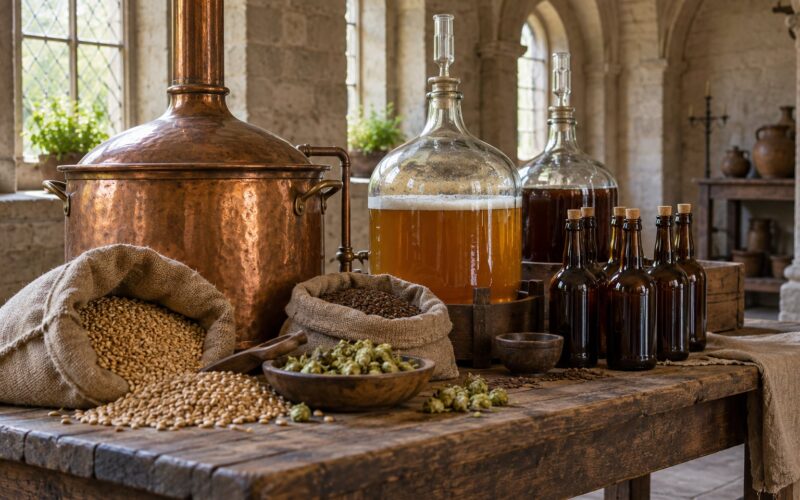
- Ingredients and quality
- Three-tier distribution is a real cost layer
- Excise tax is charged per barrel
- How Brewing Methods Affect the Final Price
- Why Taproom and Bar Prices Are Higher
- Ways to Save on Craft Beer
- Frequently Asked Questions
- Is craft beer always more expensive than domestic beer?
- Why does a craft beer taproom pint cost more than a grocery-store craft beer?
- Are expensive ingredients the main reason craft beer costs more?
- Does stronger craft beer cost more because it has more alcohol?
- Why can bottled craft beer be cheaper than a draft pour?
- Is domestic beer made with completely different ingredients from craft beer?
- Conclusion
Why Craft Beer Costs More Than Domestic at a Glance
The table below compares the usual price bands you will run into for each format, along with the single biggest reason for the gap. Read the reason column and the pattern becomes obvious fast: the more a beer passes through other people’s hands, the more of your money went to them.
| Format or type | Typical US range | Main reason for the difference |
|---|---|---|
| Domestic draft pour, 12 oz | 5 to 8 dollars | Mass production, continuous operation, no distribution layer |
| Craft draft pour, 12 oz at a bar | 8 to 14 dollars | Lower volume plus a distributor margin on the keg |
| Taproom pint, 16 oz at the brewery | 8 to 15 dollars | Direct sale keeps the distributor out, but rent and staff remain |
| Domestic six-pack, 12 oz cans | 8 to 11 dollars | Contracted ingredient pricing and near-full brewhouse capacity |
| Craft six-pack, 12 oz cans | 12 to 20 dollars | Small batch size, specialty hops, freight and retailer margin |
| Single 16 oz craft can | 6 to 10 dollars | Higher packaging cost per ounce in a larger format |
| Single 355ml craft bottle | 7 to 14 dollars | Glass, a cork or cap, and a smaller supply chain run |
| Beer flight, 3 to 4 small pours | 14 to 25 dollars | Per-pour setup cost spread across only a few ounces |
What Drives the Price Difference?
Five things account for nearly all of it. If you understand these, the price tag stops feeling arbitrary.
- Scale. A macro brewer can move millions of barrels a year and spread one brewhouse, one packaging line and one cleaning crew across all of it. A craft brewery doing a few thousand barrels pays the same fixed bills with a fraction of the volume to absorb them.
- Ingredients. Craft brewers use roughly four to ten times more hops than large domestic lager producers, and the specialty malts they buy cost more and yield less extract, so they need more grain for the same wort.
- Distribution. Most beer moves brewery to distributor to retailer to you. Each handoff takes a margin, and craft kegs are small enough that the per-keg handling charge is a bigger share of the total.
- Excise tax. Federal beer tax is charged per barrel, not on profit, so a small producer pays the same dollars-per-barrel as a giant one and recovers them across far fewer beers.
- Service and packaging. Aluminum, freight, refrigeration, keg washing and taproom staffing all land on the price of the beer you actually receive.
Why craft beer costs more than domestic, in short
If a macro brewer’s fixed costs per barrel are spread across millions of units and a craft brewery’s are spread across tens of thousands, the arithmetic does the rest. That is the entire argument in one line, and every other cost driver is a footnote on top of it.
Production and scale
Large domestic brewers run continuous high-volume operations. Fermenters get filled on a schedule, packaging lines run for weeks, and the same shift crew handles far more beer per hour than any craft brewery could match. Capacity utilization is the quiet advantage: a plant running near its rated volume pushes fixed cost down per unit, and nobody writes about it because it is invisible on the bottle.
Craft breweries run the opposite pattern. Small batch size means cleaning and setup costs get charged against fewer barrels, and equipment sits idle between runs. A regional brewery might make a few thousand barrels a year against a macro plant’s millions, so even identical machinery produces wildly different per-unit overhead. Breweries in r/beer put it plainly: the capital cost of starting and expanding a brewery is far higher than starting almost any other food or drink business.
Ingredients and quality
Hops are the headline. Domestic lager is a light, cheap hop profile, while an IPA may carry a heavy load of specialty varieties priced by the pound. The widely cited figure, from CNBC back in 2014, is that craft brewers use four to ten times more hops than regular beer companies. Treat that as a range rather than a fresh measurement, since hop prices and recipes both move.
Malt is subtler and rarely mentioned outside brewing circles. A thread on r/TheBrewery put it this way: craft malt is more expensive per pound and yields less extract, so a brewery buys more of it to hit the same target gravity. That is a hidden multiplier on the grain bill. Adjuncts like fruit, coffee, oats and lactose add more, which is one reason flavored and imperial releases sit at the top of the price range.
Where the sourcing differs too: large brewers lock in prices through contracts, while smaller breweries buy on the spot market in quantities far below a full silo. Bart Watson, chief economist of the Brewers Association, has framed exactly this gap: contracted pricing smooths commodity swings for the big players, and the little guys absorb the full swing.
Three-tier distribution is a real cost layer
Beer is regulated as a three-tier system in most US states. The brewery sells to a distributor, the distributor sells to a retailer, and only the retailer may sell to you. Each step takes a cut, and that margin is invisible on the label. On r/CraftBeer, drinkers cite distributors taking 30 to 50 dollars per keg, which on a half-barrel is a meaningful share of what the beer retails for.
Self-distribution lets some small breweries skip that layer and deliver straight to accounts or taprooms themselves, but permission depends on state law and rarely extends very far. It is also more trucks, more routing and more staff, which eats some of the savings.
Excise tax is charged per barrel
The federal beer excise tax works out to roughly seven dollars for a standard 31-gallon barrel, and states add their own rates on top. Because the tax is per barrel rather than per bottle or per dollar of profit, it does not shrink for a small brewer. A macro plant spreads those dollars across millions of barrels. A 5,000-barrel craft brewery divides the same rate by a number three orders of magnitude smaller, and each glass carries a slice of it.
How Brewing Methods Affect the Final Price
The brewing model shapes the price more than the style does. Two IPAs from two very different breweries can land on opposite ends of the menu, and a lager from a small brewery can cost more than a flagship IPA from a large one.
| Production model | Typical annual volume | How it reaches you | What it does to price |
|---|---|---|---|
| National domestic | Millions of barrels | Contracted distribution, national retailers | Lowest fixed cost per unit, thinnest margins |
| Regional craft | Tens of thousands of barrels | Regional distributor, some self-distribution | Higher fixed cost per unit, distributor margin added |
| Brewpub taproom | Small batches | Sold on site, no distributor in the middle | Lower channel cost, but rent and staff replace it |
| Limited release | One batch, sometimes under 500 cases | Bottle shop or taproom, often allocated | Fixed costs on a tiny run, scarcity pricing |
| Barrel-aged or specialty | Months to years in inventory | Taproom or bottle shop | Capital tied up for a long time, small output |
A quick way to see the fixed-cost effect: imagine a brewery’s brewhouse, fermenters and labor cost 900,000 dollars a year. Spread that across 400,000 barrels and it adds roughly 2.25 dollars per barrel. Spread the same cost across 8,000 barrels and it adds about 112 dollars per barrel before a single ingredient is bought. Barrel-aged and limited releases push it further, because the same annual overhead is carried while product sits in a barrel for a year without earning.
Style matters less than people assume. An imperial stout and a session lager from the same brewery can cost nearly the same to make, and a session pale ale from a macro-adjacent regional brewery can undercut an expensive IPA from a brewery down the street.
Why Taproom and Bar Prices Are Higher
A brewery sells beer. A taproom sells beer plus a building, a system, a staff and a cleaning regime, and the pour price has to cover all of it. Draft lines need installation and periodic servicing, glassware breaks, kegs need washing and refrigeration, and someone has to pour, clean and close every night. Rent, insurance, licenses and a nightly crew sit on top.
That is why a brewery taproom pint and a grocery store six-pack can price the same beer differently even though the production cost is identical. The taproom price is closer to a restaurant price: it bundles service and space into the liquid. Drinking a draft pour in a neighborhood bar usually carries a similar markup, plus whatever margin the bar itself keeps.
Beer flights look expensive on the ticket but are often the best per-ounce deal on a tap list. A flight gives you a few ounces of four or five beers, and the bartender sets it up once instead of pulling four full pours. When a brewery sells you a pour directly, you have removed the distributor and the retailer, but not the cost of running the room.
Ways to Save on Craft Beer
You cannot change the structural drivers, but you can change what you buy and where. These are the strategies that actually move the per-ounce number.
- Go during happy hour. Discounted pours in the late afternoon are the single biggest saving available, and they are normal practice at most taprooms rather than a promotion.
- Buy the six-pack or a case, not the single. The per-can price at a bottle shop or grocery store drops sharply once you stop paying single-unit handling twice.
- Time your brewery visits. Weekday afternoons are quiet, and quiet venues have both more taps available and more willingness to deal.
- Normalize by serving size. Before judging a price, convert everything to cost per ounce. A 16 oz can and a 12 oz pour are not comparable until you divide.
- Join the brewery mailing list. Small breweries release allocation-heavy batches to subscribers first, and that route often beats fighting a bottle shop queue.
- Order the house pour. A tap list’s own lager or pilsner is usually the cheapest option and often the best drinking beer of the night anyway.
- Take a flight instead of three full pints. If you want to taste, not consume, a flight costs less and finishes faster.
Discounts, specials and release schedules change constantly and vary by venue, so treat any specific deal as something to check rather than plan around.
Frequently Asked Questions
Is craft beer always more expensive than domestic beer?
No. Small craft breweries and limited releases usually cost more, but plenty of regional craft breweries pour and sell at or below what a domestic brand charges locally. Scale decides as much as the word craft does, so the only reliable test is to compare two specific beers per ounce at the venue or shelf where you buy.
Why does a craft beer taproom pint cost more than a grocery-store craft beer?
Because the taproom sells service and space with the beer. Rent, staff, draft system upkeep, glassware, cleaning and refrigeration all land on that one pour. Selling on site also saves the brewery a distributor margin, but the saved amount is usually smaller than the cost of running the room.
Are expensive ingredients the main reason craft beer costs more?
Not quite. Hops, specialty malts and adjuncts cost more, and craft brewers use roughly four to ten times the hops of large lager producers. But fixed costs spread across smaller batch sizes, the three-tier distribution chain and per-barrel excise tax usually add up to more of the difference than ingredients alone.
Does stronger craft beer cost more because it has more alcohol?
Alcohol itself is a cheap input, so higher proof adds only a little cost. The real expense is the extra time in the fermenter, the specialty hops and grain a stronger recipe needs, and the capital tied up while barrels or kegs sit for months. Time, not strength, is the expensive part.
Why can bottled craft beer be cheaper than a draft pour?
A bottle is made once, shipped once and sold by the unit, while a draft pour needs a line, a keg, refrigeration, cleaning and someone to serve it. Those service costs are spread across the whole session, not just one pour. Draft freshness and gas are real benefits, but they are not free to deliver.
Is domestic beer made with completely different ingredients from craft beer?
The base is nearly identical: water, malted barley, hops and yeast. The differences are in degree and choice. Domestic lagers lean on cheaper malt and light hops, while craft brewers use more hops, specialty malts and often extra ingredients like fruit, coffee or oats. Same raw materials, very different quantities and quality tiers.
Conclusion
So why craft beer costs more than domestic is not really about recipes or hype. It is fixed costs spread thin, hops and malt bought at worse terms, a distribution layer that a macro brewer largely does not need, and a tax that does not care how many barrels you make.
Start by comparing the beer format, the serving size, the venue type and the production scale behind it, all normalized to cost per ounce. Once you do that, some of the premium looks structural and unavoidable, and some of it is just an expensive pour in a room with rent. You will know which is which, and which one you feel like paying for tonight.