Here is the short version: real ale is a beer that finishes fermenting in the cask it is poured from, unfiltered and unpasteurised, served cool with gentle natural carbonation. Keg beer is a package, not a style. It is usually filtered, pasteurised, force carbonated and pushed out under gas pressure. Real ale vs keg beer explained properly means separating what is in the beer from what holds it.
The confusion is understandable. People hear real ale and assume it means stronger, richer or more old-fashioned than everything else. What it actually describes is a conditioning and serving tradition, and the container is doing most of the talking. Get that straight and the rest falls into place.
There is also an honesty problem worth naming early: a well-kept cask pint beats an average keg pint, and a badly kept cask pint loses to a fresh keg pint. Nobody who drinks this stuff regularly claims cask wins every round.
Table of Contents
- Real Ale vs Keg Beer Explained at a Glance
- What Does Real Ale Actually Mean?
- What Does Keg Beer Actually Mean?
- Ale Yeast vs Lager Yeast
- How Conditioning Changes the Beer
- How real ale vs keg beer is finished differently
- Carbonation and Serving Temperature
- Flavor, Clarity, and Freshness
- Availability, Shelf Life, and Portion Size
- Which Should You Choose?
- Frequently Asked Questions
- Can real ale be served from a keg?
- Are all keg beers filtered and pasteurized?
- Does real ale taste stronger than keg beer?
- How long does cask ale stay fresh after opening?
- Is a nitro ale the same as real ale?
- Bottom Line
Real Ale vs Keg Beer Explained at a Glance
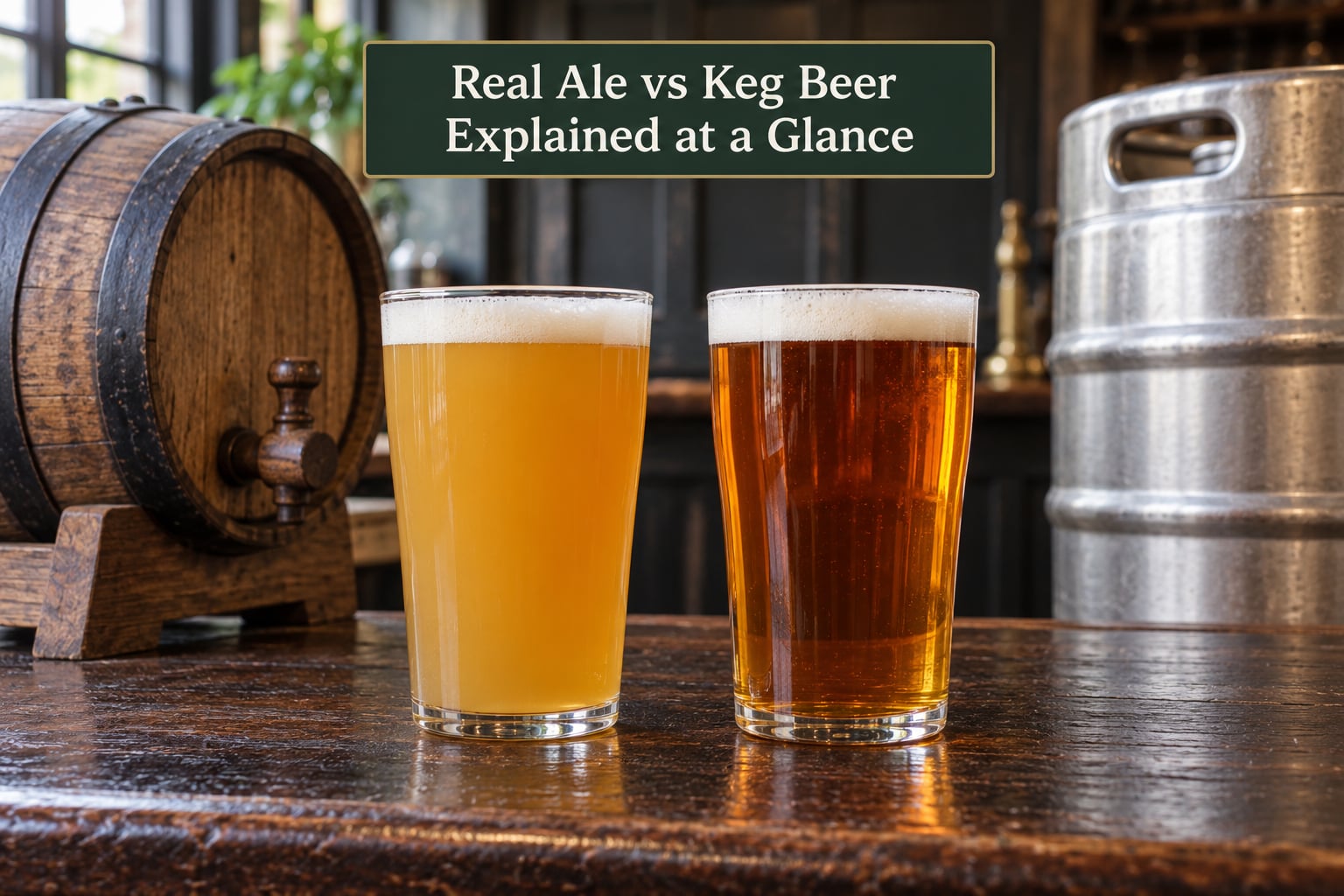
Real ale describes how a beer was conditioned and served. Keg beer describes what it came in. A keg can hold ale or lager, a sour, a stout or a lager so pale it looks like cider, which is why the comparison table below needs to compare processes rather than flavors.
| Attribute | Real ale (cask conditioned) | Keg beer |
|---|---|---|
| What it really means | A beer conditioned and served from an unlined cask | A beer packaged in a sealed steel keg |
| Yeast family | Almost always ale, fermented warm with top-fermenting yeast | Either ale or lager yeast, chosen by the brewer |
| Conditioning | Secondary fermentation finishes in the cask over days or weeks | Conditioning happens in a bright tank, then the cask is sealed |
| Carbonation method | Natural, produced by the yeast still working in the cask | Force carbonated with added gas to a set level |
| Filtration | Normally none | Usually centrifuge or microfiltered for stability |
| Pasteurisation | Never | Almost always, to halt any remaining activity |
| Dispense | Hand pump or gravity, no gas pressure behind the beer | CO2 tap and coupler, pushed by a cylinder |
| Serving temperature | Cellar cool, roughly 45 to 50 Fahrenheit | Colder, often 38 to 45 Fahrenheit for lager |
| Clarity | Often hazy, with a faint yeast layer at the bottom | Bright and clear |
| Shelf life once tapped | Best within a few days, gone in well under a month | Weeks, provided the line and gas are right |
| Pour consistency | Varies through the cask as it empties | Repeatable, same pressure and pour every time |
| Typical character | Soft carbonation, fuller texture, more yeast-driven aroma | Sharper bubbles, crisper finish, very repeatable |
| Where you find it | Traditional cask pubs, some taprooms, festivals | Almost every bar, taproom, restaurant and stadium |
What Does Real Ale Actually Mean?
Real ale is beer made with top-fermenting ale yeast, racked into an unlined cask where it finishes conditioning, served without gas pressure, and never pasteurised. It is usually left unfiltered too, which is why live yeast is still present when it reaches you.
Three parts of that definition do the real work. Conditioning in the cask is what produces the flavor and the carbonation. Leaving it unfiltered and unpasteurised is what keeps the beer alive. Dispensing by hand pump or gravity instead of a gas cylinder is what separates the tradition from modern draught systems.
The term says nothing about strength. A 3.5 percent mild and a 6 percent barley wine can both be real ale. It also says nothing about age. Modern cask beer is brewed, chilled, delivered and tapped inside a couple of weeks, and a lot of it tastes fresher than much bottled beer.
One nuance that trips people up: most cask ale now sits behind hand pumps, which look like small metal levers on the bar. Underneath, many of those pumps do use a blank cask and a low line pressure. Pressurized cask service exists and is legal, so the rigid old phrase about no gas whatsoever is not quite the whole story any more.
What Does Keg Beer Actually Mean?
A keg is a sealed stainless steel container. It says nothing about the beer inside. The standard beer keg holds around 15.5 gallons in the US, a common European half-barrel holds about 30 liters, and a sixth barrel is the small format many taprooms use for rotating guest beer.
What makes the contents keg beer is the process. Most breweries centrifuge or microfilter the beer to strip out yeast and sediment, pasteurise it to make sure nothing is left alive, then force carbonate it in a conditioning tank with a controlled amount of gas.
Because yeast has been removed, the beer cannot change after it is sealed. It keeps, pours consistently and tastes the same on the hundredth pint as on the first. That reliability is exactly why keg overtook cask in British pubs during the 1960s and 1970s, and why almost every taproom in the US has never seriously considered going back.
Old style keg and modern draught are not the same thing either. A traditional CO2 pressed keg pushes sharp bubbles. A modern draught system mixes nitrogen into the gas, and that widget settles the beer into a creamy cascade with a very fine head. People sometimes call that smoothflow.
Ale Yeast vs Lager Yeast
Ales use Saccharomyces cerevisiae, which sits on the surface of the wort and works at warmer temperatures. Lagers use Saccharomyces pastorianus, which ferments cooler and slower, giving a cleaner profile. That much is settled chemistry, and it is unrelated to the cask and keg question.
Where it bleeds into the cask debate is flavor. Ale yeast tends to produce esters and other compounds that read as fruity, spicy or bready, and those aromas develop further during the extra conditioning time a cask ale gets. A lager yeast fermented cool, conditioned for a short time and force carbonated will taste crisper, which some drinkers read as cleaner.
But the assumption that every real ale is yeastier than every keg beer does not hold. There are force carbonated ales full of hop aroma and cask lagers that taste like nothing much at all. Container tells you less about yeast than the yeast family ever does.
How Conditioning Changes the Beer
Cask conditioning and keg conditioning are two different finishing steps, and the difference between them is the difference between a beer that is still finishing and a beer that has already stopped.
How real ale vs keg beer is finished differently
For cask beer, the brewery racks beer from the main fermenter into the cask with a small amount of yeast still in it. The cask sits in a cellar for days or weeks, and the yeast keeps working. It ferments a little more sugar, drops a little protein through, and produces a little carbon dioxide that dissolves into the beer naturally.
For keg beer, the same beer finishes in a stainless tank. It is bright, it is dosed with gas to a target level, and it is sealed. Once it goes through the coupler, the only thing that changes in the glass is pressure.
That is where clarity and sediment come from. Bright beer has had the yeast taken out, so it pours clean and stays clean. Cask beer is not clear and not meant to be. Yeast settles as a thin layer at the bottom of the cask, which is why a cask ale is a cloudy amber in the first pint and often clearer near the end. The yeast is not automatically visible in every serving, and some breweries add finings to drop it faster, which reduces but does not eliminate sediment.
Carbonation and Serving Temperature
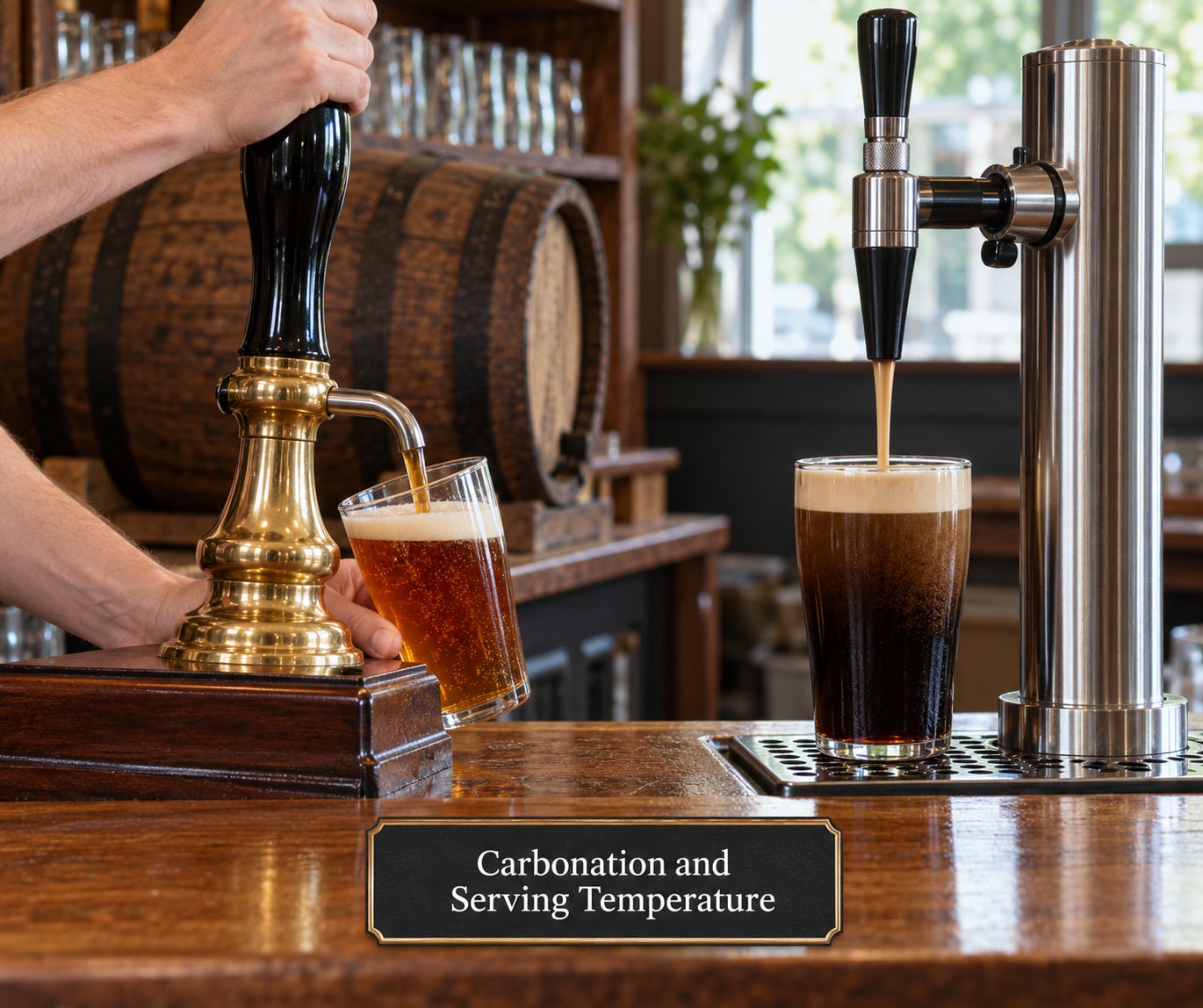
Carbonation is where the two formats diverge most on the tongue. Keg beer gets an even, aggressive push of gas that prickles the palate and tightens the finish. Cask ale arrives with a gentler tingle and a softer, rounder mouthfeel, because the gas came from the yeast rather than a cylinder.
Temperature follows the same logic. Real ale is served cellar cool, somewhere around 45 to 50 Fahrenheit, because pushing it colder dulls the esters that the cask conditioning built up. Keg beer tolerates and often wants a colder pour, particularly lager, where the crispness matters more than the nuance.
Serve cask ale from a hand pump or from gravity through a simple spigot, both of which give you a controlled, gentle pour. Serve keg beer through a coupler with gas pressure behind it, watching the pour rate and the line temperature. A nitrogen widget works on both a keg and, in some setups, a cask, and it produces the creamy look drinkers now expect from stout and pale lager.
A cask cannot safely be treated like a standard keg. Seal it under brewery gas and you are force carbonating a beer that is still fermenting, which pushes yeast and sediment into suspension and gives you a cloudy pint with a harsh edge. Modern blank cask systems solve the dispense problem without breaking the beer.
Flavor, Clarity, and Freshness
The honest answer about taste is that processing choices matter more than the package alone. A well-made, freshly poured cask bitter has more going on than a filtered keg bitter of the same age. A hazy pale ale poured from a keg two weeks after packaging can be more expressive than a cask version that sat for nine days and went tired.
Drinkers notice the difference as texture as much as flavor. One regular described cask as a gentle tongue tingle, with kegs adding an extra push. Another observed that halfway down the glass the two formats converge, because it is the same beer either way.
Freshness is the quiet variable. Cask beer has a short peak window. Once tapped, most pubs sell through it in days, because it moves. Keg beer is packaged against time, which is precisely why it exists in the modern taproom. Neither one is inherently fresher. They are fresh on different clocks.
Availability, Shelf Life, and Portion Size
Availability is where the comparison stops being close. A taproom might run a hundred or more keg lines and maybe two cask ales a week, and one of those casks may be gone by Thursday. UK pubs that serve cask keep hand pumps on the bar because the beer rotates rather than sits. Finding real ale in the US usually means asking, and asking means finding a place that actually has it.
Cask sizes are named, which is where most of the jargon comes from. A pin holds about 4.5 gallons, a firkin 9, a kilderkin 18, a barrel 36, and a butt or hogshead 54 gallons. A stillage is the stand that holds the cask so it can be tilted into position. A spile is the peg in the bung hole used to let air in, a shrive is the hole cut through the cask wall below it, and the keystone is the lever that pulls the shrive open to let beer flow by gravity. The ullage is what is left in the cask when it is empty.
Keg beer holds its quality for weeks rather than days, which lets a pub run one line reliably and lets a distributor plan around it. It is a storage format before it is a flavor format.
Two practical notes on both. A draft line still needs regular cleaning and correct temperature whatever is going through it. And cask beer needs real cellar discipline, because the failure modes are real: vinegar-like sourness when acetobacter gets in, cardboard papery solids from bad yeast management, and plain flatness from an exhausted cask. If a pint is bad, tell the person behind the bar. They would rather replace it than have you assume the whole category is overrated.
Which Should You Choose?
Choose traditional real ale if you want expressive yeast character, soft carbonation, unfiltered texture and the experience of drinking a beer that is still quietly finishing. It suits drinkers who enjoy bitters, milds, golden ales, porters and traditional stouts, and who like the idea that the beer on tap changes every week or two.
Choose keg beer if you want consistency, wide availability, larger and more reliable pours, longer storage life and a bigger selection. Hop-forward high strength pale ales and IPAs generally handle force carbonation well. A four percent session bitter through a keg, in the view of regulars, simply does not work, and it is a fair complaint.
There are hybrids, and they are where most modern drinking sits. Cask ale served under low pressure gives you a cask beer with a firmer pour. Nitro and smoothflow ale gives you the creamy head and gentle nitrogen cascade people expect from a stout. Bottled and canned ales give you cask-style character wherever you want it, and bottle-conditioned ale, sometimes labelled RAIB, is a genuinely live product that is not cask conditioned.
Frequently Asked Questions
Can real ale be served from a keg?
A cask-conditioned beer can be poured from a sealed cask fitted with a blank, low pressure line, and plenty of modern cask ale is served that way. What it cannot be is force carbonated, because the yeast is still active and added gas would push sediment into suspension and flatten the aroma. So a keg of beer cannot be real ale unless what is in that keg is cask conditioned and dispensed without brewery gas.
Are all keg beers filtered and pasteurized?
Most are, but not all. A small number of breweries package unfiltered, unpasteurised beer into kegs and use centrifuge or membrane filtration only to remove coarse solids. That beer can stay live in the keg. The difference is that it lacks the controlled, repeatable result most taprooms want, and it has a much shorter usable life once tapped, which is why it is the exception rather than the norm.
Does real ale taste stronger than keg beer?
Not as a rule. Strength is set at the brewhouse and has nothing to do with the container. What changes is perception. Keg beer arrives cold with sharper bubbles and a tighter finish, which many people read as more intense. Cask ale is warmer and softer, so a 4.2 percent bitter can taste fuller than a 5 percent keg version of something lighter in body. Compare the ABV on the pump clip, not the glass.
How long does cask ale stay fresh after opening?
A cask is at its best in its first few days and most pubs sell through it well before that window closes. Once a cask is tapped and exposed to the cellar it can start to lose its charge within a day or two, and by the last few pints it is usually tired. Nobody keeps a cask around for a fortnight. If a cask has been on more than a few days, treat the pint as a bonus rather than the reason to visit.
Is a nitro ale the same as real ale?
No. A nitro ale is a keg beer served through a nitrogen widget, so the beer has usually been filtered, pasteurised and force carbonated, then nitrogen is added at the tap to create the cascading head and creamy mouthfeel. Real ale means cask conditioned, unfiltered, unpasteurised and served without brewery gas. The two can be enjoyed in the same session and they feel very different, but only one of them is real ale.
Bottom Line
Real ale and keg beer are not rival categories. Real ale is a conditioning and serving tradition, keg beer is a package, and a keg can hold either an ale or a lager. That is the whole of real ale vs keg beer explained: the beer decides, not the container.
So when you order, ask what the beer actually is before you ask what it came in. Is it cask conditioned, force carbonated, nitro, filtered or unfiltered? That one question settles the flavor, the temperature, the shelf life and whether you are drinking something that is still alive.