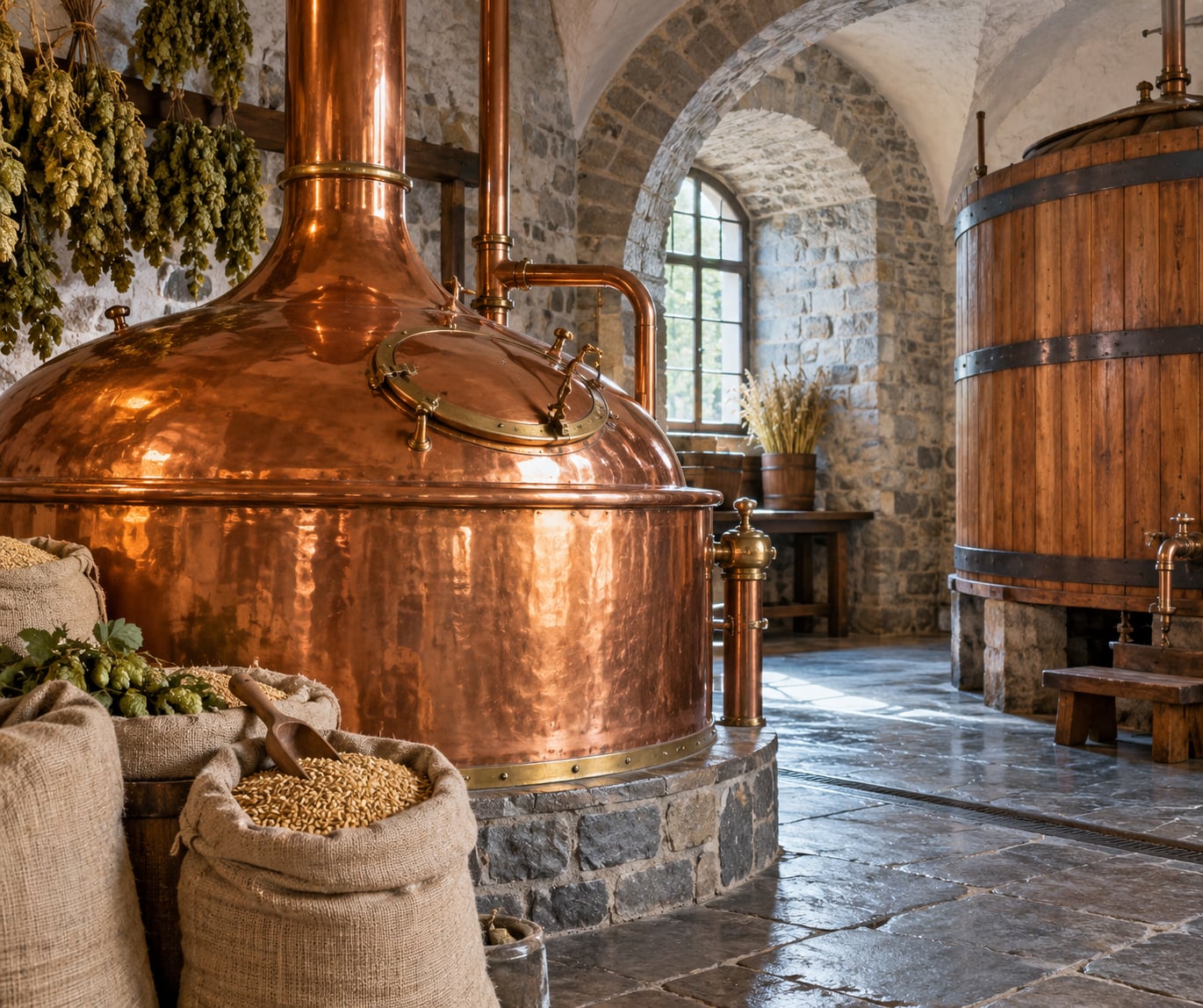
The German beer purity law, better known as the Reinheitsgebot, is a 1516 Bavarian decree that limited what could go into beer and, just as importantly, set rules for how it could be priced and sold. Understanding how German beer purity law shaped beer means separating that narrow original rule from the myths that grew around it, and from the legal fights that eventually dismantled it.
Most people learn the story backwards. They hear “three ingredients” and picture a health inspector locking the larder. What the 1516 text actually did was reserve grain for bakers, standardize a brewing vocabulary, and hand Bavaria a marketing phrase it still uses five centuries later.
Table of Contents
- What Was the German Beer Purity Law?
- Why Bavaria, and not all of Germany?
- How German Beer Purity Law Shaped Beer Over Time
- How German Beer Purity Law Shaped Beer Brewing
- Why the Purity Law Helped Define Lager Beer
- Did the Law Create Every German Beer Style?
- What Exceptions and Loopholes Reveal About the Law
- What Is the Purity Law’s Legacy Today?
- Frequently Asked Questions
- Did the German beer purity law cover all beer in Germany?
- Was the Reinheitsgebot originally a law for every German brewery?
- Why is lager yeast important to the German beer purity law?
- Did the purity law ban wheat beer?
- Can spices and other ingredients be used in German beer?
- Is the German beer purity law still enforced today?
- Conclusion
What Was the German Beer Purity Law?
The purity law was proclaimed in Ingolstadt in 1516 by Duke Wilhelm IV of Bavaria. It applied to beer brewed and sold in the Duchy of Munich, later the Duchy of Bavaria — not to all of Germany, which did not exist as a state yet.
Three points get tangled together constantly, so here they are in plain order.
- The date and place. April 1516, Ingolstadt, issued by Duke Wilhelm IV.
- The original ingredient rule. Barley, hops and water. Yeast joined later, once brewers understood what was fermenting their wort.
- The name. The law itself was called the Substitutionsverbot — the prohibition on substitutes. The word Reinheitsgebot, meaning “purity decree”, only became common around the First World War, roughly four hundred years later.
The purpose was not primarily food safety. Grain reserves were the real prize: keeping wheat out of beer left it available and affordable for bakers, who depended on it. The decree also fixed who could sell beer, on what terms, and who paid the tax.
Why Bavaria, and not all of Germany?
Bavaria’s rulers had a specific local problem. Beer was already a staple drink there, brewed everywhere from tiny farm operations to monastery cellars, and the duchy taxed it hard. A clear rule made collection easier and stopped brewers from undercutting each other with cheaper substitutes. Elsewhere in the Holy Roman Empire, brewing customs varied so much that no single rule made sense.
How German Beer Purity Law Shaped Beer Over Time
The law survived because it kept being reinterpreted, and each reinterpretation loosened it a little. This table is the fastest way to see how German beer purity law shaped beer over five hundred years.
| Year | Event | What changed |
|---|---|---|
| 1156 | Augsburg statute under Emperor Frederick Barbarossa | Early precedent allowing only domestic ale in some towns |
| 1487 | Duchy of Munich rule | Tighter restrictions on who could brew and sell |
| 1516 | Ingolstadt proclamation, Duke Wilhelm IV | Barley, hops, water only; brewing and pricing rules; grain reserved away from beer |
| 17th century | Yeast recognised as an ingredient | Added to the permitted list after van Leeuwenhoek and later Pasteur explained fermentation |
| 1906 | Imperial Act under Kaiser Wilhelm II | The rule becomes national German law |
| 1915–1918 | Beer tax debate during the First World War | The term Reinheitsgebot enters everyday use |
| 1987 | European Court of Justice judgment | Germany can no longer use the law to block imported beer |
| 2005 | German court ruling | Non-compliant products allowed if they are not labelled “beer” |
| 2015 | Bavarian brewers vote on natural ingredients | Interest in returning to fully natural raw materials |
The 1906 step matters more than most write-ups admit. Until then this was a regional Bavarian rule, and confusing 1516 with 1906 is the single most common error in English-language coverage.
How German Beer Purity Law Shaped Beer Brewing
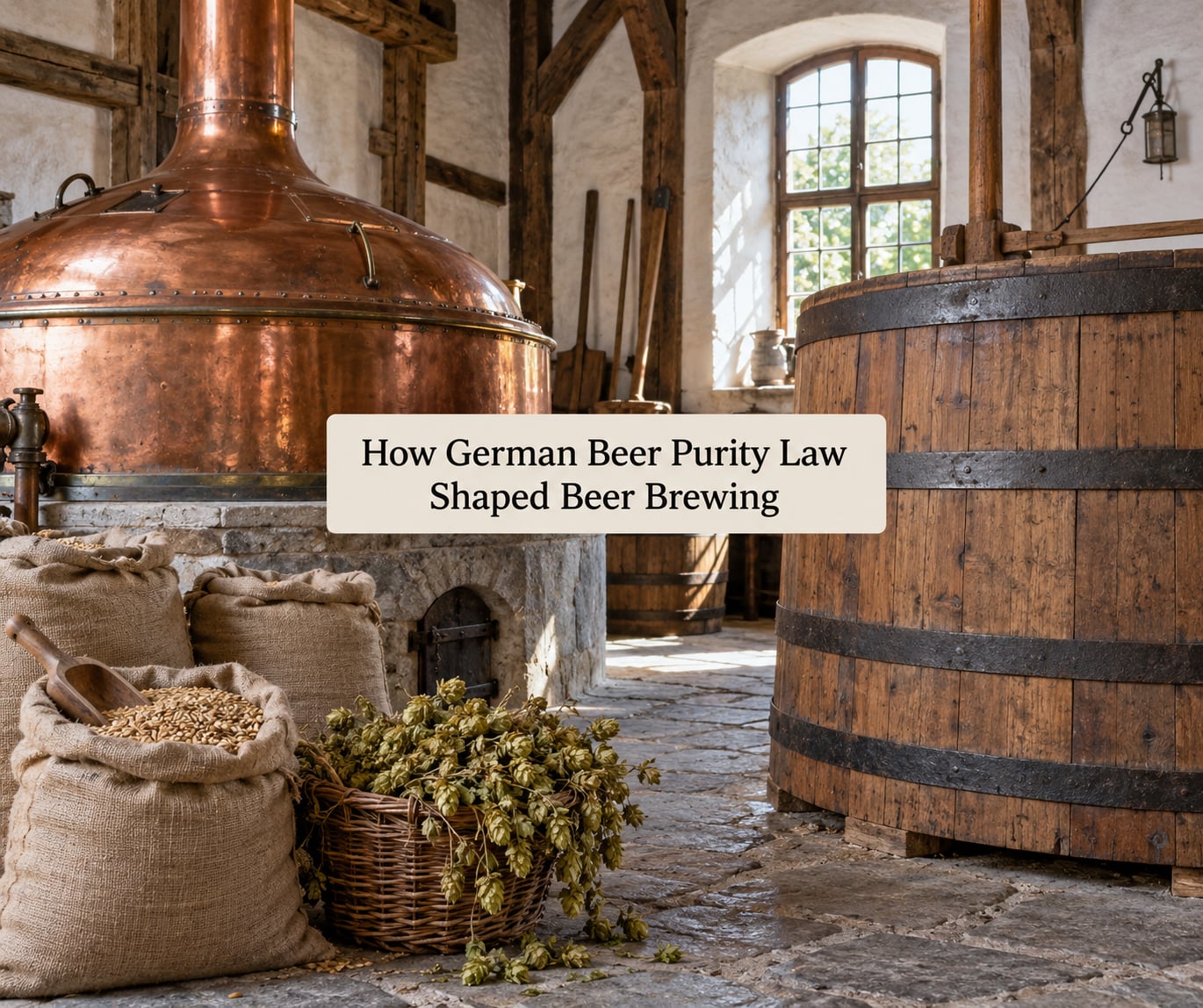
The clearest effect was on the malt bill. With wheat and rye off the table, brewers worked the same raw material for centuries, and they got very good at it. That is where the emphasis on hop varieties, kilning, and mash profiles comes from — not from a rule about hops, but from a rule about grain.
Water was never regulated by quality. German brewing regions became famous for their water profiles, and brewers shaped their yeast and fermentation practice to suit what came out of the ground.
Yeast is the odd one out. The 1516 law did not forbid yeast; it simply did not know yeast existed. Airborne yeast from nearby bakeries was already getting into wort and doing the work. Once microscopy and Pasteur’s research explained fermentation, brewers had to name it, and the permitted list grew to four.
Economically, the decree attached brewing rights to places and people, and tied sale price to the beer tax. That gave large breweries a protected home market and made small operations serve locally. The stability is often credited as the foundation of Germany’s brewery survival rate.
Why the Purity Law Helped Define Lager Beer
Fix the inputs and the brewers get better at everything else. With no new ingredients to discover, attention went to fermentation temperature, yeast strain handling, and maturation time — exactly the variables that separate lager from ale.
Cold fermentation in Bavaria’s cellars, often near alpine cold sources, combined with bottom-fermenting yeast and weeks of lagering, produced a beer that travelled better than anything brewed with top fermentation. When Bavarian techniques spread through Bohemia, the Netherlands and then the rest of Europe, the lager family grew out of that production discipline.
Randy Mosher, who has written more about brewing history than most working brewers, argues the trade went both ways: the lager style that dominates the world today is largely a German export, and its clean fermentation profile was exactly what a rule limiting recipe novelty pushed brewers to perfect.
Did the Law Create Every German Beer Style?
No, and any article that says yes is overselling it. Pilsner is a Bohemian story driven by local soft water, pale malt and Saaz hops. Altbier and Kölsch come from the Rhineland and Cologne with their own top-fermentation cultures. Doppelbock grew out of monastic brewing in Franconia, where lean Lenten weeks made strong bocks a sensible target.
Climate mattered. Bavarian winters made cold storage cheap; the North Sea and Rhine trade moved hops and malt. Taxation shaped which styles could survive commercially. What the purity law contributed was a stable frame around all of that, not the styles themselves.
| Style | Grain | Standing under the original rule |
|---|---|---|
| Pilsner | Barley | Inside the rule |
| Helles, Märzen, Dunkel | Barley | Inside the rule |
| Doppelbock, Bock | Barley | Inside the rule |
| Schwarzbier | Barley | Inside the rule — dark does not mean wheat |
| Hefeweizen, Weizenbock | Wheat | The famous exception, brewed at scale and sold everywhere |
| Altbier, Kölsch | Barley, sometimes wheat | Regional top-fermented styles sold freely |
What Exceptions and Loopholes Reveal About the Law
The gaps in the law tell you where it never applied. Wheat beer is the loudest: Weizenbier sits outside the letter of the 1516 rule, and wheat beers account for a substantial share of Bavarian beer sales today. Nothing about purity stopped that.
Enforcement was never uniform either. Regional top-fermented beers were sold openly for centuries, which suggests the rule functioned more like a marketing boundary than a recipe police force. Brewers have always joked that a distilled or hop-bumped batch is still Reinheitsgebot-conforming, ergo still beer — enthusiasts treat the name as a label question, not a chemistry exam.
The 2005 court ruling formalised that instinct. Non-compliant beer may now be produced and sold in Germany as long as it is not called “beer” — the workaround covers everything from flavoured malt drinks to coffee-infused stouts.
What Is the Purity Law’s Legacy Today?
For beer drinkers, the legacy is a promise on the label. Reinheitsgebot beer carries EU protected traditional food status, so a brewer claiming the designation is asserting a recipe and a method, not a marketing mood.
For brewers, the counterweight to “Germany can’t innovate” is worth hearing. The German Brewers’ Association points to roughly 100 hop varieties, around 40 malt types and more than 200 yeast strains in commercial use, and a craft sector of well over a thousand breweries. A narrow base makes for a wide range of finished beers when the yeast and the water change.
The other legacy is the argument. Beer writers like Greg Koch have said quality exists on both sides of the line and cheap beer exists on both sides too. German brewers, pressed privately, call the law a nuisance while defending it in public — a contradiction that says more about the law’s usefulness as a brand than about its strictness.
Frequently Asked Questions
Did the German beer purity law cover all beer in Germany?
No. The 1516 decree applied only to beer brewed and sold in the Bavarian duchy, and it reached national German law only in 1906 through an Imperial Act. Even then, wheat beers and regional top-fermented styles like Altbier and Koelsch never fully sat inside the rule, and a 2005 court ruling allowed non-compliant products to be sold as long as they were not labelled beer.
Was the Reinheitsgebot originally a law for every German brewery?
It was a Bavarian local rule, not a national standard. Duke Wilhelm IV issued it in Ingolstadt in 1516 for the duchy alone, and it was as much a baker-protection measure as a brewing rule, keeping wheat out of beer so it stayed available for bread. It only became a nationwide German statute in 1906.
Why is lager yeast important to the German beer purity law?
Fixing the grain bill left brewers with one raw material and pushed their skill into fermentation. Bottom-fermenting yeast, cold cellars and long lagering became the craft worth mastering, and the resulting clean, stable style travelled far better than top-fermented beer. That production discipline is a large part of why lager is the world’s dominant beer family.
Did the purity law ban wheat beer?
Technically it excluded wheat malt from beer, which is why Hefeweizen and Weizenbock are treated as the famous exception rather than proof of the rule. In practice enforcement lagged: wheat beer was brewed and sold in Bavaria for centuries, and wheat beers now make up a large share of Bavarian beer sales. Anyone claiming dark German beers are outside the law because of colour is wrong — dunkel and schwarzbier are barley beers.
Can spices and other ingredients be used in German beer?
Not in beer sold as Reinheitsgebot-compliant. Permitted inputs are water, barley malt, hops and, since the seventeenth century, yeast. Wheat, rye, corn, rice, sugar, spices, fruit, coffee and cocoa all fall outside the designation, and a 2005 court ruling permits products using them as long as they are not labelled beer.
Is the German beer purity law still enforced today?
In three layers, and the answer depends on which one you mean. The 1906 statute still governs what may be sold as beer in Germany, the 1987 European Court of Justice judgment stopped Germany using it to block imports, and the 2005 ruling allows non-compliant products under other names. Separately, the EU protects Reinheitsgebot beer as a traditional foodstuff, so the designation itself carries legal weight on labels.
Conclusion
The purity law mattered less as an ingredient ban than as a set of decisions that stayed useful: grain reserved for bakers, a brewing vocabulary written down, and a label German brewers could still hang their reputation on five hundred years later.
It did not invent pilsner, altbier or bock. It did push brewing skill toward fermentation and lagering, which is a fair share of why German lager techniques ended up defining beer worldwide.
If you want to taste the difference it makes, start with a Helles from Munich next to a Weizenbier from the same city. One is the rule taken seriously. One is the exception taken just as seriously.