How fruit is added to beer comes down to one decision: which of five points in the brewing process you add it at. Fruit goes into the mash, the boil, primary fermentation, secondary fermentation, or straight into the finished beer in the keg. The stage you pick decides whether you get bright, fresh aroma or a dull cooked jam flavour, and it decides whether leftover sugar blows up your bottles.
Most homebrewers land on secondary fermentation, usually a week or two after primary. That is the sweet spot for aroma retention without wrecking the body of the beer. This guide covers all five methods, how much fruit to use, how to make fresh fruit safe, and what to do when things go wrong.
Table of Contents
- What Happens When Fruit Is Added to Beer?
- How Fruit Is Added to Beer at Each Brewing Stage
- Which Brewing Stage Is Best for Different Fruit?
- Adding fruit in the boil
- Adding fruit during primary fermentation
- Adding fruit after fermentation
- Adding fruit at serving time
- How Fresh Fruit and Dried Fruit Behave Differently
- How Much Fruit Should You Add?
- How Fruit Sugar and Acidity Change Beer
- How to avoid a bottle bomb
- How to Prepare Fruit Without Spoiling the Batch
- Which Beer Styles Work Best with Fruit?
- Common Problems When Brewing with Fruit
- Frequently Asked Questions
- When is the best time to add fruit to beer?
- Should I use fresh fruit or frozen fruit when brewing beer?
- Can I add fruit after fermentation is complete?
- How can I prevent fruit from spoiling the beer?
- What fruit is easiest for a homebrewer to start with?
- Conclusion: Start with One Fruit Addition
What Happens When Fruit Is Added to Beer?
Fruit does four jobs in the fermenter at once. It contributes volatile aroma compounds, it carries fermentable sugar, it brings colour and body, and in some cases it brings acid. The volatile part is the fragile one, and heat destroys it.
Fresh raspberry aroma sits almost entirely in the skin and the cells just beneath it. Boil raspberries for an hour and you get cooked, sweet, jam-like flavour with nothing fresh behind it. The same fruit dropped into a clean secondary retains that top note through packaging.
Sugar changes the beer in a less romantic way. A pound of ripe mango carries a meaningful amount of fermentable sugar, and yeast will happily eat it. That raises gravity, raises final alcohol, and fills out mouthfeel. It also means the beer is not finished when you think it is.
That last point drives most of the bad fruit-beer stories. Fruit sugar that never fully ferments keeps a reference alive in the package, and a bottle is not a pressure vessel you built for that.
How Fruit Is Added to Beer at Each Brewing Stage
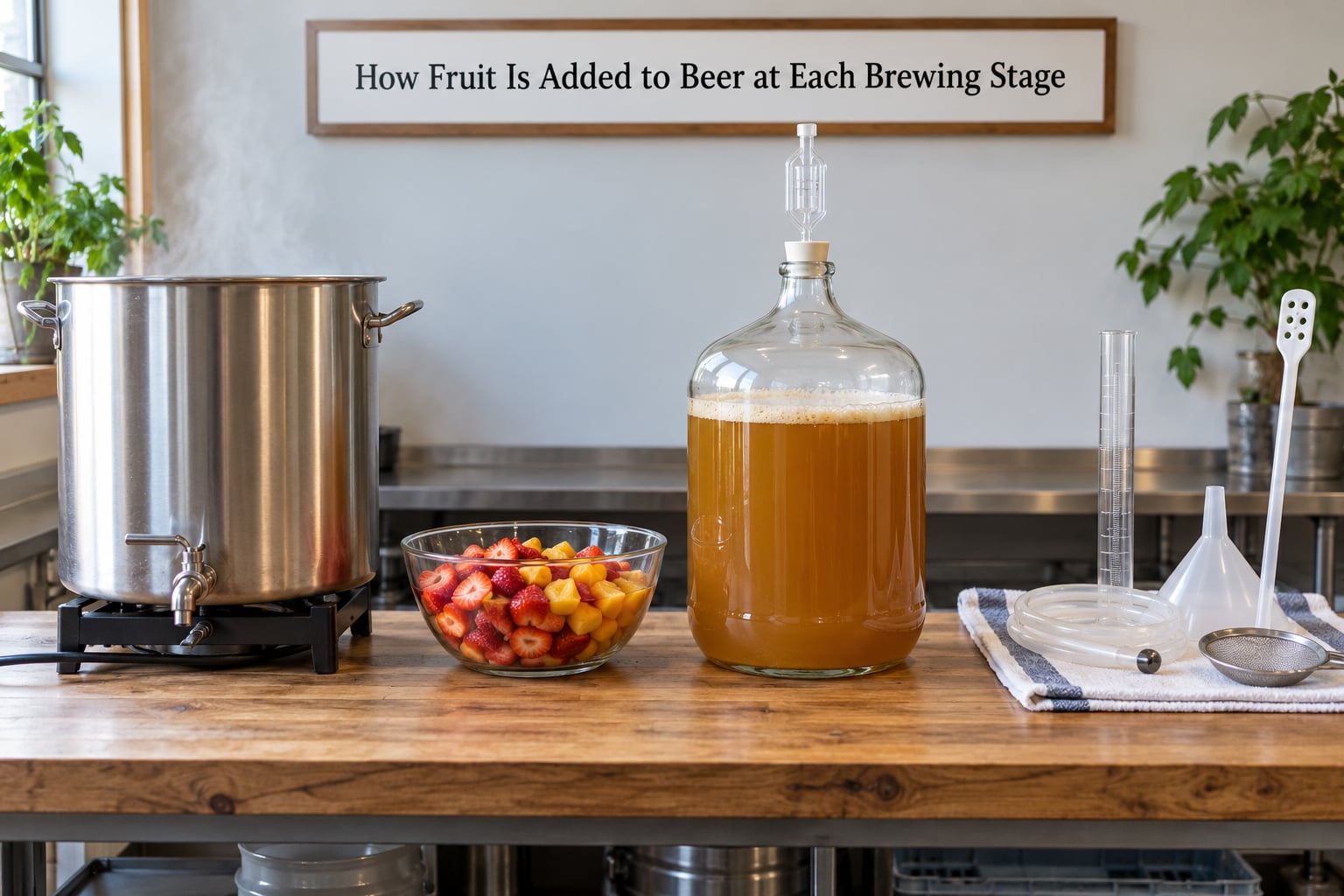
Five addition points, five very different beers. Here is the whole map in one place.
| Addition point | Flavour retention | Contamination risk | Best suited to |
|---|---|---|---|
| Mash | Very low, almost all aroma driven off | Moderate, fruit sits in hot liquid for hours | Fermentation support in historical or adjunct-heavy ales, not flavour |
| Boil, last 10-15 minutes | Low, cooked character | Low, heat kills wild organisms | Dark, caramelised fruit notes in stouts and Belgian styles |
| Primary, high krausen | Medium, integrated and fermented | Moderate, fruit sits in active beer | Fruit that should taste like part of the beer, not a garnish |
| Secondary, 3-14 days | High, fresh aroma survives | Low to moderate, easier to control | Berries, stone fruit, tropical fruit, almost everything else |
| Post-fermentation in the keg | Highest, fruit barely ferments | Lowest if the beer is stabilised first | Aroma bombs, smoothies and slushy styles, non-alcoholic fruit beer |
The general rule most brewers land on is simple: the later you add it, the more of the original fruit you keep.
Which Brewing Stage Is Best for Different Fruit?
Adding fruit in the boil
Boil additions exist mostly for tradition and for body. Fruit in the last 15 minutes of the boil contributes sugars and a cooked, jam-like note that suits porters, stouts, old ales and Belgian styles where that profile already belongs. Berries added this way taste like preserves. Citrus peel added at the end of the boil gives a gentler, less raw bitterness than dry hopping the same peel.
Adding fruit during primary fermentation
Adding fruit during high krausen means the yeast is active, healthy and plentiful, so the sugar disappears quickly and the fruit character reads as integrated rather than layered on top. HomebrewTalk regulars describe 7 to 14 days as the range that finishes the job and pulls real extraction out of the fruit. The cost is aroma, because fermentation strips the most volatile compounds, and a longer total fermentation time.
Adding fruit after fermentation
Secondary is where most fruit beers are made. Fermentation is basically finished, so the yeast population is small and slower, and it eats the fruit sugars without stripping the top notes. The Brulosophy split-batch trials found the airlock resumed activity for two to three days after puree was added to beer already at terminal gravity, which is exactly the behaviour you are relying on here. Watch gravity until it stops moving for three days before you package.
Adding fruit at serving time
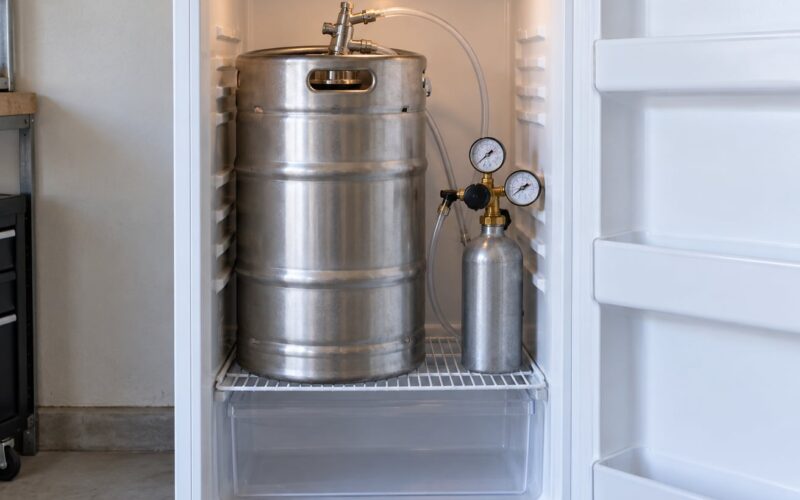
Keg additions at the end give you the freshest aroma of any method, because the fruit barely touches the yeast at all. The tradeoff is that sugar in a sealed keg produces a lot of pressure and foamy pour-offs. Stabilise first, add the fruit in a mesh bag, and refrigerate. This is the standard commercial method for smoothie and slushy beers.
How Fresh Fruit and Dried Fruit Behave Differently
Form matters as much as timing. The same raspberry arrives as a berry, a frozen berry, a purée, a concentrate, dried fruit or an extract, and each behaves differently in the fermenter.
Fresh fruit carries the most aroma but also whatever lives on its skin, which is why it needs a sanitation step. Frozen fruit has broken cell walls, so it releases juice and colour faster and mashes into a slurry easily, but freezing costs you some of the volatile top notes. HomebrewTalk users run 6 to 8 lb per five-gallon batch of fresh fruit, frozen, thawed, then pureed with a cup of vodka in the blender to keep the slurry workable and add a small measure of preservative effect.
Purée from an aseptic pouch is the cleanest option and the most consistent. Nothing to sanitise, no wild yeast risk, and the flavour arrives at full strength, so you use less of it. Many brewers blend a pouch of purée with fresh or frozen fruit to get both intensity and some authentic fruit character. Concentrate is purée with water removed, which means more sugar per pound and a heavier body, and it will stick and scorch if you boil it hard.
Dried fruit is concentrated fruit. Unsulfured dried cherries, apricots and raisins bring intense cooked-flavour and body, and they are already pasteurised by the drying process. They overdo it fast, so start with about half the fresh-fruit weight. Freeze-dried fruit keeps more character than dried because it is dried from frozen, at a higher cost. Fruit extracts and natural flavours give aroma with none of the sugar, which makes them useful when you want a smoothie beer that stays thin and stable.
How Much Fruit Should You Add?
For a five-gallon batch, most brewers land between 1 and 3 lb of fresh fruit per gallon, so 5 to 15 lb for the batch. Harder-to-capture fruit needs more; soft, aromatic fruit needs less.
| Fruit | Per gallon | Per 5-gallon batch | Notes |
|---|---|---|---|
| Raspberry | 1-2 lb | 5-10 lb | Very aromatic, degrades fast, use earlier if the beer is pale |
| Strawberry | 1-3 lb | 5-15 lb | Widely used frozen, works well blended with purée |
| Cherry | 2-3 lb | 10-15 lb | Pit fresh fruit, kernels add bitterness |
| Peach or apricot | 2-3 lb | 10-15 lb | Peel is fine, pit and stone, freeze-softens the flesh |
| Mango | 2-4 lb | 10-20 lb | Frozen mango chunks are the easiest route |
| Dried orange peel | 2-4 oz | 10-20 oz | Bitter by default, add late, keep the quantity low |
| Dried cherries or raisins | 0.75-1 lb | 4-5 lb | Use about half the fresh weight, they are intense |
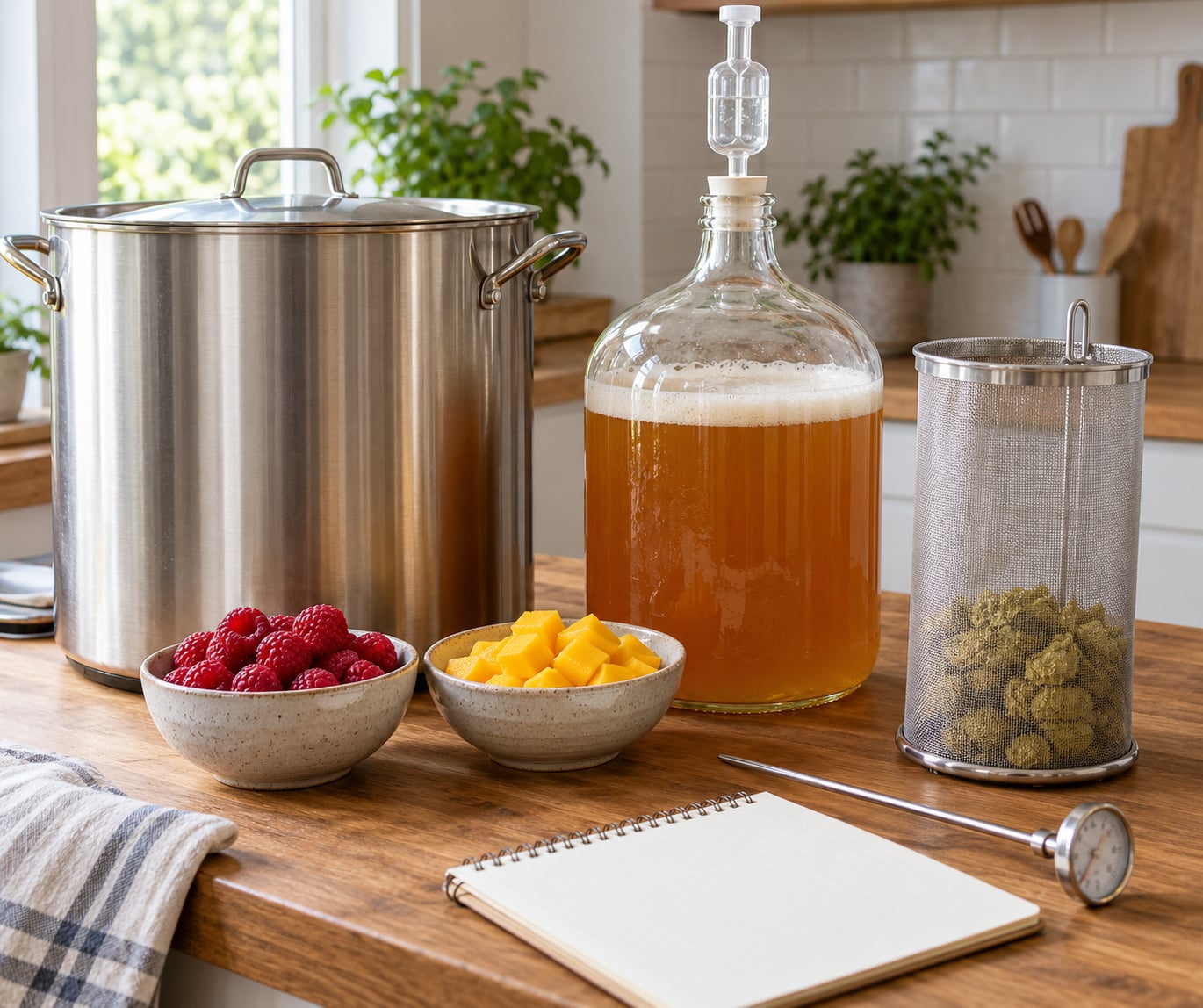
Exact quantities matter less than writing them down. Once you find a fruit and a stage you like, record the weight, the timing, the day and the finished gravity, and the next batch becomes a repeat rather than a guess.
How Fruit Sugar and Acidity Change Beer
Fruit behaves in two opposite directions at once, and that is where a lot of confusion comes from. Sugar adds alcohol and body. Acid adds tartness, and tartness cuts the perception of sweetness and makes a beer drink lighter than it is.
| Addition | What changes | What it does not change |
|---|---|---|
| Fermentable fruit sugar | Higher final gravity, slightly higher alcohol, fuller mouthfeel | Nothing about aroma, which is lost to heat and CO2 |
| Acidity from fruit or added acid | Sharper finish, more drinkability in a heavy beer | Alcohol level |
| Pectin and pulp | Haze, sometimes a silky mouthfeel | Fermentation, though haze can survive a cold crash |
| Unfermented sugar at packaging | Refermentation, over-carbonation, gushing | Flavour, which is already where it will be |
That first row has a subtlety worth knowing. Add juice to a 1.070 IPA and the finished beer can come out slightly lower in alcohol than the base would have been, because the added liquid dilutes the original gravity even as the sugar ferments. Add the same juice to a light session beer and alcohol goes up. Fruit does not have one fixed effect on ABV, which is why the base recipe matters as much as the fruit when you work out how fruit is added to beer.
For acidity, brewers use citric, malic or lactic acid in solution, added by the millilitre rather than the pound. Start light, taste, and add again. Fruit that is naturally tart, such as cherries, sour currants and many berries, needs no help at all.
How to avoid a bottle bomb
Never package a fruit beer while fruit is still in it and gravity is still moving. Residual sugar plus an active yeast culture plus a sealed bottle equals pressure that will not be contained.
Before you bottle, can or force-carbonate: read the gravity twice, three days apart, and only package when the reading has not moved. Rack off the pulp and solids onto a mesh bag or hop spider first. Then leave it cold for a day or two, which drops the yeast count enough that the reference is far weaker. Sorbate stabilisers exist for exactly this problem and stop yeast activity, though they take care off the table. If a fruit beer comes out of a bottle foaming, open it over a sink with a towel over your hand, never over your face.
How to Prepare Fruit Without Spoiling the Batch
The fear of contamination is the reason many first-time brewers never fruit a beer. It is a real concern, because the skin of a fresh apple carries wild yeast and bacteria that a clean wort will happily host. Three methods deal with it.
- Freeze it. Spread the fruit in a sealed bag and freeze for at least 36 hours, then thaw overnight in the fridge. Freezing kills most surface organisms and the freeze-thaw cycle ruptures the cell walls so the fruit releases colour and sugars faster. This is the most common home method.
- Treat it with sulphite. A campden tablet, which is potassium metabisulfite, crushed into the fruit slurry and given a day to work before it goes in. Users on r/Homebrewing describe treating frozen blended strawberries with campden and waiting about 24 hours before adding to the primary.
- Heat it gently. Hold the fruit at 150 to 170 F for about 15 minutes in a double boiler. That kills surface organisms, though it costs you the fresh aroma, so it suits cooked-flavour fruit more than berries.
Beyond that: wash everything, pull the pits out of cherries and apricots because the kernels add bitterness, peel mango if you want cleaner flavour, and keep the fruit submerged. Fruit that floats on the headspace is fruit sitting in oxygen, and it is where mould starts.
Sanitation applies to the gear too. Anything that touches the beer after the addition, the mesh bag, the spoon, the funnel, the racking siphon, gets a sanitiser bath and a rinse first. Open generic fruit, wash it, cut it with a clean knife on a clean board, and use a spoon you have sanitised rather than the one that was in the fruit bowl. Fruit handled this way survives long enough for the timing of how fruit is added to beer to matter more than anything else.
One note on storing cut fruit: refrigerate cut fruit at or below 40 F and use it within a day or so. If it has sat on the counter warm, toss it.
Which Beer Styles Work Best with Fruit?
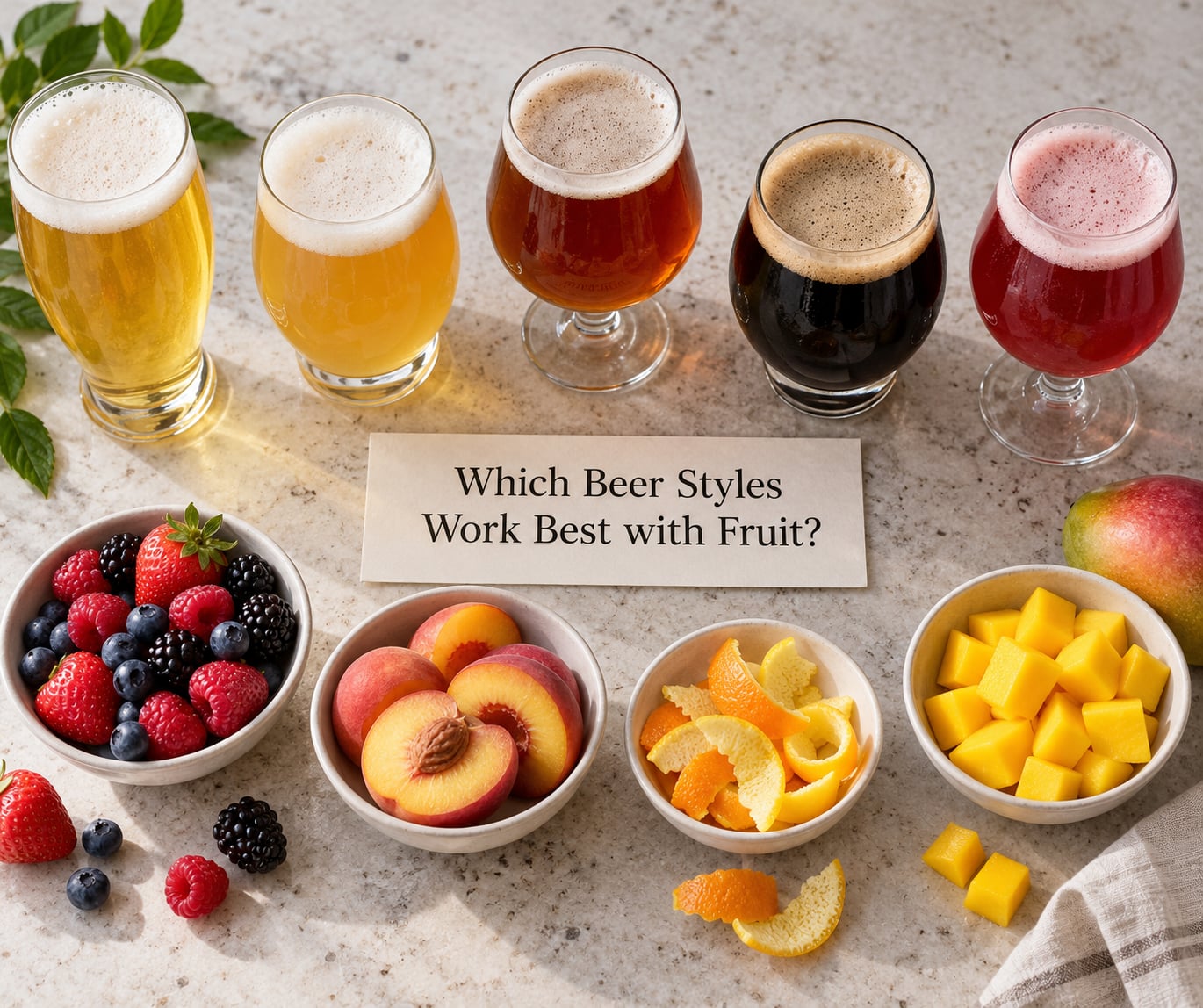
Fruit is not an upgrade to every beer. It works best when the base style already has room for it, and the least well in a beer where it fights the yeast and hop character.
Fruited sour ales and Berliner Weisse take raspberries, cherries and currants happily, and the acid already in the style makes the fruit taste integrated rather than layered. Sour beer also gives you natural protection against the wild organisms on fruit skin, since the beer is already in that world. Fruit sours and kettle sours with mango or passionfruit are the easiest good result for a beginner.
Belgian kriek and lambic-inspired blends are traditionally cherry, added in secondary or conditioned on it for months. Hazy tropical IPAs take mango, passionfruit and pineapple, usually as purée added late, because the base is already loud and the fruit only needs to push the aroma sideways. Fruit wheat beers and fruit saisons use berries in secondary for a drinkable, aromatic result. Amber ales and stouts take cherries, plums and dried fruit, and the darker base hides the colour shift. Pastry stouts and mead-like heavy ales use fruit for body as much as flavour.
What does not work as well: anything dry and highly bitter where a pound of cherry per gallon just reads as sweet, and very light beers where fruit sweetness pushes the beer past its strength.
Common Problems When Brewing with Fruit
The beer tastes like jam, not fruit. The fruit saw too much heat, either in the boil or in a hot primary. Fruit added during high krausen ferments at 68 to 72 F, which is warm enough to drive off aromatics. Add later next time, around day three to five, or move to secondary entirely.
The fruit aroma disappears entirely. Usually one of three things: too little contact time, fruit added too early in primary, or too much of it packed down in the bottom of the fermenter where the yeast strips the aromatics first. Secondary helps. A mesh bag helps the beer circulate around the fruit.
Way too much sweetness and a wine-like beer. Too much fruit, and a base beer that was already strong. Fruit sugar is real sugar. Cut the quantity to 1 lb per gallon, or pick a lighter base.
Harsh, puckering acidity. Fruit that was overripe or crushed badly and sat too long, or acid added on top of naturally tart fruit. Acid is hard to remove once added, so the correction is next batch: pick firmer fruit, use it sooner, and add any acid in small split doses while tasting.
Fermentation stalls after the fruit goes in. Usually sucrose-heavy fruit such as mango or grape straining an already-tired culture. Add the fruit earlier while yeast is healthy, pitch extra yeast, or split the addition into two smaller additions a few days apart.
Cloudy beer that will not clear. Pectin, mostly, and it is worse from canned or puréed fruit. Enzymatic pectinase added at packaging helps, and a longer cold settle in a bright, cold space clears more. Some brewers on Northern Brewer forums argue a certain fruit haze actually lifts perceived fruit intensity, so judge it by taste rather than by clarity alone.
A floating island of white or fuzzy growth. Mould, from fruit sitting in the headspace above the beer line. Not salvageable. Keep the fruit submerged with a mesh or a weight, and if you see fuzzy growth anywhere above the liquid, dump the batch.
It just tastes like fruit juice. No bittering hop bite and low bitterness throughout, which is common in fruit purées that dilute hop perception. Dry hop late, or add a small quantity of bitter hops during the boil to give the beer an edge the fruit cannot swallow.
Frequently Asked Questions
When is the best time to add fruit to beer?
Secondary fermentation, about a week after primary, gives most fruit beers the best balance of fresh aroma and a stable beer. Add earlier during high krausen if you want the fruit integrated into the body of the beer, and later into the keg if you want maximum aroma and a slushy texture. Boil additions only suit cooked, dark-fruit styles.
Should I use fresh fruit or frozen fruit when brewing beer?
Frozen fruit is easier to use and safer, because freezing kills most of the wild organisms on the skin and breaks down the cell walls so flavour releases faster. It costs some of the volatile aroma. Fresh fruit keeps more top-note character but needs a sanitation step first. Many brewers use both, blending a frozen batch with a pouch of aseptic puree.
Can I add fruit after fermentation is complete?
Yes, and it is the cleanest way to keep fruit aroma intact, but you have to stabilise the beer first. Fruit sugar left in a package with any active yeast produces carbon dioxide pressure, which means gushing and broken glass. Rack off the pulp, confirm gravity has not moved for three days, cold crash for a day or two, and package from there.
How can I prevent fruit from spoiling the beer?
Treat the fruit before it goes in. Freeze it sealed for at least 36 hours and thaw it in the fridge, or crush in a campden tablet and let it stand about 24 hours, or hold it at 150 to 170 F for 15 minutes. Sanitise anything that touches the beer after the addition, keep the fruit submerged rather than floating in the headspace, and remove the solids before packaging.
What fruit is easiest for a homebrewer to start with?
Frozen mango or frozen raspberries, added in secondary at about 1 to 2 lb per gallon. Both are widely available year-round, both freeze well, and neither needs pitting or peeling. Mango leans sweet and tropical, raspberry leans sharp and aromatic, and both are hard to overdo. Aseptic fruit puree is the lowest-risk first attempt of all, since there is nothing to sanitise.
Conclusion: Start with One Fruit Addition
Pick your stage based on what you want to drink. Fresh aroma means secondary, or the keg once the beer is stable. Integrated, fermented fruit character means primary. Cooked, dark-fruit depth means the boil.
Then keep the first batch small and simple. One fruit, one addition point, 1 to 2 lb per gallon. Write down how fruit is added to beer for that batch: the weight, the day, the stage and the finished gravity, and you will learn more from it than from any recipe you read.