Craft beer became popular in the US in overlapping waves rather than one big moment. Homebrewing revived in the late 1960s and 1970s, a handful of pioneer breweries opened in 1979, regional breweries broke through distribution barriers through the 1980s and 1990s, and festivals, taprooms and a style explosion carried craft into the mainstream in the 2000s. Today it is roughly a fifth of American beer drinkers and a much larger share of what those drinkers care about.
The reason people remember that rise as a single story is simple contrast. For most of the twentieth century, American beer meant one flavor: a pale lager brewed at scale by a handful of enormous companies. Almost everything interesting happened outside that glass.
Table of Contents
- How Craft Beer Became Popular in the US
- What Counts as Craft Beer in the United States?
- How Craft Beer Rose from Its Post-Prohibition Roots
- Why the 1970s Brewing Revival Changed American Beer
- Homebrew clubs and the first craft breweries
- The decade-by-decade timeline of American craft beer
- How Craft Beer Became Popular Beyond Homebrewing
- Regional waves that shaped American craft beer
- How the Craft Beer Boom Accelerated in the 2000s
- What Made Beer Festivals, Taprooms, and Bar Crawls Matter
- How Consumer Taste and Drinking Culture Continued to Change
- Why American Craft Beer Is Popular Today
- Frequently Asked Questions
- When did craft beer become popular in the United States?
- What was the first major American craft beer movement?
- Did Prohibition create American craft beer?
- How did homebrewing help popularize craft beer?
- Are beers from large acquired breweries still considered craft beer?
- Are craft beer sales declining?
- Conclusion
How Craft Beer Became Popular in the US
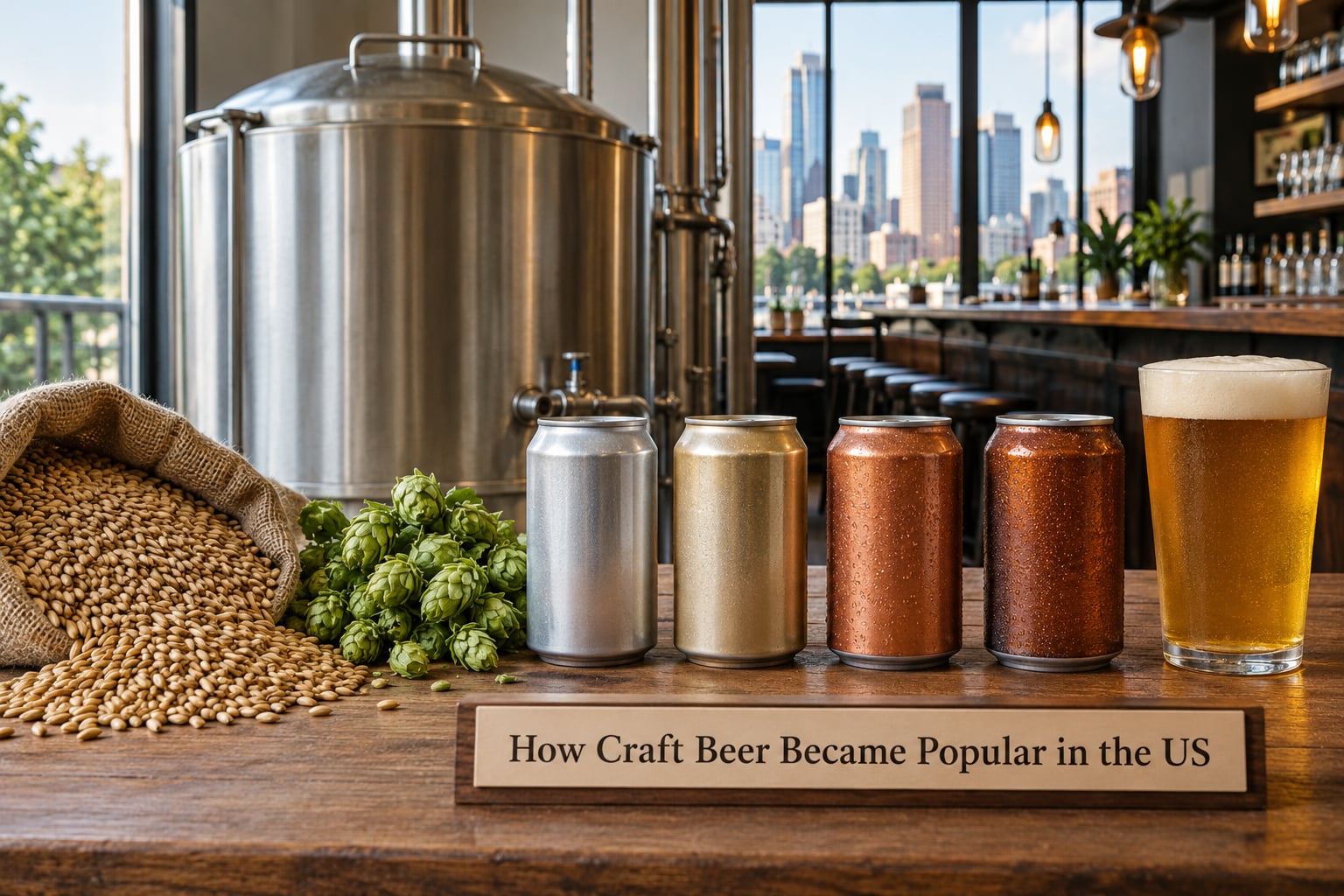
Craft beer grew through five forces that reinforced each other: a homebrewing hobby that taught people what good beer tasted like, breweries that brewed for flavor instead of consistency, a fight to get bottles and taps into the three-tier distribution system, a social culture built around taprooms and festivals, and a consumer shift toward variety and stronger beer.
The dates matter more than most people expect. The American Homebrewers Association was founded in 1978. Sierra Nevada Pale Ale and Boulder Beer both opened in 1979. Boston Beer shipped Sam Adams in 1984. The Great American Beer Festival, first staged under another name, has run since 1982.
By the mid-2000s craft had become a category supermarkets had to stock and a term drinkers used without irony. The rest of this piece walks that path in order: what the beer tasted like first, who started the movement, and the specific obstacles that took a decade to clear.
What Counts as Craft Beer in the United States?
Craft beer is not a style. It is a description of who brewed it and how, and the definition has been contested for forty years.
The Brewers Association, the trade group that publishes the widely cited brewery counts and craft segment statistics, has historically defined an independent craft brewery as one that produces beer, is small relative to the macro brewers, has an independent or traditional brewing approach, and makes beer its primary business rather than treating it as a side product for a larger operation.
That last clause is where the arguments start. When macro-owned brands launch hoppy, bottle-conditioned lines, plenty of drinkers call them crafty rather than craft. It is a fair suspicion, since a brand that can spend on national advertising is not competing on the same terms as a brewery with one taproom.
So when you ask whether something is craft beer, it helps to ask three separate questions. Who owns the brewery? How much is being brewed, and where? Does the brewer lead with flavor and style, or with the price and the distribution?
You will also see the term used loosely in conversation, meaning anything that tastes flavorful or hoppy. That is how most people use it, and for most drinkers that is fine.
Two other words get mixed into the same conversation and are worth separating. A microbrewery is simply a small brewery, and since the 2010s the term has been nearly retired as breweries that started small grew well past the old micro label. An artisanal or craft-style beer says something about the recipe and the marketing, not necessarily about the company printing the label. Only the ownership and scale question actually determines the craft designation, which is why serious drinkers check who brewed it before they check what it is called.
How Craft Beer Rose from Its Post-Prohibition Roots
American brewing was nearly destroyed between 1920 and 1933. Prohibition shut down legal sales, drove breweries underground or out of business entirely, and left a legacy of breweries with no trained brewmasters and no equipment worth starting up with.
What came back after repeal was not what existed before. The lager breweries of the previous century had been built around German immigration and urban brewing, with pale lagers fermented cold and aged in ways that suited a long supply chain. After Prohibition, fewer breweries made more beer, using adjuncts like rice and corn to lighten the body and a filtered package that hid the yeast.
The result was a decade of consolidation and a taste that drinkers who lived through it remember with real specificity. One industry memoir from 2012 described traveling the country and finding light, nearly identical lager everywhere. Long-time drinkers in BeerAdvocate threads put it more bluntly: there genuinely was no good beer here.
Three forces kept brewing alive in the gap.
First, families who had brewed before Prohibition never fully stopped. Second, a few very small regional breweries survived by selling local contract work. Third, imports never fully disappeared, which quietly taught drinkers that beer could come in more than one form.
One thing worth clearing up, since it comes up constantly: Prohibition did not create American craft beer. It destroyed the pre-Prohibition industry and set craft beer on a seventy-year detour. The movement was built later, by hobbyists who had to learn the recipes from scratch.
The scale of that loss is easy to underestimate. The legal brewing industry that existed before 1920 included several thousand breweries, most of them small and local, many of them German- or Czech-owned and located in cities with large immigrant populations. Nearly all of that disappeared. What replaced it was a national system optimized for long-distance distribution of a pale lager that could be produced identically in any of a handful of enormous plants, and that product definition is the direct ancestor of the thing craft drinkers reacted against in the 1970s.
By the time the homebrewing revival began, there was very little left for a new brewer to inherit: no local grain, no regional yeast, no intact tradition in most towns, and a professional brewing world that had narrowed to a few dozen nationally recognized brands. That is part of why the early craft breweries imported knowledge from British and Belgian brewing traditions rather than reviving local ones.
Why the 1970s Brewing Revival Changed American Beer
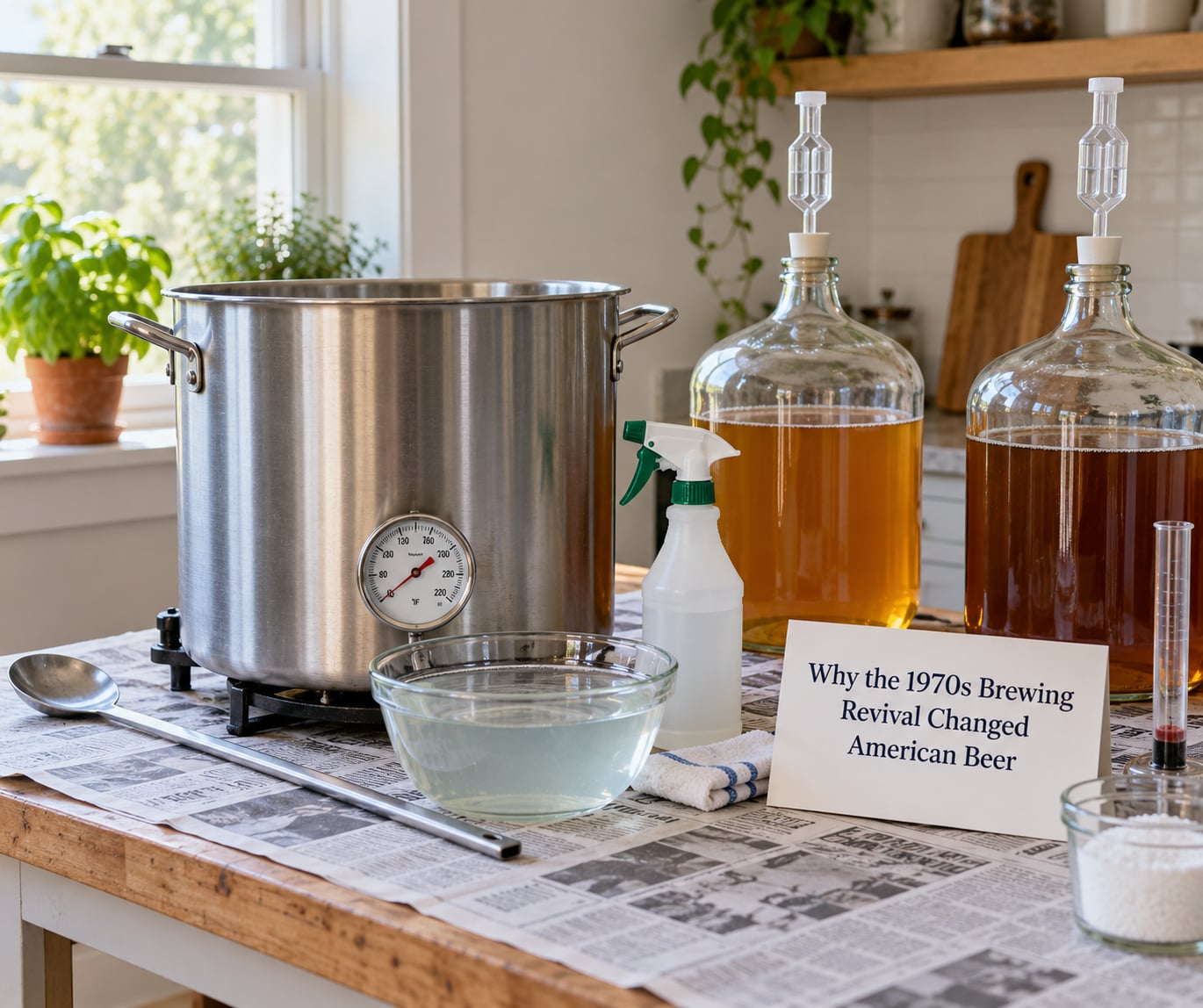
The 1970s brewing revival began because people started brewing at home, and it changed American beer because homebrewers were the only ones making flavorful beer at all. That hobby supplied both the technical knowledge and the taste expectation that the entire craft industry later ran on.
Homebrew clubs and the first craft breweries
Charlie Papazian wrote about homebrewing in the late 1970s, founded Homebrew Digest in 1978, and in the same year helped organize the American Homebrewers Association, which still exists as an advocacy voice for hobby brewers. Mail-order supply shops sold malt extract, hops and yeast to people who had no local option to buy any of it.
The knowledge moved fast. Simple extract kits worked, small homebrew systems came down in price, and a club member with a garage could make beer that tasted nothing like the supermarket lager. Papazian later opened a brewpub in Colorado, and several other early homebrewers did the same in different cities.
Then came the breweries, almost simultaneously. Sierra Nevada Brewing opened in Chico, California, and released Pale Ale in 1979. Boulder Beer opened in Colorado the same year. Anchor Brewing had already been revived in San Francisco as a small steam-beer maker, and Fritz Maytag, who took it over in 1965, is often credited as the first modern craft brewer even though he never sold the idea as craft.
The decade-by-decade timeline of American craft beer
| Period | What changed | Landmark names and events |
|---|---|---|
| 1920-1933 | Prohibition wipes out legal brewing; repeal returns lager at a larger scale than before | Fewer breweries making far more beer; adjunct lagers and filtered packaging become standard |
| 1933-1965 | Consolidation into a handful of enormous regional brewers; taste flattens | Anheuser-Busch, Miller and Coors become category-defining national brands |
| 1965-1977 | First homebrew era; Anchor revives steam beer; regional craft breweries appear in numbers in the single digits | Charlie Papazian, Fritz Maytag, Fritz Maytag’s Anchor |
| 1978-1980 | Organized homebrewing arrives, then the first wave of purpose-built craft breweries | American Homebrewers Association (1978), Homebrew Digest (1978), Sierra Nevada Pale Ale (1979), Boulder Beer (1979) |
| 1981-1989 | Brewpub model gives small breweries a cash flow source; hops and character become the selling point | Great American Beer Celebration in Denver (1982), Rogue, Pyramid, Pizza Port, Samuel Adams shipped nationally from 1984 |
| 1990-1999 | Brewery counts climb into the hundreds; bottled and draught craft reaches more cities; rating sites appear | Dogfish Head (1995), New Belgium (1991), Stone Brewing (1996), BeerAdvocate founded 1996, RateBeer 1999 |
| 2000-2009 | Craft becomes a mainstream category with supermarket listings, national brands and a hop-led style boom | IPA overtook other styles; major macro breweries begin acquiring craft brands; brewery counts pass 1,500 |
| 2010-2019 | Taproom culture, barrel-aged and sour programs, brewery tourism; operating breweries near or above 8,000 | Craft segment holds roughly a fifth of retail beer volume; hard-seltzer and variety packs expand the aisle |
| 2020-2026 | Saturation, closures, a slower segment and a new wave of low and no-alcohol beer | Brewers Association reported a craft segment volume decline of about 4% for 2024, the first sustained drop after years of growth |
How Craft Beer Became Popular Beyond Homebrewing
Craft beer moved past hobbyists when distribution changed. Before 1977 most states ran tight three-tier laws that separated producers, distributors and retailers, forcing small breweries to buy shelf space from middlemen who had no incentive to carry a product that sold in dozens of cases a year.
Two changes broke the logjam. Federal and state action in the late 1970s cut excise taxes and bonding requirements for small brewers and let them sell directly to consumers. Then brewpubs gave new breweries a way to sell beer at retail without a distributor at all: brew the beer, pour it in your own room, put food in front of people. A brewpub on a busy corner was the original craft supermarket.
Later, taprooms became the standard model. A brewery taproom sells direct, keeps the full margin, puts the brewer’s rarest beer in front of the customer, and turns a business trip into a destination. Knowing what to order on a first visit matters more than it sounds, since a tap list can run to forty unfamiliar names.
Regional waves that shaped American craft beer
Craft beer did not spread evenly across the country. It grew in regional clusters, each with its own climate, hops, immigrant brewing history and signature styles, which is why a brewery in one region can taste nothing like a brewery three states away.
| Region | Anchor cities | Signature breweries | What the region is known for |
|---|---|---|---|
| Pacific Northwest | Seattle, Portland, Eugene | Pike Brewing, Anchor, Deschutes, Hair of the Dog | Pale ales and early craft culture; the inspiration for the 1970s homebrewing wave |
| Northern California | Chico, Santa Cruz, San Diego | Sierra Nevada, Mad River, Russian River, Stone Brewing | Hops and high-alcohol west coast IPAs and stouts |
| Colorado | Boulder, Fort Collins, Denver | Boulder Beer, New Belgium, Oskar Blues, Great Divide | Homebrew equipment culture, brewpubs, sours and farmhouse ales |
| New England | Boston, Burlington, Portland | Boston Beer, Harpoon, Dogfish Head, Allagash | Brewpub pioneers, high-alcohol Belgian styles, hop-forward pale ales |
| Midwest and Mountain | Chicago, Grand Rapids, Milwaukee | Bell’s, Three Floyds, Founders, Great Lakes | Farmhouse ales and accessible craft lagers that undercut macro on price |
| Mid-Atlantic and South | Washington DC, Baltimore, Richmond, Austin | Dogfish Head, Baltimore Brewing, Oskar Blues, Southern Tier | Fast-follower markets with dense taproom districts |
Respected beer writing and the first rating sites gave the movement something it had never had: a way to argue about quality with evidence. Before that, a brewery’s reputation traveled by word of mouth within one city. Rating sites let a brewery in Chico, California earn a national reputation overnight, and they gave drinkers a starting point when a taproom offered forty unfamiliar taps.
How the Craft Beer Boom Accelerated in the 2000s
Craft became mainstream in the 2000s because three things lined up: hop-forward beer proved it could sell at scale, craft lagers gave non-hop drinkers a way in, and macro breweries started putting money behind craft brands, which paid for distribution that small breweries could never afford.
The hop revival is the clearest example. West coast IPAs in the early 2000s turned bitterness and aroma into the main event, and drinkers who had been told for decades that American beer was supposed to be neutral started asking for more of it. Within a few years, hop-forward IPAs were the defining American craft style and the engine of brewery growth.
Craft lagers mattered just as much for reach. Brewers making clean, drinkable lagers and pales gave the mass-market lager drinker a reason to switch brands without changing the experience. That is the bridge category most people crossed on the way into craft.
And then the money arrived. Macro breweries acquired well-known craft brands through the 2000s and 2010s, which put their beer into national distribution in a way no independent could match. Supporters of craft said independence was being diluted. The Brewers Association tightened its definition of craft in response, requiring independent ownership, and campaigns like Take Craft Back pushed the argument publicly.
Whatever you think of those acquisitions, they pushed craft into mainstream awareness far faster than organic growth would have. The visibility came with a price, and drinkers noticed.
Retail distribution is the less visible half of the story. Once supermarket chains and big box stores added a craft cooler door, a brewery in a mid-sized city could reach a metro area it could never have reached through three-tier wholesalers, and the buying decisions of a regional grocery manager started shaping which breweries grew. That is also when package and price competition began, with cans and four-packs undercutting the bottled specialty pricing early craft had relied on.
The other accelerant was professional credibility. Brewers trained at larger operations, used lab equipment, and published brewing data that let small breweries improve faster than they would have alone. American hop growers reaped part of the benefit too, as demand for several specific varieties grew enough to justify farming them domestically rather than importing everything.
What Made Beer Festivals, Taprooms, and Bar Crawls Matter
Festivals, taprooms and organized bar crawls mattered because discovery in craft beer happens in person. You do not find a new favorite style by reading about it, and the tasting table is still where most drinkers decide what to buy next.
The Great American Beer Festival, held in Denver, has been running since 1982 and remains the largest gathering of US brewers. For a brewery that sells a few hundred barrels a year, a single festival placement can generate more customers than a year of regional distribution. That is a structural reason festivals matter, not just a party reason.
Local festivals work the same way at smaller scale. Regional beer weeks and city festivals give breweries a concentrated weekend of attention, and they give the surrounding bars a reason to extend their taps. The practical side of a crowded festival matters: a tasting passport, a plan for what you can actually finish, and an early start beat standing in line at 2 p.m.
Taprooms changed the economics. Direct sales cut out the distributor, let a brewery keep rare releases cheap to buy, and turned regulars into a base that shows up on a Tuesday. The side effect is a culture where the brewery is the destination and the beer is the reason to go.
Bar crawls came along for the same reason in a different shape. A crawl moves through several taprooms in one neighborhood in a single evening, which is efficient discovery for a city with twenty breweries. The risk is obvious, so pace the route by neighborhood rather than by tap count, eat between stops, and pick one style per venue.
How Consumer Taste and Drinking Culture Continued to Change
After the boom, the styles kept moving. Barrel aging went from curiosity to a permanent program, sour and wild beers went from a footnote to a category drinkers ask for by name, and hazy IPAs split the hop market into two camps.
Sours are the clearest case of a style that went from misunderstood to standard in about a decade. The technique is old, imported knowledge revived by brewers experimenting, and for a while some drinkers found it actively unpleasant. That reaction is worth keeping in mind for whatever comes next.
Packaging changed too. Cans stopped being the cheap option and became the premium option, because breweries found that people judge aroma less in a can and buy more of what they can carry. Variety packs and mixed cases became a major entry point for newcomers who do not yet know which style they want.
Transparency became part of the ask. Drinkers who spent years decoding brewing jargon started expecting brewery names, styles and alcohol content on the label to mean something, which is a direct result of an era when macro-owned craft lines blurred those lines.
And the newest wave is low and no-alcohol beer. Once a compromise, it now gets shelf space and tap listings of its own, driven by moderation, daytime drinking and the idea that a beer brand has to work for more occasions than the evening one.
International influence runs in both directions, which is worth noting because the standard story is one-way. American brewers popularized the high-alcohol, hop-forward IPA as a category, and brewers in the UK, Scandinavia and elsewhere built on that template while bringing back their own traditions. Collaboration beers became routine, and American brewery exports grew enough to matter in other markets. The style vocabulary people use worldwide now comes from both sides of that exchange.
Veteran drinkers describe the loss of novelty plainly, and it is the most common source of frustration in craft forums: too many identical hazy IPAs, too many taprooms serving the same four guest taps, and a sense that styles people loved have been crowded out. That reaction is a useful signal. Every style that felt niche twenty years ago, from farmhouse ales to sours to barrel-aged imperial stout, has been through the same cycle, and the current backlash is usually what precedes the next revival.
Why American Craft Beer Is Popular Today
Craft beer is popular now because the habits built during the rise never went away. People still want a wide range of flavors from one category, and they still want their beer to come from somewhere specific.
Regional identity does a lot of that work. A brewery that sources local hops, donates to local causes and employs people in the neighborhood offers something a national brand structurally cannot, and drinkers reward that at the register and on a brewery tour.
Discovery keeps the category interesting. With thousands of breweries and a tap list that changes weekly, there is always something untried, which is a different kind of appeal from the one-time novelty that drove the early boom. Food pairing also matured along the way, and a brewery that plans its taps around a menu makes itself the obvious dinner choice.
The numbers reflect that durable appeal. Craft still accounts for roughly one in five beers sold in the US by volume, a share built over decades rather than a single spike. The current slowdowns are real, but they look like a maturing category rather than the end of one.
Economically, small breweries are also an unusually visible local business. Brewing employs skilled people, supports agriculture through hop and grain contracts, draws visitors to a town, and keeps beer money circulating locally rather than sending it to a corporate bottler in another state. Local governments noticed that advantage during the boom and have kept offering incentives, which is a large part of why brewery counts held so high for as long as they did.
Food is the quieter growth engine. A brewery that publishes a pairing menu turns itself into a dinner destination, and drinkers who were bored by beer at a restaurant are often simply not in the habit of asking for the local tap list. A well-run taproom with food is competing with the wine list as much as with the bar next door.
One thing has changed for good: drinkers who arrived during the boom and got burned by a nine-percent Imperial Stout nobody could discuss now ask for balance, clarity and lower alcohol. The market is more selective, which is a very different problem from a market that never caught on.
Frequently Asked Questions
When did craft beer become popular in the United States?
Craft beer became popular in stages rather than at one moment. Homebrewing revived in the late 1960s and 1970s, the American Homebrewers Association formed in 1978, and the first wave of purpose-built craft breweries opened in 1979 with Sierra Nevada Pale Ale and Boulder Beer. The category reached mainstream status in the 2000s once supermarkets stocked it, taprooms opened in most cities and hop-forward IPAs sold at scale. Most drinkers meet it during those two periods.
What was the first major American craft beer movement?
The first major movement was the homebrewing revival of the late 1960s through the 1970s. Homebrew clubs taught people to make flavorful beer, mail-order supply shops made ingredients available, and Charlie Papazian helped organize the American Homebrewers Association in 1978. That hobby supplied the recipes and the palate expectations that the first craft breweries later commercialized, which is why most histories of American craft beer start with a kitchen, not a brewery.
Did Prohibition create American craft beer?
No, it did the opposite. Prohibition from 1920 to 1933 destroyed most of America’s breweries and left few surviving operations with trained brewmasters or usable equipment. Repeal in 1933 brought back lager brewing, but at a much larger scale and with a blander product, which set up the pale lager monoculture craft beer later broke. The craft movement itself was built from homebrewers who had to reconstruct traditional recipes from scratch.
How did homebrewing help popularize craft beer?
Homebrewing created the demand before any brewery could fill it. Hobby brewers learned what hops, yeast and fermentation temperature actually do, and they were often the only people in their towns drinking anything with flavor. That knowledge produced the first brewery employees and founders, supplied recipes and equipment knowledge, and created an informed customer base that judged beer by taste instead of by brand recognition. When craft breweries opened, there was already a market waiting for them.
Are beers from large acquired breweries still considered craft beer?
That depends on who you ask. The Brewers Association has historically required independent ownership for a brewery to count as craft, so most acquired brands have been dropped from official craft statistics. Many drinkers still describe any flavorful, brewery-focused beer as craft regardless of ownership, which is where the argument gets heated. If you care about the distinction, check ownership on the can or tap handle rather than the style on the label, since macro-owned craft-style brands exist in every major style.
Are craft beer sales declining?
Partly, and it depends on what you measure. The Brewers Association reported the US craft segment fell about 4% by volume for 2024, breaking a long run of growth, and operating brewery counts have come off a record above 9,000. Closures have hit smaller and poorly capitalized breweries hardest. Even after the dip, craft still holds roughly a fifth of American beer volume, and low-alcohol beer has partly offset the losses in some markets.
Conclusion
There was no single moment when craft beer became popular in the US. A homebrewing hobby created the knowledge, a few breweries turned that knowledge into product, distribution law forced a decade-long fight for shelf space, and festivals, taprooms and a hop-led style explosion finally carried it to a mass audience in the 2000s.
The best place to pick up that thread is close to home. Find the taprooms within a few miles of you, try something from a brewery you have never heard of, and then try the same style from a brewery a hundred miles away. You will notice the difference immediately, and that difference is the whole story.