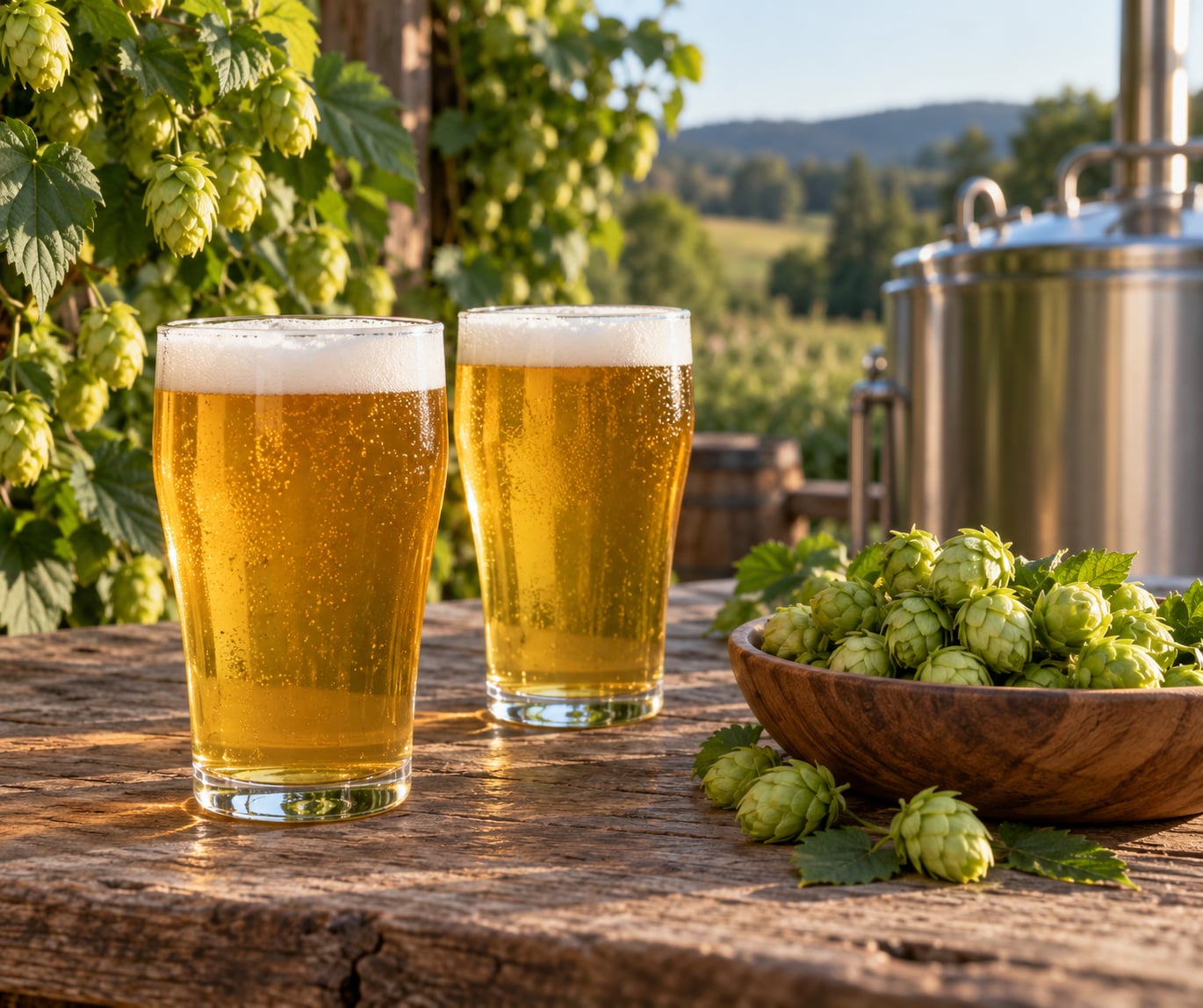
Fresh hop beer is beer brewed with whole, undried hop cones that reach the brewery within roughly 24 to 36 hours of being picked off the vine, so it carries the plant’s bright green, floral and pithy character instead of the resinous, preserved flavor of kiln-dried hops.
If that sentence is the only thing you take away, the rest of this guide explains how it gets brewed, why it tastes the way it does, and how to get a glass of it before the season moves on. Updated for October 2026, because this is genuinely a once-a-year topic.
The term is not new and it is not formal. Nobody certifies a fresh hop beer, and the word shows up on labels alongside wet hop and harvest ale with no consistent usage. What all of those labels share is timing: the hops went from the field to the kettle while they were still on the plant’s schedule, not a storage schedule.
Table of Contents
- What Is Fresh Hop Beer?
- How Is Fresh Hop Beer Made?
- Why the 24 to 36 hour window decides everything
- Can you brew fresh hop beer at home?
- What Does Fresh Hop Beer Taste Like?
- Why it tastes green instead of resinous
- How to judge a pour in about thirty seconds
- Fresh Hop Beer vs. Regular Hoppy Beer: What’s Different?
- Fresh hop, wet hop, dry hop and cryo hop compared
- Why Is Fresh Hop Beer Usually a Seasonal Release?
- How Do You Choose and Drink Fresh Hop Beer?
- Frequently Asked Questions
- Is fresh hop beer always more bitter than regular beer?
- How long does fresh hop beer stay fresh?
- Why is fresh hop beer sometimes hazy?
- Can you age fresh hop beer after release?
- Which beer styles are made with fresh hops?
- Conclusion: Start With the Release and the Season
What Is Fresh Hop Beer?
Any beer uses hops, so the useful comparison is not fresh hop beer versus beer without hops. It is fresh hop beer versus the hop-forward beer most of us drink all year, which is brewed with hops that were harvested months earlier, dried in a kiln, and often compressed into pellets. Fresh hopping skips that preservation step.
Drying is what makes year-round brewing possible. It also changes what hops taste like: kilning drives off volatile aromatics that never come back, so a dried-hop beer leans resinous, piney and citrus-forward. Fresh hops keep those volatile oils intact but bring plant matter along with them, which is where the green, grassy, herbal character comes from.
Here is how it differs from a standard hoppy beer at a glance:
- The hops: whole, unkilned cones off the bine, used within a day or two of picking, usually from the Yakima Valley in Washington or the Willamette Valley in Oregon.
- Flavor profile: bright, green and vegetal, with floral and pithy citrus overtones rather than dense resin and dank.
- Brewing process: late-boil or whirlpool additions and sometimes dry hopping with the same fresh cones, since a long boil would strip the aromatics out.
- Season and shelf life: brewed once a year during the late-summer harvest and meant to be drunk while it is fresh.
Two naming notes. First, fresh and wet are the same thing in practice: hop cones straight off the plant are around 80% water by weight, and nobody describes them as wet so much as unkilned. Second, dry hop is a verb meaning hops added after fermentation, not a synonym for dried hops, which is the single most common mix-up in this whole corner of beer.
How Is Fresh Hop Beer Made?
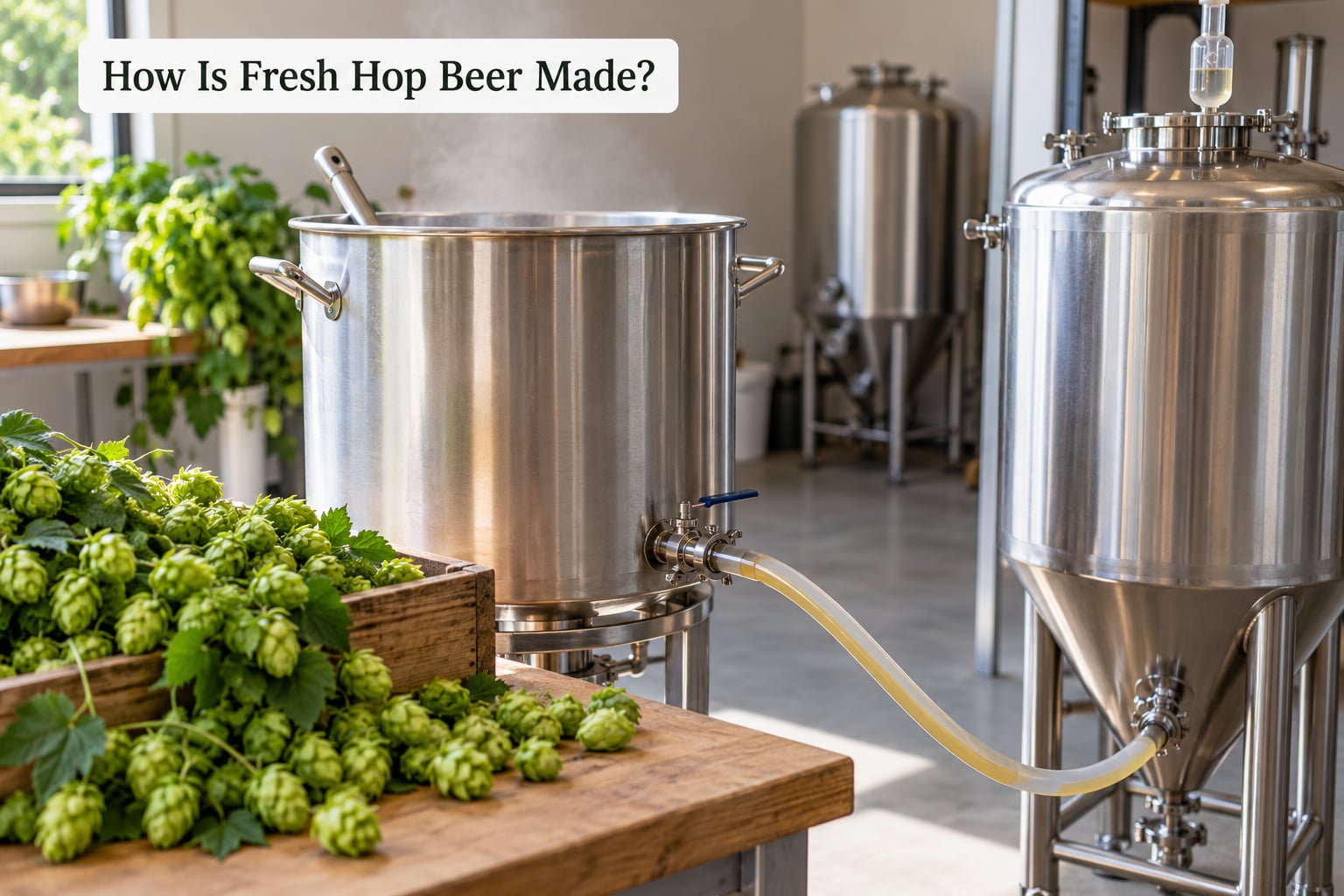
Making fresh hop beer starts in a field, not a warehouse. Hop bines come down in late July through September depending on variety and weather, and a brewery that wants fresh hops has to have its brew day scheduled around the pick date rather than the other way around.
- Pick and strip. Bines are cut, and the cones and leaves are separated by machine, usually within hours of coming off the plant.
- Move fast. The cones go into bags or shallow boxes and head to the brewery. The workable window is about 24 to 36 hours; after that, heat and enzyme activity start breaking the aromatics down.
- Mill or leave whole. Some breweries run cones through a mill to break the lupulin glands open right before the kettle. Others use whole cones, which release their oils more slowly.
- Add late. The addition lands in the last minutes of the boil, in the whirlpool, or in the fermenter as a dry hop. A full 60-minute boil would cook out exactly the character the brewer paid for.
- Ferment and package fast. Fermentation runs fast, and the beer moves to package with a short turn-around because every extra day costs aroma.
Why the 24 to 36 hour window decides everything
Green hops are roughly 80% water, while dried pellets sit around 8 to 10% moisture. Water is weight a brewer pays for and does not get flavor from, so a brewery using fresh cones needs several times the hop weight to hit the same intensity, and the guidance most homebrewers follow is six to eight times as much by weight.
Fresh cones also carry chlorophyll and other plant material that drying and kilning strip out. Boil them hard and you get vegetal, tobacco-like off-flavors. Add them late and those same compounds read as fresh green aroma instead of a flaw. Alpha acid percentages are also unpredictable in fresh cones, so bitterness is harder to calculate than in a dried-hop recipe, and brewers tend to let hop bitterness sit lower.
Can you brew fresh hop beer at home?
Yes, if you have a harvest date you control. Backyard hop growers usually face a choice: brew immediately with wet cones, or dry them properly and treat them like any other hop. The standard advice from homebrewing writers is to dry below 140°F until the cone snaps brittle rather than bends, which lets you keep the harvest for months.
Brew immediately and the math is simple but unforgiving: plan on six to eight times the dried-hop weight by weight, add late, and accept that you cannot split one harvest between the kettle and the dry hop bin because the wet material has to go in all at once. Mold and oxidation are the two real risks, and hop aroma fades within a day or two of picking, so timing matters more than technique.
What Does Fresh Hop Beer Taste Like?
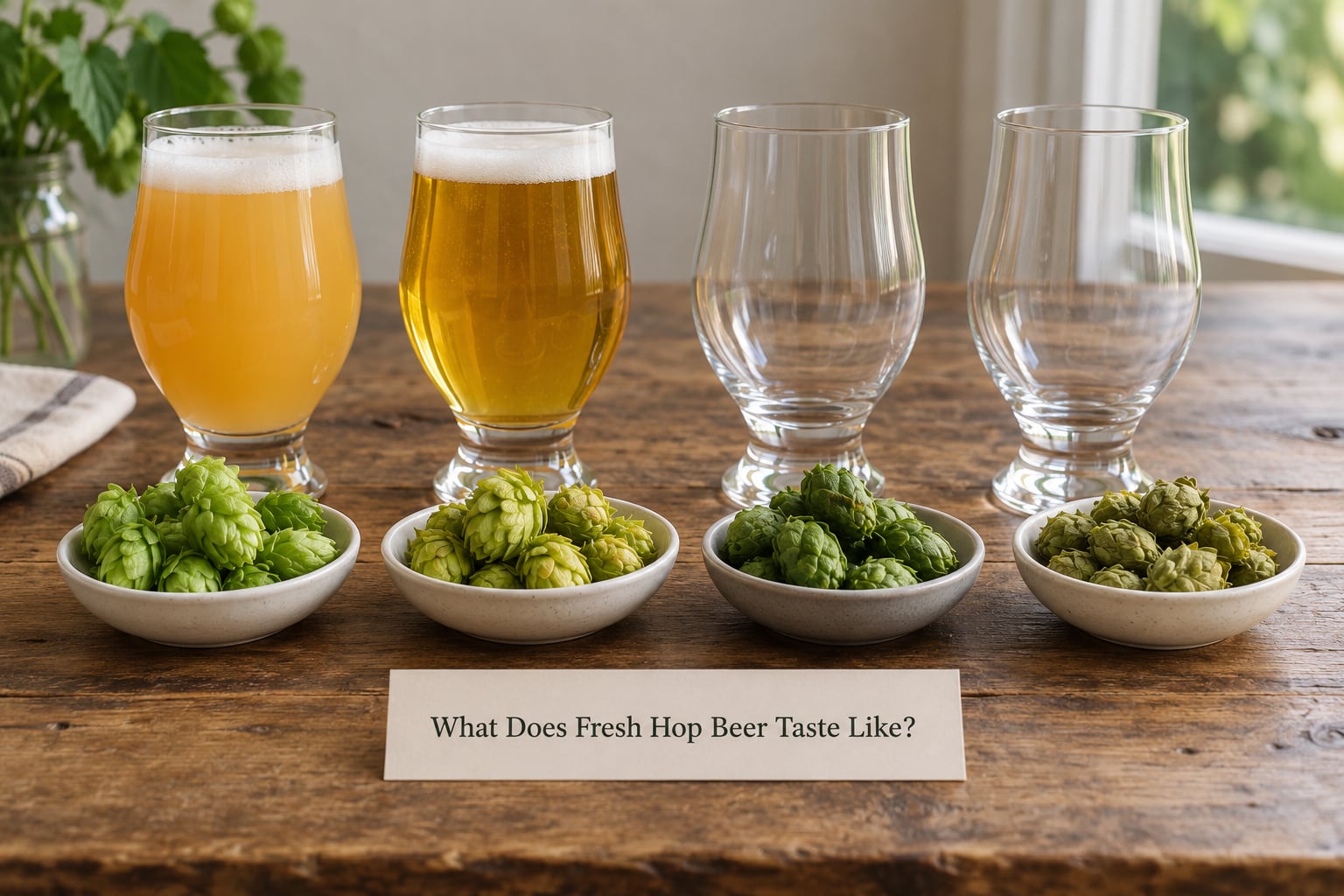
The first thing most people notice is that fresh hop beer smells like a plant rather than like a fruit. Green, grassy and herbal notes lead, often with hay-like or cut-grass edges, and floral or pithy citrus follows underneath. Some examples push into tropical fruit, depending entirely on which varieties were picked.
Bitterness usually lands lower than an equivalent IPA, and the finish tends to be drier and cleaner than the piney, lingering close you get from dried hops. Aroma intensity is the variable: a beer brewed with the best of the harvest can be astonishingly aromatic, while one that sat around after release loses that top note fast.
Why it tastes green instead of resinous
Resinous character comes from heat-driven changes in alpha acids and stored oils that develop during kilning. Fresh hops never went through that, so what you smell is closer to smelling a hop vine in a field in late August. Green is not a defect here. It is the entire point of the style, and drinkers who expect a heavy West Coast IPA are the ones most often surprised.
How to judge a pour in about thirty seconds
Useful markers when a beer is on style: a vivid green or herbal aroma, a light body, moderate hop bitterness, and a clean finish. Markers that it has gone past its moment: cardboard, wet paper or bruised apple, a flat muted aroma, and a thin papery taste. Oxidation hits light-bodied fresh hop beers hard because there is very little malt to hide it.
Haze is also normal here. Suspended hop material and protein from an aggressive whirlpool can leave a beer looking cloudy, and it has nothing to do with a fault.
Fresh Hop Beer vs. Regular Hoppy Beer: What’s Different?
| Factor | Fresh Hop Beer | Standard Hoppy Beer |
|---|---|---|
| Harvest timing | Used within 24 to 36 hours of picking | Used months after harvest |
| Hop format | Whole unkilned cones, sometimes milled | Kiln-dried pellets or whole dried cones |
| Moisture | About 80% water by weight | About 8 to 10% moisture |
| Hop weight needed | Roughly six to eight times more by weight | Measured in ounces per barrel |
| Flavor | Green, grassy, herbal, floral, pithy | Resinous, piney, dank, citrus peel |
| Bitterness | Typically moderate and less predictable | Calculated from alpha acid data |
| Availability | Seasonal, often regional, short window | Year-round, national distribution |
| Shelf life | Drink within weeks to a couple of months | Months of stable storage |
| Oxidation risk | High, and very obvious when it happens | Moderate in most styles |
| Best used for | Drinking fresh at release | Cellaring, casual drinking, shipping |
The practical summary: standard hoppy beer is engineered for consistency across seasons, and fresh hop beer trades that consistency for a flavor snapshot that only exists for a few weeks.
Fresh hop, wet hop, dry hop and cryo hop compared
| Hop state | What it is | Timeline from harvest | Typical style |
|---|---|---|---|
| Fresh or wet hop | Whole unkilned cones | One to two days | Fresh hop pale ale, harvest ale |
| Dry hop | Hops added cold after fermentation | Days to weeks, dried | IPA, pale ale |
| Cryo hop | Unkilned hops flash-frozen into pellets | Weeks to months | Cold IPA, hazy IPA |
| Dried and pelletized | Kilned, then compressed | Months to years | Nearly every style |
Cryo hops deserve the extra attention because drinkers ask about them constantly, particularly in PNW brewing circles where the recurring question is whether flash-frozen unkilned pellets count. They are the closest thing the market has to fresh hops outside harvest, because they are frozen instead of dried and keep more of the green character. They are not the same thing. Cryo pellets are still a manufactured format designed to survive a warehouse, and a brewery can use them in February.
One preference worth passing along, because it comes up again and again in homebrew forums: fresh hop pale ales are often favored over fresh hop IPAs, since a lighter base lets the delicate fresh hop character come through instead of competing with heavier hopping.
Why Is Fresh Hop Beer Usually a Seasonal Release?
Because the crop only comes off the vine once a year. There is no fresh hop supply in February, and a brewery that uses real fresh cones has to brew its batch inside the harvest window. That single constraint explains most of what looks like marketing: the release date, the small batch, the taproom-only kegs, and the sense that you need to hurry.
Geographic limits reinforce it. The large commercial hop farms concentrate in the Yakima Valley and the Willamette Valley, plus Idaho, which is why regional breweries dominate the style. A brewery outside those areas usually either buys in-window cones at a cost the beer cannot absorb, or settles for cryo hops and calls it something else.
Shelf life is the final piece. Fresh aromatics fade in weeks, not months, and the light body leaves nowhere to hide oxidation. That makes fresh hop beer a release-day purchase rather than a cellar item. Beer writers and retailers keep saying the same thing about these bottles: buy it and drink it right away.
Breweries use recognizable names for the same idea. Great Divide’s Fresh Hop pale ale, Founders Harvest Ale and Bale Breaker Piled High all flag the hop state on the label, and Sierra Nevada’s Celebration Ale is the annual marker most drinkers in the Northwest plan their fall around.
How Do You Choose and Drink Fresh Hop Beer?
Read the label for three things: the style, the hop varieties, and the release or pour date. A fresh hop pale ale gives the fresh character the clearest stage, so that is where I start. If you only know one thing about the label, look for the word fresh, wet or harvest next to the hops.
Serve it cold but not warm, somewhere around 38 to 42°F, in a stemmed tulip or a teku so the aroma gets somewhere to go. A frozen mug or an ice-chilled pint will numb the very aromatics you paid a premium seasonal release to taste.
At a taproom or festival, order the fresh hop beer first, before heavier examples, while your palate is neutral. Ask the bartender when it was poured and whether the batch went out cold-side or warm-side conditioned. Buy a bottle to take home, but drink the glass you have in front of you now.
Food pairing is straightforward. Fresh green hop character handles fresh green food: grilled chicken, a pork shoulder, fresh corn, a tomato and mozzarella plate, or a salad with a sharp vinegar dressing. Rich fried food covers up the aroma, and very sweet desserts flatten it entirely.
Outside the harvest regions, try these in order. Look at brewery release calendars in late August and early September, since Seattle, Portland and San Francisco taprooms post theirs early. Check bottle shops that specialize in PNW and Northwest brewers. Watch for festival releases in September, where a fresh hop festival can put dozens of breweries in one building for a weekend. Finally, ask for the brewery’s fresh hop seasonal by name at any well-stocked taproom, because the beer usually exists even when the sign does not.
Frequently Asked Questions
Is fresh hop beer always more bitter than regular beer?
No. Fresh hop beer is usually less bitter than a comparable dried-hop IPA, because whole unkilned cones have unpredictable alpha acid levels and brewers add them late in the boil or whirlpool. The character you notice is aroma, not bitterness: green, grassy and floral on the nose with a cleaner, drier finish than a resinous IPA.
How long does fresh hop beer stay fresh?
Weeks, not months. Fresh hop aromatics fade quickly, and the light body of most examples shows oxidation fast. Drink it as close to the release or pour date as you can, and keep refrigerated if you cannot open it right away. A cardboard or bruised-apple note means the window has closed, even if the bottle looks full and clean.
Why is fresh hop beer sometimes hazy?
Haze is normal and usually harmless. Whole fresh cones shed plant material and proteins during the whirlpool, and unkilned hops carry more of both than dried pellets do. That suspended material scatters light and gives the beer a cloudy look. A properly settled fresh hop beer should pour with a soft haze that clears as it rests in the glass.
Can you age fresh hop beer after release?
Not really. The whole point of the style is a snapshot of the harvest, and the volatiles that make it interesting fade within weeks. Refrigerated and sealed, a bottle might hold its character for a couple of months, but the green aromatics are the first thing to go. Buy small, buy once, and drink the whole bottle in one sitting.
Which beer styles are made with fresh hops?
Fresh hop pale ale is the most common, followed by fresh hop IPA and American IPA. You will also see harvest ale and wet hop ESB, where the hops support an English-style body rather than dominating it. Pale ales show the fresh character best because the lighter base does not compete with it.
Conclusion: Start With the Release and the Season
Fresh hop beer is beer brewed with whole, unkilned hop cones used within a day or two of picking, so it tastes green, grassy and floral rather than resinous. That is the whole idea, and it is why the style only exists for a few weeks a year.
Start with four things: the style on the label, the hop varieties named, the release timing, and the pour date. Then drink it cold in a tulip while the aroma is still bright, and compare it side by side with a dried-hop IPA of the same strength. The green note that surprises first-time drinkers is the entire reason the beer was brewed, and it will not be there next month.