Why some beers have salt in them comes down to three separate reasons: brewers add brewing minerals to fix their water, one German style puts salt in on purpose, and drinkers sprinkle table salt into a glass for balance and better carbonation. Only one of those three is a defining ingredient of the beer.
Most people asking the question have had a pint that surprised them. Sometimes the surprise is good, as with a gose that tastes faintly like the sea. Sometimes it is a pilsner that seems to have picked up a briny edge nobody asked for, and the drinker wonders whether the brewery messed up.
This guide separates those cases, explains what salt actually does to a beer, and gives you a way to taste the difference between deliberate salinity, sourness, and a genuine fault.
Table of Contents
- Why Do Some Beers Have Salt in Them?
- Which Beer Styles Intentionally Taste Salty?
- Gose: the style built around salt
- The michelada: salt, lime and cold lager
- How Does Salt Change a Beer’s Flavor and Mouthfeel?
- How Do Brewers Add Salt to Beer?
- A note for homebrewers
- Is Salt in Beer the Same as a Salty or Sour Beer?
- What Makes a Beer Taste Salty When No Salt Was Added?
- Why does my beer taste salty when I never added any?
- How Can You Tell Whether Salt Was Added?
- How Much Salt Is Usually Used in Beer?
- Frequently Asked Questions
- Does beer have salt in it?
- Is salt in beer bad for you?
- Why do brewers add salt to beer?
- Why does salt make beer foam more?
- What type of salt is used in gose beer?
- Why does my beer taste salty when I did not add any?
- Conclusion
Why Do Some Beers Have Salt in Them?
Three things are happening in beer, and they get lumped together constantly. Keeping them apart is the fastest way to answer the question properly.
- Brewers adjust their water with mining salts. Gypsum, calcium chloride, and sometimes plain sodium chloride go into the mash and boil water so the finished beer has the right mineral balance.
- One style is built on added salt. Gose, a German wheat-and-spice beer from Saxony, is defined by salt and coriander, and its tartness is meant to sit next to that saltiness.
- Drinkers salt the glass. A pinch of table salt or a flavored rim seasoning goes into a pint at the bar, usually to make a hoppy or sour beer easier to drink over a long session.
There is also a fourth, quieter source: the brewing water itself. Depending on where a brewery draws its water and whether it treats it, a beer can pick up noticeable minerals without anyone deliberately salting anything.
Which Beer Styles Intentionally Taste Salty?
Salt shows up in beer in a handful of places, and it carries a different job in each one. This is the useful part, because it tells you whether a salty sip is correct for what you are drinking.
| Style or context | Role of the salt | What it should taste like |
|---|---|---|
| Gose | Defining ingredient, added during the boil | Light, sour, faintly briny, with coriander and a mineral snap |
| Sour ales aged in oak or steel with salt | Often a deliberate addition to sharpen acidity | Tart first, with a clean saline finish behind it |
| Kettle sours | Sometimes dosed with salt alongside the souring step | Clean lactic tartness with a short, dry, slightly salty tail |
| Lagers brewed on mineral-rich water | Water profile, not an addition | Very subtle, described as crisp or slightly briny rather than salty |
| Michelada | Added at the glass with lime and often chili | Sour and salty up front, then a cold, plain lager underneath |
| Hop-forward pale ales and IPAs salted at the bar | Drinker’s choice, not part of the recipe | Softer, rounder bitterness with more aroma and a drier finish |
| Pilsner, stout, or any style with no salt history | None expected | A distinctly salty sip here usually signals a problem |
Gose: the style built around salt
Gose comes from Saxony in Germany, historically from the area around Goslar, and it earned its name from the River Gose. It is a top-fermenting wheat beer with a high proportion of malted wheat, finished with salt and coriander, and it is usually only lightly sour.
That recipe survived a strange stretch. Gose was close to gone in Germany for decades after the second world war, and its revival in the 1990s after the fall of the Berlin Wall was led largely by brewers in Leipzig. Today it is brewed far outside Germany, and competition guidelines list it as its own style with salt treated as part of the definition rather than an optional extra.
The result tastes like nothing else in the category. Light body, soft wheat character, coriander and orange peel on the nose, gentle lactic tartness, and a distinct briny note that reads as mineral rather than salty. Drinkers who enjoy it often describe it as refreshing and oddly moreish, and the salt is the base note everything else sits on.
The michelada: salt, lime and cold lager
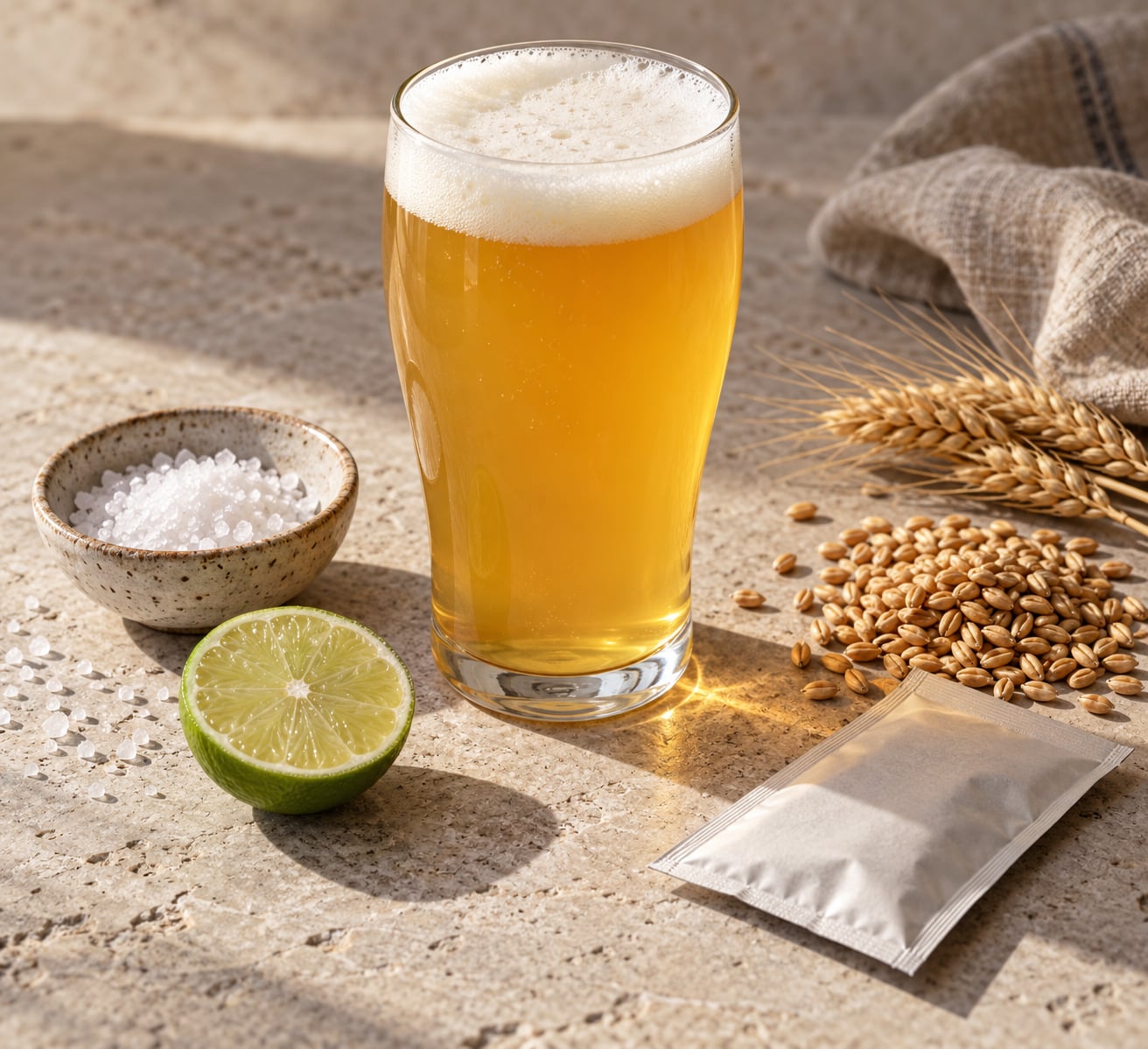
A michelada is a Mexican preparation rather than a brewing style. You take a cold light lager, add fresh lime juice, salt, sometimes chili or a prepared seasoning, and often salt the rim of the glass. It is usually served in its own glass with ice, and it is meant to be drunk alongside food rather than savored as a tasting beer.
Searching for a reason will turn up several explanations, and nobody has settled on one. The practical answer is that a beer is mostly water, so the lime and salt land on the same tongue receptors as the rest of the drink. Salt makes sweetness and sourness read more clearly, and it softens the bitterness that competes with the lime.
How Does Salt Change a Beer’s Flavor and Mouthfeel?
Salt is a flavor amplifier, and it is fussy about the order in which the palate registers things. A small amount suppresses perceived bitterness, and that single effect explains most of what people notice about salted beer.
Bitterness in beer comes from hops and sometimes from roasted malt. A little salt calms that bitterness so it stops shouting, which is why a salted IPA tastes rounder and longer than the same IPA unsalted. Sweet malt character also reads more clearly for the same reason, so an amber or brown ale can seem sweeter without any sugar changing hands.
Aroma gets the same treatment. Salt heightens sensitivity to light fruit and spice notes, so citrus, stone fruit, peppery spice, and floral hop character all become easier to pick up. This is why salting works so well on hoppy beers and fruit-forward sours.
Texture shifts too. Sodium ions increase mouthfeel and give a fuller, rounder sip, and they suppress the astringent, drying edge that higher sulfate water can create. The practical effect is a beer that feels lighter in the stomach and easier to drink across a long sitting, which is exactly what drinkers chasing a sessionable beer are after.
None of this means you should taste table salt. The doses involved are small enough that the effect reads as balance rather than brine, and overshooting turns a clean beer into something you will not finish.
How Do Brewers Add Salt to Beer?
Commercial brewers rarely add plain table salt for flavor. What they do is adjust the mineral content of the brewing water, because the water a brewery draws has a fixed chemical profile that does not suit every beer they want to make.
Four minerals do almost all of the work, and they do different things to the finished beer.
| Mineral | Common name | Effect on the beer |
|---|---|---|
| Calcium sulfate | Gypsum, sold as brewing salt | Raises sulfate, adds a dry and slightly astringent edge, tightens hop bitterness |
| Calcium chloride | Also sold as a brewing salt | Raises chloride, adds roundness and body, softens the finish |
| Sodium chloride | Table salt | Adds both ions at once, contributes a saline note at higher doses |
| Magnesium sulfate | Epsom salt | Strong at low doses, adds dryness and a faint mineral bitterness |
Brewers talk about the sulfate-to-chloride ratio because that balance, more than any single salt, shapes the finish of the beer. A high sulfate profile tends to produce crisp, dry, hop-forward ales. A higher chloride profile produces fuller, softer, malt-forward beers. Getting there means adding gypsum or calcium chloride to a water profile that needs adjusting, and the dose depends entirely on what the water started with.
Salt can also be added later in the process. In gose it typically goes in during the boil, often with coriander, so it distributes through the beer and interacts with the fermentation. Some brewers dose sour beer after fermentation to sharpen perceived acidity.
A note for homebrewers
Most homebrewers run the same short list of questions on the forums: which salt, how much, and when. The consistent advice is to use plain non-iodized salt with no anti-caking agents, since iodine and additives leave traces that can taste off, and to start lower than the recipe suggests. A traditional gose batch typically lands somewhere in the range of five to fifteen grams of salt for a five gallon, roughly nineteen liter, batch, and cutting it in half on the first attempt is a common recommendation.
The honest caveat is that a dose is not a fixed number. It shifts with the mineral content of your water, the percentage of malted wheat in the grain bill, how sour the beer already is, and how much bitter hop you charged. Salt added to a beer brewed on reverse osmosis water behaves differently from salt added to hard tap water.
Is Salt in Beer the Same as a Salty or Sour Beer?
No, and telling them apart is easier than people think once you know what to look for. Saltiness, sourness, and savory fermentation character are three different signals from three different sources.
Saltiness is a mineral sensation. It sits on the tongue without sharpness, lingers as a briny or drying finish, and makes bitterness taste softer. Think of the finish in a good gose or a salted pilsner at the bar.
Sourness is acidity. It comes from lactic acid, acetic acid, or both, and it has the sharp puckering quality of lemon or unripe fruit. Sourness gets stronger as it moves across the tongue, while saltiness tends to sit more evenly and dry things out rather than puckering them.
Fermented savoriness shows up in long-aged sour ales and in darker beers with roasted malt. It reads as meat, leather, soy, or hay, and it comes from extended contact with microbes and oak rather than from any addition.
A useful test: if the beer puckers, it is sour. If it dries and firms up, there is salt or a high sulfate mineral profile involved. If it tastes like a cellar, something aged it.
What Makes a Beer Taste Salty When No Salt Was Added?
Why does my beer taste salty when I never added any?
Several possibilities, and they are worth separating because the remedies differ completely.
- The water carried it. Hard tap water with high sulfate or chloride will produce a beer with a distinctly briny or mineral edge, and so will coastal water sources that reflect into brewery profiles. A brewery that treats or blends its water removes most of this.
- A salt addition overshot. Small measurement errors in a kettle addition, or doubling a recipe without scaling, produce a beer that is plainly salty rather than subtly mineral. Homebrewers report this failure more than any other.
- A contaminated ingredient or vessel. Cleaning products, briny well water, or shared equipment can introduce sodium chloride without anyone intending it.
- The salt came from somewhere indirect. A brewer correcting an off flavor, a canned beer packed at a different location than its label suggests, or a tap line that has not been cleaned properly can all change what you taste.
- Oxidation and age. Old, warm-stored beer develops stale, cardboard-like, sometimes vaguely salty notes that people mistake for added salt. Oxidation does not add salt, but it can make a beer taste like it has it.
Here is the limit worth being honest about: taste alone cannot identify which of these is happening. If a beer tastes salty and nothing in its declared style explains it, the answer lives in the brewery’s brewing notes or a lab, not in your glass.
How Can You Tell Whether Salt Was Added?
A few checks narrow it down fast, whether you are at the bar, at a brewery, or at home.
- Read the beer and its brewery notes. Gose styles almost always declare salt. Many breweries publish a brewing sheet describing water adjustments, and a brewery that is proud of a mineral-forward beer will say so.
- Check whether the style fits. Salt in a gose, a sour, or a deliberately mineral lager is a feature. Salt in a pilsner, a stout, or a session lager is a question worth asking about.
- Pour a small amount first. Start with a few ounces in a clean glass. Salt reads much more clearly on a small pour than in a full pint, and it prevents the immediate foam overflow that catches people out.
- Compare aroma and finish. Added salt tends to sit in the finish as brine while the aroma stays neutral. A mineral water profile gives more aroma character along with the taste, and oxidation gives you a stale nose as well as a stale finish.
- Try a second beer by the same brewer. If the saltiness shows up across everything from that brewery, it is likely their water. If it shows up in one beer, it is likely that beer.
How Much Salt Is Usually Used in Beer?
There is no universal figure, because the right dose depends on the volume of beer, the style, the mineral content of the water, and how much the brewer wants the salt to be noticed. The ranges below give you a sense of scale rather than a recipe.
| Context | Typical amount | Notes |
|---|---|---|
| A pint at the bar | A small pinch, roughly a few tenths of a gram | Add it to an empty or partly filled glass, then pour over it |
| A michelada | Whatever the lime and seasoning call for | Rim seasoning uses far more than an in-glass pinch |
| Gose in a commercial brewery | Usually a small addition during the boil | The amount is part of the style definition |
| A homebrew gose batch | Roughly five to fifteen grams for a nineteen liter batch | Start low and taste before adding more |
| Brewing water adjustment | Grams per batch, worked out from a water report | Set by the sulfate-to-chloride target, not by taste alone |
| Sour beer sharpened after fermentation | Very small additions, repeated and tasted | The aim is to sharpen acid, not to create brine |
Overshooting is the common failure at every level. If a gose leaves you puckering for salt instead of tartness, or a salted pint tastes like a margarita, the answer is not more water. It is less salt next time.
Frequently Asked Questions
Does beer have salt in it?
Almost all beer contains some sodium, usually only a few milligrams per 12 oz serving, because the grain and the brewing water both carry trace amounts. Beers with mineral-rich water or an intentional salt addition sit at the higher end of that range, typically up to a few dozen milligrams. That is a small fraction of the recommended daily sodium limit for most adults.
Is salt in beer bad for you?
For most people drinking normally, no. A 12 oz serving of even a deliberately salted beer carries a small amount of sodium compared with packaged snacks, and the bigger health considerations with beer are alcohol, calories, and how much you drink. If you are on a sodium-restricted diet, check the label or ask the brewery, and treat a heavily salted michelada as a snack as much as a drink.
Why do brewers add salt to beer?
Most often to adjust the mineral content of the brewing water. Gypsum and calcium chloride shift the sulfate-to-chloride balance, which changes whether the finished beer tastes dry and hop-forward or round and malt-forward. In gose, salt is the defining ingredient and is added for flavor balance and tradition. Drinkers add a little at the glass to soften bitterness and lift aroma.
Why does salt make beer foam more?
Dissolved carbon dioxide needs nucleation sites, tiny surfaces where gas can form bubbles. Salt crystals provide plenty of them, so carbonation escapes faster as foam instead of staying dissolved in the liquid. That is why a salted pint fizzes eagerly and why people find it easier on the stomach. It is also why you should salt an empty glass rather than a full one.
What type of salt is used in gose beer?
Plain non-iodized salt is the standard choice. Iodized table salt can leave a noticeable trace in a lightly flavored beer, and anti-caking agents do not belong in a finished brew. Sea salt and specialty salts also work and are popular with modern brewers who want a slightly different mineral character, but the underlying sodium is the same. Homebrewers are advised to start with a smaller dose than the recipe suggests.
Why does my beer taste salty when I did not add any?
Start with the water, because hard brewing water high in sulfate or chloride is the most common cause. Beyond that, an overshot kettle addition, contaminated equipment, and oxidation in an old or warm-stored beer can all read as saltiness. Tasting alone will not tell you which one it is. Check the style, read the brewery’s notes, and compare against another beer from the same brewer.
Conclusion
Start with the style, because that single check answers most of the puzzle. If it is gose, a sour, or a deliberately mineral-forward lager, the salinity is doing a job and belongs there. If it is a pilsner or a stout, that sip is worth asking about, and the brewery’s brewing notes will usually tell you whether it came from the water.
The fastest way to build a reference for yourself is to taste three beers side by side: a good gose, a sharp sour, and a salted pale ale poured into an empty glass. Once you can place a sip into one of those three buckets, the question of why some beers have salt stops being a puzzle and becomes a preference.