What a wild fermented beer is, in one line: a beer made without pitching a commercial yeast culture. Instead, ambient yeast and bacteria from the air, the brewery’s own surfaces, and the wood of barrels do the fermenting, which is where the tartness, funk, and huge variation come from. Lambic, gueuze, and kriek are the classic examples.
It sounds like a shortcut, but the opposite is true. Managing a fermentation where nobody controls which organisms arrive takes far more attention than pitching a dry packet of brewer’s yeast and waiting a week. Last reviewed for 2026 at dcbeerathon.com.
Table of Contents
- What Is Wild Fermented Beer?
- How Does Wild Fermentation Work?
- How a wild fermented beer progresses, step by step
- What Flavors and Aromas Does Wild Beer Taste Like?
- What Are Common Wild Beer Styles and Examples?
- How Is Wild Beer Different from Sour Beer?
- How Do You Taste and Choose Wild Fermented Beer?
- Frequently Asked Questions
- Is wild fermented beer spoiled?
- Is every wild fermented beer sour?
- Does wild fermentation mean the beer sits open to the air?
- How long should wild fermented beer age?
- Can wild beer be brewed safely at home?
- What does funk mean in wild beer?
What Is Wild Fermented Beer?
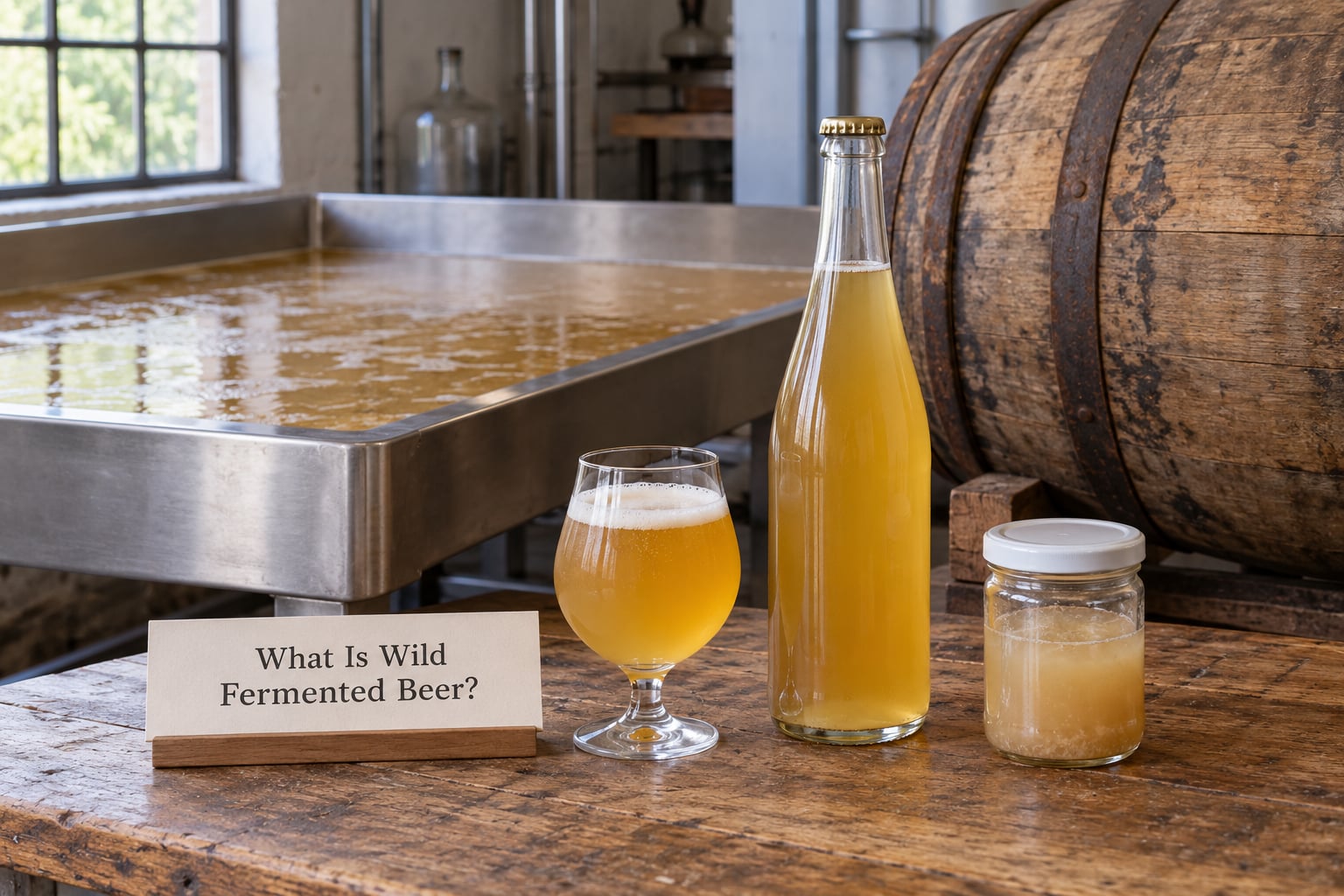
Every brewery starts with wort: boiled, hopped malt sugars waiting to be eaten. A wild fermented beer is one where the organisms that eat those sugars are not purchased and poured in by a brewer. They arrive on their own, or they are inherited from whatever vessel holds the beer.
That is the whole difference, and everything else follows from it. Predicted flavors like banana and clove are harder to dial in. Acidity appears. Two batches from the same recipe rarely match. A brewery’s real estate becomes part of the recipe, down to the resident culture living in its oak.
The words get used loosely, so here is a plain translation of the terms you will meet on a tap list or a bottle label.
| Term | What it means |
|---|---|
| Wild fermentation | Fermentation using naturally present or intentionally introduced microorganisms instead of a single managed brewing yeast |
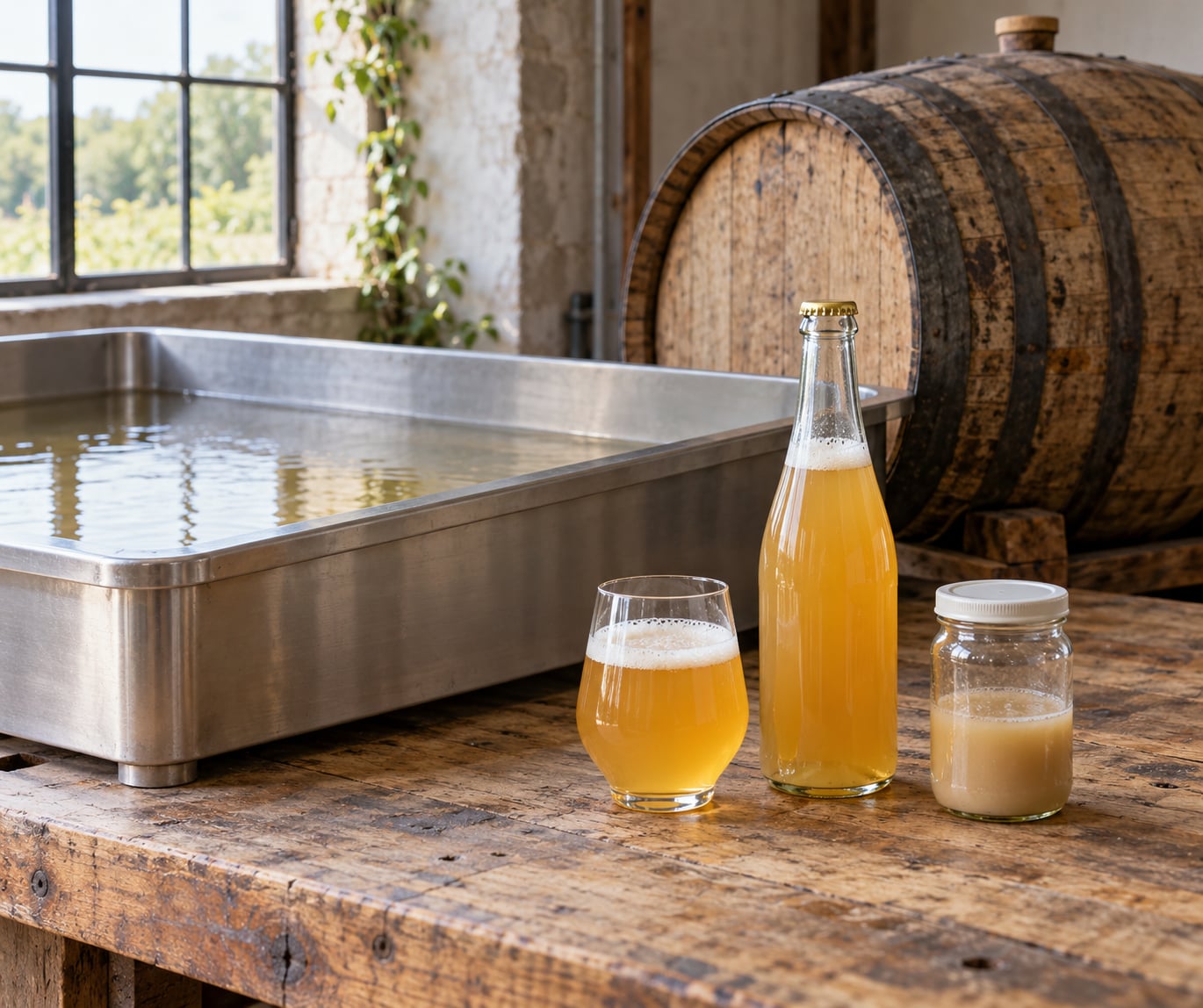
| Spontaneous fermentation | Cooling wort overnight in open shallow vessels, usually a coolship, so airborne microbes settle into it before it moves to barrels |
| Mixed culture | A blend of yeast and bacteria deliberately inoculated, often harvested from an existing barrel or foedre |
| Brettanomyces | A genus of wild yeast that, when it takes over, produces phenols people describe as horse blanket, leather, or barnyard |
| Sour beer | A broad taste category. Sour beer can be made by wild microbes, by cultured bacteria, or by adding acid after fermentation |
| Coolship | A shallow open cooling vessel, historically the roofed type, used to expose hot wort to night air |
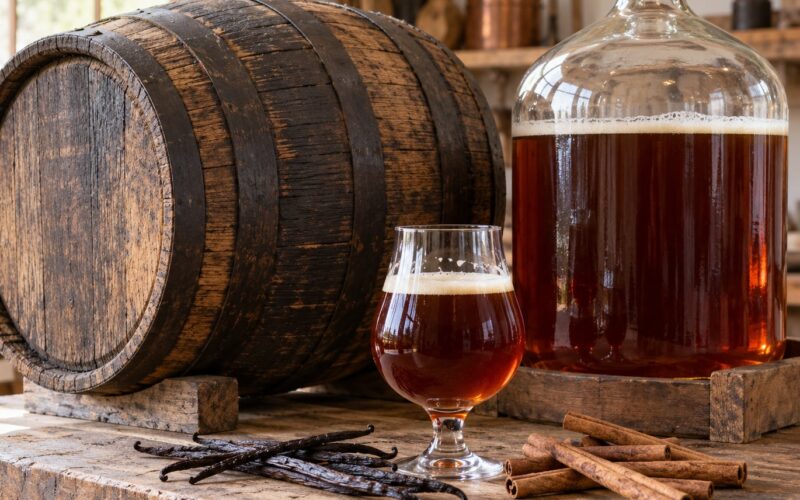
| Barrel-aged | Aged in wood. The barrel carries a resident culture, so barrel-aged sour and wild beer often overlap but are not synonyms |
How Does Wild Fermentation Work?
There are two ways to get wild organisms into beer, and one marketed version that is neither.
In spontaneous fermentation, hot wort is cooled overnight in an open coolship or on a cooling floor. Cool air is denser than warm, so it sinks through the wort and carries microbes with it. Nothing is added; the brewery simply accepts whatever lands there, then keeps a tight handle on temperature and timing in the barrel afterwards.
With mixed culture fermentation, the brewer pitches microbes on purpose, usually scooping a few liters of beer from an established barrel or foedre and transferring it into a fresh batch. That culture already holds Brettanomyces, Lactobacillus, Acetobacter, Pediococcus, and whatever else lives there. This is far more controllable and is what most American wild ales are made from.
What all of them share is the chemistry. Yeast and bacteria convert sugar into alcohol, carbon dioxide, organic acids, and the aromatic compounds that make a beer taste like a place rather than a product. The bacteria are the interesting part: Lactobacillus and Pediococcus drop the pH and give clean lactic sourness, while Acetobacter oxidizes ethanol into acetic acid, which reads as vinegar sharpness. Brettanomyces is slower and contributes earthy, phenolic funk rather than acid.
How a wild fermented beer progresses, step by step
- Cool the wort overnight. Fresh wort drops into a coolship or open cooling surface and sits for roughly eight to twelve hours. This is the inoculation step.
- Let the air settle. Cool air falls through the liquid and microbes ride down with it. Covered roofed coolships slow the process without blocking it.
- Transfer into wood. The wort goes into barrels or large oak foedres that already hold a resident culture. Unseasoned neutral wood usually needs an inoculation step first.
- Ferment slowly. Wild fermentations often move at a fraction of the speed of a pitched batch, sometimes over weeks, because the organisms are adapting rather than already in growth phase.
- Age. Lambic-family beer rests in wood for one to three years or more. Time is a flavor ingredient here, not a leftover step.
- Blend, bottle, and condition. Young beer is cut with older stock to balance sharpness and oak, then bottled with live yeast and left to referment in the bottle. Some traditional brewers add nothing at packaging at all.
What Flavors and Aromas Does Wild Beer Taste Like?
New drinkers usually ask for flavors when what they need is a bridge. Sourness reads as lemon, green apple, rhubarb, or raw pickle. Funk reads as a stable or a blanket, sometimes leather or damp basement floor, sometimes cherry and black pepper. Earthy reads as soil, walnut, mushroom, or wet hay.
Here is the map from organism to taste, which is the fastest way to work out what you are drinking.
| Organism | What it contributes |
|---|---|
| Brettanomyces | Funk, horse blanket, leather, tropical fruit over time; also the source of 4-ethylphenol |
| Lactobacillus | Clean, bright lactic sourness, similar to yogurt or sourdough |
| Pediococcus | Sharper, more aggressive sourness; can drop out in an unwanted way if it dominates |
| Acetobacter | Acetic acidity, the vinegar note, strongest where wood meets air |
| Saccharomyces cerevisiae | Alcohol and some fruit esters; the house yeast of most breweries |
| Saccharomyces pastorianus | The lager yeast line, cold-fermenting and clean; rare in wild beer |
Two notes on expectations. First, high carbonation is standard, because wild organisms generate more CO2 than a managed pitch. Second, dryness is a hallmark: there is little residual sweetness to soften the acid, so a sour beer can be tart and still finish bone dry.
The same phrase comes up constantly from drinkers describing a first attempt: a little funky with a slightly sour finish, somewhere between a farmhouse ale and a saison. That is a fair description of what most American wild ales actually are.
What Are Common Wild Beer Styles and Examples?
Styles are easier to understand as families with a shared process rather than a list of rules.
Lambic is the spontaneously fermented base style from the Senne Valley of Pajottenland, west of Brussels, where breweries with roofed coolships and oak foedres have worked for centuries. Unfiltered, unfined, and bottled with mixed refermentation, it is tart, earthy, and vinous.
Gueuze is a blend of young and old lambic, sometimes called oude geuze when the blend is old enough to carry vintage labelling. Blending pulls the sharp edge off young beer and keeps the older, oak-rounded beer from being one-dimensional. It is drier and more sparkling than any component.
Kriek is lambic blended with cherries, traditionally from the same growing region. Modern versions often use far more fruit than historical ones, so fruit character can dominate where an old-school kriek tastes mostly like lambic.
Oud bruin, or Flanders brown, is aged in wood but uses a managed house culture rather than open-air spontaneous fermentation. It leans nutty, sweet-edged, and vinous with cherry-like fruit, and it shows how barrel aging and wild fermentation are separate things.
American wild ales cover everything from coolship spontaneous projects to mixed-culture barrel-aged farmhouse ales, and the label tells you very little beyond that. The phrase “wild house” usually means a recurring mixed culture kept alive in the brewery and reused batch after batch.
The regional protection question comes up constantly in brewing circles. In practice, lambic is the geographically protected term for beer from Pajottenland, and breweries elsewhere tend to use wild ale or spontaneous sour to describe similar work.
These beers also command more than most people expect, and the reason is arithmetic rather than mystique. A barrel holds a limited volume, wood must be seasoned with beer before it flavors properly, and lambic-family beer can rest one to three years before anything is released. Add that a regional tradition means few producers, and the price reflects years of tied-up capacity.
How Is Wild Beer Different from Sour Beer?
They are not the same thing, and the confusion causes real problems on a beer list. Sour describes a taste. Wild fermentation describes a process. Sour is the result; wild fermentation is one route to it.
| Approach | Organism source | Predictability | Typical character |
|---|---|---|---|
| Wild fermentation | Air, brewery surfaces, barrel wood | Low, and vintage to vintage | Tart, funky, earthy, dry |
| Cultured bacteria | Purchased Lactobacillus or Pediococcus | High | Clean sourness, restrained funk |
| Post-fermentation acid | Nothing; acid adjusted after | High | Sharper, sometimes thinner |
| House culture | Saved from a previous batch | Medium, and house-specific | Consistent version of a wild profile |
So a clean, consistently sour farmhouse ale from a brewery that pitches its bacteria is still a sour beer, just not a wild one. And a funky, low-alcohol barrel-aged beer that was never pitched at all is wild even if it barely registers as sour.
How Do You Taste and Choose Wild Fermented Beer?
The practical version: you are not looking for a bad beer that went off. You are looking for a different set of flavors, and the first glass is mostly about expectation. Serve it slightly cool, around 45 to 50 degrees Fahrenheit, in a wide glass so you can smell it. A tulip or a small wine glass works; a narrow pint glass hides everything.
If funk is the part you are unsure about, a three-step progression gets you there without a bad night:
- Start with a clean cultured sour. A kettle soured or Lactobacillus-pitched farmhouse ale gives you brightness with nothing else going on.
- Move to a barrel-aged sour. Oak adds tannin, vanilla, and a little oxidation character, but no funk. This is a comfortable middle step.
- Finish with the full wild or lambic. Now the barnyard and earthy notes have somewhere to land because you already know you like acid and oak.
On a bar list, look for style rather than brewery. Lambic, gueuze, oud bruin, spontaneous, mixed culture, and barrel-aged sour are all useful signals. “Wild house” tells you it will be funky and probably dry. If a tap list gives you no style at all, ask what is on the wood.
For food, the rule of thumb is that sourness invites fat and salt. Gouda, aged cheddar, charcuterie, mussels, fish and chips, pork, and barbecue all work. Very delicate desserts and anything already vinegary do not.
Cellaring is also worth knowing about. Well-made lambic-family beer and American wild ales commonly improve for years in the bottle because refermentation continues in the glass. Buy a bottle you are unsure about, put it away for a year, and taste it alongside a fresh one. That comparison teaches more than any tasting note.
Frequently Asked Questions
Is wild fermented beer spoiled?
No. The sour, funky flavors that make wild beer taste unusual come from yeast and bacteria the brewery wants, not from spoilage. Spoiled beer smells of rotten eggs, burnt rubber, or nail polish remover, and tastes of diacetyl like damp flannel. Wild beer can smell like a barnyard or an old horse blanket, which is Brettanomyces doing its job. If a bottle smells clean and sharp rather than rotten, it is working as intended.
Is every wild fermented beer sour?
No. Acidity comes mostly from bacteria, and a wild fermentation does not have to be heavily bacterial. Some Brettanomyces-driven American wild ales taste earthy, fruity, and leathery with only a light tang. Oud bruin and barrel-aged Flanders brown are wood-aged but usually only mildly sour. Sour and wild overlap often, but you can have a very wild beer with little sourness, and a very sour beer with no wild organisms at all.
Does wild fermentation mean the beer sits open to the air?
Only briefly, and only in the true spontaneous method. Hot wort is exposed overnight in a coolship or open cooling surface, sometimes 8 to 12 hours, so airborne microbes can settle in. After that the beer is transferred into barrels or closed vessels and stays protected for the months or years of aging. Most American wild ales are not exposed to air at all, since the brewer pitches a mixed culture harvested from an existing barrel.
How long should wild fermented beer age?
It depends on the style. Lambic-family beer typically rests in wood for one to three years before release, and gueuze blends beer of different ages together. American wild ales are often drinkable within a few months but commonly improve for one to three years in the bottle, since refermentation continues after packaging. Once opened, expect it to keep for months refrigerated, though carbonation and flavor shift faster than in a clean beer.
Can wild beer be brewed safely at home?
Yes, and it is a popular homebrew project, but sanitation habits change. Never pitch a culture directly from an unknown or moldy source, and keep equipment clean even though you are inviting microbes in. A purchased Brettanomyces culture or a few hundred milliliters of a brewery-provided mixed culture is far safer and more predictable than harvesting from air or wild fruit. Remember that federal law allows homebrewing for personal use only and prohibits selling it.
What does funk mean in wild beer?
Funk is the shared-descriptor term for the earthy, animalistic aromas produced when Brettanomyces dominates. People reach for barnyard, horse blanket, leather, damp basement, wet hay, and sometimes cherry or black pepper depending on how far fermentation has gone. It is a genuine fermentation byproduct rather than a fault, and it intensifies with age. If you do not like it, start with a young Brettanomyces beer before spending money on something heavily aged.
Start with a cultured sour or a young mixed-culture farmhouse ale and see whether you want more of that. If you do, the next step is a young lambic or a light American wild ale, and after that you can start cellaring bottles against each other.