What brettanomyces does to beer comes down to one thing: it keeps changing the beer long after you thought fermentation was over. Brettanomyces (usually shortened to Brett) is a wild yeast that adds funk, tropical and stone fruit, extra dryness, sometimes a lift in acidity, and a slow evolution in the bottle that no cultivated brewery yeast can imitate.
It is the yeast behind lambic, gueuze, farmhouse saison, Oud Bruin and Flanders red, and it is also the reason a lot of homebrewers scrub their garage with caustic soda. Same organism, opposite reputation, depending entirely on whether anyone meant it to be there.
If you are a drinker who keeps seeing the word “funk” on a tap list and wondering whether you would like it, this guide is for you. If you brew, there is a section on timing, temperature and how to keep Brett out of a clean batch.
Table of Contents
- What Brettanomyces Does to Beer
- Brettanomyces and Its Characteristic Flavors
- How Brettanomyces Changes Beer During Fermentation
- What Brettanomyces Does to Acidity and Mouthfeel
- Brettanomyces in Sour, Wild, and Specialty Beers
- How Brewers Control Brettanomyces
- Is Brettanomyces the Same as Infection?
- Frequently Asked Questions
- Does Brettanomyces make beer sour?
- Is beer with Brettanomyces in it safe to drink?
- How long does Brettanomyces take to work?
- What beers use Brettanomyces?
- How do I keep Brettanomyces out of my homebrew?
- Can I get rid of Brettanomyces once it is in my equipment?
- Conclusion
What Brettanomyces Does to Beer
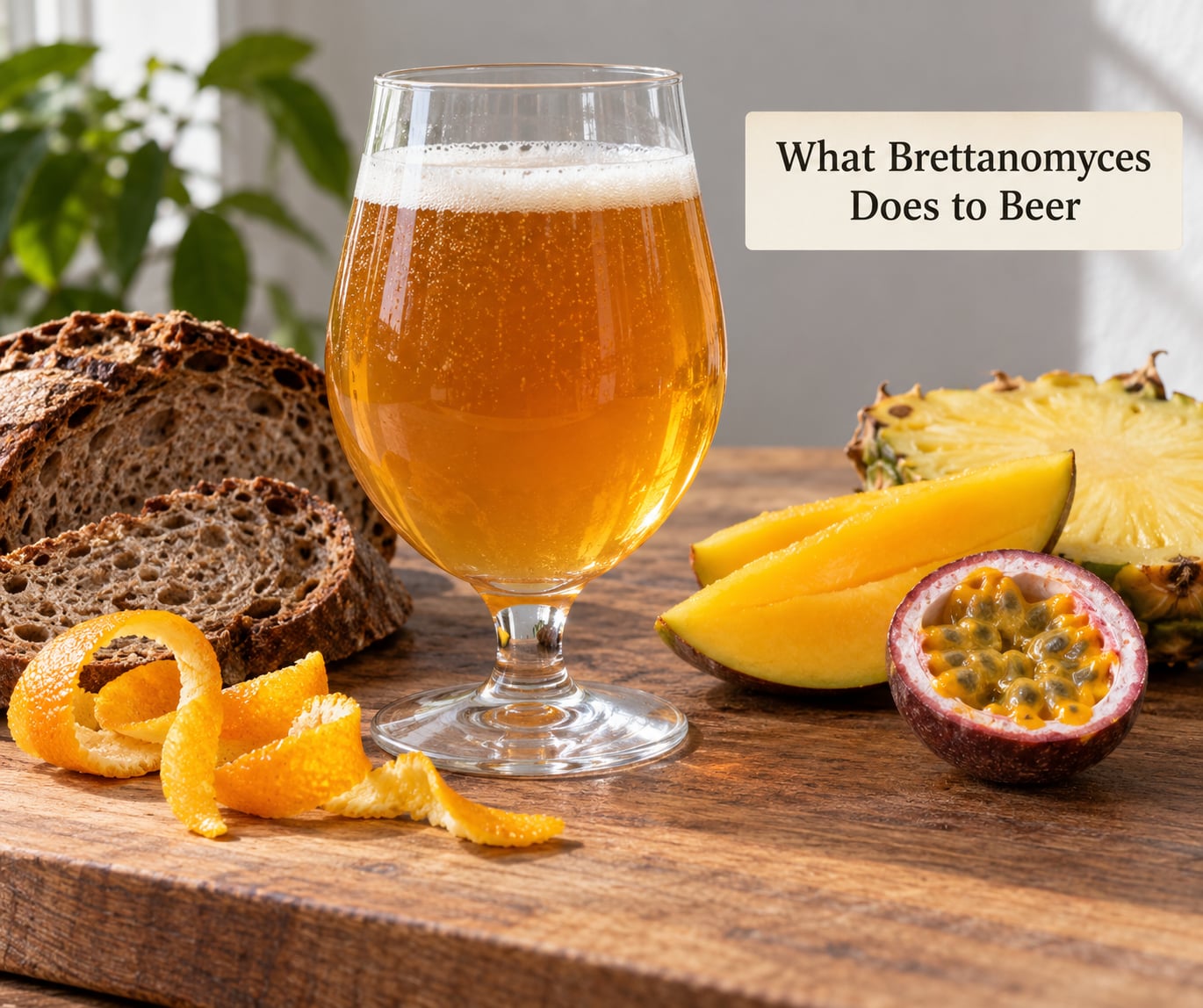
Brettanomyces does six specific things to beer, and every funky bottle you have ever tasted is the sum of them:
- Adds phenolic funk. It produces compounds that read as barnyard, horse blanket, sweaty leather, earth or a smoky clove-and-bandaid note.
- Adds fruit esters. Depending on the strain you get pineapple, overripe apple, stone fruit, citrus or a tropical edge that a clean ale simply does not have.
- Dries the beer out. Brett is a more complete fermenter than brewer’s yeast, so it leaves a thinner, lighter, more attenuated finish than a standard Saccharomyces fermentation.
- Unlocks bound aromas. It releases aroma compounds that are locked inside malt and hop plant material, which is why a hoppy beer can shift character once Brett gets involved.
- Can raise acidity indirectly. Brett is not a souring bug, but in a mixed fermentation it can push a beer toward sharper, more aggressive tartness.
- Keeps evolving for months or years. A Brett beer is a moving target: fruity and bright when young, drier and earthier as it ages.
The single most important practical fact is timing. Brewers’ yeast usually finishes a fermentation in a week or two. Brett can take weeks or months, and it will often start slowly, sit flat for a while, and then keep working. That is why Brett beer tastes different in March than it does in November.
One more thing worth knowing up front: the genus name literally means “British fungus” in Greek. The yeast was first described from British ales, which is part of why it ended up carrying the reputation of an English ale spoilage organism rather than a Belgian style staple.
Brettanomyces and Its Characteristic Flavors
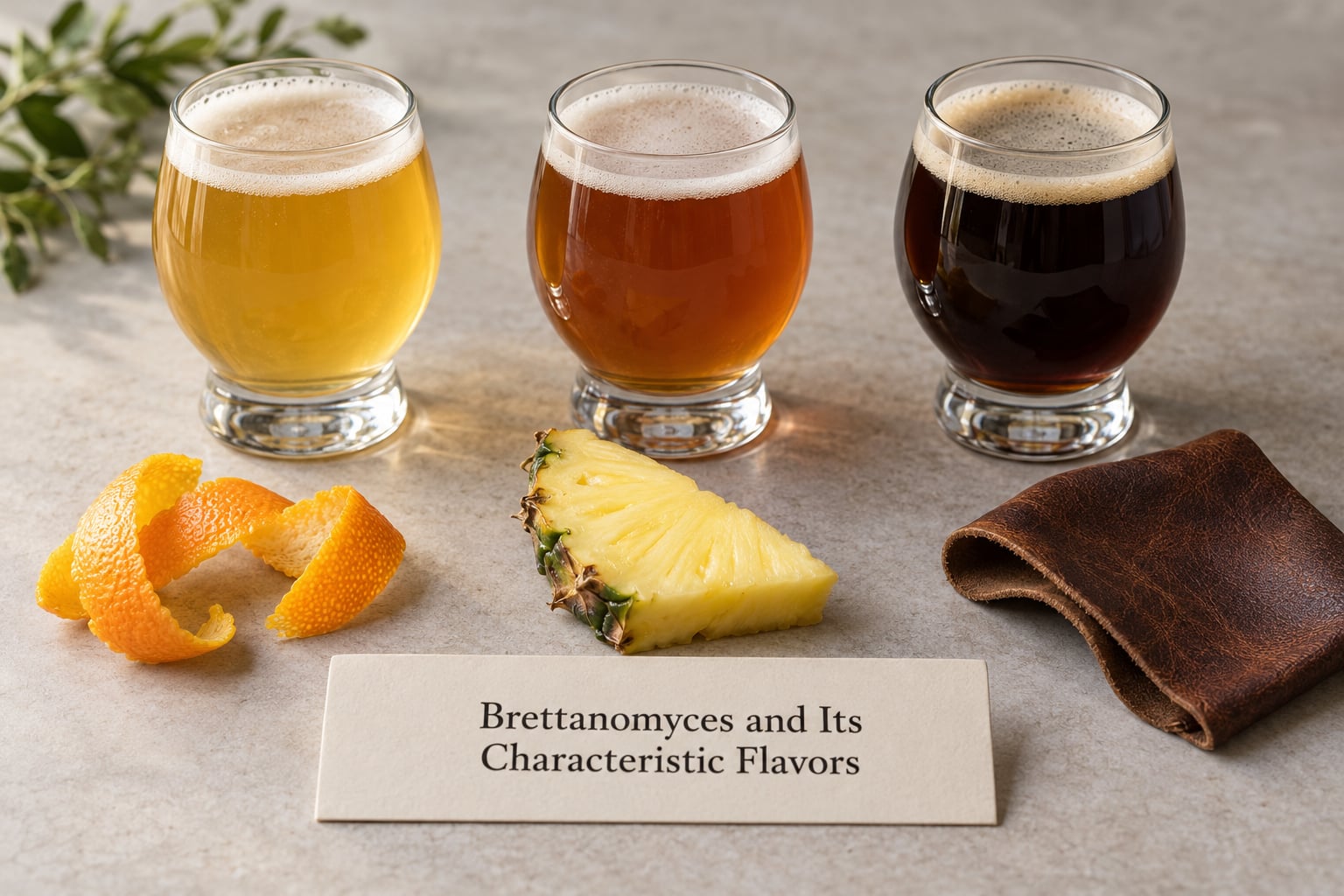
The word “funk” is the most overloaded term in beer tasting. It is a real family of aroma compounds, not a vague idea, and once you know what each descriptor means you can decide whether a beer appeals to you or repels you.
| What tasters say | What you are probably actually smelling |
|---|---|
| Barnyard | A stable or animal-shed smell: hay, damp straw and old leather |
| Horse blanket | A dusty, warm, animal musk note with a mineral edge |
| Sweaty saddle | The same family as horse blanket, usually the strongest version |
| Band-Aid | The antiseptic, iodine-adhesive note of 4-ethylphenol |
| Leathery | Old tack and saddles, with a faint tobacco undertone |
| Tropical fruit | Overripe pineapple, mango or passion fruit, sometimes fizzy like canned fruit |
| Green or overripe apple | A sharp orchard-fruit edge, the classic farmhouse note |
| Smoky or spicy | Clove, woodsmoke and dried herbs from related phenolic compounds |
| Earthy | Wet soil and forest floor, common in aged and barrel examples |
Why does the same beer smell like a barnyard to one person and like pineapple to another? Part biology, part perception. People differ sharply in their ability to detect 4-ethylphenol, and the gene for smelling it varies enough that a genuinely strong aroma reads as “band-aid and horse blanket” to some drinkers and “nice spice” to others.
Beyond the nose, four variables shift what you get: the strain (B. bruxellensis strains and B. anomalus behave quite differently), the base beer style, how much oxygen the yeast saw during fermentation, and how long it has been aging. More stress and more time generally mean more funk and more dryness.
That last point explains a common homebrewing mystery people ask about constantly. A bottle can smell like a horse blanket and still taste clean. The volatile phenols show up in the aroma long before they show up in the finish.
How Brettanomyces Changes Beer During Fermentation
Brett is a facultatively anaerobic yeast, which is plain-English for “it can work with or without oxygen.” That flexibility is one reason it survives in barrels, cellars and brewery equipment far longer than most brewing yeasts.
Three mechanics explain most of what happens in the glass. First, Brett ferments sugars that brewer’s yeast abandons. It happily uses maltotriose and, crucially, the complex sugars that structured malt releases, so a finished beer still has food available for it.
Second, Brett secretes an enzyme called beta-glucosidase that cuts aroma molecules loose from plant material. Hops and malt are full of bound flavor compounds that taste like nothing until that enzyme frees them. This hop biotransformation is why a Brett session beer can pick up a character that seems to come from nowhere.
Third, Brett ferments slowly and keeps metabolizing for a long time, and the stress response changes what it produces. Cellars, warm rooms, oxygen and nutrient depletion all push it toward the earthy, phenolic end of the spectrum. Handled carefully and it can produce a remarkably clean beer. Handled carelessly and it dominates.
It also forms biofilms and pellicles, sticky films on the surface of fermentations. That lets it hide in cracks, gaskets and drains where sanitizers never reach, and it explains the homebrewing rule of thumb that once Brett has lived in a system, treat that system as permanently Brett-positive.
What Brettanomyces Does to Acidity and Mouthfeel
Brett on its own does not make beer sour in the way that most people picture sour beer. It is not a lactic acid bacterium and it is not a vinegar bacterium. Sourness in beer comes from Lactobacillus, which produces clean, rounded lactic acid, and from Pediococcus, which produces a sharper, more aggressive sourness.
So why does that glass of lambic make your face pucker? Because of what happens in a mixed fermentation. Brett raises the acidity and ethanol over time, and in a shared culture with bacteria that shifts the balance toward sharper, more volatile acidity. Brett is helping create the sourness, but it is not manufacturing the acid.
The distinction matters when you are tasting. Clean tartness has a rounded, yoghurt-like or lemon-like curve and finishes quickly. Harsh, nail-polish-remover sourness is acetic acid, and that is a fault, not a feature, even in a wild beer.
On mouthfeel, the effect is subtler but just as noticeable. Brett strips residual sugars and thins the body, so a Brett beer often feels lighter and drier than its listed original gravity suggests. That dryness also accentuates hop bitterness, which is exactly why brewers who use Brett deliberately keep the bitterness low. Pair it with a high IBU and the beer turns harsh rather than crisp.
Brettanomyces in Sour, Wild, and Specialty Beers
Brett is not an occasional guest. In several classic styles it is load-bearing.
- Lambic and gueuze. Brett is not pitched deliberately here. It survives in the cooling wort from aged hops and the wooden foeder, and it is one of the microbes that makes traditional lambic what it is.
- Saison and farmhouse ale. Breweries blend Brett with Saccharomyces for a dry, peppery, fruity farmhouse profile. The peppery clove note is often Brett working alongside other spice-producing microbes.
- Flanders red and Oud Bruin. These oak-aged sour ales are matured for months or years, and Brett contributes the oxidative, leather-and-cherry character on top of the bacterial sourness.
- Berliner Weisse and gose. Frequently blended with aged Brett beer to add dryness, fruit and body complexity to a light, highly acidic base.
- Barrel-aged sours and stouts. Long barrel contact lets Brett mature alongside everything else in the barrel, adding tropical and earthy layers to big beers.
Brett-focused beer has moved well past the contamination story too. Competition guidelines now break out experimental and mixed-fermentation categories, and commercial breweries list pure Brett releases on their taproom boards the same way they list a pilsner. That shift in how it is described is a fair signal of how mainstream the yeast has become.
One useful comparison if you are ordering: saison is yeast-driven, peppery and dry with restrained fruit; lambic is fermentation-driven, sharper, more acidic and more rustic. Same family of microbes, very different result.
How Brewers Control Brettanomyces
If a brewer wants Brett and only Brett character, the playbook is about timing and restraint.
Primary versus secondary. Pitching Brett in primary gets more of its fruit, a fuller body and a shorter lag. Adding it in secondary, or in a secondary conditioning step, tends to push the earthy and leathery notes harder and lightens the body more. Dry hopping is widely reported to help: hop aroma can cover leathery off-notes while leaving the citrus and funk showing through.
Temperature. Brett works happily warm. Running a warm secondary around the mid-70s Fahrenheit gives you more activity and more phenolic character than a cool one.
Oxygen. More oxygen means more stress response and more oxidative, earthy character. Restrict oxygen and the same strain reads much cleaner.
Blending. Many breweries bottle a portion of strong young Brett beer and blend it back into fresher, cleaner beer at packaging time. That controls how much funk lands in the final glass without giving up the fermentation work Brett does.
Packaging. Because Brett can keep fermenting after bottling, package at a stable final gravity and be conservative with priming sugar. Homebrewers who want Brett character usually keg for this reason; a slow secondary fermentation in the bottle is how you get gushing caps and, if the beer was not fully attenuated, genuine bottle bombs.
Sanitation. If you do not want Brett, the countermeasure is aggressive cleaning and a sulfite-based sanitizer, since Brett tolerates ordinary unsulfured sanitizer far better than many brewers expect. Barrels are the hard case, and many breweries simply retire a barrel after it goes Brett-positive.
Is Brettanomyces the Same as Infection?
No, and separating the two is the most useful thing a drinker can learn about this yeast. The organism is identical. What differs is intent, and the signs are usually visible if you know what to compare.
| Signal | Deliberate Brett | Unwanted contamination |
|---|---|---|
| Aroma | Layered, fruity plus funk: pineapple, citrus, earth, leather | Funky alone, with dirty, horse-blanket or solvent notes on top of the beer |
| Flavor | Dry and complex, finishes clean and often bright | Harsh, astringent or thin, with bitterness that grows more aggressive as it sits |
| Acidity | Rounded lactic tartness that lifts the beer | Vinegar-like acetic sharpness that stings |
| Where it shows up | A named style, a listed Brett yeast strain, or a brewery known for funk | A clean style like a pale ale or IPA that never asked for it |
| Bottle behavior | Controlled, clean carbonation | Gushing, a pop off the cap, over-foaming in the glass |
| What to do | Drink it, let it age, learn which strains you like | Do not drink; check the rest of the batch and your sanitation |
The practical test at a bar is simple: ask whether the beer is meant to be funky. A brewery-tapped farmhouse ale, gueuze or a blend listed as Brett beer is deliberate. A cheap mass-market pilsner that tastes like a wet animal shed is not, and you should send it back.
For homebrewers, the anxiety is about the future rather than the glass. Brett is nearly impossible to eradicate from a system once established, and the rule most experienced brewers repeat is that if Brett gets into a batch in a given system, it is very likely to turn up in the next one too. Treat it as part of your equipment now, not as an accident you can clean away.
Frequently Asked Questions
Does Brettanomyces make beer sour?
Not directly. Brett is not a lactic acid bacterium, so it does not create the sourness itself. It raises alcohol and acidity over time, which shifts a mixed fermentation toward a sharper, more aggressive edge of tartness alongside bacteria that produce the actual acid. That is why lambic tastes sour even though Brett is only one of the microbes involved.
Is beer with Brettanomyces in it safe to drink?
Yes, in the sense that Brettanomyces is not a pathogen and does not harm humans. Sour and funk beers are routinely brewed and sold. The reason to avoid a bottle is quality, not safety: a contaminated clean-style beer can taste harsh, solventy or outright vinegar-like, which signals something you would rather not drink.
How long does Brettanomyces take to work?
It works far more slowly than brewer’s yeast. A standard Saccharomyces fermentation finishes in about a week, while Brett can take weeks or months, often with a long quiet stretch before activity picks up. A young Brett beer is more fruity, and the dry, earthy, barnyard character builds with age in the bottle or barrel.
What beers use Brettanomyces?
Lambic and gueuze rely on wild Brett from the cooling wort and foeder. Saison and farmhouse ales usually blend Brett with brewer’s yeast. Flanders red and Oud Bruin gain leather and cherry notes from Brett during long oak aging, and Berliner Weisse and gose are often blended with aged Brett beer for dryness and fruit.
How do I keep Brettanomyces out of my homebrew?
Use a sulfite-based sanitizer rather than unsulfured sanitizer, soak every item that touches beer including tubing, stoppers and keg parts, and replace cracked or pitted plastic that hides biofilm. Keep barrels out of the clean path if you have them. Once Brett has established itself in a system, expect to treat that system as permanently Brett-positive.
Can I get rid of Brettanomyces once it is in my equipment?
Completely, no. Bleach and caustic cleaners will not reach biofilm sitting in gaskets, chill plates and drain lines, and repeated cleaning usually reduces it without eliminating it. The realistic options are to dedicate that equipment to Brett beers going forward, or to replace the plastic components and treat stainless steel with a brewery-grade sanitizer as a strict routine.
Conclusion
Understanding what brettanomyces does to beer changes how you read any glass in front of you. The yeast makes beer drier, fruitier, funkier and more changeable than anything a clean cultured strain can, and it is the reason some classic styles taste the way they do. It is not a disease, it is not sour-making on its own, and the same organism that ruins a pale ale can be the whole point of a gueuze.
So start by figuring out which of three situations you are in. If you are drinking, check whether the style is meant to be funky before you judge it. If you suspect a contaminated bottle, send it back rather than trying to taste past it. If you are brewing, decide now whether you want Brett on purpose, because the answer changes what you do with your equipment and your cleaning routine.