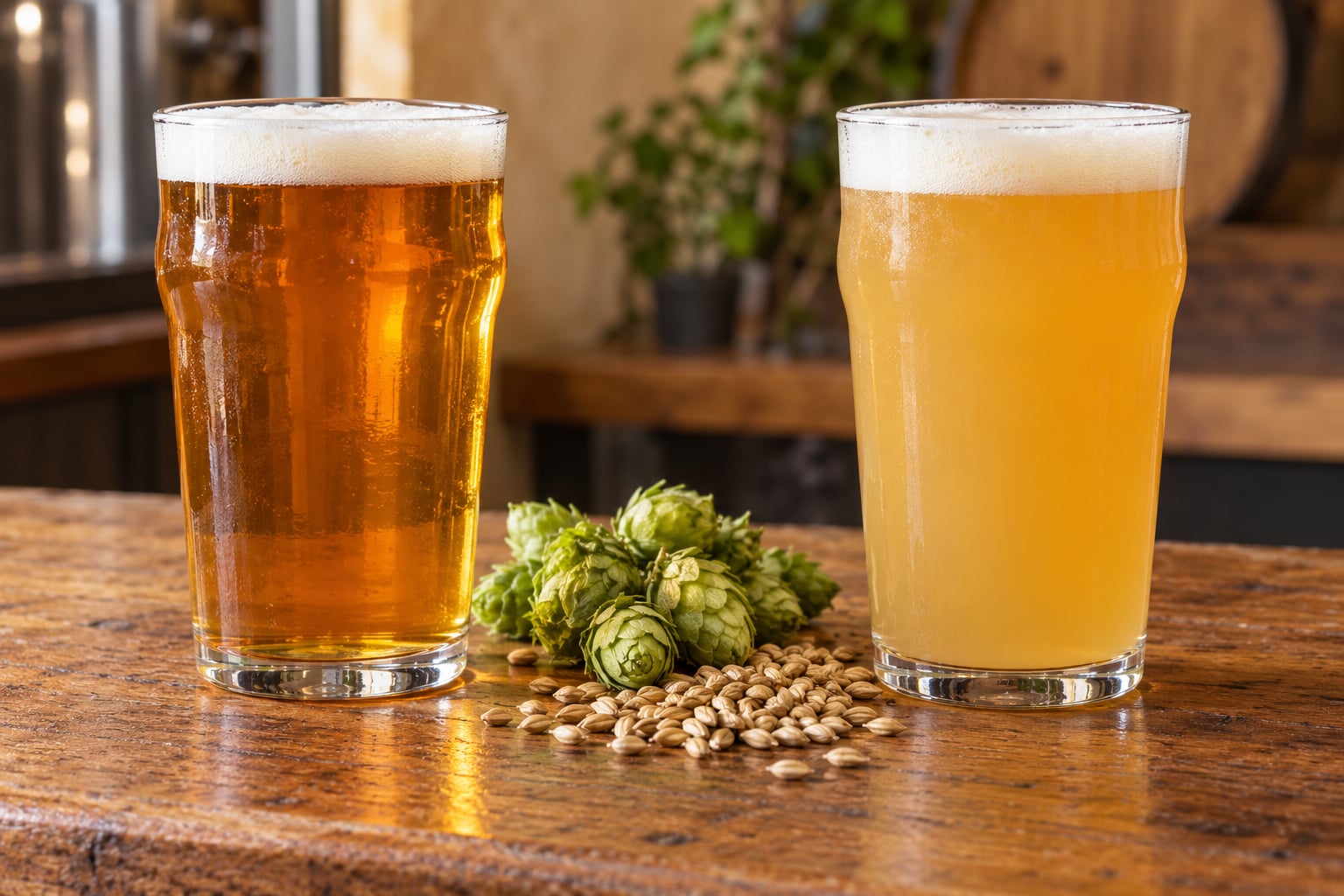
British beer and American beer are made from the same four ingredients: barley, hops, yeast and water. What changes is the specification. British beer, and cask ale above all, is built for drinking slowly in small quantities, so it leans on English heritage hops, heritage malts, moderate strength and soft natural carbonation. American beer is built to be refreshing and, in the craft segment, deliberately loud, so it leans on Pacific Northwest hop varieties, clean fermentations, higher alcohol and sharp, force-carbonated cold service.
The useful way to read the difference is as two design briefs, not as a quality contest. One tradition optimised for a seated pub session, the other for a cold, quick drink at scale. Neither brief is better; they just answer different questions.
Table of Contents
- How British Beer Differs from American Beer at a Glance
- How the Brewing Traditions Developed Differently
- Flavor and Yeast: Clean and Nutty Versus Bold and Fruity
- English ale yeast ferments warm and leaves esters behind
- American craft ale yeast is usually cleaner and drier
- Malt does the rest of the work
- Hops: Earthy and Herbal Versus Grapefruit and Tropical
- How British beer differs from American beer when it comes to hop choice
- Strength, Body, and Sessionability
- Carbonation and Serving: Cask Ale Versus Draft Beer
- Why the pint sizes confuse people
- Which Should You Choose?
- Frequently Asked Questions
- Is British beer generally stronger than American beer?
- Why do British ales often taste nuttier than American ales?
- Why do American IPAs usually taste more citrusy or tropical than British beers?
- Are British and American pale ales made in the same way?
- What is the easiest way for a beginner to compare British and American beer?
- Does cask conditioning make British beer better than American draft beer?
- Bottom Line
How British Beer Differs from American Beer at a Glance
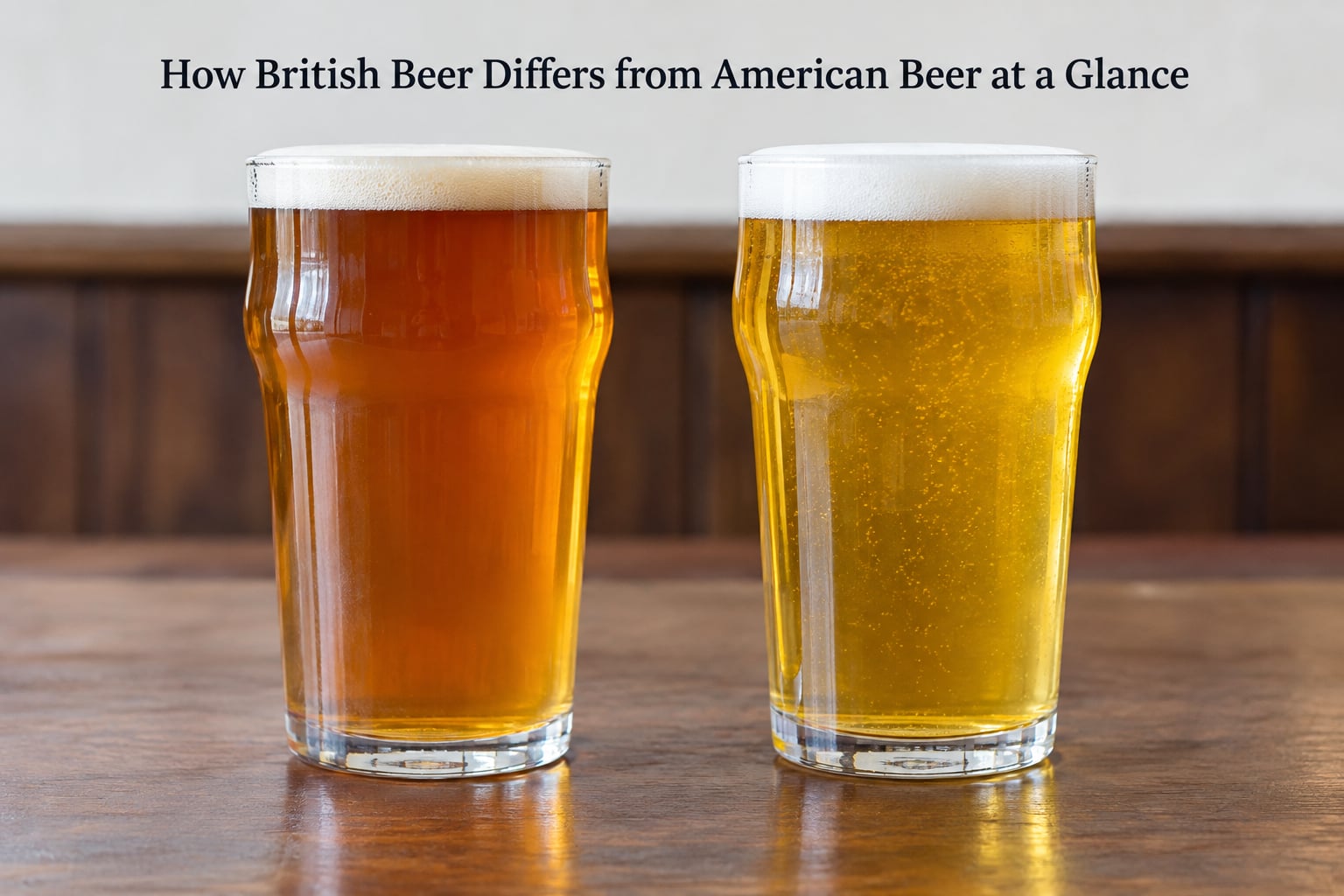
The key differences between British and American beer come down to four decisions: which yeast is used and how warm it ferments, which hop varieties go in, how the beer is packaged and served, and what strength the brewer is aiming for. British brewing favours top-fermenting ale yeast around 18-20C, sulfate-rich water, English hops and heritage malts, then often conditions the beer in an unpasteurised cask served through a handpump at cellar temperature. American brewing ranges from cool bottom-fermented lager yeast to warm-fermented craft ales, with a far wider spread of hop intensity depending on which segment you are in.
| Criterion | British tradition | American tradition |
|---|---|---|
| Typical yeast | Top-fermenting English ale yeast, 18-20C | Bottom-fermenting lager yeast, 8-13C, or clean American ale yeast at 18-21C |
| Typical ABV | Mostly 3-5.5% | Mass-market lager 4-5%; craft ale 5-8% and up |
| Hop varieties | East Kent Goldings, Fuggle, Target, Challenger | Cascade, Centennial, Citra, Simcoe, Amarillo, Mosaic |
| Hop intensity | Restrained; earthy, herbal, floral, spicy | Low in mass-market lager, very high in craft IPA |
| Base malts | Maris Otter, Golden Promise, crystal malts | Two-row pale malt, caramel and specialty malts, adjuncts in lager |
| Water profile | Sulfate-rich Burton upon Trent style water accents bitterness | Typically treated municipal water, often heavily adjusted in craft breweries |
| Carbonation | Natural conditioning in cask, soft | Force carbonation in keg, can or bottle, sharp |
| Serving temperature | Cellar temperature, about 11-13C (52-55F) for cask | Ice cold, roughly 3-7C (37-45F) |
| Glassware | Nonic or dimpled pint, 568ml imperial pint | Pint glass, 473ml US pint, or a 355ml can |
| Serving format | Handpump in a pub, bottle, or keg in a taproom | Tap line, taproom, bottle shop, can |
Read that table as tendencies, not rules. A British brewery in Yorkshire dry-hops a pale ale with American hops all the time, and an American brewery in San Diego brews a restrained English-style pale ale with Maris Otter. The dials are set differently, which is what makes the two traditions taste recognisably different even when the style names match.
How the Brewing Traditions Developed Differently
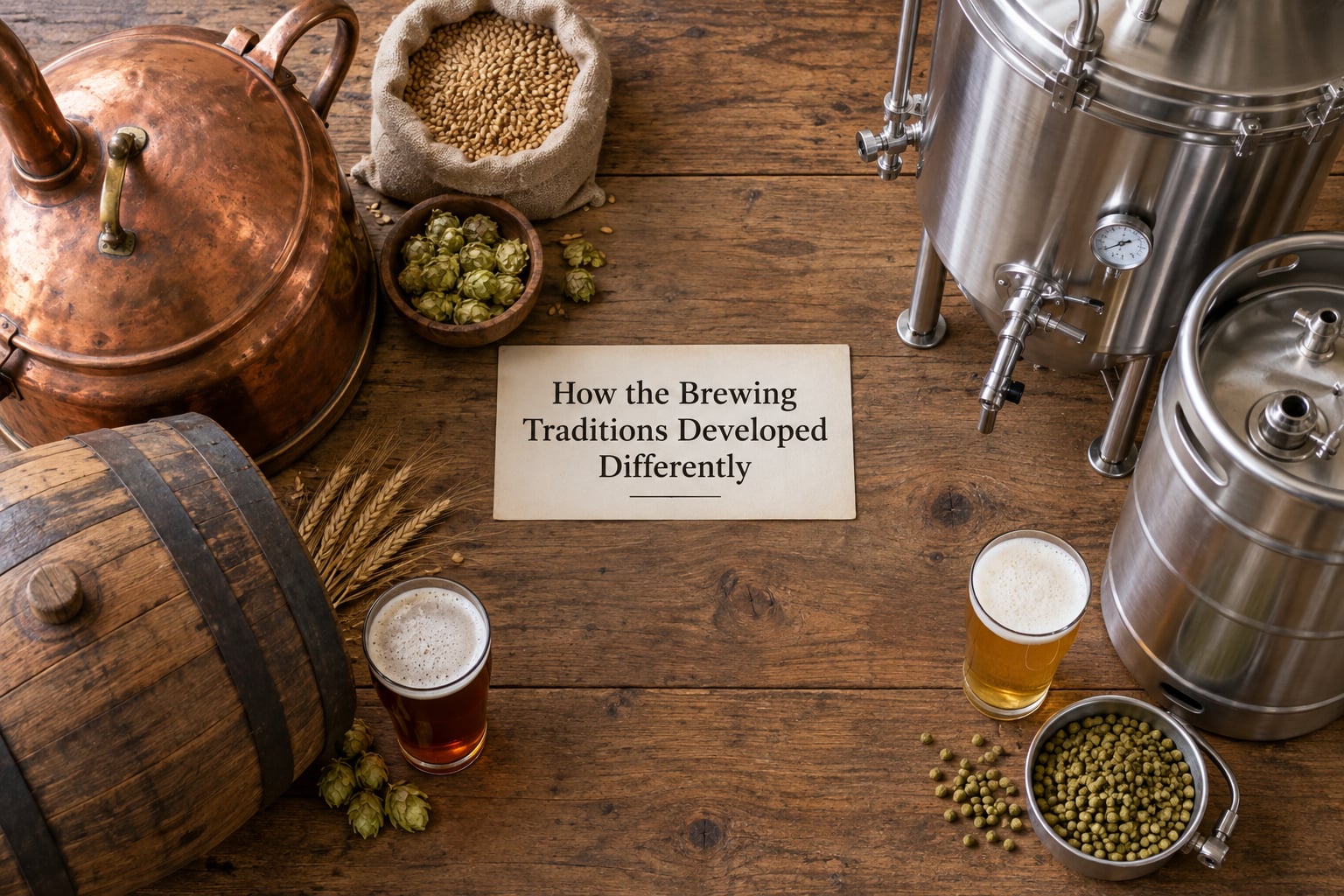
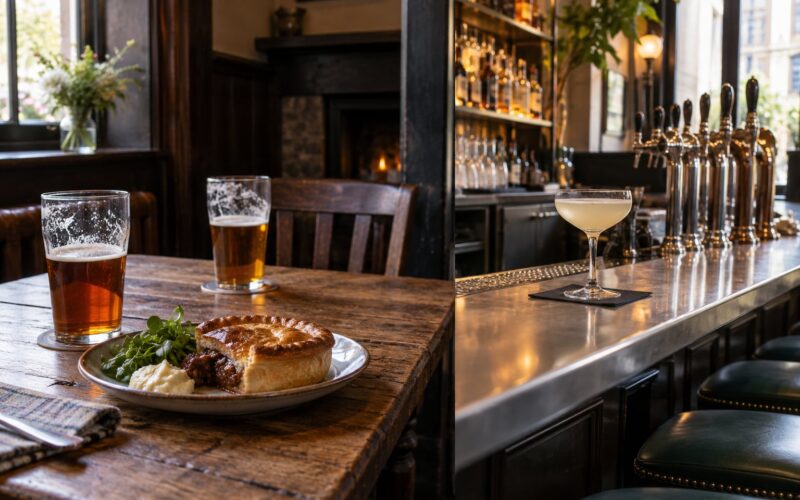
British brewing grew out of a pub economy that had no refrigeration for most of its history. Beer arrived by gravity from the brewery to the cellar, sat there, and went to the pub through a handpump with no further intervention. That environment rewarded a beer that stayed stable for weeks, kept its character through a second conditioning stage, and could be sold by the pint without a delivery window measured in hours.
Cask conditioning is what that system produced. Beer finishes fermenting in an unsealed cask, develops its own natural carbonation, and is usually left unpasteurised because heat treatment would flatten the very flavours the system was designed to protect. The result is beer with a soft, low-gravity texture and a sediment that has to be managed before the cask goes on sale.
American brewing developed under refrigeration and distribution. Cold storage, sealed packaging, pasteurisation and long-distance trucking all pushed American breweries toward stability and shelf life first. That produced a national lager culture built on pale malt, adjunct grains, clean fermentation and force carbonation, where consistency mattered more than a sense of place.
The craft revolution from the late 1970s onward attacked that sameness directly, and it did it by borrowing British and German style vocabulary wholesale. Homebrewers reconstructed pale ales and porters from published recipes, then small breweries scaled them up and pushed the one ingredient American growers were clearly better at: hops.
So the two traditions are not ancient rivals. One is an old system refined by continuous pub service, the other a young one that deliberately reinvented itself by studying the first and then outbidding it on aroma.
Flavor and Yeast: Clean and Nutty Versus Bold and Fruity
The yeast is the single biggest reason an English pale ale and an American pale ale never converge, even when brewed from similar malt and hops. Temperature and strain behaviour do most of the work.
English ale yeast ferments warm and leaves esters behind
English ale strains ferment at roughly 18-20C and are not fully attenuated, which leaves some of the higher alcohols in the finished beer. That residual sweetness plus the fruity esters the yeast produces during fermentation is where the apple, pear, plum and sometimes stone-fruit character comes from.
Many English ales also retain a low level of diacetyl, the compound that smells of butter, toffee or butterscotch. American drinkers trained on clean ales often read it as a fault, and it is listed among off-flavours in style guidelines, but in a traditional bitter or pale ale it is part of the intended character.
American craft ale yeast is usually cleaner and drier
Most American craft ales run at similar or slightly higher temperatures but with strains selected and pitched for clean, complete fermentation. The beer attenuates fully, leaving a drier finish that lets hop aroma sit on top without a fruity or biscuity base interfering.
That dryness is not a universal rule. New England IPAs, farmhouse ales and many Belgian-influenced styles rely heavily on expressive yeast, and plenty of American brewers deliberately under-pitch to pull fruit forward. The general pattern still holds, though: you are more likely to taste the yeast as a flavour in an English ale and as an absence of flavour in an American one.
Malt does the rest of the work
British pale ales lean on Maris Otter or Golden Promise, both heritage barleys with a characteristically biscuity, slightly nutty base, plus crystal malts for caramel and toffee depth. The malts carry more of the beer than they do in a heavily hopped American IPA.
American pale ales build on two-row pale malt, which is lighter and cleaner, then lean on late and dry hopping for aroma. A big West Coast IPA can contain only a small proportion of its grist as speciality malt, because the hops and the alcohol are doing most of the talking.
Hops: Earthy and Herbal Versus Grapefruit and Tropical
English hops tend to taste herbal, earthy, floral and sometimes spicy or tobacco-like. American hops tend to taste citrusy, piney, resinous, grapefruity and tropical. That split is genetic, agricultural and old, and it is the flavour difference drinkers notice first.
How British beer differs from American beer when it comes to hop choice
Traditional English varieties include East Kent Goldings, Fuggle, Target and Challenger. They grew in Kent and Herefordshire for generations, and they contribute gentle floral notes, herbal character and moderate bitterness. They are not weak hops; they are simply expressive in a different direction from the American varieties that dominate modern craft brewing.
Cascade, Centennial, Citra, Simcoe, Amarillo and Mosaic dominate the American side, mostly from Washington, Oregon and Idaho. Cascade brings pine and flower; Centennial brings pine and resin; Citra and Amarillo bring intense grapefruit, passion fruit and mango. Since homebrewers started using them in the 1980s, these varieties have also moved into British brewing.
That last point deserves correcting, because the idea that American hops are a recent American invention is wrong. American hops, including native wild selections, have been used in British brewing for well over a century. What is new is their scale and their intensity, not their presence.
Bitterness follows the same split. English bitters and pale ales are built on balance, where bitterness supports the malt rather than leading. American West Coast IPAs routinely push bitterness into territory British brewers abandoned decades ago.
Strength, Body, and Sessionability
No, British beer is not generally stronger than American beer. The answer is style by style, and the two averages are closer than most people assume.
| Style | British ABV | American counterpart | American ABV |
|---|---|---|---|
| Bitter | 3-4.2% | American amber ale | 4.5-6% |
| Extra Special Bitter | 4.2-5.2% | American strong ale | 6-8% |
| English pale ale | 4-6% | American pale ale | 4.5-6.2% |
| India Pale Ale | 5-7% (export-leaning heritage versions higher) | American IPA | 6-7.5% |
| Porter | 4-5% | American porter | 5-7% |
| Stout | 4-4.7% | American stout | 5-8% |
| Barley wine | 7-10% | American barley wine | 8-12% |
| Premium lager | 4.5-5% export style | US premium lager | 4.5-5% |
Where the real difference shows is gravity and body. British ales at 4% can taste denser and more substantial than an American beer at 5%, because the English recipe leans on high fermentability of the malt without chasing full attenuation, while the American version may finish drier and thinner.
Sessionability is the practical word. A session beer is one intended to be drunk slowly over a couple of hours, and that band sits around 3-4.2% in Britain. American craft brewing has largely moved past session strength as a category, which is exactly why a 4% English bitter can feel like a different proposition from a 4% American craft ale even though the number on the pump is the same.
Higher alcohol in American IPAs has a historical logic too. British IPA grew out of pale ales brewed stronger and better hopped for export to India, and modern American brewers scaled that idea up aggressively. The hop aroma that makes those beers distinctive dissolves quickly once a beer is warm, so strength and hopping travelled together.
Carbonation and Serving: Cask Ale Versus Draft Beer
This is where British and American beer diverge most visibly in the glass. Cask ale is conditioned in the cask and served low-pressure through a handpump; American draft beer is force carbonated in a keg and served cold through a tap line.
| Factor | Cask ale | Force-carbonated draft |
|---|---|---|
| Carbonation | Natural, from a secondary conditioning stage | Injected under pressure before serving |
| Texture | Soft, low-gravity, sometimes very still | Firm, sharp, consistent head |
| Temperature | Cellar temperature, about 11-13C | About 3-7C |
| Treatment | Usually unpasteurised | Usually pasteurised or filtered |
| Shelf life | Days to a few weeks once on sale | Weeks to months |
| Hardware | Handpump or beer engine | Tap line and coupler system |
Cask ale needs slower service and a cellar kept in the recommended band, which is why CAMRA focuses on the mechanics of the handpump and why Cask Marque exists to accredit venues that handle it properly. Both sides of the Atlantic now use each other’s methods: American taprooms run cask and unfiltered beer, and British brewers release can and keg ranges of hop-heavy ales.
Why the pint sizes confuse people
A UK imperial pint is 568ml, and a US pint is 473ml. Ask for a half in Britain and you get 284ml; the standard US serving is a 355ml can or bottle. Order a pint in London and you receive roughly a fifth more liquid than a pint in Chicago.
Glassware follows the same split. The nonic pint glass bulges near the top and the dimpled pint has a textured lower half; both exist so a hand-held glass has grip on a pub table with no coaster in sight. Neither shape has a functional role in a US bar, where a straight-sided pint glass is standard.
Which Should You Choose?
Match the beer to the drinking occasion, not to the country of origin. Once you know what you enjoy, the tradition is an easy second question.
If you drink malt-forward beer and like brown sugar, toast, nuts and dried fruit, start with a British bitter, an English pale ale or an extra special bitter. If you chase grapefruit, pine and mango, a balanced American pale ale is the right entry point, and a heavier West Coast IPA is where that preference escalates.
For a session where you want to stay upright through an afternoon, Britain has the better answer. A 3.7% bitter or a 2.8% mild is built for two, three or more hours without becoming the reason you skip dinner.
If you want one beer for a barbecue, a football match or a long night out, American craft is the easier pick. It is more widely available, more consistent, and better suited to being drunk cold and quickly.
For food, both traditions pair well with pub classics. Fish and chips, a ploughman’s lunch, a meat pie or a Sunday roast all suit a cask bitter or an English pale ale, while a pale ale with a spicy wing or a rich curry suits a heavily hopped American IPA.
For a first taste comparison, pick two restrained beers rather than the extremes. An English bitter or an English pale ale on one side, an American pale ale on the other. Strong ales and imperial IPAs will tell you almost nothing on a first pass, because alcohol and raw hop intensity both drown out the differences you are trying to learn.
If you are in the US and want British-style beer, your options are bottle shops with a decent import section, taprooms running cask, and the small group of American breweries that specialise in English styles. Start with a bottled ESB or a brown ale, then hunt down cask when you can.
Frequently Asked Questions
Is British beer generally stronger than American beer?
No, not as a rule. Ordinary British pub ale sits at 3-5% ABV, while mainstream American lager runs 4-5% and American craft ales usually run 5-8%. British exports and barley wines are strong, but the day-to-day average is not higher than the American equivalent. Compare style by style, not country by country.
Why do British ales often taste nuttier than American ales?
Two reasons. English ale yeast ferments warm and leaves fruity esters plus a trace of diacetyl, which reads as butter, toffee or biscuit. The base malts, usually Maris Otter or Golden Promise, also carry more weight than the cleaner two-row pale malt common in American brewing. You get more flavour from the grain and the yeast.
Why do American IPAs usually taste more citrusy or tropical than British beers?
It comes down to hop genetics. American varieties such as Cascade, Centennial, Citra and Simcoe carry high concentrations of the oils that produce citrus, pine, resin and tropical fruit notes. English varieties like East Kent Goldings and Fuggle lean herbal, floral and earthy. American brewers also dry hop heavily, which extracts aroma without adding bitterness.
Are British and American pale ales made in the same way?
The process is the same but the specification is not. A British pale ale uses top-fermenting ale yeast at 18-20C, English hops and heritage base malts, and is often served from cask at cellar temperature. An American pale ale uses clean fermenting yeast, Pacific Northwest hops, late and dry hopping, and force carbonation served cold.
What is the easiest way for a beginner to compare British and American beer?
Buy a restrained English bitter or pale ale and a balanced American pale ale, pour both into the same glass, and serve each at its own proper temperature, around 11-13C for cask ale and 4-7C for the American beer. Smell before tasting, then note malt, hops, fruit and body separately instead of reaching for a single verdict.
Does cask conditioning make British beer better than American draft beer?
No, it makes it different. Cask conditioning gives softer carbonation, a living beer that keeps evolving, and no pasteurisation, at the cost of a short shelf life and the need for careful cellar temperature and handpump handling. Force carbonation gives consistency, a longer shelf life and total control over texture. Neither approach is a shortcut.
Bottom Line
How British beer differs from American beer comes down to a handful of deliberate choices about yeast temperature, hop variety, malt bill, carbonation and serving temperature. One side built a seated pub session around soft cask ale and heritage malts; the other built cold, sharp, force-carbonated beer and then reinvented itself around extreme hops.
Start with a restrained British bitter and a balanced American pale ale, pour both into the same glass, and taste them side by side. That single comparison teaches more about how British beer differs from American beer than any amount of reading, and it takes about ten minutes.