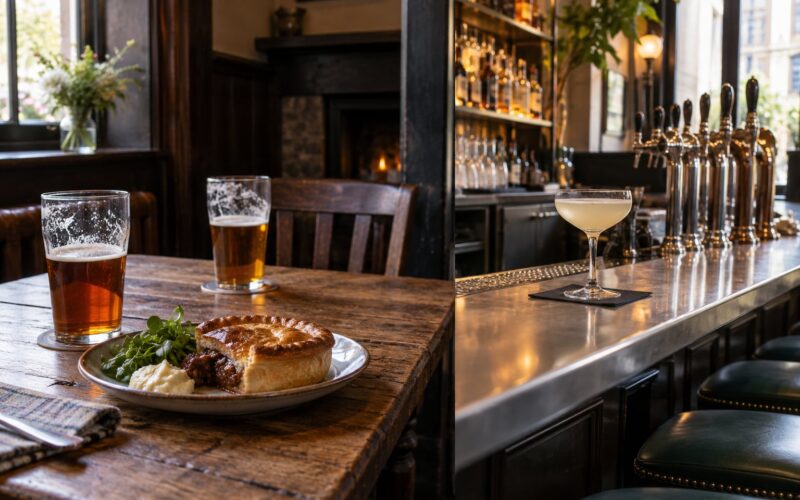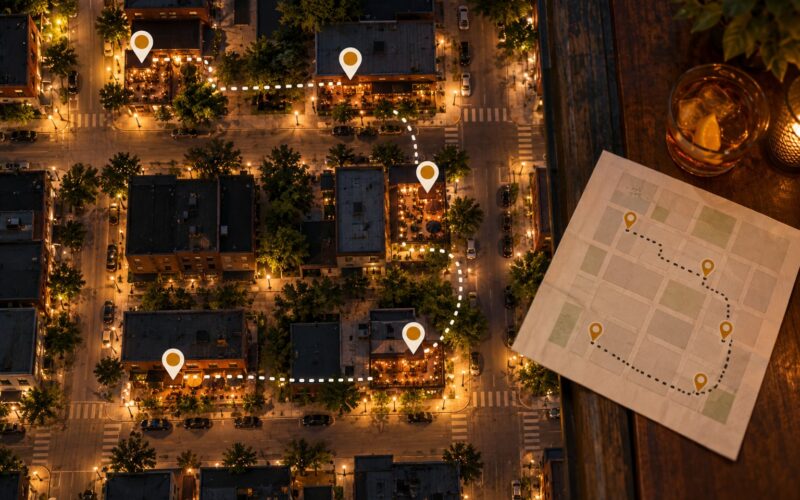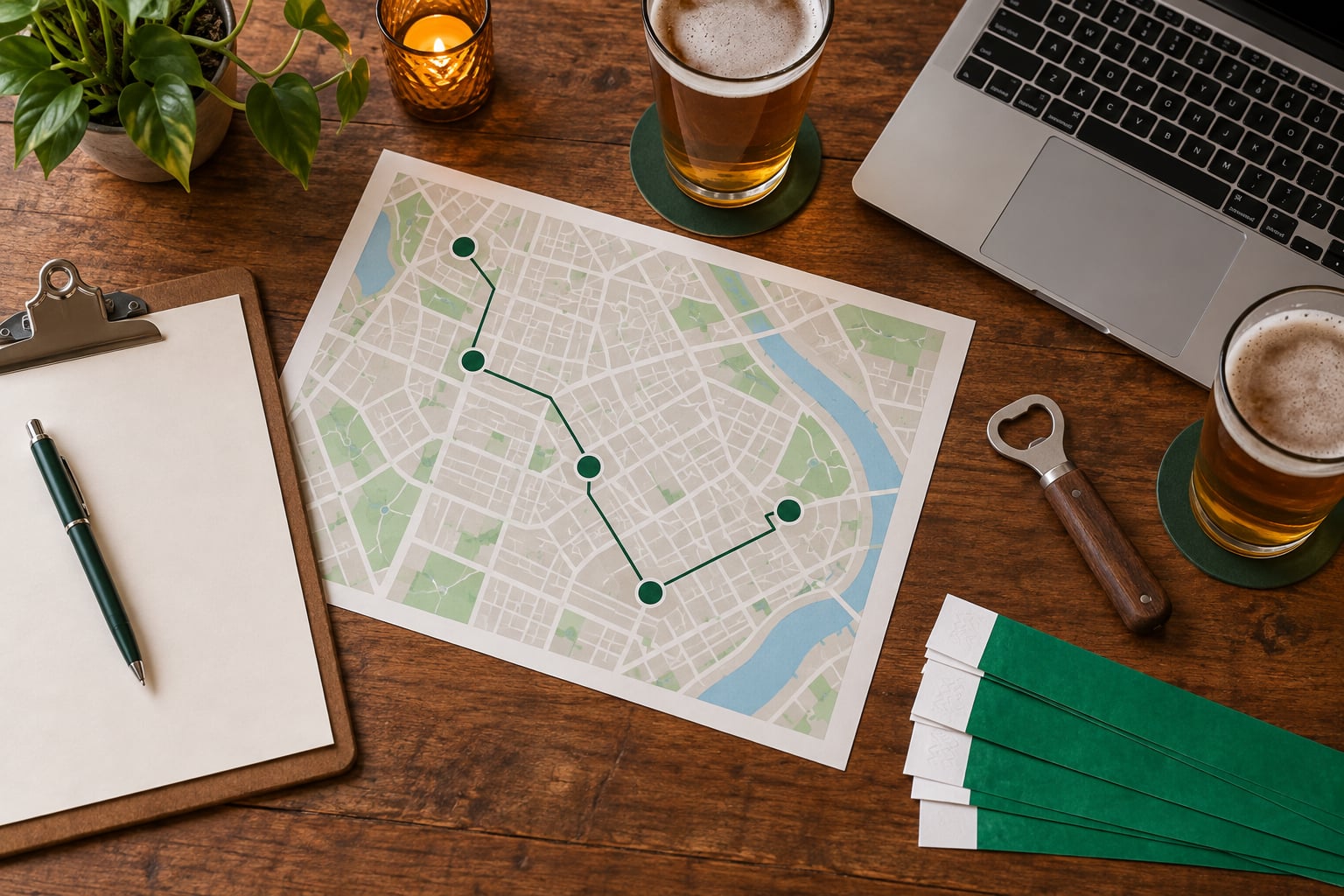
To organize a bar crawl fundraiser, pick a cause and a number, recruit four to six nearby bars that agree in writing to give back part of the night’s sales, sell tickets in advance, then run the crawl on a fixed timed schedule with a check-in table, wristbands and arranged transportation. The money comes from tickets, from each venue’s percentage of sales, and sometimes from per-stop pledges. Most first-time organizers underestimate the budget and over-estimate attendance, so this guide spends real space on both. Ten weeks is a comfortable runway; six is tight.
Updated October 2026. Written for community organizers, charity staff, school groups, clubs, and brewery or taproom teams who want the night to work financially, not just socially.
Table of Contents
- What You Need
- Step-by-Step: How to Organize a Bar Crawl Fundraiser
- 1. Set the fundraising goal and name the beneficiary
- 2. Pick the city, date and crawl format
- 3. Recruit the bars and confirm the route
- 4. Get permissions and plan for safety
- 5. Design tickets and the fundraising budget
- 6. Promote the event and recruit volunteers
- 7. Run the crawl and reconcile the results
- Common Mistakes
- Choosing too many venues
- Relying on one promotion channel
- Unclear beneficiary details
- Hiding fees until the end
- Under-covering safety
- Packing the route too tightly
- Failing to reconcile payments
- Frequently Asked Questions
- How much should a bar crawl fundraiser ticket cost?
- Do bars need to donate a percentage of their sales?
- What permits or insurance are needed for a bar crawl fundraiser?
- How can I make a bar crawl fundraiser safer for guests?
- Should the fundraiser include beer tasting or full drinks?
- How do I keep track of ticket sales and money raised?
- Conclusion
What You Need
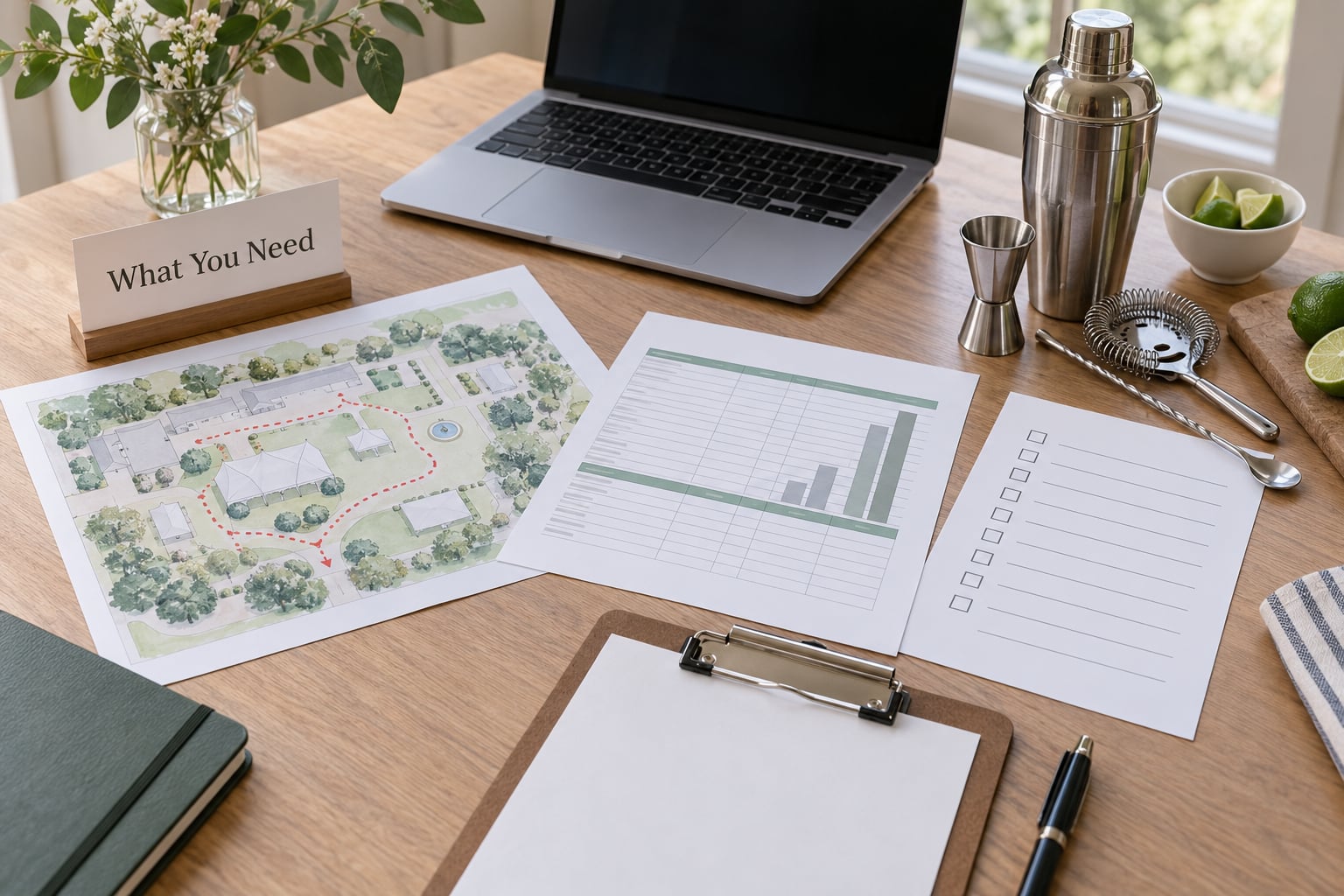
Before you call a single bar, you should be able to answer “yes” to most of these. If three or four are still blanks, the event is not ready to promote.
- A cause and a beneficiary. A named organization receiving the money, and the specific thing it buys: meals for a shelter, scholarships, animal rescue medical bills. Vague causes undersell tickets.
- A target amount and a headcount. You need both to know how many tickets to sell.
- A date, a start neighborhood, and a rough stop count. Venues will ask for all three.
- Written venue confirmations. Email or signed agreement, not a text saying “yeah probably.”
- A ticket or registration system. A page that takes payment, issues a confirmation, and keeps a count.
- A money-handling method. Someone who counts, records, and deposits, and a second person who checks.
- Volunteers. Check-in, route support, and a float of sober drivers or a shuttle plan.
- A safety plan. 21-plus ID checks, wristbands, a stated cutoff time, and transportation home for everyone.
- Permits and insurance, or at least a call to your city about them. Most multi-venue alcohol events need a certificate of insurance on file with each venue.
- Promotional materials. An event page, a poster per participating venue, and social assets sized for each platform.
One thing most organizers skip: a printed run sheet. A single page that says when each stop begins and ends, who is leading, and where the shuttle picks up will save the night.
Step-by-Step: How to Organize a Bar Crawl Fundraiser
1. Set the fundraising goal and name the beneficiary
Write down a specific number and a specific recipient. “Five thousand dollars for the animal rescue’s medical fund” sells tickets; “to help a local charity” does not. The Kalamazoo Zoo Best Damn Charity Bar Crawl built its whole appeal on a named beneficiary, which is the pattern to copy.
Then reverse-engineer the attendance. If you need 2000 dollars net and your realistic net per ticket lands between 15 and 25 dollars after costs, you are looking at roughly 80 to 130 paying guests. Write down both your optimistic and pessimistic headcounts, and plan against the pessimistic one. Real events sell out (the Port Colborne charity crawl did, and came back the next year), but first-year crawls routinely draw half the signups they hoped for.
Decide in advance what happens if you fall short: extend the deadline, add a matching-donation partner, or hold the money until you can run it again. Organizers who write that sentence down calmly in October make a real decision in November.
2. Pick the city, date and crawl format
Walkability beats venue count. Four to six stops inside a compact area with transit access is the standard, and the sweet spot for most groups. More than six stops turns a fundraiser into a foot injury.
Pick a format that fits the cause. A neighborhood crawl is the easiest and the most forgiving. A themed crawl, where teams dress up and order themed drinks, works well — the Tipsy Tiki crawl ran exactly that way, and costumed crowds photograph better than any other. A ticketed progressive tasting suits a brewery district, where taprooms can pour small samples instead of full drinks and the pace stays reasonable. A charity pub night, one long evening in a single venue, has the lowest risk of all and needs no permits for a moving group.
Choose a Saturday or a weeknight in early autumn or spring. Avoid major holiday weekends, big local sports fixtures, and the two weeks around the year-end fundraising push, when donors are tapped out.
3. Recruit the bars and confirm the route
Ask in person or by phone, not by email. Email gets ignored; a ten-minute visit at a quiet hour gets a commitment. Go at 2 to 4 in the afternoon, introduce yourself and the cause, and bring the date, the expected headcount, and a one-page summary of what the night looks like.
Venues consistently prefer a percentage of sales over a flat donation, because a percentage costs them nothing on a slow night. Ask for things in this order, hardest first:
- A named signature drink where a set amount per drink goes to the cause
- A percentage of crawl-attributed sales during the event window, often 10 to 20 percent
- A buy-one-get-one or happy-hour special that lifts volume
- In-kind food for the final stop, which keeps people on site longer
- A flat donation from the till or from staff tips, usually the hardest ask
What the venue gets matters as much as what you get: guaranteed foot traffic in a normally slow hour, sampling of a beer they are proud of, social content from a themed crowd, and a repeat customer base for next year’s event. Tell them the expected headcount out loud. A bar owner who hears “sixty people” and one who hears “four hundred” answer very differently.
Keep the route honest. Aim for five to eight minutes of walking between stops and 45 to 60 minutes of dwell time at each. Six stops at 50 minutes plus walking is a four-hour event, so a 7 p.m. start ends around 11 p.m. Anything past midnight turns away the working adults and the designated drivers you need. Get every venue’s agreement in writing, with the date, the event window, the percentage agreed, and the name of the person who signed.
Always build a spare: one backup venue and one shorter version of the route. Weather takes a crawl outdoors, or a venue calls off, and a three-stop version lets you run the night anyway.
| Model | How money comes in | Best fit | Watch out for |
|---|---|---|---|
| Pre-sold tickets | Fixed price per person, sold before the night | New organizers; you know your cash before anyone shows up | Ticket price has to match what the guest actually gets |
| Percentage of sales | Each venue gives back a share of crawl-attributed sales | Established relationships and small crowds | Sales totals need a POS report afterward, and the raise is uncertain |
| Per-stop pledges | Supporters pledge an amount each time a crawler checks in at a stop | Groups with an engaged donor base who want to participate | Takes a live person at every stop to collect and count |
The Jersey City Pride crawl ran the percentage model across named downtown venues including Pint, Legends, Pet Shop and Six26. The Barman’s Fund of Louisiana runs the same shape for an animal rescue. Neither had to sell a single ticket in advance.
4. Get permissions and plan for safety
Call your city or county licensing office and ask what a moving alcohol event requires. Depending on where you are, the list can include a special event permit, a right-of-way permit if the group gathers in a street, state charitable solicitation registration if you are collecting money as a charity, and a certificate of insurance naming each participating venue as an additional insured.
You do not need nonprofit status to run a crawl, but charitable solicitation rules are separate from tax status. Groups without 501(c)(3) status often run the event through a fiscal sponsor, which handles the money and issues the tax receipt. Your venue’s insurer will want to see the coverage before they agree, so buy general liability coverage early — many small organizers find that a single-day event policy in the several-hundred-dollar range is enough, and venues usually ask for a minimum limit stated in their agreement.
Now build the safety plan, because this is what participants check first and what venues require before saying yes:
- Transportation. A shuttle or party bus loop, a designated-driver group with a sober ride voucher, or a named rideshare code printed on the wristband. Announce it at check-in and again at the last stop.
- 21-plus ID checks at the door. The crawl is adults only. Check at check-in, not at each bar.
- Wristbands. One color for guests, a second for volunteers and staff, and a distinct one for designated drivers. Non-drinkers get a wristband too, so nobody has to explain themselves at the bar.
- A stated cutoff time. Say it out loud at check-in. Most organizers set last call 30 minutes before the event ends and end service at the close time, no exceptions.
- A refusal policy. Staff have standing permission to cut anyone off, and the bartender at each stop knows it. This is a condition of most venues agreeing to participate.
- An emergency contact and a first-aid kit with the route lead, plus the address of the nearest urgent care to the start location.
5. Design tickets and the fundraising budget
A bar crawl fundraiser ticket usually lands between 25 and 50 dollars depending on city, stop count and whether drinks are included. What matters more is that the guest can see what they get. A ticket that includes one signature drink at each stop, a commemorative wristband, cover at the final stop, and entry into the prize table reads as a value; a ticket that is really just a donation with a bar attached does not.
Publish one honest number: “every dollar after venue and event costs goes to the cause.” Then show the breakdown after the fact. Transparency is the single easiest way to keep your nonprofit or club credible, and it dodges the objection that the organization is profiting from alcohol.
Model the budget before you publish a goal. Here is a typical first-year crawl:
| Category | Typical range | Optional? |
|---|---|---|
| General liability insurance | 300 to 900 dollars | No — venues usually require it |
| Ticketing platform fees | roughly 5 to 10 percent plus a per-ticket fee | No, but a free peer-to-peer page with a fee option cuts it |
| Permits and filings | 0 to a few hundred dollars | Sometimes waived for nonprofits |
| Printing: wristbands, tickets, signage | 100 to 300 dollars | Cheaper if venues print their own |
| Promotion: design, social ads, posters | 100 to 600 dollars | Yes — earned social usually carries it |
| Prizes and auction items | 0 to several hundred dollars | Often donated outright by businesses |
| Transportation support | 0 to several hundred dollars | Yes if you rely on designated drivers |
| Contingency | 10 percent of the total | Do not skip this line |
Now run one example end to end. 75 tickets at 35 dollars is 2625 dollars gross. After platform fees, insurance, permits, printing and contingency, roughly 1435 dollars remains. If your five venues each return 15 percent of crawl-attributed sales, and guests spend an average of 40 dollars across the night, that 3000 dollars in attributed sales returns about 450 dollars. Your net to the cause lands near 1000 dollars. That is a realistic first event for 75 people, and it is why organizers who promise 3000 dollars from 75 tickets run out of money by March.
Add a second revenue stream at the final stop: a silent auction, a prize table, or a pledge card at check-out. Donated items from local businesses cost you nothing and add a second mechanism. A matching-donation partner doubles the impact of the night at no extra cost to you.
6. Promote the event and recruit volunteers
Build a promotion plan that mixes owned, earned and partner channels. Your event page is the hub; every link points to it. Partner venues are your best earned media — each one posts its own stop and its own special, and their audience is already local and already 21-plus.
Add local community groups, email lists, the neighborhood newsletter, and one email to a local reporter. Fundraising coverage in a city paper costs nothing and often doubles ticket sales in the final week. Post the poster count: seven venues posting the same design is more persuasive than one account posting seven times.
To cut no-shows, take payment at signup rather than promising to collect at the door. One tactic from nonprofit organizers is to attach a signup party: a future fun event people register for in advance, which both pre-commits attendance and gives you a second moment to engage the people who came.
Recruit volunteers by role, not by “anyone who shows up”:
- Check-in lead — ID checks, wristbands, ticket collection, first-minute headcount
- Route leads — one walking ahead and one at the back, telling groups when to move
- Stop hosts — one volunteer physically at each venue, greeting the group and confirming the venue’s contribution
- Money trackers — one person per revenue stream, counting in the moment
- Transport coordinator — owns the shuttle loop or the designated-driver list
- Safety contact — one phone number, given to every venue manager at the start
Six to eight volunteers handle 80 guests comfortably. Ten handles 150.
7. Run the crawl and reconcile the results
On the day, set up check-in 30 minutes before start: a table, a laptop or tablet, a wristband stack, a printed roster, and a posted headcount board. Collect tickets or confirmations, check 21-plus IDs once, hand out wristbands by color, and give each person the route map with the times printed on it.
Groups drift apart, and drifted groups are the most common complaint from venues. Prevent it with hard timing: a text or group message fifteen minutes before each stop, a route lead who counts heads at every departure, and a single start time that does not flex for late arrivals.
At each stop, the volunteer confirms the venue’s special, notes approximate headcount, and hands the group along. Have each venue log crawl-attributed sales in a shared sheet during the night. Without that, the percentage-of-sales model collapses at reconciliation.
Close out the money the next day, not the next week. Ticket platform payouts reconciled against the roster, venue statements collected, tips and in-kind gifts logged, expenses documented with receipts, and two people counting independently. Then send the final total to every participant within a week, name the venues that contributed, and tell people what the money did.
That last part is the whole point. Organizers who report impact get their donors back for a second year; organizers who disappear after the night do not. If you plan early enough, the next crawl should already have a date on the calendar.
Common Mistakes
Choosing too many venues
Seven stops sounds generous and arrives as blisters, three lost stragglers, and a group that quits at stop four. Cap it at six, cut dwell time, and shorten the route instead of adding stops.
Relying on one promotion channel
One Instagram post reaches nobody in your donor base. Fan out: each venue posts, each community group posts, one email goes out twice, and the poster goes in the three places your audience already looks. Count your channels, not your posts.
Unclear beneficiary details
If the ticket page does not say who receives the money and what it pays for, people assume the worst. Say it in one sentence, put it on the wristband, and repeat it at the final stop.
Hiding fees until the end
Ads that show gross ticket income and never mention venue splits destroy trust. Publish the net figure in advance and report both numbers afterward. Organizers who do this get flak on the night and gratitude the following week.
Under-covering safety
No ride home is the deal-breaker for both guests and venues. Solve transportation before you promote anything, and publish the plan where people will see it. This is not an extra — it is the entry requirement for selling tickets at all.
Packing the route too tightly
Forty-five minutes of dwell plus eight minutes of walking, six times over, is a four-hour event with no slack. Add 15 minutes of buffer per stop. If your math ends after 11 p.m., cut a stop rather than ending later.
Failing to reconcile payments
Undocumented tips and missing venue statements are how good fundraisers end up unable to report a number. Assign the money-tracking role by name in advance and set a deadline: reconciled within seven days, reported within fourteen.
Frequently Asked Questions
How much should a bar crawl fundraiser ticket cost?
Most charity crawls land between 25 and 50 dollars per person, depending on city, stop count and whether drinks are included. At that price, a 75-person crawl brings in a few thousand dollars gross and roughly half of that reaches the cause after fees, insurance and venue splits. Include one signature drink per stop, wristband, cover at the final stop and prize table entry so the ticket reads as value.
Do bars need to donate a percentage of their sales?
No. Venues agree to different things depending on the ask: a percentage of crawl-attributed sales, a set amount per signature drink, a buy-one-get-one special, in-kind food, or a flat donation from the till. Percentage-of-sales is usually the easiest to get because it costs the venue nothing when attendance is low. Get whatever you agree in writing, including the event window and how sales will be reported.
What permits or insurance are needed for a bar crawl fundraiser?
Start by asking your city or county licensing office. Depending on location you may need a special event permit, a right-of-way permit if the group gathers in a street, and state charitable solicitation registration if you collect money as a charity. Most venues require a certificate of insurance naming them as additional insured, so buy single-day general liability coverage early. A fiscal sponsor can handle the money and receipts if you are not a registered nonprofit.
How can I make a bar crawl fundraiser safer for guests?
Announce a transportation plan before you sell a ticket: a shuttle loop, a designated-driver group with sober ride vouchers, or a printed rideshare code on the wristband. Check 21-plus IDs at a single check-in point, use colored wristbands including one for non-drinkers and designated drivers, set and announce a last-call and end time, and give staff standing permission to refuse service. One named safety contact goes to every venue manager at the start.
Should the fundraiser include beer tasting or full drinks?
Both work, for different crowds. Small samples suit a brewery-district taproom crawl: the pace stays controlled, guests stay sober enough to enjoy four stops, and venue margins stay healthy. Full drinks suit a traditional pub crawl and sell higher ticket prices, but you need more transport, a stricter cutoff time, and fewer stops. A tasting format is also the easiest to sell to a beer-focused audience and the easiest to run in a single neighborhood.
How do I keep track of ticket sales and money raised?
Take payment at signup through one platform so the roster and the cash total match automatically, and name a money tracker by role rather than by whoever is free. Have every venue log crawl-attributed sales in a shared sheet during the night, because percentage-of-sales promises are unprovable without it. Reconcile payouts, venue statements, tips and documented expenses within seven days, with two people counting, then publish gross and net totals.
Conclusion
Start with three things this week: name the beneficiary and the target number, walk a two-block radius and count the bars that would actually say yes, and get a transportation plan firm enough to publish. Those three answers determine whether the rest of the planning is worth doing.
Keep the first route small. Three stops, one neighborhood, 45 minutes of transportation covered and one committed sponsor is a complete, defensible event that raises real money for the cause. Scale to five or six stops only after the first one reconciles cleanly and every venue comes back for a second. That is how events like the Port Colborne crawl turn into something that runs year after year instead of a single good night nobody repeats.