There is no way to guarantee you will wake up fine, but you can sharply lower the odds. If you want to know how to avoid a hangover from beer, the four habits that carry the most weight are eating before you start, keeping intake to roughly one standard drink per hour, alternating every beer with water, and getting real sleep. Most damage happens long before you feel sick.
A standard drink in the United States is about 14 grams of pure alcohol. That sounds academic until you translate it into beer, because a 16oz can of a 7% IPA is close to two standard drinks in something that looks like one.
This guide is general information for adults. It is not medical advice. If you take prescription medication, drink heavily on a regular basis, or have a liver or heart condition, ask your doctor what is safe for you before you drink.
Table of Contents
- What You Need
- Step-by-Step: How to Avoid a Hangover from Beer
- Eat Before and During Drinking
- Pace Your Beer Intake
- Alternate Beer With Water or a Nonalcoholic Drink
- Choose Beer Gradually and Avoid High-Alcohol Options
- Stop Drinking, Get Home Safely, and Rest
- Common Mistakes
- What Does Not Prevent a Beer Hangover?
- When Beer Hangover Symptoms Need Attention
- Frequently Asked Questions
- Is beer more likely to cause a hangover than other drinks?
- Does drinking water completely prevent a beer hangover?
- How many beers can someone drink before getting a hangover?
- Are hangover pills or supplements effective at preventing symptoms?
- What should you do if someone has a hangover after beer?
- How can I tell the difference between a hangover and alcohol poisoning?
- Conclusion
What You Need
Prevention works best when it is planned rather than improvised. Before the night starts, line up these five things.
- A number. Decide the maximum amount you will drink and write it down or tell someone. A limit you pick at 8pm works better than one you negotiate with yourself at midnight.
- Nonalcoholic fluids. A gallon of water for a long night, plus something with sodium and potassium such as a sports drink or electrolyte packets.
- Food. A real meal with protein, fat, and carbohydrates in the two hours before your first beer. Trail mix alone will not do it.
- A way home. A sober driver, a rideshare, or transit. Decide it before the first pour, not after the last one.
- A place to stop. A bar seat away from the group, a bathroom you can reach, and permission to leave early without explaining yourself.
Step-by-Step: How to Avoid a Hangover from Beer
Eat Before and During Drinking
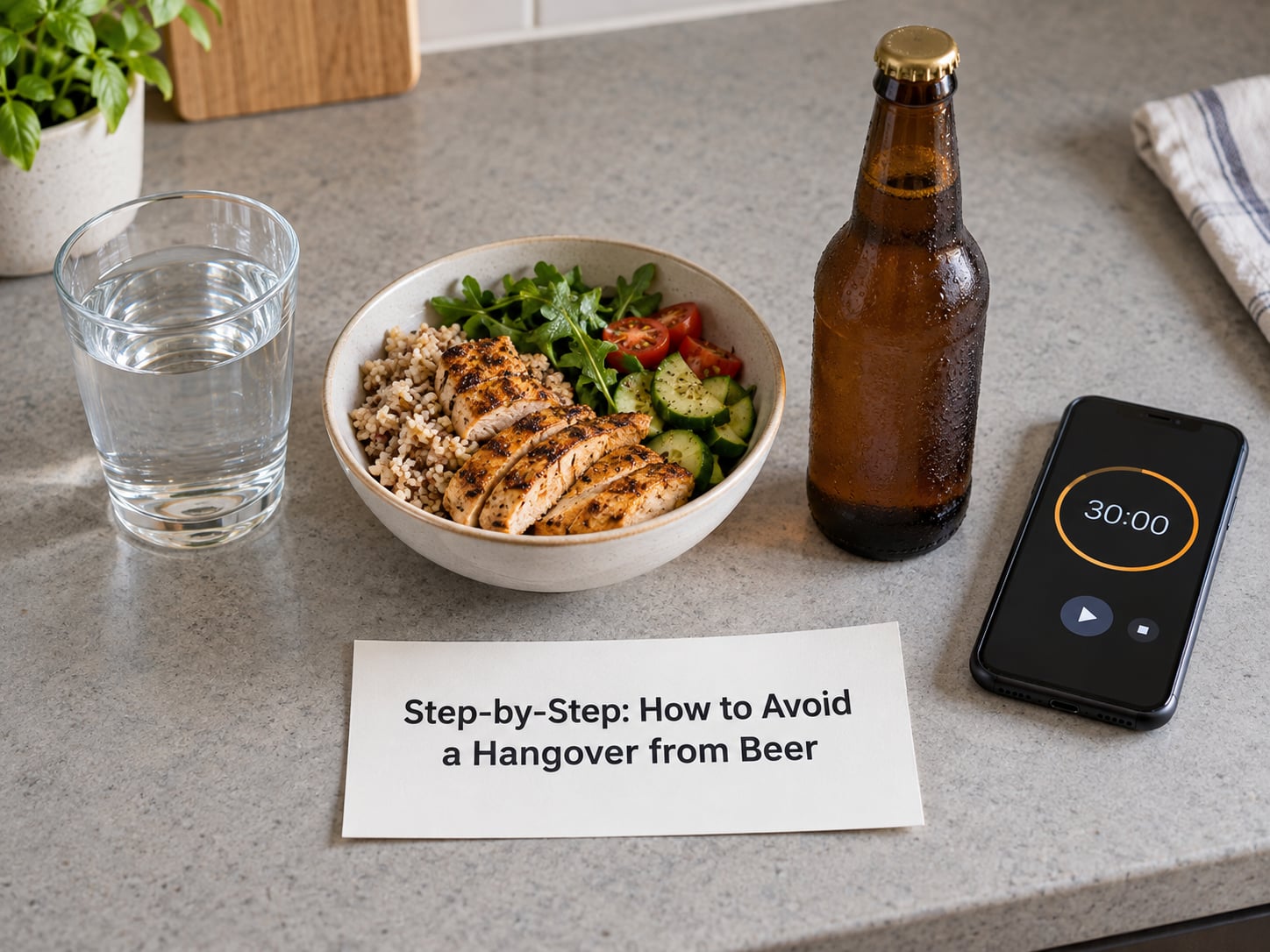
Alcohol absorbs faster through an empty stomach, which is one reason the first three beers of a night hit harder than the next three. A meal with protein, fat, and carbohydrates slows that absorption, so your blood alcohol concentration climbs more gradually and your liver has more time to work.
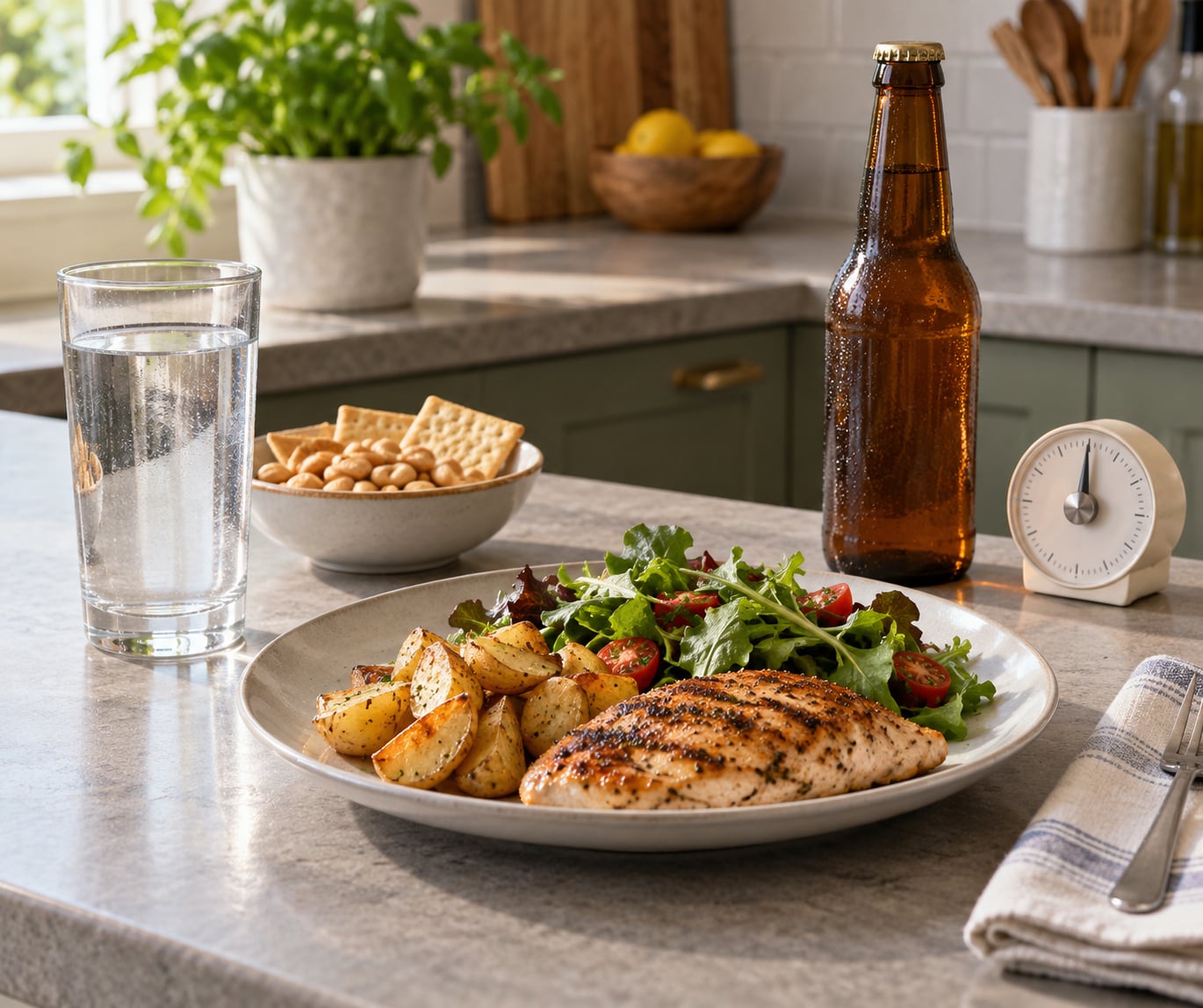
Concretely: grilled chicken, a burrito, or fish and rice about two hours before your first pour. Then keep eating during the night, even in small amounts. A handful of crackers or a taco at hour three is not the same as a full meal, but it beats nothing.
Food does not cancel alcohol. It slows the curve; it does not lower the total. How you feel an hour in is a poor measure of what you consumed.
Pace Your Beer Intake
The most useful number in this whole article is one standard drink per hour. Cleveland Clinic, Harvard Health, and MedlinePlus all frame it roughly this way, and drinkers on forums agree it is the single habit that changes the morning most.
| Serving | At 4% ABV | At 6% ABV | At 8% ABV | At 12% ABV |
|---|---|---|---|---|
| 12oz bottle | 0.9 | 1.3 | 1.7 | 2.6 |
| 16oz can | 1.1 | 1.7 | 2.3 | 3.4 |
| 16oz pint | 1.1 | 1.7 | 2.3 | 3.4 |
| 22oz bomber | 1.6 | 2.3 | 3.1 | 4.6 |
| 40oz tall boy | 2.9 | 4.3 | 5.7 | 8.6 |
Figures are approximate standard drinks, rounded to one decimal, based on 14 grams of pure alcohol per standard drink.
That table answers the question people actually ask, which is whether a night of six or seven beers is a lot. Six 16oz cans at 6% is about 10 standard drinks. That is not a casual evening, and the math is the reason.
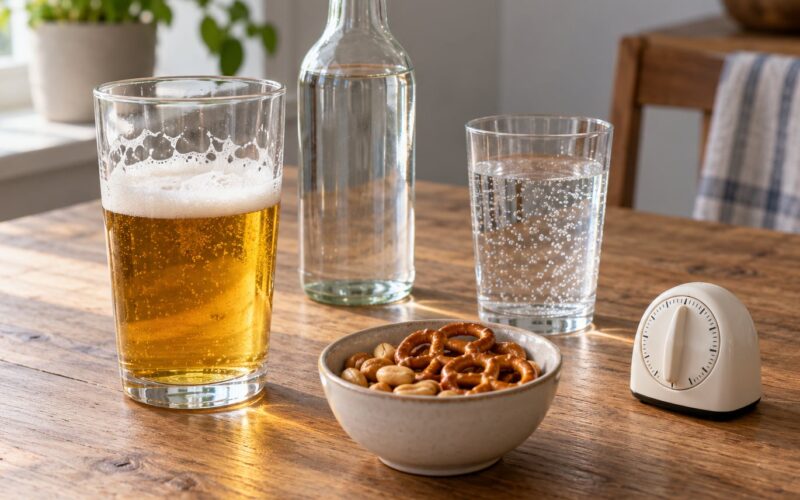
Set the pace with something concrete. Put a timer on your phone for 55 minutes between pours, or commit to one beer and one full glass of water before the next one. At a taproom or festival where the default pour is a 16oz pint, ask for a 12oz pour or a taster size. Drink the whole glass slowly, and put it down between sips.
The hard part is social. Heavier drinkers set the tempo, and matching it is the single most reliable way to end up over your limit. Drink at your own interval even when the table is emptying faster than yours.
Alternate Beer With Water or a Nonalcoholic Drink
Alcohol suppresses antidiuretic hormone, so your kidneys flush out water faster than you take it in and lose sodium and potassium along with it. That fluid and electrolyte loss is what produces the headache, the dry mouth, and the dizzy feeling when you stand up.
Alternating works because it slows your pace and replaces fluid at the same time: one beer, then a full glass of water or a nonalcoholic drink, then the next beer. Drinkers who alternate report fewer headaches than those who do not, and the mechanism is straightforward.
A useful self-check is your urine. Pale straw color through the evening suggests you are keeping up; dark urine in the morning suggests you did not.
One thing to be clear about: water does not sober anyone up. It does not lower blood alcohol concentration or speed the liver. It only replaces what you lost.
Choose Beer Gradually and Avoid High-Alcohol Options
Beer varies enormously in alcohol content, and so does the next-day effect. The risk drivers are total alcohol, congener load, and carbonation.
| Style | Typical ABV | Why it hits harder | Verdict |
|---|---|---|---|
| Light lager, sessionable pilsner | 3-4% | Less total alcohol per serving | Lowest risk |
| Standard lager | 4-5% | Moderate alcohol, moderate congeners | Reasonable |
| Wheat beer, session IPA | 4-5.5% | Often high carbonation | Moderate |
| IPA, pale ale | 6-7.5% | More alcohol per 12oz, hop-heavy | Higher risk |
| Draught taproom pour | 5-8% | Larger default pour, carbonation | Higher risk |
| Stout, porter, barrel-aged | 6-12% | Dark beer congeners plus high ABV | Highest risk |
| Imperial, double, barleywine | 9-15% | One glass can be 3-4 standard drinks | Highest risk |
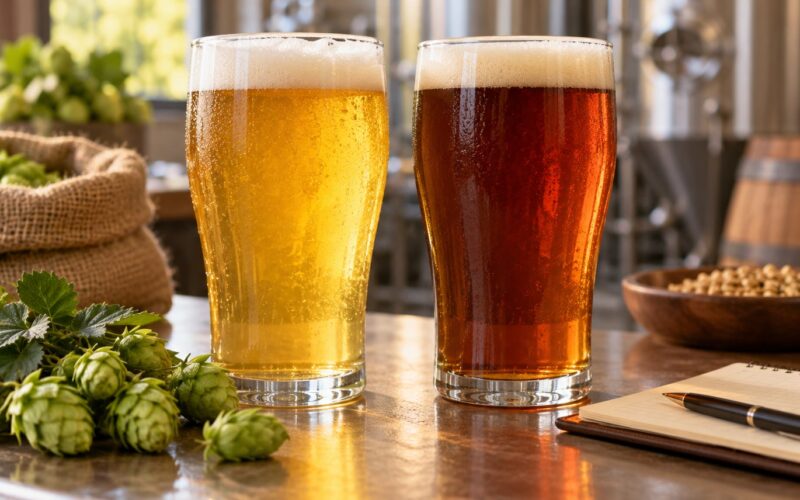
Congeners are the chemical cousins of ethanol found in darker and more heavily roasted drinks. They are metabolized slowly and are widely blamed for the worst of the headache. Many drinkers say dark beer wrecks them out of all proportion to how much they had, and that report is consistent enough to take seriously.
On carbonation: a widely cited finding from the University of Manchester is that carbonated drinks can speed alcohol absorption, because the gas pushes the drink through the stomach faster. Drinkers on forums frequently report harsher mornings after draught than after canned beer of the same strength, which fits that theory even though a single glass versus a can is also just a different volume. Carbonation is probably the smaller factor, but it is not nothing.
What is left is volume. Drink two 16oz IPAs and you have had roughly 4.6 standard drinks. Nobody at a festival counts these correctly, which is why people get blindsided.
The low-ABV and sessionable option is genuinely the best strategy for a long night. Most breweries now sell a beer under 4% for exactly this reason, and it lets you keep the ritual of a drink every hour without the accumulation.
Stop Drinking, Get Home Safely, and Rest
Decide your stopping point in advance and treat it as fixed. Once you are there, eat something with carbohydrates, drink a large glass of water or an electrolyte drink, and get home by a safe route you already arranged.
Carbohydrates before bed help because alcohol suppresses the release of stored sugar from your liver while you sleep, and a blood sugar dip is part of why you wake up shaky and nauseated. Bread, rice, toast, or a banana are enough.
Sleep is the part most people skip. Alcohol fragments sleep, suppressing REM early and letting it rebound badly later, so a night of eight hours after drinking often functions like five. If you can, sleeping longer genuinely reduces next-day symptoms.
No home remedy removes alcohol from your bloodstream. Time is the only thing that does. Everything else just makes the wait more comfortable.
Common Mistakes
Using coffee to sober up. Caffeine makes you feel more alert while your blood alcohol concentration stays exactly where it was. It is not a fix and can leave you more impaired than you realize.
Taking painkillers with alcohol. Do not mix alcohol with acetaminophen, ibuprofen, naproxen, or aspirin. Acetaminophen and alcohol together strain an already-working liver. NSAIDs add strain on the kidneys and stomach that alcohol has already irritated. If you need pain relief, ask a pharmacist or check the label first.
Hair of the dog. A morning beer delays the hangover rather than removing it, keeps your blood alcohol elevated, and ruins your sleep. It is the most common bad advice in this entire category.
Mixing types to compensate. Beer before liquor is a myth with no mechanism behind it. What matters is the order at which your body clears ethanol and acetaldehyde, not the drink type. Ordering matters, the sequence does not.
Drinking fast to keep up. Matching a heavier drinker is not a neutral act. The math of standard drinks does not care about your friends’ pace or your tolerance.
Trying to sweat it out. Exercise, hot tubs, and saunas do not meaningfully speed alcohol clearance. You finish slightly more dehydrated than when you started.
Treating food as a green light. A heavy meal slows absorption and gives some protection. It does not cancel six standard drinks, and people who eat first still get hungover.
What Does Not Prevent a Beer Hangover?
Most hangover cures are sold on hope. Here is what the evidence does not support.
- Hangover pills and supplements. No over-the-counter product has been shown to prevent a hangover. Anything claiming otherwise has not been tested well enough to say so.
- Vitamins and activated charcoal. Alcohol does not deplete vitamins in a way supplements can correct overnight, and charcoal does not clear alcohol already absorbed.
- Strong coffee and cold showers. A shower may make you feel briefly more alert. It changes nothing about your blood alcohol level or your fluid balance.
- Sports drinks versus plain water. There is no strong evidence that electrolyte products beat water for preventing hangovers. They are a reasonable way to replace sodium and potassium and add flavor, which makes water easier to drink, but they are not a treatment.
- Milk thistle and herbal remedies. The clinical evidence is thin and mostly does not support a preventive effect. Some data on liver enzymes does not translate into fewer hangovers.
- Skipping sleep to recover faster. Losing sleep while your body is metabolizing alcohol makes the next day harder, not easier.
What reliably helps is boring: moderate intake, food, water, time, and sleep. Cleveland Clinic, Harvard Health, and MedlinePlus all land on the same list.
When Beer Hangover Symptoms Need Attention
Most hangovers are miserable but ordinary. Mapping the symptom to the cause usually makes it feel less random.
| Symptom | Likely cause |
|---|---|
| Headache and thirst | Fluid and electrolyte loss |
| Nausea and stomach upset | Direct irritation of the stomach lining |
| Shaky hands and sweating | Blood sugar dip and mild withdrawal effect |
| Brain fog and poor focus | Poor sleep and effects of acetaldehyde |
| Trouble sleeping or vivid dreams | Alcohol-fragmented sleep |
| Anxiety and pounding heartbeat | Adrenaline response plus disrupted sleep |
These are useful for tracking a pattern. The same symptoms after the same number of drinks, every time, are worth raising with your doctor, along with any medications you take.
Hangovers do not cause loss of consciousness, seizures, or slow or irregular breathing. Those symptoms point to alcohol poisoning or another emergency, and they need help now, not in the morning. Call emergency services if someone cannot be awakened, is having a seizure, is breathing slowly or irregularly, has skin that is cool, clammy, or blue-tinged, or has been vomiting and cannot keep any liquid down. Do not let a person who is showing these signs sleep it off alone.
Persistent vomiting, confusion, or a headache that does not ease over a day or two also deserves a call to a doctor rather than another remedy.
Frequently Asked Questions
Is beer more likely to cause a hangover than other drinks?
Beer is not uniquely punishing, but it is easy to overconsume without noticing. A 16oz can at 6% ABV is about 1.7 standard drinks, so three of them is over five. Beer also brings congeners, and darker styles carry more of them, which are linked to worse headaches. The main risk is volume, not the drink type.
Does drinking water completely prevent a beer hangover?
No. Water replaces fluid and electrolytes you lose, which takes the edge off headache and dizziness, and alternating with water slows your pace. It does not reduce the total alcohol your liver has to process and it does not sober you up. Prevention still depends mainly on how much you drink and how slowly.
How many beers can someone drink before getting a hangover?
There is no safe number that guarantees no hangover, and there is no universal limit. At roughly one standard drink per hour, a 5% beer is about one drink every 50 minutes. Six 16oz cans at 6% ABV works out to about 10 standard drinks, which is well past the point where most people feel unwell the next morning.
Are hangover pills or supplements effective at preventing symptoms?
None has been shown to prevent a hangover in reliable studies. Some contain electrolytes or herbal extracts, but the evidence does not support a preventive effect. Activated charcoal does not clear alcohol that has already been absorbed. The methods with support behind them are food, pacing, hydration, limit, and sleep.
What should you do if someone has a hangover after beer?
Give them water or an electrolyte drink, something with carbohydrate, and time. A quiet dark room and sleep help more than anything else. Keep them off acetaminophen, ibuprofen, and aspirin, and do not offer a morning drink. If they cannot be woken, are vomiting continuously, or are breathing oddly, call emergency services immediately.
How can I tell the difference between a hangover and alcohol poisoning?
A hangover is uncomfortable but you stay awake, aware, and able to keep fluids down. Alcohol poisoning means you cannot be awakened, have a seizure, breathe slowly or irregularly, or have cool clammy skin. Confusion, repeated vomiting, and a temperature that feels wrong are also warning signs. If any of these are present, call emergency services now.
Conclusion
To avoid a hangover from beer, start before you take the first sip. Eat a meal with protein and fat, set a number and stick to it, keep it near one standard drink per hour, alternate every beer with water, choose lower-ABV pours when you have the choice, and get home safely by a route you arranged earlier.
None of that guarantees a painless morning. It stacks the odds in your favor, and it works far better than anything you can attempt at 7am.