Nobody invented beer. No single person, no single people, no single clever accident with a name and a face behind it. Fermented grain drinks showed up independently in several places, and the oldest hard evidence points to hunter-gatherers in the Levant roughly 13,000 years ago, long before Sumerians were writing down recipes in Mesopotamia.
That answer sounds like a dodge, so here is who invented beer in the version with the receipts underneath it. Archaeological work has produced sealed vessels with drink residue in them, clay tablets with brewing instructions, tomb reliefs of brewers at work, and laboratory analysis of what is left in the pottery. Rank those by date and by how firm the evidence is, and you get a much better picture than any “Einstein of beer” story.
I have read through the primary-source literature on this topic, and the pattern is consistent: the further back you push, the less certain anyone can be, and the more the answer stops being about an inventor at all. Updated for 2026, this is where the record stands.
Table of Contents
- Key Takeaways
- Who Invented Beer? The Short Answer
- What Was the First Beer Like?
- Where Did Beer Originate?
- How Do We Know When Beer Was Invented?
- Clay tablets with brewing instructions
- Sealed vessels and residue analysis
- Tomb reliefs and painted scenes
- Grinding tools and grain-processing changes
- Radiocarbon dating of the layers
- Did the Sumerians Invent Beer?
- Did the Egyptians Invent Beer?
- Who Were the Earliest Beer Makers?
- How Did Ancient People Make Beer?
- Preparing the grain
- Mashing
- Boiling
- Fermenting
- Straining and serving
- Did Beer Come From Bread or From Grain?
- How Does Beer Relate to Today’s Craft Beer?
- Frequently Asked Questions
- Who invented beer?
- Which country has the oldest evidence of beer?
- Did ancient people drink the same beer as modern brewers?
- Was beer invented before agriculture?
- Were Egyptians or Sumerians the first beer makers?
- How do archaeologists know that ancient drinks were beer?
- Conclusion
Key Takeaways
- 13,000 years ago, Levant: Natufian-period hunter-gatherers at Kebara Cave in Israel ground grain with stone tools, and a 2018 Stanford University study identified starch and yeast-derived compounds consistent with a fermented drink. Whether it was strong enough to call beer is the argument.
- 7000 BCE, Jiahu, China: Residue in sealed pottery from a Neolithic village contained a mixed fermented beverage of rice, honey, hawthorn and grape, the earliest such claim widely cited.
- 5000 to 4600 BCE, Jebel Hamra, Egypt: Chemical analysis of vessel residues found barley beer, the oldest confirmed example made from a recognisable brewing grain.
- 3400 BCE onward, Sumer and Mesopotamia: The first written brewing records, including the Hymn to Ninkasi, a song of roughly 1800 BCE that functions as a recipe and a religious offering to the goddess of beer.
- The honest bottom line: Fermentation happens wherever grain meets wild yeast and water. Beer was probably discovered rather than designed, then improved by whoever found it worth brewing again.
Who Invented Beer? The Short Answer
If you need the answer in one breath: no single person invented beer, and it is not accurate to say any one culture can claim the honour. The oldest physical evidence of grain being prepared as a fermented drink comes from Natufian hunter-gatherers in the Levant around 13,000 years ago, while the first written evidence comes from Sumer in Mesopotamia after 3400 BCE. Beer then developed on its own in China, Egypt, Mesoamerica and Europe.
The reason the question has no clean answer is basic. You do not need a workshop, a blueprint or an inventor to turn a pile of germinated grain into an alcoholic drink. You need moisture, wild yeast and time, and all three are free.
What Was the First Beer Like?
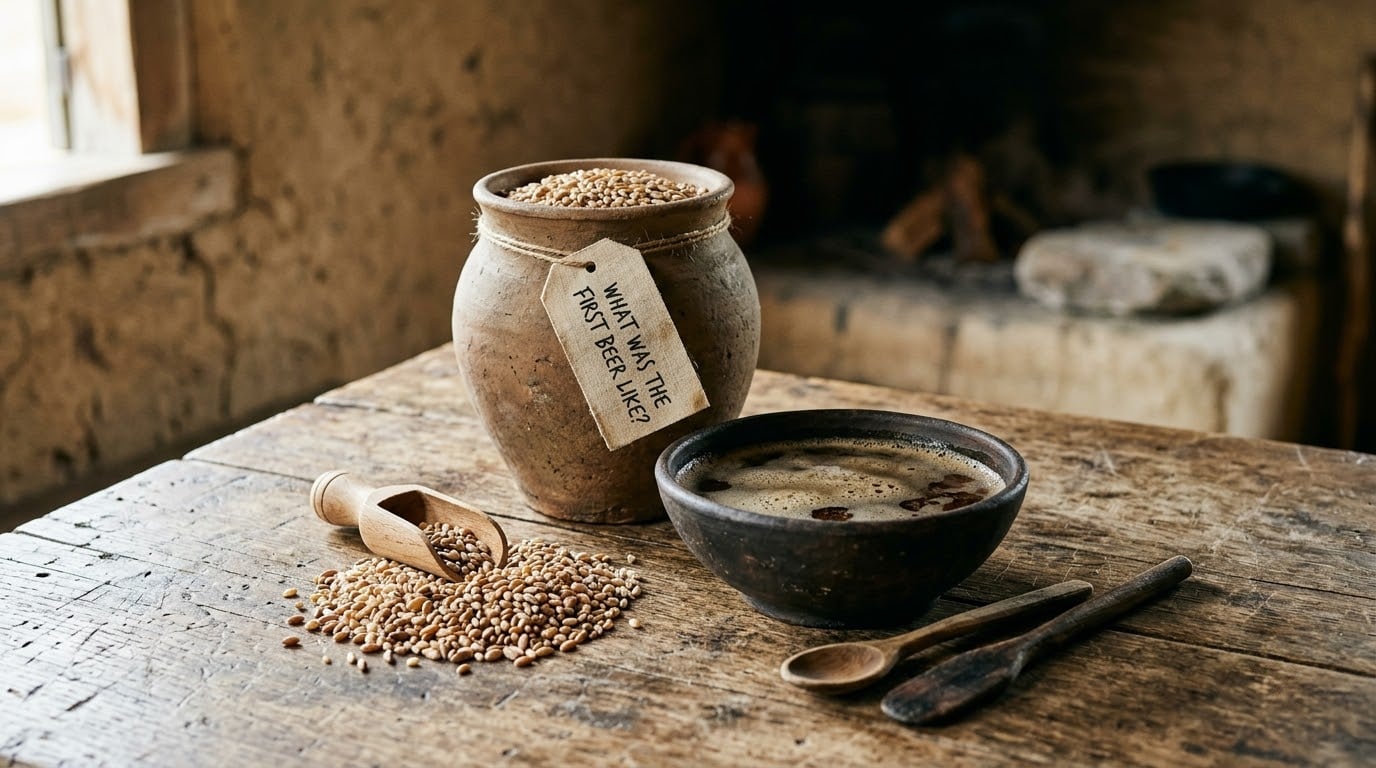
Early beer was almost certainly not the clear, cold, carbonated drink in a glass. The most likely picture is a thick, warm, slightly sweet gruel, somewhere between porridge and today’s sour-mash and wheat beers, often with visible grain still in it.
Beyond the cereal base, brewers had flavouring material available without a marketplace for it. Honey, wild fruit, and aromatic herbs or seeds all turn up in the record. Ancient Egyptian brewers, for instance, are depicted and described with additions that sweetened and spiced the base.
How strong was it? That depends on how you read the evidence, and there is no way to bottle-test a Neolithic vessel. The Kebara Cave material was never drunk by anyone living, so the concentration question is inferred rather than measured. Most reconstructions of ancient beer land somewhere in the low single digits of alcohol by volume, occasionally higher in a ceremonial batch.
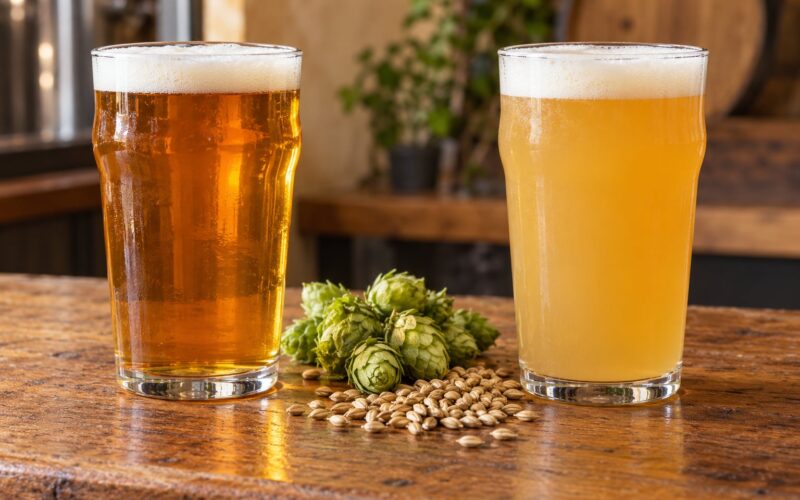
One more practical point. Almost none of it had hops, because hops were not being used in Europe until many centuries later. Without hops, beer keeps the flavour of the grain and whatever else was added, which is a very different profile from a modern pale ale.
Where Did Beer Originate?
Beer did not start in one place. The table below ranks the leading candidates by the age of the physical evidence, not by who claims the title. The “what it actually was” column matters most, because most of the argument about who invented beer is really an argument about what counts.
| Place and date | What the evidence is | What it actually was | Confidence |
|---|---|---|---|
| Kebara Cave, Israel, roughly 11,500 to 13,000 BCE | Grinding stones, mortars and 13,000-year-old Natufian burials; 2018 Stanford analysis of starch and yeast compounds | A fermented grain drink, possibly mixed with honey or fruit | High for a fermented drink, low for the label “beer” |
| Jiahu, Henan, China, roughly 7000 to 6600 BCE | Chemical residues in sealed ceramic vessels from a Neolithic village | A mixed rice, honey, hawthorn and grape fermented beverage | High for a fermented drink, contested as beer |
| Teotihuacan and the Valley of Mexico, roughly 2000 to 1000 BCE | Earthenware vessels, fermented-beverage chemistry, later distillation | Pulque, a fermented cactus juice that is not beer | High, but a different drink |
| Jebel Hamra, Cairo, roughly 5000 to 4600 BCE | Residue analysis of sealed pottery by Patrick McGovern’s team | Barley beer, the oldest confirmed brewing-grain example | High |
| Sumer and Mesopotamia, from about 3400 BCE | Inscribed clay tablets, seal impressions, later the Hymn to Ninkasi of roughly 1800 BCE | Organised, large-scale beer, traded and taxed | High for written record, lower for “first” |
| Tomb reliefs at Saqqara, Egypt, from about 2400 BCE | Scenes of barley being crushed, mixed with water and dried into cakes | A working brewing process, depicted step by step | High |
Two things fall out of that table. First, if you define beer narrowly as a fermented cereal drink, the Levant and China claims get shaky, because both may be honey-and-fruit mixtures with grain. If you define beer loosely as any fermented grain-based drink, both move up the table.
Second, the oldest date is not the most interesting date. A 13,000-year-old gruel made by people who had not invented farming tells you fermentation is old. It does not tell you anyone had a beer recipe.
How Do We Know When Beer Was Invented?
Archaeologists date beer through five kinds of evidence, and the strength of any claim depends on which of them a site actually has.
Clay tablets with brewing instructions
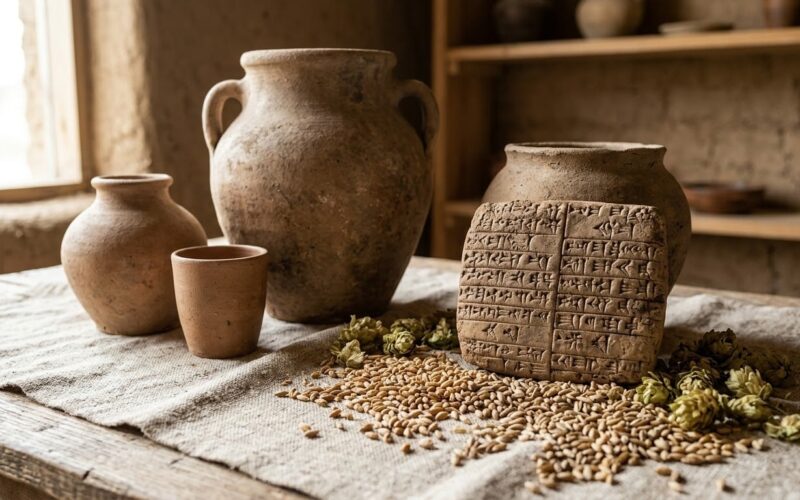
The Hymn to Ninkasi, a Sumerian composition of roughly 1800 BCE, describes filtering a mash through a sieve, boiling it, and cooling it before fermentation. It is not a modern recipe card, but it is the oldest surviving written description of how to make beer, and it tells us the process was already standardised and worth memorialising.
Sealed vessels and residue analysis
Most of the dating comes from pottery. A sealed vessel preserves what was inside, and laboratories then separate the compounds. Finding ethyl alcohol and its by-products means yeast acted on fermentable sugar. Finding lipids from a specific plant means you can say which plant, which is how the Jiahu mixture was pieced together and how barley was identified at Jebel Hamra.
Tomb reliefs and painted scenes
Egyptian tomb art is unusually useful because it shows the actual sequence: grain, crushing, mixing with water, drying into cakes. It gives historians a process rather than just a presence, which is why the Egyptian material is so often treated as the best documented ancient brewery tradition.
Grinding tools and grain-processing changes
When archaeology shows a shift from whole-grain processing to pounding and sieving, something changed about how people ate and drank. A 2004 study by Christopher McGovern and colleagues proposed that the shift to large-scale agriculture around 11,500 years ago may have been driven in part by a demand for beer, since you need far more grain for brewing than for eating.
Radiocarbon dating of the layers
Every one of these finds is dated by the material around it, not by the drink itself. That is the main source of the arguments: a disputed find can move a date by centuries, and a good result still only dates a layer, not an invention event.
Did the Sumerians Invent Beer?
The Sumerians did not invent beer, but they are the first people for whom we have a written brewing record, which is why they get handed the title anyway. The earliest Sumerian tablets mentioning beer appear after 3400 BCE, and by the Old Babylonian period brewing was a full part of the economy, complete with ration records and regulations. The Code of Hammurabi, from around 1750 BCE, sets out the wages owed to a worker who drinks brewery beer on the job.
“To Ninkasi, the goddess who fills the belly with beer, who pours beer into the stomachs of the dead… she covers the ancient with a garment, she binds the young ones with her charm…”
There is a scholarly wrinkle worth knowing. Later chemical re-analysis of pottery from Sumerian-era settlements turned up beer residues in vessels belonging to communities whose residents were not Sumerian, which some researchers read as evidence that Sumerian brewers were producing beer for export as well as for local ritual. There is also a hint in the evidence that some of the beer was diluted with water enough to be closer to a thick drink than to anything modern drinkers would recognise.
The bigger point is that the Hymn to Ninkasi is a religious document. It tells us what Sumerians believed about beer as much as what they did with it, which is worth keeping separate from laboratory results.
Did the Egyptians Invent Beer?
Egypt did not invent beer either, but it has the best-documented early brewing tradition in the world, and in one respect it comes closest to beer as we know it. Residues from vessels at Jebel Hamra in Cairo, dated to roughly 5000 to 4600 BCE, were analysed chemically and identified as barley beer. That is the earliest confirmed example made from what is still the main brewing grain on earth today.
Egypt also has the visuals. Tomb reliefs from around 2400 BCE show the sequence of crushing partly germinated barley, mixing it with water, and drying the result into cakes that could be stored and rehydrated later. Baking those cakes into bread is one step away from brewing them, which is the reason bread and beer stay tangled together in this story.
Beer was not a treat in Egypt. It was food, religion and pay. Tomb scenes show it in funerary rites, and records show brewery workers at the Giza pyramid construction sites receiving rations reported at about ten pints a day. Whether every worker drank that much is a fair question, and historians are still arguing about it.
Who Were the Earliest Beer Makers?
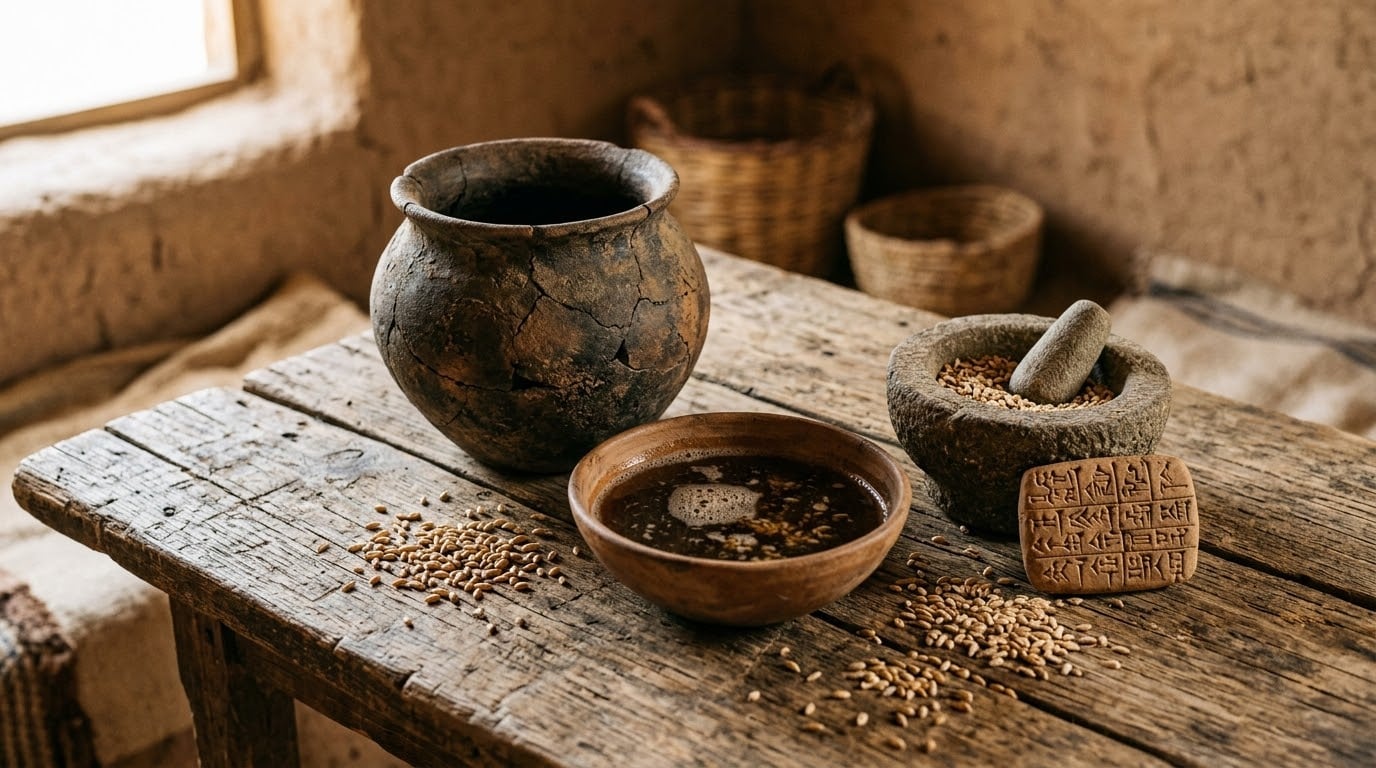
So who invented beer? The answer is communities, not individuals, and the earliest of them were hunter-gatherers. The Natufians who worked the Levant before farming spread into the region were grinding wild cereal and pulse into a mash, and the 2018 Stanford study by Dani Nadel and Ron Shimelmitz found starch and yeast-derived compounds in the stone tools and burials at Kebara Cave dating to roughly 13,000 years ago.
They were not doing it as a profession. They were doing it because a mix of damp grain and airborne yeast ferments on its own, and a group that enjoys the result keeps making it. Everywhere that pattern held, expertise grew: the people who knew which grain to soak, when to stop, and how to keep a batch alive were the people who brewed.
Sumerian tablets give us names for that expertise, including Ninkasi, the goddess credited with teaching people to brew. That is religion rather than a personnel file, but it tells you something real about how the knowledge was held. People credited a goddess, which means the knowledge belonged to everyone and to no one.
It also means the question of who invented beer is partly unanswerable by design. The early drinkers did not record who started.
How Did Ancient People Make Beer?
Ancient methods varied by place and period, but the core sequence is recognisable, and modern archaeologists have rebuilt it partly from the experimental work of researchers like Carol Miles and Dirk Gertsch.
Preparing the grain
Grain was soaked, and often partly germinated first, to release the enzymes that turn starch into sugar. Whether the malt was deliberately dried and kept, as the Egyptian cakes suggest, or brewed straight from fresh sprouted grain, varied by region.
Mashing
The grain was crushed and mixed with water, either in a vessel or in a pit lined with a woven mat, then strained to separate the wort from the solids. Egyptian and Mesopotamian imagery both show sieves, and the Hymn to Ninkasi describes the filtering step explicitly.
Boiling
The wort was boiled, which does two useful things: it makes the drink safer to drink, and it sets up a clean ferment. This is the point where the “beer was safer than water” story comes from, and historians now treat it as a myth. Ancient people who drank beer were not doing so because the alternative was untreated river water; the claim is a modern retelling with almost no support in the record.
Fermenting
Wild yeast from the air and the grain did the work. There was no pure culture, no temperature control and no pitching, so outcomes varied wildly and beers were often mixed and re-pitched from batch to batch. The result was a mixed fermentation with character no modern brewery would recognise.
Straining and serving
It was strained, sometimes again, and poured for immediate drinking. Ancient beer was generally drunk young, within days, and it was more liquid than modern beer but also thicker.
Did Beer Come From Bread or From Grain?
Both, in a sense, and the two are hard to separate because the process runs in both directions. Leavened dough and beer share the same central mechanism: yeast converting grain starch into sugar and then into alcohol and carbon dioxide. The leftovers of one can become the start of the other.
This produces a well-known theory, usually called beer before bread. The argument is that people discovered a nutritious, starchy fermented mash, liked the effect, and repeated it deliberately, which encouraged them to plant more grain than they needed to eat. On that reading, farming came partly because of beer rather than the other way round, and the Jiahu mixture made from rice, honey, hawthorn and grape is exactly the kind of drink that could sit at that origin point.
It stays a theory. The Natufians who were mixing grain into a fermented drink at 13,000 years ago were not yet farmers, and the idea sits awkwardly alongside the fact that bread-making and brewing probably co-evolved rather than following one another. What is fair to say is that the oldest known alcoholic drinks and the oldest known leavened foods sit in the same cultural package, and separating them is a modern convenience.
How Does Beer Relate to Today’s Craft Beer?
The honest link is chemical, not stylistic. Nobody on this site is claiming that a Sumerian brew was a forerunner of a modern IPA, because it was not. What carried forward was the raw material and the principle.
Grain still is beer, and the difference between ancient and modern malt comes down to control. If you want to know why what malt does in beer flavor, the short version is that modern malting standardises the enzymes and sugars in a way nobody achieved before the 20th century. Ancient beer tasted of whatever the local field and the local air gave it, which is why recreations rarely resemble anything from the era they copy.
Yeast is the other story. What yeast does in beer in a modern brewery is the work of a deliberately chosen culture. For most of history, wild yeast did the job, which means every batch was a mixed culture and no one could predict the strength. Emil Hansen’s pure-yeast work in the 1880s, after Louis Pasteur had shown fermentation was a biological process, is the hinge between ancient beer and beer as brewed now.
Hops are the other hinge, and they came late. Gruit, the herbal bittering blend of bog myrtle and other plants, is what most pre-modern European beer used instead. Hops Humulus lupulus were adopted in monasteries from around the 9th century CE, pushed in the 16th by brewers such as those in Britain who wanted a stable bittering plant, and defended by figures including Martin Luther. Hopping changed beer more than any earlier addition, and the regional styles that grew out of it are still with us, as covered in how British beer differs from American beer.
That history also fuels a small but lively trend: brewers reconstructing ancient recipes. Anchor’s Sumerian-style beer, a Chinese reconstruction of the Jiahu mixture, an Egyptian-style recreation, a gruit and a tomb-mead recreation all exist as commercial beers. Drinkers who try them report the same thing: they are flat, sour, sometimes salty, sometimes a little acetone-sharp. That is not a failed experiment. It is what the recipe asks for, and it is the clearest taste-test available of how far brewing has moved.
Frequently Asked Questions
Who invented beer?
No single person or culture invented beer. Fermented grain drinks appeared independently in several regions, and the earliest physical evidence comes from Natufian hunter-gatherers in the Levant around 13,000 years ago, while the first written evidence comes from Sumer after 3400 BCE. Fermentation is a natural process that needs only damp grain, water and wild yeast, so no one needed to set out to invent it.
Which country has the oldest evidence of beer?
Israel leads on the age of the physical evidence: the Natufian material from Kebara Cave dates to roughly 11,500 to 13,000 years ago and was identified as a fermented grain drink in a 2018 Stanford study. China follows at roughly 7000 BCE with the Jiahu mixture, and Egypt at roughly 5000 to 4600 BCE with the Jebel Hamra barley beer, which is the oldest confirmed example made from a recognised brewing grain.
Did ancient people drink the same beer as modern brewers?
No. Ancient beer was warm, thick and unhopped, often with visible grain in it, and it was drunk young within days of fermenting. It relied entirely on wild yeast, so every batch was a mixed culture with unpredictable strength. Modern brewing uses purified water, kilned malt of consistent enzyme content, hopped wort and a chosen yeast culture, so taste, strength and shelf life are all controlled.
Was beer invented before agriculture?
The chronology points that way. The 13,000-year-old Kebara Cave evidence predates the agricultural transition in the Levant, and the Jiahu mixture of rice, honey, hawthorn and grape dates to about 7000 BCE. Researchers including Richard Unger and Christopher McGovern have argued that a demand for fermented grain may have helped drive plant cultivation, though this remains a hypothesis rather than a demonstrated cause.
Were Egyptians or Sumerians the first beer makers?
Sumer has the first written record, with brewing tablets appearing after 3400 BCE and the Hymn to Ninkasi of roughly 1800 BCE as the oldest surviving beer recipe. Egypt has the strongest physical and pictorial record, with confirmed barley beer from Jebel Hamra around 5000 BCE and detailed brewing scenes in tombs from about 2400 BCE. On balance, Egypt has the better-documented early tradition and Sumer the better-documented early literature.
How do archaeologists know that ancient drinks were beer?
They analyse residue from sealed vessels. Laboratories identify fermentable sugars, ethanol and its by-products, which show yeast was active, and plant lipids or starches that reveal what was brewed. Combine that with grinding tools, inscriptions describing brewing, and tomb scenes of the process, and a claim can be graded by how much independent evidence supports it.
Conclusion
So who invented beer? Not a person, and not a people. The record points to a habit that emerged from chemistry: damp grain plus wild yeast plus patience, repeated by whoever found it worth repeating, in the Levant, in China, in Egypt, in Mesopotamia and probably in places nobody has dug yet.
The useful thing to take from this is the split between the unknown first brewer and the many independent traditions that followed. Nobody signed the recipe. What survived is evidence: residue in sealed pots, a song from Sumer about a goddess who fills the belly with beer, tomb walls showing the crush and the mash, and reconstructions in a glass that taste nothing like what came before.
If you want the practical version, pick the tradition that interests you and drink the reconstruction. It is the fastest way to understand how much of beer’s history is in the grain, and how much of it is in the control.