If you have ever wondered what is a collaboration beer, it is a beer jointly created by two or more breweries, a beer maker, or a brewery and another brand — a collab beer, in the plain terms most drinkers use. The partners share a recipe, a brew day, ingredients, or all three, and the label usually carries both names.
It is one of the easiest craft beer ideas to explain and one of the hardest to pin down, because the beer itself can be anything at all. Two breweries that both make pale ales have produced something wildly different from a brewery and a coffee roaster making a stout. What stays constant is authorship.
Table of Contents
- What Is a Collaboration Beer?
- What separates a real collaboration from a sponsored beer
- How Does a Collaboration Beer Get Made?
- Why Do Breweries Make Collaboration Beers?
- To borrow equipment they do not own
- To try an ingredient or technique that is risky alone
- To reach drinkers who do not know them
- To mark an event or a place
- To pay homage to another brewery or a brewer
- To make something that feels like an occasion
- What Does a Collaboration Beer Taste Like?
- What Are the Most Common Types of Collaboration Beers?
- Same recipe, two breweries
- Two interpretations of one brief
- A pale beer and a dark counterpart
- A shared specialty ingredient
- Barrel-aged or blended releases
- Venue, festival, and local tradition collaborations
- How Do Breweries Divide the Work?
- What Each Partner Contributes to the Beer
- What Should You Look for on the Label?
- How Are Collaboration Beers Different From Co-Brandings?
- Frequently Asked Questions
- Is a collaboration beer always brewed by two breweries?
- Can two collaboration beers have the same name but different tastes?
- Are collaboration beers usually limited releases?
- Does a collaboration beer have to use an experimental ingredient?
- Why do collaboration beers cost more than regular brewery beers?
- Conclusion
What Is a Collaboration Beer?
A collaboration beer is a limited, jointly conceived beer released by two or more independent breweries, breweries plus a non-brewing brand, or breweries from different countries, where the partners share decision-making over the recipe, the production, and the branding. Neither party could have released it alone.
That last part matters more than it sounds. When Avery and Russian River released “Collaboration, not Litigation” in the early 1990s, it came out of a naming dispute — both breweries had a beer called Salvation — and the solution turned a legal problem into a beer. The two brewers worked out the recipe together, brewed it, and put both names on the label. The story is the reason people still bring it up.
Today the format runs from two local taprooms sharing a kettle to a six-brewery project with one host brewery doing all the production. On r/CraftBeer and r/TheBrewery, people describe them less as a product and more as a standing invitation between brewers who otherwise compete for the same shelf space.
What separates a real collaboration from a sponsored beer
A sponsored beer has one brewery making the beer and another company paying for the rights to put its name on it. A licensed co-branded can may be a single brewery brewing a recipe developed for a partner with no brewing role at all. The tell is contribution: did the partner have a hand in the ingredients, the recipe, or the brewing?
If the partner’s only contribution is money or a logo, you are looking at a co-branding, and the explanation is much simpler.
How Does a Collaboration Beer Get Made?
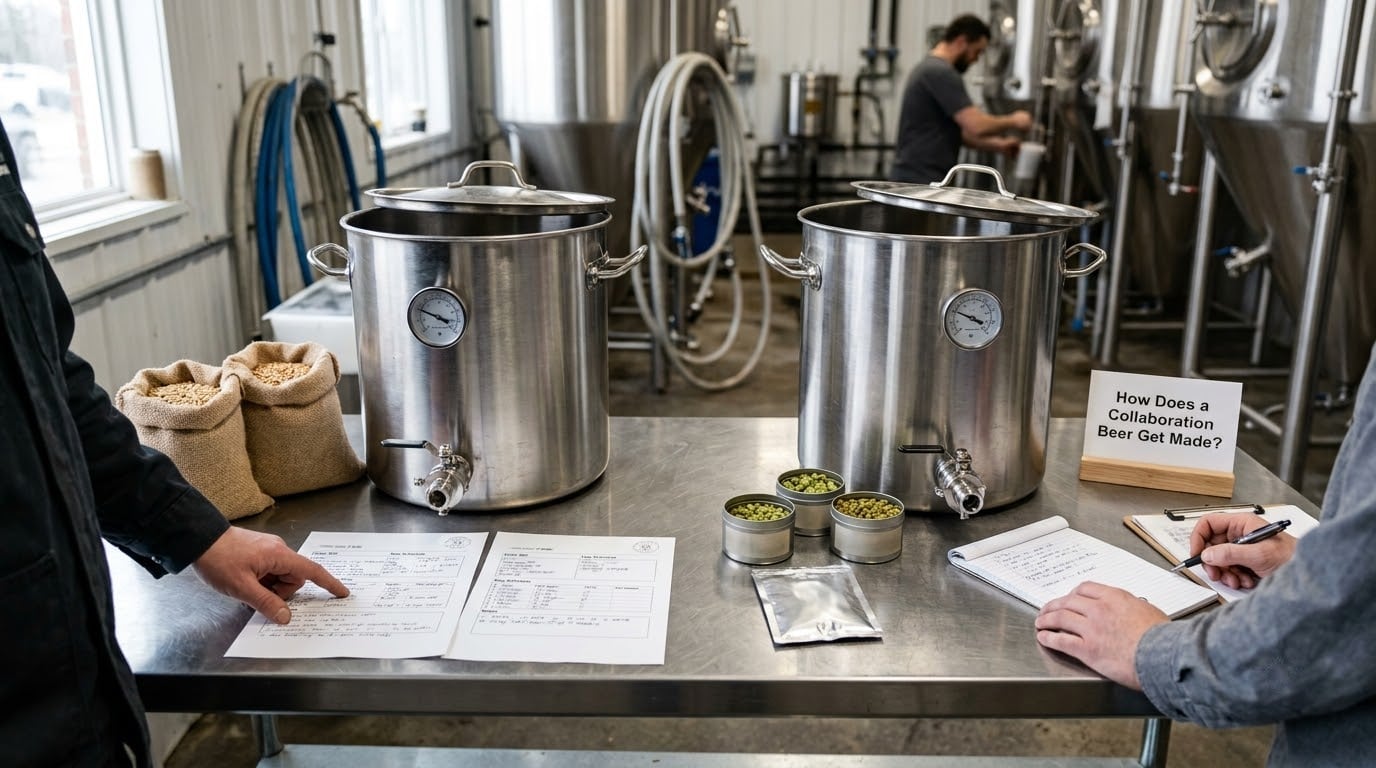
The mechanics depend on scale, but the arc is consistent. Two brewers pick partners, agree on a concept, divide responsibilities, develop the recipe, brew it, then release it with a shared story attached.
- Choose the partner. Usually a brewery whose strengths differ from your own — a brewery known for barrel work collaborating with one known for hop-forward pale ales, for example.
- Agree on the concept. A style, an ingredient, an occasion, or a shared equipment resource. The idea is settled before anyone measures grain.
- Decide who brews it. One brewery hosts, both brew their own versions, or the teams brew together at one facility. This is the decision with the most consequences, and it is usually about labels and shipping law rather than preference.
- Develop the recipe. Frequently done by email over weeks, with one side leading the grain bill and the other leading the hops or the fermentation.
- Brew and ferment. Some collaborations ship ingredients and never share a room. Others have brewers fly in for brew day, which is why the same collaboration can exist in two versions with different yeast strains.
- Package, split, and release. The beer is bottled, canned, or kegged, then divided between the partners’ taprooms, distributors, and sometimes a festival-only run.
- Tell the story. Label copy, a taproom release party, and social posts. The story is not decoration here; it is the reason the beer is worth a premium.
| Collaboration structure | Who controls the recipe | Where it is brewed | How the versions differ |
|---|---|---|---|
| Host brewery brews the other brewery’s recipe | Both approve, one writes it | One facility | Usually one beer, two names |
| Each brewery makes its own version | Each writes its own | Two separate facilities | Different yeast, hops, malt, sometimes different ABV |
| Both teams brew together at one brewery | Jointly, on the day | One facility, two sets of hands | Closest match; small batch-to-batch variance |
| Guest brewery brews at a host it does not own | Guest leads, host advises | Contract brewery or host taproom | Guest’s house character, host’s equipment |
The host brewery model is the standard because of how alcohol labeling and distribution actually work in the United States. A brewed-in formula carries a TTB-approved label, and shipping finished beer across state lines runs into a different set of laws in every state. Rather than solve that twice, the partners usually brew in one place and split the finished beer.
Why Do Breweries Make Collaboration Beers?
Brewers give a lot of reasons, and the honest ones are less romantic than the label suggests. The BeerAdvocate community threads and r/TheBrewery discussions that come up around any big collab usually land on six motives.
To borrow equipment they do not own
Not every brewery has a barrel program, a cold side, a centrifuge, or a kettle big enough for a one-off. Hosting a collaborator solves that without a capital expense. The visiting brewer gets access, the host gets a new beer on its menu, and both get a reason to talk to people who would not have crossed shops otherwise.
To try an ingredient or technique that is risky alone
A new yeast strain, an unmalted grain, juniper, a fruit nobody else in the state can source. A collaborator spreads the risk and the cost of failure. If the odd version is bad, it is one shared embarrassment instead of a whole batch of somebody’s signature beer.
To reach drinkers who do not know them
This is the commercial reason nobody admits to first, and it is still a real one. Your fans are already in your taproom. Putting your beer in a brewery across town, or in a hundred stores you have never cracked, is cheaper than buying that distribution yourself. Cross-promotion gets each brewery in front of the other’s audience.
To mark an event or a place
A brewery opening, an anniversary, a harvest, a local festival, a charity night. Collaboration gives an event a beer that only exists for it, which makes the event feel bigger than a tap takeover with six tap handles.
To pay homage to another brewery or a brewer
Some collaborations exist to say thank you. A brewery that got its start on a shared system, or learned a technique from someone specific, brews that person’s recipe and puts their name on the can. It is closer to a tribute than a product launch.
To make something that feels like an occasion
A brewer told by an accountant to make a stable, repeatable core beer cannot also chase a weird idea with a stranger. The collab is a place to put the idea, and the limited release is a permission slip. That is why so many are one-offs.
The tradeoffs are real. Production has to be scheduled around another brewery’s tank availability, one partner’s small system can cap the batch size for both, recipe ownership gets murky fast when both sides edited it, and the marketing has to add up to a single identity instead of two. When a collaboration misses, the most common reason is that nobody made one person responsible for the final call.
What Does a Collaboration Beer Taste Like?
There is no house flavor. A collaboration beer can be a hazy pale ale, a dry brown, a barrel-aged sour, or a gose with lavender in it, and all of them count. The defining feature is shared authorship, not a style.
What you tend to notice is contrast. When two breweries combine their strengths, the flavors that surface are usually the ones the other side does not do well — which is the practical answer to what is a collaboration beer when you are standing at the bar with no label in front of you.
- Malt and hops. One brewery’s clean, neutral grist and the other’s assertive hop schedule, which reads as a more defined beer than either would have made alone.
- Yeast character. One house strain, one guest strain, sometimes both. What yeast does in beer is the fastest way to understand why two versions of the same recipe can taste like different products.
- Fermentation and conditioning. A brewery that ages everything in oak contributing the vessel to one that does not, or the reverse.
- Texture and finish. A dryer, sharper finish from one side, a rounder body from the other.
A hypothetical example: brewery A is known for a soft, bready, low-bitterness pils, and brewery B is known for heavy dry hopping. Combine them and you get a beer that smells like a pils in the first second and then turns into a hop aroma halfway down the glass, with a dry finish. That is what people mean when they say a collaboration “shows both houses.”
Malt can do the same work. Swapping in a few percent of a specialty grain — the reasoning behind what specialty grains do in brewing — for caramel depth from one side while the other keeps the body light is a quiet, effective collaboration. So is a shared hop schedule where one brewery picks varieties the other has never used.
Whichever way it goes, ask what each side is known for. If you cannot answer that, the label copy is doing all the work.
What Are the Most Common Types of Collaboration Beers?
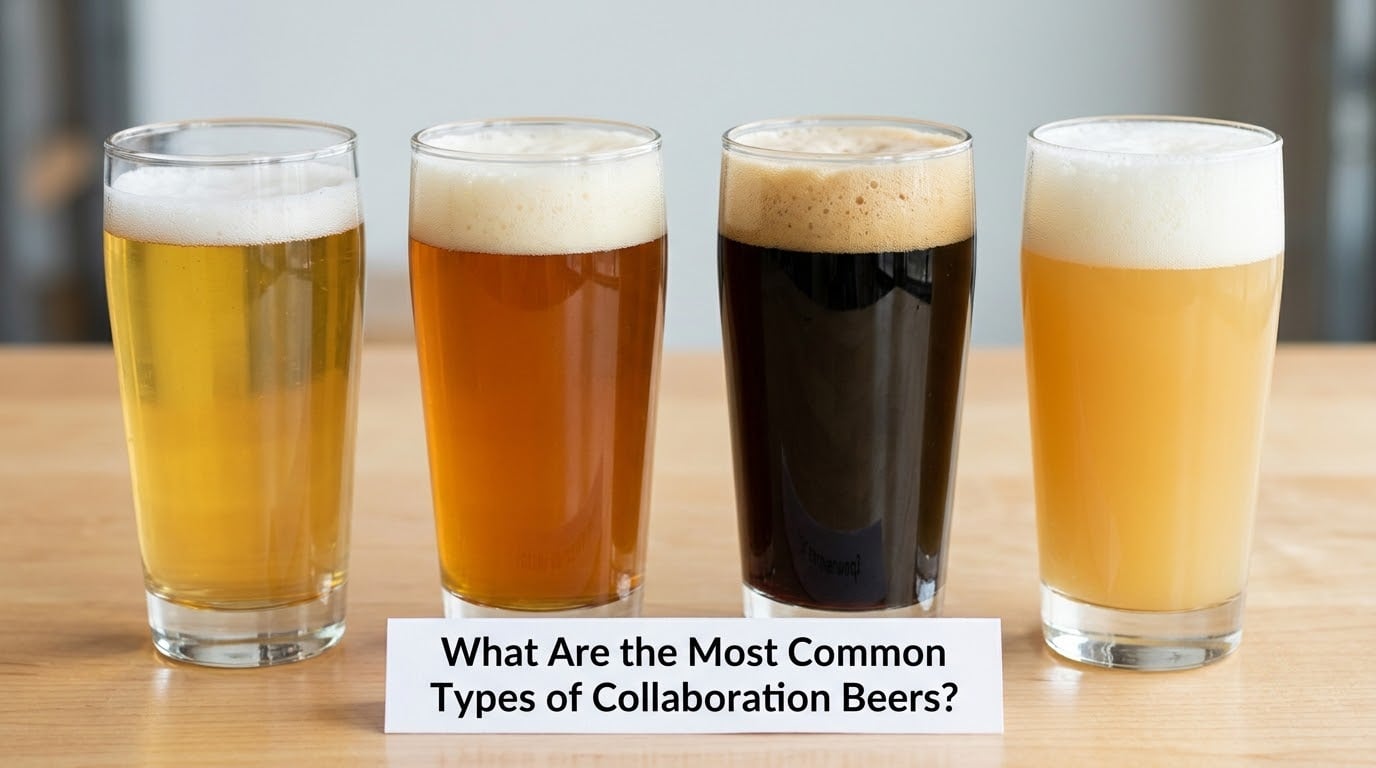
Six formats cover most of what shows up on a release calendar. Each has its own defining feature, its own typical flavor, and its own reason the versions are not identical.
| Format | Defining feature | Likely flavor | What sets the versions apart |
|---|---|---|---|
| Same recipe, two breweries | One agreed recipe brewed in two places | Whatever the recipe dictates, with house yeast differences | Fermentation, water, and packaging method |
| Two interpretations of one brief | Each side interprets the same concept | Same family, different balance | Everything, by design |
| Pale and dark counterparts | Two beers sharing a concept across the spectrum | Light and hop-forward against dark and malty | Malt bill and yeast selection |
| Shared specialty ingredient | One unusual ingredient supplied by a partner | A recognizable signature note over a base style | How prominently the ingredient shows |
| Barrel-aged or blended release | Maturation in a shared or swapped vessel | Oak, oxidation character, layered fruit, higher strength | Barrel provenance and blend ratios |
| Venue, festival, or tradition collab | Built around a place, an event, or a local custom | Style chosen for the occasion, often a local specialty style | Availability, sometimes one venue only |
Same recipe, two breweries
The purest form of the collaboration. Both parties sign off on one recipe and each brews it, which gives you two beers to compare in the same sitting — genuinely useful, because the house yeast and the water profile come through immediately.
Two interpretations of one brief
One concept, two answers. A brewery that specializes in kettle souring and one that specializes in farmhouse yeast might both be handed “a sour beer” and produce something that shares an ingredient and little else. Fun to hunt for, harder to describe.
A pale beer and a dark counterpart
One idea rendered twice, once light and once dark. This works well because the shared ingredients read as a through line. A maple-and-salt idea, for instance, shows up as a maple cream ale and a maple porter.
A shared specialty ingredient
One partner supplies something the other brewery has never worked with — a local honey, a coffee, a fruit grown on a hillside. It is the most approachable format for a drinker who has never bought a collab, since the base style is usually familiar.
Barrel-aged or blended releases
The long ones. The beer is brewed, then matured, sometimes for years, and often blended with a younger batch to balance the acidity or the oak. At the ambitious end, one host brewery coordinates a whole group project in which five or six partner breweries each contribute a different hop variety to a single release, which is the format stretched about as far as it goes.
Venue, festival, and local tradition collaborations
Made for a place rather than a market. The international version of the idea works the same way: a US craft brewery and a German weizen brewery have both taken a Weisse, brewed their own version with local hops and yeast, and split the run between their home markets — the concept travels, the ingredients stay home.
How Do Breweries Divide the Work?
Every collaboration has a deal behind it, even if nobody prints it. Ingredients, brew time, and packaging are the three costs, and who absorbs which one shapes the outcome more than the recipe does.
The common arrangements are straightforward. Each brewery buys and supplies its own signature ingredient, both split the brewing and packaging costs evenly, or the host brewery fronts everything and takes a set share of the finished beer. A bar or venue that supplies the venue, the staff, and the fridge sometimes takes payment in beer and placement instead of cash.
Profit is usually handled by splitting the beer rather than moving money, because a beer is easier to divide than a margin. Each partner takes the volume it distributed through its own channels, and the host keeps the portion it sold in its own taproom. The bookkeeping is simple, which is exactly why more elaborate structures are rare.
Regulation is the part that shapes the split. In the US, the beer has to carry an approved label for the formula, and finished beer cannot simply be trucked across state lines under a single permit. So the host brewery produces, the partner ships nothing but its name, its ingredients, and its share, and the labels get approved before the first keg is filled.
What Each Partner Contributes to the Beer
A workable collaboration has named owners. One side writes the recipe, one side buys the specialty ingredient, one side brews, one side handles fermentation, and both sides approve the label and the release plan. Then there is the unglamorous part nobody volunteers for: deciding who has final say when the beer misses. Assign that before brew day, not after.
What Should You Look for on the Label?
Reading a collaboration label is straightforward once you know the markers.
- Two or more names, with roles implied. Both marks present, both breweries named as brewers or contributors rather than one listed as a sponsor.
- Shared design rather than one logo on a sticker. Joint labels usually credit both. A logo pasted onto a house beer is the classic co-branding tell.
- Limited-release language and a size that sounds small. Batch numbers, bottle counts, a vintage year on an aged release, or a festival-only note.
- Brewed-in and produced-by information. A city and state for the production brewery tells you who actually made the beer and, usually, where you can still find it.
- Ingredient and style specifics. The actual yeast, hops, or unusual adjunct, in enough detail to tell whether the collaboration is real work or a rebrand.
What collaboration does not mean is worth saying plainly. It does not mean experimental, stronger, more expensive, or better. Plenty are clean, well-executed pale ales made because two friends get along. Plenty are thin one-offs put out for a photo.
Useful questions for a bartender: which brewery brewed this, is it a taproom-only pour, and was it one batch or several. Those three answers tell you most of what the label leaves out. Breweries also tend to announce collabs on their own release pages, which is the fastest way to know a beer exists before it reaches a shop near you.
How Are Collaboration Beers Different From Co-Brandings?
A co-branding puts two names on one product. A collaboration involves two parties shaping the product itself. That is the whole difference, and it shows up in four places: whether the recipe was written or approved by the partner, whether the partner took part in brewing, whether the partner supplied something real, and whether the brand system was designed for both rather than assembled from one logo.
Licensed products, promotional giveaways, and one brewery putting a sports team or a record label on a can all fall on the co-branding side. That is not a criticism. Those products are built for reach, and they are usually honest about it. The confusion starts when a label uses the language of collaboration without the involvement, and a drinker pays for a shared recipe that never happened.
The test is a question you can answer from the label: what did the second name actually do?
Frequently Asked Questions
Is a collaboration beer always brewed by two breweries?
No. One partner may be a non-brewing brand such as a coffee roaster, a distillery, a cidery, a food company, or a venue. In those cases the brewery still brews, but the partner usually supplies an ingredient or a flavor target and has a say in the recipe. The involvement has to be real to count as a collaboration rather than a sponsorship.
Can two collaboration beers have the same name but different tastes?
Yes, and that is common. When each brewery brews its own version of an agreed concept, house yeast, water profile, and conditioning choices change the result. The same name and the same core ingredients can produce two noticeably different beers. When only one brewery brews it, the partners split the same finished beer instead, and the versions will taste identical.
Are collaboration beers usually limited releases?
Most of them are, because collaborations are planned around a single brew day and a fixed tank schedule. A collaboration is often the only place a brewer can afford to make something odd, and odd recipes do not age well in a tank. That said, a few breweries have turned a successful collaboration into a permanent, if small, part of the lineup, usually after fans keep asking for it.
Does a collaboration beer have to use an experimental ingredient?
No. Plenty of collaborations use a completely standard bill of malt, hops, water, and yeast. What is experimental is often the combination rather than any single component: a low-bitterness base brewery working with a heavy dry-hopping brewery produces a clean, hop-forward pale ale that neither would have made alone. A collab can be conservative in ingredients and still new in result.
Why do collaboration beers cost more than regular brewery beers?
The batch is usually smaller than a core beer, and the extra cost covers shared ingredients, a rented or borrowed tank slot, extra label work, and a limited distribution run. A collaboration also splits its volume between two taprooms instead of selling through one distribution network, so each partner carries more per-unit overhead. The premium buys scarcity and the story, not better ingredients.
Conclusion
A collaboration beer is defined by shared creation rather than by any one flavor, and that is the only reliable thing to check. Start with the participating breweries, then work out who brewed it and who wrote the recipe, what style it is, and whether the versions use one shared recipe or contrasting interpretations. Ask what each partner is known for; the answer is usually sitting on the label.