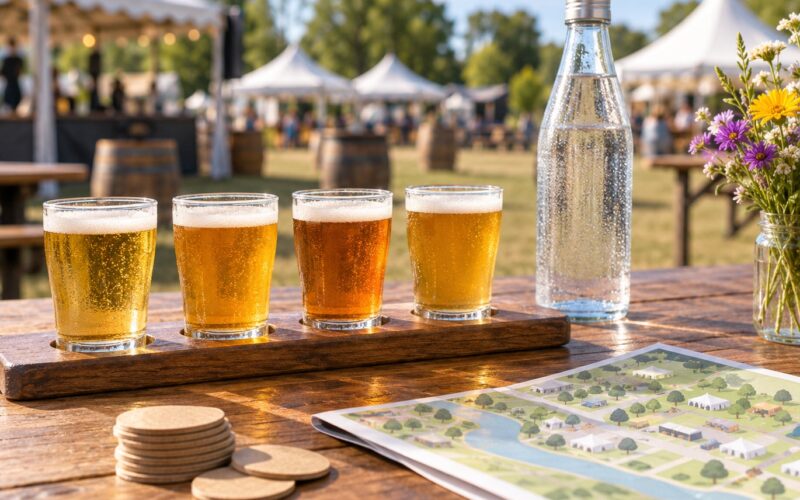
A beer festival tasting token is a small piece of festival currency you hand to a brewery volunteer at a tasting booth, and they hand back a pour of beer to fill your glass. That is how beer festival tasting tokens work at most events that charge per sample: you buy a set number of tokens with your ticket, spend one at each booth, and some beers cost extra. The confusing part is not the exchange, it is the arithmetic. Here is what the tokens actually are, why festivals use them, and how to avoid draining your stack at a premium pour.
Table of Contents
- What Is a Beer Festival Tasting Token?
- How Beer Festival Tasting Tokens Work at a Glance
- How Do You Buy Beer Festival Tasting Tokens?
- What Does One Beer Festival Tasting Token Usually Cover?
- How Do You Redeem a Token?
- Why Do Some Beer Festivals Use Different Token Values?
- Can You Use a Token for Any Beer?
- What Happens When a Festival Runs Out of a Beer?
- Can You Get Refunds or Extra Tokens?
- How to Avoid Overspending on Tokens
- How Festival Token Rules Differ from Regular Bar Service
- Frequently Asked Questions
- What is a beer token?
- How much are beer tokens worth?
- How many tokens do you get with a beer festival ticket?
- What happens if you run out of tasting tokens?
- Can you share beer festival tokens with friends?
- Are beer festival tokens or an unlimited wristband better?
- Conclusion
What Is a Beer Festival Tasting Token?
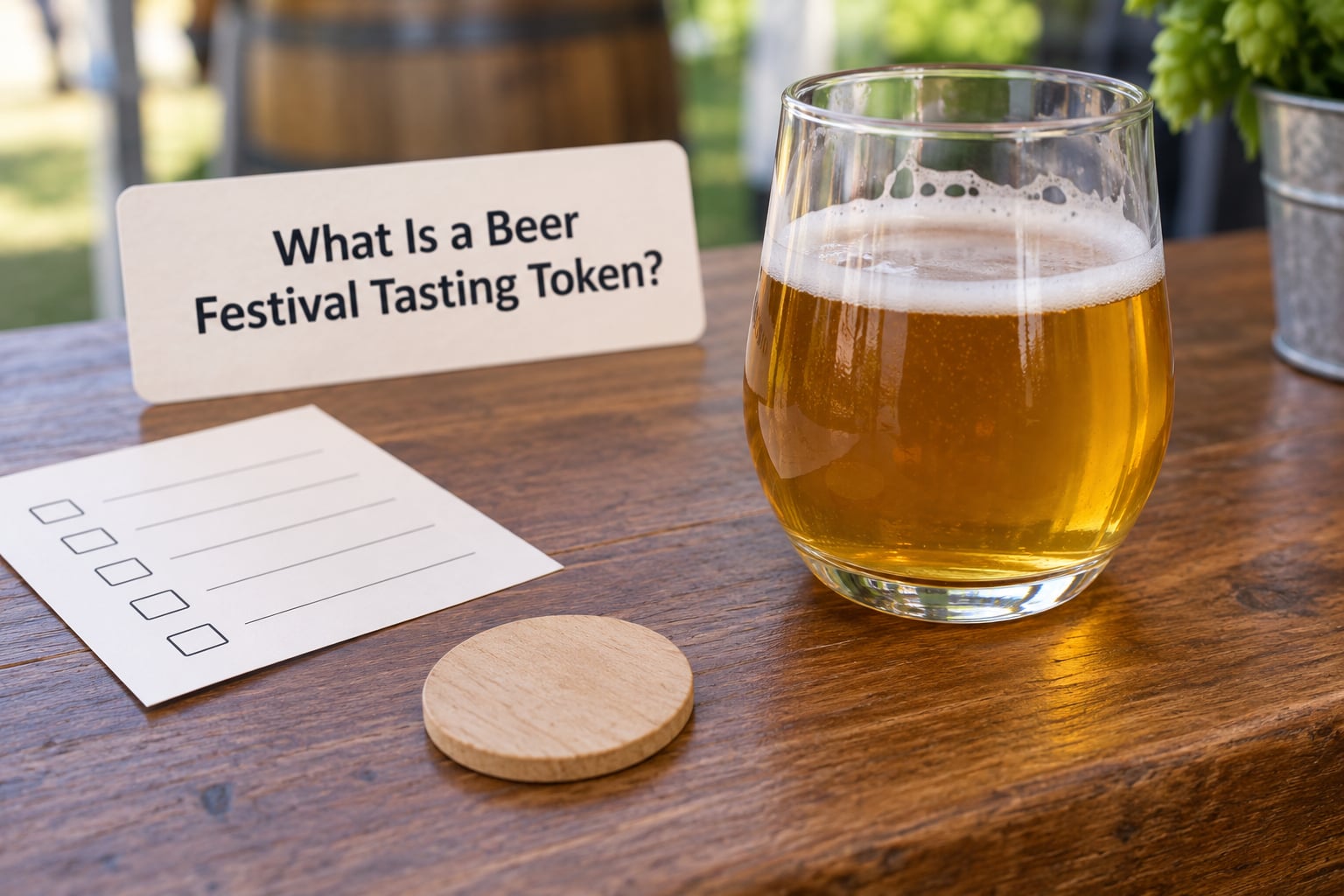
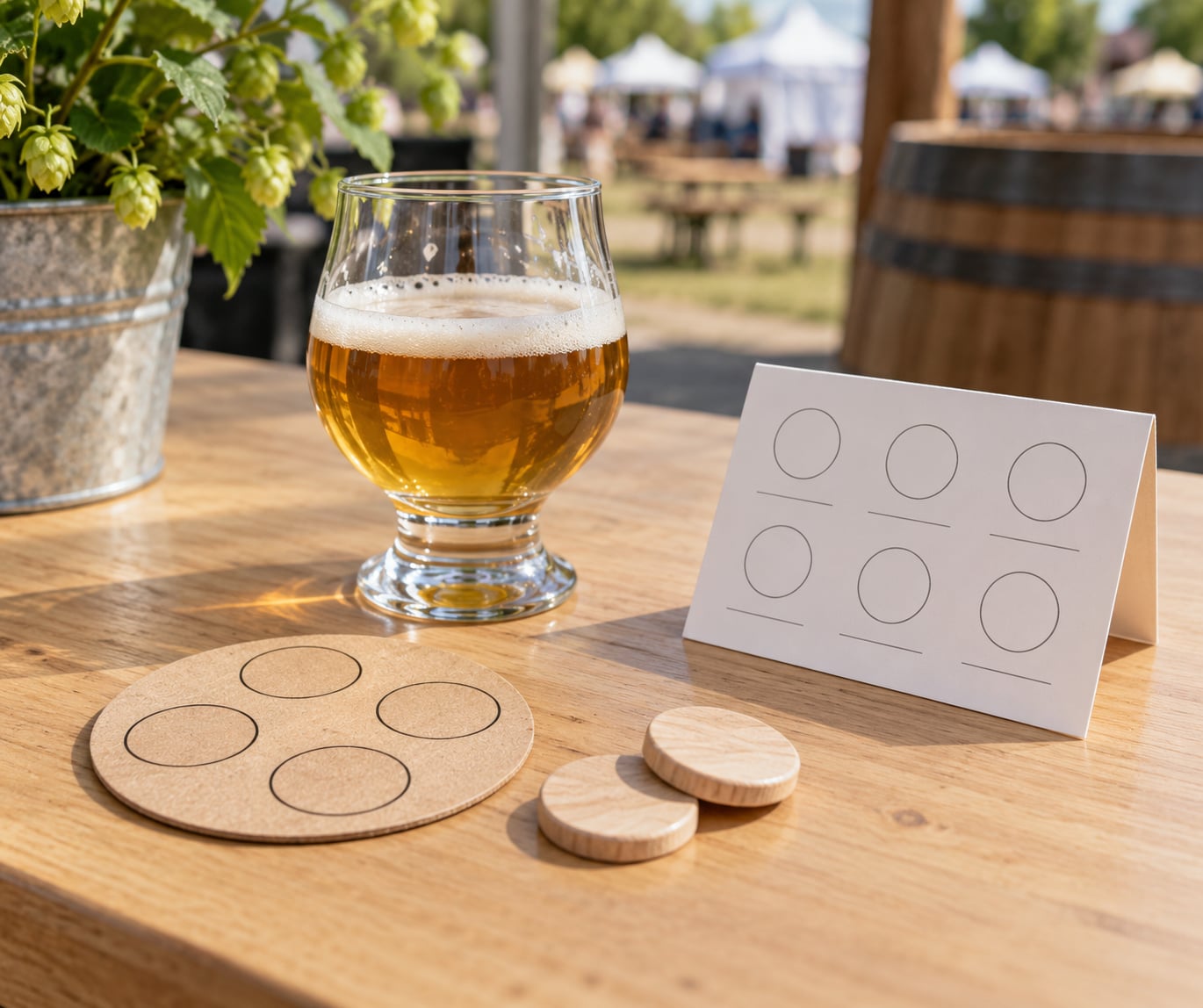
A tasting token is one unit of the festival’s own money. It might be a wooden disc, a stamped cardboard token card with punch spaces, or a credit loaded onto a wristband. You cannot buy anything with it outside the event, and you usually cannot get change for it. Inside the event, one token buys one standard tasting pour.
Tokens are not the same thing as your admission ticket, a wristband, or a drink coupon. The ticket gets you through the gate. A wristband in some festivals means unlimited sampling; in others it is simply proof that you are of legal drinking age and carries your tokens as a balance. A drink coupon is closer to a token than a ticket is, but it usually entitles you to one specific item at one specific booth.
There is a practical reason organizers reach for tokens instead of a cash bar. Beer festivals generally operate under a temporary event licence, and tokens help organizers stay on the right side of alcohol sales law, because the drinks are treated as part of the licensed event rather than as ordinary retail sales. Tokens also cut down on cash handling and speed up lines. A volunteer who takes a token does not have to open a cash box, count change, or reconcile it at the end of the night.
How Beer Festival Tasting Tokens Work at a Glance
Most festivals run on one of a handful of setups. The mechanics change a little; the basic loop does not.
| Festival format | How you get tokens | How you pay at the booth | Typical sample size | Leftover tokens |
|---|---|---|---|---|
| Pay-per-pour with loose tokens | A set number handed over with your ticket or bought at a booth | Hand over one token per standard pour, more for premium pours | Often 3 to 5 ounces, sometimes an uncapped fill | Usually kept, sometimes returned to the merch booth for a credit |
| Token card or punch card | Card issued at the gate, or sold as a ticket add-on | Volunteer punches a space and hands over the pour | Varies by festival | Often discarded, sometimes redeemed for a stein or a discount |
| Tokens loaded onto a wristband | Balance added at check-in or at a top-up counter | Volunteer scans the wristband and deducts one | Varies by festival | Balance may or may not clear when you leave |
| Unlimited sampling | No tokens at all; the wristband is the payment | Show the wristband, receive a small pour | Often 2 to 3 ounces | Not applicable |
| Tiered tasting tickets | Admission covers a block of tastings, extras sold in blocks | Volunteer marks the count against your ticket | Small samples, capped by the tier | Depends on the event’s published policy |
Read the festival’s own page before you arrive. Exact token values, sample sizes and refund terms are set by the organizer and they change between years.
How Do You Buy Beer Festival Tasting Tokens?
There are three common purchase models, and most festivals use more than one of them.
Tokens bundled with admission. You buy one ticket and a fixed number of tokens come with it. The Detroit Beer Festival hands out 15 wooden tokens per admission, with one token buying one beer.
Tokens as a checkout add-on. The ticket stays simple and tokens are sold separately, often in bundles. Fremont Oktoberfest puts five tokens on its Tasting Pass ticket with the option to add five more at check-out, and pours them into a 5 oz acrylic mini-mug.
Tokens bought during the event. Most festivals run a booth or the merchandise counter where you can add more after you have used what you walked in with. Some events take cards, some take cash, and some accept only one of the two, so carry a little cash.
Buying in advance is usually cheaper than buying on site, where the per-token rate tends to be higher. Whether unused tokens stay valid after the event depends entirely on the festival, and most treat them as use them or lose them. Nobody is obligated to buy you a refund, so check the published terms rather than assuming.
What Does One Beer Festival Tasting Token Usually Cover?
One token normally covers one standard tasting pour, and that is the convention nearly everywhere tokens are used. The part that catches first-timers is that the pour is not a full beer.
A festival sample is usually somewhere between 2 and 5 ounces, sometimes poured into an uncapped fill where you stop when you are ready. Multiply that by your token count and you get a fair picture of the night. Fifteen tokens at a 4 oz pour is about 60 ounces of beer in total, which is roughly four standard 12 oz servings.
Premium pours break the one-token rule. Barrel-aged releases, high-ABV imperial stouts, unfiltered or un-yeasted beer, and anything a festival labels a special release commonly cost two or three tokens. The Winter Beer Festival cut its pour size because charging three tokens for a half pour would have dramatically overcharged people. Whatever the multiplier, the booth signage tells you before you commit.
How Do You Redeem a Token?
Redeeming a token takes a few seconds once you know the routine.
- Check the posted token cost for that beer. Most booths are one token, and the premium ones say so on a sign above or beside the tap.
- Get in line with your glass. Bring the glass to the front of the queue rather than waiting with an empty one.
- Hand over the token. At the Detroit Beer Festival, tokens go straight to the person manning the booth. On a punch card, they punch a space instead.
- Say your pour. Ask for a regular sample or a half pour, and confirm whether the half costs more before they pour it.
- Step aside and taste it properly. Standing in the queue while you drink is how festival beer gets forgotten.
If a wristband carries your balance, the volunteer scans it and the deduction shows up on a screen. That system is faster to move through, and it also means your balance is a number on a device rather than a pile of discs in your pocket.
Why Do Some Beer Festivals Use Different Token Values?
When a beer costs two tokens where the beer next to it costs one, it is usually the pour rather than the beer.
One festival posted a scale of five tokens for a cask pint, six for a tap pint and three for a half. Cask beer takes longer to pull and yields less per pull than a tap, so the price reflects the labour and the yield. Other festivals use a flat one-token rule and make up the difference by shrinking the sample size across the board, which is a simpler thing to run when you have thousands of guests moving through the hall.
Cost comes into it too. An imperial stout at high ABV, a barrel-aged sour, or a beer brewed in a limited batch uses more ingredients per serving than a pale lager, and organizers price those separately. Logistics plays a role as well: a booth that sits at the far end of the venue, or one that has to pour from casks and hand-fill bottles, tends to carry a higher token price than a row of chilled taps.
Can You Use a Token for Any Beer?
Usually not, and the exceptions are worth knowing before you queue up.
A single token normally covers standard pours from taps and standard bottled or canned releases at a general booth. Items that usually cost extra are barrel-aged and bottle-conditioned beer, imperial and high-ABV pours, special and limited releases, and anything sold as a flight or a sample set.
Bottle purchases, merchandise and food sit outside the token system completely at most festivals. Cider, seltzer and non-alcoholic options sometimes share the same token pool and sometimes need a separate ticket or token, so check before you commit to a full lap of every booth.
What Happens When a Festival Runs Out of a Beer?
Running dry is common in the last hour at a popular festival, and organizers plan for it.
The most common outcome is a substitution. The volunteer offers another beer from the same brewery at the same token price. Depending on the event, you might get a partial pour of a different beer instead, or you might be offered a credit back against your remaining tokens. A few events keep a waitlist running for the cask that is expected back on line.
What almost never happens is a cash refund at the booth. The organizer’s posted policy is what controls here, and volunteers usually cannot override it. If a beer you paid for never arrived, note the booth number and take it to the event desk before you leave.
Can You Get Refunds or Extra Tokens?
Extra tokens are usually available. Refunds for unused ones usually are not, and festivals differ on the edge cases.
Most events sell additional tokens at a merchandise or token counter during the session, sometimes at a higher rate than you paid at check-in. A few cover the difference with a token return or a credit against merchandise, which is why it is worth asking before you throw a card in the bin on the way out.
Lost tokens are usually just lost. Nobody is tracking a wooden disc that fell into a crowd, so carry them in a closed pocket or a small pouch rather than loose in a cup holder.
Groups raise the question of pooling tokens constantly. Whether friends can share depends on how the event ties drinks to a person. If tokens sit on a wristband scan tied to one wristband, sharing will not work. If they are loose, handing one to a friend is usually fine as long as each person is still within their own limit and has shown ID.
How to Avoid Overspending on Tokens
Spending more than you planned is nearly always the same mistake twice: a two-token premium pour, and a booth you queued for out of habit.
Decide your budget at the gate. Know the token count you walk in with and the rate at the refill counter, then set a ceiling for add-ons before the first pour.
Do a quick lap first. Walk the hall with an empty glass, see what is pouring, and mark the booths with two-token prices. Then start spending. Attendees who taste in booth order end up draining their stack in the first hour.
Keep the premium list short. Pick two special releases you actually want and skip the rest. Sampling broadly beats chasing the expensive stuff.
Use the food and the water. Festivals sell food, and eating between pours is the single most effective pacing tool you have. Keep water in your other hand.
Agree on tokens before you enter. If you are with a group, decide who holds the tokens and who tops up. Losing track of a shared stack is how people accidentally overspend.
How Festival Token Rules Differ from Regular Bar Service
A festival booth is not a bar with a faster queue. The rules are different in ways that catch people out.
Pour sizes are smaller and set by the organizer, not by what you ordered. Payment is prepaid and non-negotiable at the moment of the pour. Substitutions are offered when a tap runs dry, which almost never happens at a regular bar. Lines form around the beer rather than the register, because the volunteer pouring is also the one taking your token.
Limited releases are also more likely. A festival is one of the few places a brewery will pour a barrel-aged batch to hundreds of strangers at once, and that is exactly why those pours cost more tokens.
The trade-off runs the other way too. You know your ceiling before you start, you are not buying rounds you did not plan, and a designated driver ticket is often available at a reduced rate on the same page as the token add-on. Check both when you book.
Frequently Asked Questions
What is a beer token?
A beer festival tasting token is one unit of the festival’s own currency. You hand it to a volunteer at a tasting booth and they fill your tasting glass with a standard sample. It might be a wooden disc, a stamped cardboard punch card, or a balance loaded onto a wristband. It is not your admission ticket, and it usually cannot be exchanged for cash or used anywhere outside the event.
How much are beer tokens worth?
A token is worth one standard tasting pour, which is usually between 2 and 5 ounces rather than a full serving. Premium pours cost more: barrel-aged releases, imperial high-ABV beers and special releases commonly take two or three tokens. Some festivals also charge more for cask pours than tap pours because cask pulls are slower and yield less per pull.
How many tokens do you get with a beer festival ticket?
It depends on the festival. The Detroit Beer Festival includes 15 wooden tokens per admission, with one token buying one beer. Fremont Oktoberfest puts five tokens on its Tasting Pass ticket with five more available to add at check-out. Some festivals sell tokens only as a separate add-on, so check what your ticket includes before you assume you have any.
What happens if you run out of tasting tokens?
Most festivals sell additional tokens at a merchandise or token counter during the session, and the on-site rate is often higher than the check-in rate. Some events also let you return unused tokens for a credit against merchandise. Nobody is obligated to give you a cash refund, so ask the event desk before you leave rather than assuming at the end of the night.
Can you share beer festival tokens with friends?
It depends on how the festival tracks drinks. Loose tokens are usually shareable, as long as each person stays within their own limit and has shown ID. Tokens loaded onto a wristband are tied to that wristband and cannot be passed to someone else. If you are pooling a stack as a group, decide who holds it and who tops up before you go in.
Are beer festival tokens or an unlimited wristband better?
Tokens cost you nothing until you spend them, so you choose which booths to visit and can pour slowly at the good ones. An unlimited wristband lets you sample freely in 2 to 3 ounce pours, which suits someone who wants breadth and moves quickly. Tokens suit a smaller, more deliberate tasting. Unlimited suits a crowd that wants to see everything.
Conclusion
Tasting tokens are simple in practice: buy them with your ticket or at a counter, hand one over at each booth, get a small pour, and watch out for the beers that cost two or three. The systems are moving in different directions, too. The Detroit Fall Beer Festival now says it no longer needs to exchange tokens or tickets for samples after legislative changes, while other events have moved to wristband balances. Before you go, check the organizer’s page for the token value, sample size, premium pour rules, and refund terms for that specific event.