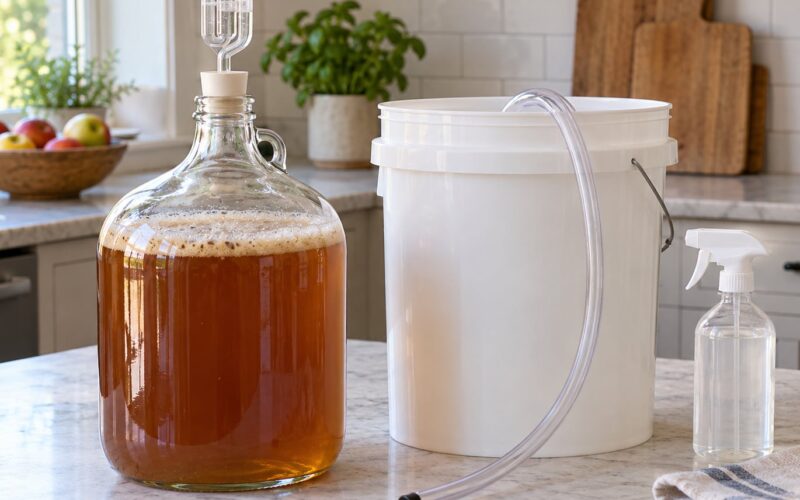
A white film on top of a homebrew fermenter is usually harmless yeast activity: krausen, a yeast raft, or Kahm yeast that grew where oxygen slipped in. It can also be an Acetobacter pellicle, or true mold if the layer is fuzzy and spotted. Texture, smell, and taste settle it in about thirty seconds.
Most of the anxiety comes from forums splitting fifty-fifty between “bin it” and “drink it.” The distinction is not luck, though. Something sitting on the surface of your beer is either gas and foam, dead debris, or a living aerobic culture, and each one behaves in a way you can check without guessing. Here is the ordered process I run through before deciding anything about a batch.
Table of Contents
- What You Need to Check for White Film on Top of Homebrew Fermenter
- Step-by-Step: How to Diagnose a White Film
- 1. Confirm When the Film Appeared
- 2. Check the Fermentation Vitals
- 3. Look for a Healthy Krausen Pattern
- 4. Inspect the Lid, Gasket, and Airlock
- 5. Distinguish Film From Visible Contamination
- 6. Decide Whether to Wait, Isolate, or Discard
- Common Mistakes
- Frequently Asked Questions
- Is white film on top of a homebrew fermenter always mold?
- Can I open my fermenter and remove a white film?
- How long should I wait before treating a white film as contamination?
- Does a strong alcohol smell mean the beer is contaminated?
- Can a homebrew batch with mold still be saved?
- How can I prevent white film from appearing again in my next batch?
- Conclusion
What You Need to Check for White Film on Top of Homebrew Fermenter
You need very little, and none of it requires opening the fermenter. Most of this diagnosis happens from the outside, through the airlock, the temperature, and a gravity reading you already took.
- The fermenter manual. Vessel-specific guidance matters, because a conicle with a built-in blow-off behaves differently from a bucket with a loose lid.
- Your fermentation log. Gravity readings, temperature notes, and the day you pitched.
- A hydrometer or refractometer, plus a sample line or thief if the vessel has one. If it does not, plan to read at packaging rather than disturbing an active ferment.
- A clean sample vessel and spoon for a small taste, taken with the least possible air exposure.
- Cleaning supplies ready for afterwards: unscented detergent, a food-safe sanitizer, and a brush that reaches the lid seam and gasket groove.
- A backup vessel for the case where you decide to rack from underneath or move the batch.
One rule before you start: do not open an active fermenter just to look. Unscrewing a lid to peer at foam introduces exactly the oxygen that causes Kahm yeast and Acetobacter in the first place, and it can turn a manageable film into a contaminated batch. Follow the manufacturer’s instructions on venting and opening, and if your setup genuinely does not permit a look, diagnose from outside the vessel and sample at packaging.
Write down what you see before you form a theory. Color, thickness, whether it breaks apart when the vessel is nudged, whether it clings to the walls, and what time of day you are looking at it. Two minutes of notes now beats arguing with strangers online later.
Step-by-Step: How to Diagnose a White Film
1. Confirm When the Film Appeared
Timing is the single most useful piece of information you have. Pale foam that shows up two or three days after pitching, while the airlock is still bubbling, is almost always krausen. Foam that appears after the airlock has gone quiet, or after cold crash, or in the week before packaging, is a different conversation entirely and deserves more attention.
Pull up your recent gravity readings and ask whether fermentation is still moving. If gravity has been flat for a day or two and the film appeared anyway, you are looking at something that is not simply active fermentation. If gravity is still falling and the airlock is lively, you are very likely looking at yeast doing its job.
2. Check the Fermentation Vitals
Four readings together tell you far more than the film alone. Check the temperature against your target, watch the airlock, note how much weight or volume the vessel has lost since the last measurement, and take a gravity or refractometer reading if your setup allows a sample without opening the fermenter.
A flat gravity reading, a sluggish or silent airlock, and a film all at once point away from healthy yeast and toward something aerobic at the surface. A steadily dropping gravity with an active airlock points toward krausen, even if the foam looks alarming. If your beer has stalled partway and the film is new, a stalled batch changes how much oxygen the liquid can absorb, so read the film problem alongside our guide to why homebrew goes flat and what to check.
3. Look for a Healthy Krausen Pattern
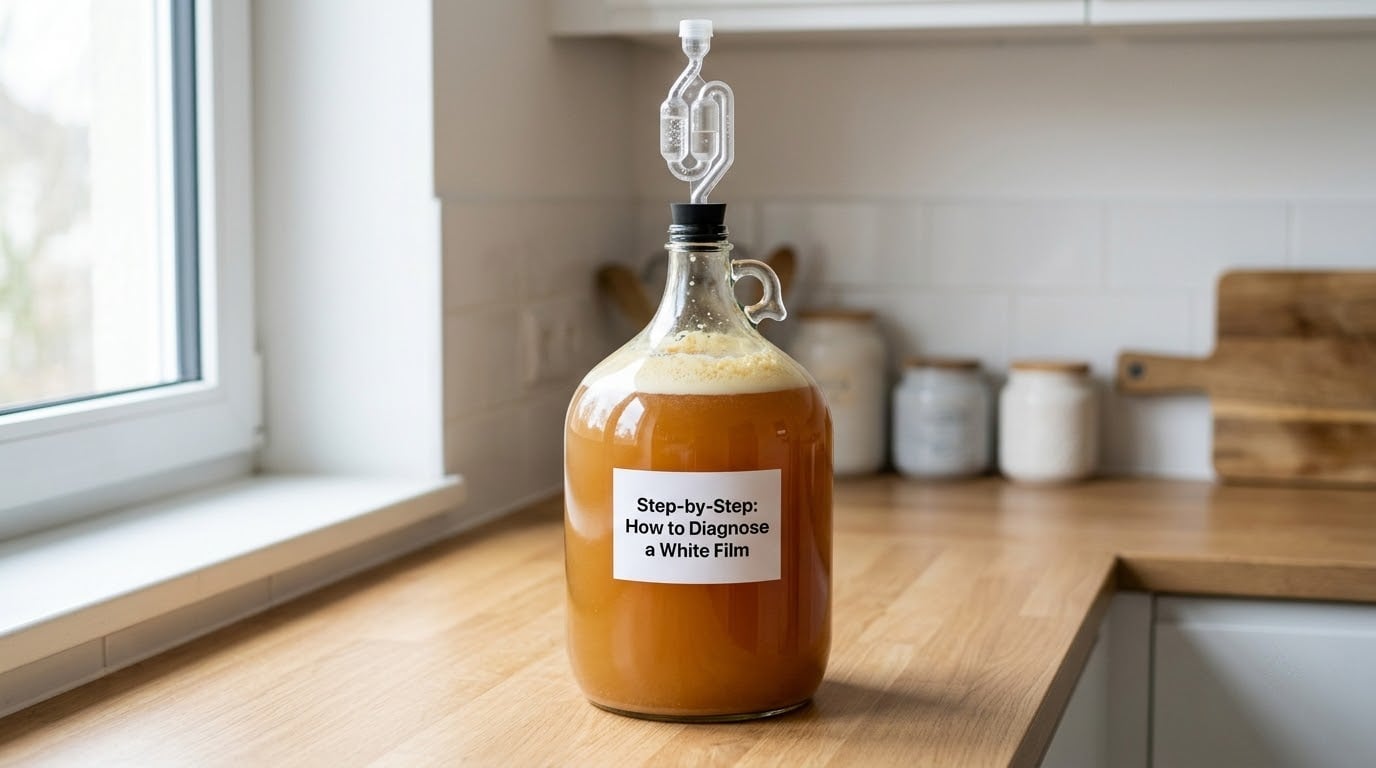
Healthy krausen is uniform. Beige, tan, or off-white, with a loose texture and visible bubbles, and it moves when the vessel moves. It often forms a ring up the sides of the fermenter as the level rises and falls, and in a hefeweizen it can be thick enough to look alarming while being entirely normal, because wheat beer carries more protein and foams harder.
Strain matters more than people expect. White Labs California Ale is repeatedly reported to throw thick, off-white, gloop-like krausen, and WLP001 is often named as a pellicle-former in secondary. An old HomebrewTalk thread on a light honey ale turned out to be exactly this: goopy krausen, no contamination, batch drank fine. If your yeast is known for a heavy head, expect one.
A dense mat of yeast sitting in a single unbroken layer, separate from any foam, is usually called a yeast raft. It is the same Saccharomyces, just collected where the gas pushed it. Both krausen and a raft should dissipate once fermentation slows and the yeast flocculates.
4. Inspect the Lid, Gasket, and Airlock
Sometimes what looks like a film on the beer is really foam that arrived from outside the liquid. Yeast under pressure will push krausen up a dry airlock, through a vent, or out of a lid seam, and that foam can sit in a ring on top of the lid or around the gasket. It smears instead of floating, and it leaves a trail down the outside of the vessel.
Check whether the airlock is seated and whether its vent is clogged, whether the gasket is seated in its groove and clean, and whether the lid seam is tight. A gasket that has been flipped, pinched, or coated in dried krausen will admit air, and that is the most common root cause of both Kahm yeast and Acetobacter films. Handle the fermenter as its manufacturer describes, and replace a gasket that has gone hard or perished.
5. Distinguish Film From Visible Contamination
This is where visual identification earns its keep, with one honest caveat: no photo and no description can conclusively prove what an organism is. Lab work can. What the table below gives you is a strong shortlist that tells you which action fits.
| What you see | What it looks like | Smell | Fuzzy? | Drink it? | Action |
|---|---|---|---|---|---|
| Krausen | Loose foam, beige to off-white, rises up the walls | Clean, hoppy, sweet | No | Yes | Leave it alone |
| Yeast raft | Dense unbroken mat of white cells on the surface | Clean or fruity | No | Yes | Leave it, it drops with flocculation |
| Kahm yeast | Thin, wrinkled, matte, waxy or veiny skin, breaks into white points when jostled | Sour, tangy, sometimes acetone | No | Usually, flavor is affected | Skim it, keep oxygen out |
| Acetobacter pellicle | Rubbery, leathery skin, often stretches and clings to the walls as the level drops | Vinegar, sharp and unmistakable | No | Only if packaged fast, from underneath | Keg immediately, rack from below |
| True mold | Downy or fuzzy, dry, with green, black, orange, or pink specks | Musty, damp basement, rotten | Yes | No | Dump the batch, decontaminate |
| Hop oil or dry hop film | Thin, oily, sometimes iridescent, breaks into many white points when moved | Hoppy, normal | No | Yes | Do not let it reach the package |
| Cold break and hot break trub | Loose white flecks and flakes, sinking rather than floating, clear day-old wort | Clean | No | Yes | Leave it settled, rack above it |
| Tea, herbs, spices, juice, oil | Whatever you put in, floating in pieces, often visibly plant matter | Matches the addition | No | Usually, if it is your addition | Skim or bag it out |
Two tells separate the benign films from the dangerous ones. Fuzzy is the clearest one, since a fuzzy or downy surface with colored specks means mold. Persistent is the other: a pellicle that reforms every time you skim or blow it off, or that stays put while gravity sits flat, is a living aerobic culture rather than debris.
And watch for the two false positives that mislead people most often. Window light refracting off the headspace of clear glass can paint a milky sheen across the top that is not there, which came up repeatedly on HomebrewTalk. A band of clearer wort sitting above a bed of flocculating yeast, called stratification, also reads as a film in a side-lit fermenter. Take a look with the light behind you, not in front, before you start making decisions.
6. Decide Whether to Wait, Isolate, or Discard
There are four honest outcomes, and picking the right one early saves you weeks of worry.
Wait and monitor. Fermentation is healthy, the layer looks like krausen or a raft, gravity is still moving, and the smell is clean. Do nothing. Take another reading in a day or two.
Skim and continue. A Kahm yeast film or hop oil will not clear on its own, but it is not fatal. Skim the surface, reseal properly, and check the seal on the gasket so the oxygen does not keep coming back. Kahm is harmless to drink but it flattens aroma and adds a sour, tangy edge.
Rack from underneath and package fast. An Acetobacter pellicle means the batch has been exposed to oxygen long enough for an obligate aerobe to build a skin. Acetobacter cannot grow once sealed and oxygen-depleted, so kegging or bottling from beneath the pellicle can save the batch. Expect a faint vinegar whiff when you open the container, which effervescence pushes out of solution. One HomebrewForum thread followed exactly this route: a wheat beer that looked like drain cleaner, kegged straight from underneath, and the brewer reported drinking it with no problem. If the beer already tastes of vinegar rather than clean acidity, treat it as a sour character problem and judge it on that basis alone, or work through how to fix off flavors in homebrew.
Dump it. Fuzzy or colored growth, a rotten or musty smell, a pellicle you cannot rack beneath, or a batch that tastes plainly bad will not be rescued. Opening, adding chemicals, or raising the temperature cannot reliably fix mold, and some spores survive attempts to boil the beer off. If you want to double-check before you pour it out, inoculate a small DME or sugar starter with a sample of the film and leave it a few days to see whether it grows, a simple at-home test for whether anything is living in there.
Common Mistakes
Assuming every white film is mold. This is the expensive error, and it sends good batches down the drain. One HomebrewTalk poster described Kahm yeast as flat and waxy, like the skin on heated pudding, and noted that it breaks up so easily you cannot scoop it out cleanly. Fuzzy plus colored is the mold test. Matte and wrinkly is not.
Opening an active fermenter out of curiosity. Unscrewing the lid to look defeats the purpose of the exercise. You are feeding the two organisms you were trying to rule out, and you cannot un-do the air you just let in. Diagnose from the outside, and sample at packaging.
Trusting your nose alone. A clean smell does not clear a fuzzy film, and a sharp sour note does not mean mold. Pair the smell test with the texture test and your recent gravity readings. All three together are worth much more than any one of them.
Pitching a fresh yeast starter into a suspect batch. More yeast does not outcompete Acetobacter, and if the problem is mold, you have just fed it the sugar it wanted. Figure out what you have before you change anything.
Changing temperature in a hurry. A sudden temperature swing stresses yeast, stalls fermentation, and can change how the head behaves mid-batch. Fix the root cause, not the symptom.
Cold crashing to fix a film. Chilling drops yeast out of suspension, but it does nothing to a pellicle or a Kahm film. It is a packaging tool, not a treatment.
Reusing equipment before a full sanitation cycle. Repeated infections in the same fermenter usually mean sanitizing was skipped or rushed. Give the vessel, lid, gasket, airlock, and any siphon parts a proper clean and sanitize, and let them dry fully. If a pellicle has been living in the vessel, a bleach solution followed by a thorough rinse is the honest option.
Once you know what you are dealing with, the next layer is usually oxidation or sour character, since Kahm and pellicle problems almost always arrive alongside one of those two. If the aroma is throwing you off as much as the film is, why homebrew tastes like cider breaks down the most common aroma faults worth ruling out.
Frequently Asked Questions
Is white film on top of a homebrew fermenter always mold?
No. Most white surface layers are yeast: krausen during active fermentation, a yeast raft after it, or Kahm yeast where oxygen got in. Mold is the exception, and it is easy to spot: fuzzy or downy texture with green, black, orange, or pink specks. A wrinkled matte skin with no fuzz is almost never mold. Judge texture first, then smell, then taste, before you decide a batch is lost.
Can I open my fermenter and remove a white film?
Only if your equipment and the batch condition allow it safely. Opening an active fermenter lets in the oxygen that causes Kahm yeast and Acetobacter, so avoid it while fermentation is lively. If you must open, do it quickly, reseal immediately, and follow the manufacturer instructions. Skimming a Kahm film or hop oil from a quiet batch is low risk and often worth doing.
How long should I wait before treating a white film as contamination?
Give it until fermentation clearly stops, which for most ales is roughly four to seven days after pitching, and give lagers and high-gravity batches longer. If the layer persists after the airlock goes quiet, reforms after you skim it, or appears while gravity is flat, stop waiting. A film that shows up in the days before packaging deserves a full texture and smell check immediately rather than another week of monitoring.
Does a strong alcohol smell mean the beer is contaminated?
No, alcohol smell is normal during active fermentation and strongest at peak. What matters is a smell that is off in character rather than strong: vinegar means Acetobacter, acetone or nail polish remover points to stressed or healthy-at-the-end yeast, and musty or damp basement notes suggest mold. A clean, sharp, hoppy or fruity aroma is exactly what you want to smell while the batch is still working.
Can a homebrew batch with mold still be saved?
Treat a fuzzy, colored mold growth as unsalvageable. Mold hyphae grow through the whole liquid rather than sitting on top, can carry mycotoxins, and spores are hard to kill, with some surviving boiling. Boiling will not make the batch safe. Discard it, then decontaminate the fermenter, lid, gasket, airlock, and any siphon parts before the next batch goes in.
How can I prevent white film from appearing again in my next batch?
Block oxygen and start clean. Seat the lid properly, check the gasket for hard or perished rubber, keep the airlock clear, and manage a blow-off rather than sealing a fermenter that is going to foam over. Sanitize every piece of equipment before contact with wort, and keep hops out of the fermentation vessel where you can. Dry hopping and a loose seal are the two setups most often linked to surface films.
Conclusion
Do not open the fermenter first. Note the film’s color and texture, check the temperature and airlock, pull your recent gravity readings, and smell the batch. If fermentation is healthy and the layer looks like krausen, let it clear on its own. If you see fuzz, color, or a rubbery pellicle, decide then whether to package from underneath or pour it out.