To recruit volunteers for a beer event, work out how many people each role needs, write short honest job descriptions with real shift lengths, then recruit from beer communities you already have: local beer groups, brewery taproom regulars and homebrew clubs. Confirm the roster with a waiver, a briefing, and a named person on the day.
Beer events are unusual because the work is inseparable from alcohol service. A volunteer at a general festival might run a merchandise table; a volunteer at your beer event might be checking IDs at the bar, handing out tokens, or carrying a keg line through a crowded hall. That makes the recruitment brief heavier than a normal sign-up form, and it makes the quality of the description matter more.
Volunteers still show up for the same reason people volunteer anywhere: a clear task, a bounded commitment, and something real at the end of it. On the Great American Beer Festival, set-up and tear-down crews are the standard on-ramp for first-timers, and the trade is explicit: work one shift, get in for the rest. Posters in the r/TheBrewery thread about festival volunteering put it the same way. It’s a good deal for anyone who loves beer and has a Saturday to spare.
Table of Contents
- What You Need
- A locked event definition
- A staffing estimate, not a wish
- A named role sheet
- Written job descriptions
- Compliance and paperwork
- A small budget for the essentials
- Step-by-Step
- How Many Volunteers Does a Beer Event Need?
- What Volunteer Roles Should You Create?
- Where Can You Find Beer Event Volunteers?
- What Should You Ask Volunteer Applicants?
- How Do You Confirm and Prepare Volunteers?
- Common Mistakes
- Vague roles with no hours attached
- Recruiting too late
- Overpromising the perk
- Ignoring the alcohol-service rules
- No point of contact and no communication
- Forgetting to thank people
- Frequently Asked Questions
- How far in advance should I recruit volunteers for a beer festival?
- Do beer festival volunteers have to be 21 or older?
- Do beer festival volunteers get paid?
- What should I offer volunteers at a beer festival?
- Do beer festival volunteers have to drink while they work?
- What do I do if I am short on volunteers a few days before the event?
- Conclusion
What You Need
Before you post anything, six things should exist in writing. Skipping any one of them is how organizers end up with a bar full of guests and nobody to pour.
A locked event definition
Date, doors-open time, session length, attendance target, and the legal drinking age where the event is held. Municipal beer garden rules in the United States commonly set a floor of 21 for everyone working the event, not just guests, so check your city or county requirements before you write a single job description.
A staffing estimate, not a wish
Convert your attendance target into per-role numbers using the headcount math later in this article. A number you can defend is also the number you can report to a brewery partner who is sending you four people.
A named role sheet
One page listing every role, what it involves, the shift length, whether it is standing or active work, and whether the person may be around alcohol service. The roles only beer events need are listed below; adapt them rather than inventing new ones on the night.
Written job descriptions
Three to five sentences per role: the task, the hours, the physical demand, what the volunteer gets, and who to ask. One of these is written for you further down.
Compliance and paperwork
A liability waiver, a confirmation that each volunteer meets the local age requirement, a named beer manager, and any licensing paperwork the venue requires. Where temporary event notices apply, that filing sits with the venue or promoter, but it constrains how many people can be behind the bar at once, so ask.
A small budget for the essentials
Tokens, a printed roster with a phone tree, name badges, high-vis vests, wristbands, and something to thank people with. The most common perk costs almost nothing: a free commemorative glass, or entry for the day after a four-hour shift.
Step-by-Step
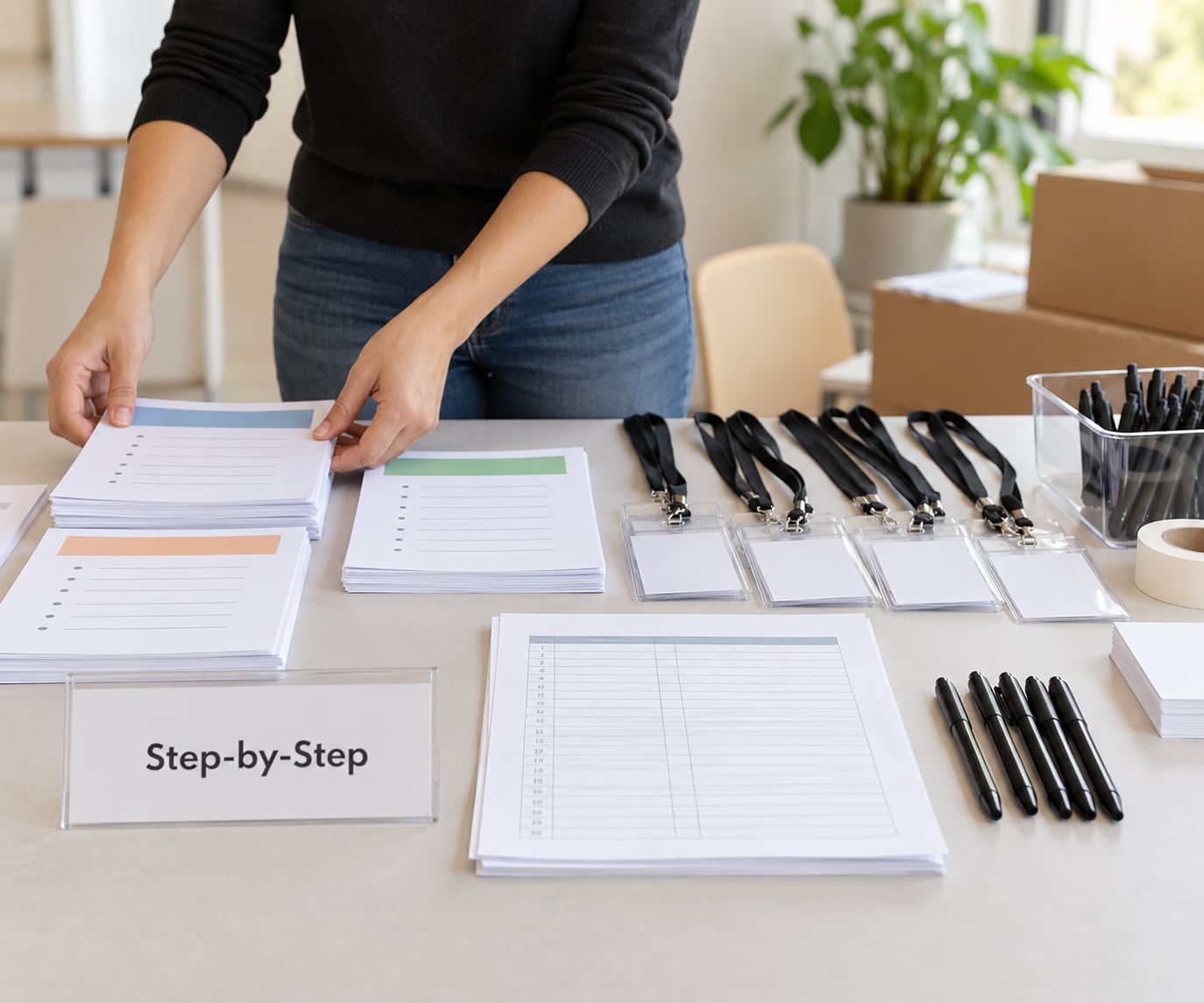
Here is the whole process in nine moves. The order matters more than the detail at each step.
- Lock the event details and build a role list with a headcount for each role.
- Write one short job description per role with an honest shift length.
- Decide what volunteers receive: entry, tokens, a glass, a staff pour, a shirt, or a next-event ticket.
- Open a single sign-up form with no more than seven questions.
- Recruit from warm channels first: taproom regulars, homebrew clubs, local beer groups, tap takeovers, and past attendees.
- Post the open call publicly, naming the shift length and the perk, rather than writing “volunteers needed”.
- Screen for reliability and availability, then assign roles and send a confirmation.
- Run a short orientation and a day-of briefing, with a named contact on site.
- Thank volunteers within a week and ask for their help at the next event.
Run it against a calendar rather than a to-do list. Most first-time organizers are two weeks late on the one step that cannot be compressed: getting enough people to apply.
| When | Action | Owner | Target |
|---|---|---|---|
| T-12 weeks | Lock date, venue, attendance target and legal age requirements; build the role sheet with headcounts | Event lead | Role list signed off |
| T-10 weeks | Approach taprooms, breweries and local beer groups directly with a named ask | Volunteer coordinator | 2 or 3 partner commitments |
| T-8 weeks | Open the sign-up form; post the first public call with shift length and perk stated | Coordinator | 50% of needed headcount applied |
| T-6 weeks | Follow up with past attendees and mailing lists; collect waivers and confirm ages | Coordinator | 75% applied |
| T-4 weeks | Assign roles and shifts; flag gaps in safety-critical roles; recruit floaters | Coordinator plus beer manager | 100% applied, 90% confirmed |
| T-2 weeks | Send the orientation pack: map, dress code, arrival time, contact, what to expect | Coordinator | All confirmed volunteers acknowledged |
| T-1 week | Run a 30-minute online orientation; confirm shift start times individually | Beer manager | Under 10% unconfirmed |
| Event week | Print roster, badges, phone tree; pack check-in kit and spares | Coordinator | Kit packed two days out |
| Event day | Check volunteers in, run the briefing, log hours, name the on-site contact | Coordinator | Every shift covered |
| T+3 days | Thank-you message, hours recorded, next-event invitation | Coordinator | 100% contacted |
How Many Volunteers Does a Beer Event Need?
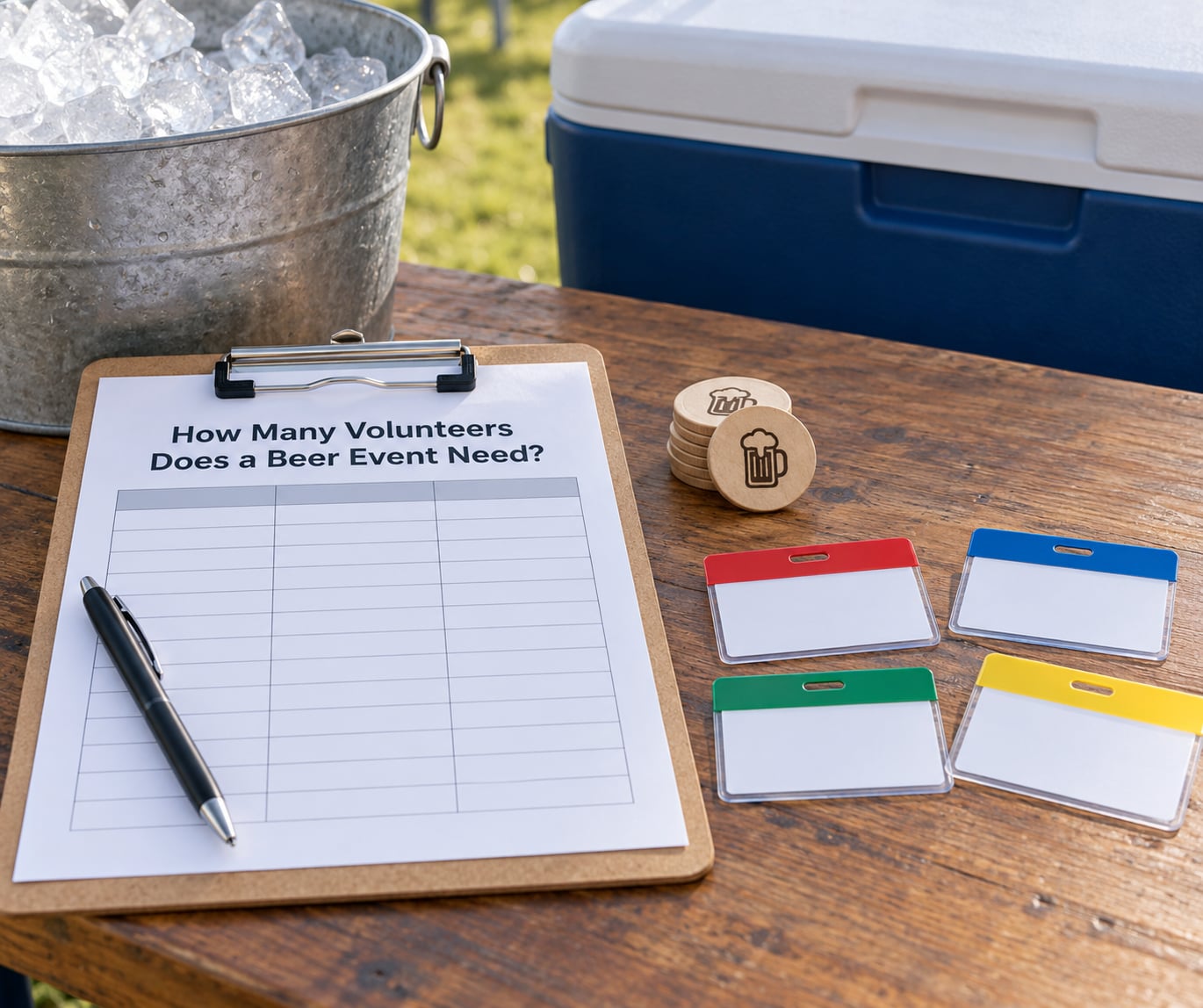
Budget one volunteer per 25 guests for a standard taproom-style tasting, and closer to one per 15 for a festival with a gate, tokens, and multiple beer stations. Those are starting points, not rules. The variables that actually move your number are gate volume, how many bars are pouring, and how long your shifts run.
Breaks are the part people forget. A volunteer who works a four-hour shift still needs a break, and you cannot have your entire token desk walk away at once. Add roughly 15 percent to your role count as relief coverage, then add two or three floaters who are not tied to a station.
| Role | What they do | Typical shift | Headcount guidance |
|---|---|---|---|
| Set-up crew | Tables, signage, badges, keg lines, glassware, wristband station | 3 hours before doors | 1 per 50 guests, minimum 3 |
| Greeter and admission | Check tickets, apply wristbands, answer questions, hold the door line | 2-3 hours | 1 per 150 guests per entry point |
| Token desk | Sell and reconcile tokens, handle top-ups, explain the system | 3-4 hours | 2 per 300 guests |
| Beer pourer | Pour, wipe, watch the glass, refuse service where needed | 2-3 hours | 1 per 25 guests per bar |
| Cellar or stillage runner | Move kegs, casks, ice and dirty glass back and forth | 3 hours | 1 per 2 pourers |
| ID checker | Check identification at the bar under the event’s age policy | 2-3 hours | 1 per 100 guests per bar |
| Queue and accessibility | Manage lines, keep the accessible route clear, assist guests | 3 hours | 1 per 200 guests |
| Safe ride volunteer | Arrange and drive designated drivers, keep the list at the exit | Full event | 2, non-drinking role |
| Trash and recycling | Clear glass, bins, and spills through the session | 2-3 hours | 1 per 100 guests |
| Floater | Backfill no-shows and breaks across any role | Event length | 2-3 |
Here is a worked example. A 200-person taproom beer festival, three beer stations, one entry point, sessions running 1 to 6 in the afternoon and 6 to 11 at night, staffed by 18 volunteers: four on set-up, two greeters, two on the token desk, five pourers, two cellar runners, one ID checker, one queue and accessibility volunteer, and one floater who rotates between breaks. Six of those are set-up and teardown volunteers working outside session hours. That is the roster that works, and it is close to what a mid-size city beer festival runs.
What Volunteer Roles Should You Create?
Generic festival roles do not translate. Split “event staff” into the jobs a beer event actually has, and give each one a name volunteers can picture. Specific roles are also what stops a bar manager from pulling a token-desk volunteer to help carry a keg mid-session.
- Set-up and teardown crew. The best entry point for first-time volunteers because the work is physical, well defined, and outside the busiest hours. Most festivals use it as the default first shift.
- Greeters. Meet the line, check tickets, hand out wristbands. Fast to train and the first thing guests judge the event on.
- Token desk. Sells and redeems tokens, reconciles at the end of a session. Needs someone detail-minded and comfortable saying no when a token does not match a wristband.
- Beer pourers. The role people want, so staff it with your most reliable people. Pour, keep the glass clean, and stop pouring when a guest has clearly had enough.
- Cellar and stillage runners. The role nobody volunteers for and everybody notices when it is empty. Kegs, ice, dirty glass, bins.
- ID checkers. Placed at the bar, not at the door, under the event’s age policy. In the United States that is 21; Challenge 25 is a common UK practice that asks for identification from anyone who looks under 25.
- Queue and accessibility crew. Keeps lines moving, holds the accessible route, and handles the guest who needs a seat or a hand carrying something.
- Designated driver volunteers. A formal, non-drinking role with its own perk. One Maine beer festival advertises free designated-driver admission or a discounted tasting ticket, and it is a genuine recruitment asset.
- Photographers and social crew. Useful for next year’s marketing, but keep them off the pour stations.
- Merchandise sellers. Only if you are selling glassware, shirts or beer-related product, and only if you can reconcile cash.
Add two rules to the role sheet and you will cut most event-day problems. Volunteers do not drink on shift. And nobody moves between stations without telling the volunteer coordinator, because the missing person is always the one being looked for.
Where Can You Find Beer Event Volunteers?
The fastest volunteers come from lists you already have or can get in one email. Broad public posts fill a role slowly and unreliably; a taproom’s own customer list fills it in a day.
- Local beer groups and CAMRA-style volunteer bodies. The UK equivalent is the local branch of the Campaign for Real Ale, which already fields trained volunteers for beer festivals. Anywhere else, look for the regional beer appreciation society, guild or festival society.
- Brewery taprooms. Ask the taproom manager directly, and offer the brewery something in return: a mention, a tap slot, or a table at the event. Taproom regulars are pre-qualified by the fact that they already know how a beer festival works.
- Homebrew clubs and brewing guilds. Enthusiastic, group-organized, and used to working a shared event for free. They also tend to bring their own equipment.
- Local beer Facebook groups and subreddit threads. Post the specific ask: date, hours, role, what they get. r/sandiego threads show beer pouring described as a desirable, easy-to-find volunteer opportunity, with people asking organizers how to sign on.
- Tap takeovers and beer walks. The organizer of the takeover is often a two-person team who would love ten extra bodies. You are solving their problem too.
- Hospitality and culinary programs. Culinary schools, hospitality associations and university event-management clubs have students who need hours and will take a shift seriously.
- Your own attendees. People who came last year and bought a token bundle are your warmest list. Ask them first, and ask specifically.
Say who the event benefits. Experienced volunteers are quick to notice when a nonprofit list is being used to staff a commercial event, and a short, honest line about where the money or the surplus goes prevents the whole applicant pool from quietly deciding not to reply.
What Should You Ask Volunteer Applicants?
Use a short form. A long application on a volunteer event is the single most common reason a good applicant disappears halfway through, and the questions that make it long are usually the ones you could ask on the day.
Ask these seven:
- Name and mobile number, so you can text on event day.
- Which role or roles are you interested in, and can you cover more than one?
- Which shift can you work: set-up, first session, second session, or teardown?
- Have you volunteered at an event like this before? One line is enough.
- Are you available for the full shift plus the briefing, including standing and lifting?
- Do you meet the event’s legal age requirement, and can you show identification on site?
- What would make this worth your time, and how should we reach you on the day?
Cut the resume request, the essay, the full legal name, the date of birth, the emergency contact form that repeats what the waiver already collects, and the multi-page indemnity. Keep the waiver itself, in a form that actually gets signed rather than one people scroll past.
Screen on two things only: did they answer clearly, and did they commit to a specific shift. Reliability is the thing that matters, and the most honest predictor is whether they told you no about something.
How Do You Confirm and Prepare Volunteers?
Confirmation is where a recruiting process either holds together or falls apart on the morning. A volunteer who does not know where to go, when to arrive or who to ask becomes a no-show at 9 in the morning.
- Send a confirmation the day you assign the role. Role, shift start and end time, arrival point, parking or transit note, dress code, and the name and mobile of the coordinator on site.
- Collect the waiver and confirm the age requirement. Keep a simple sheet with a signature date. Municipal rules in the US commonly require everyone working the event to be 21 or older, and some beer gardens publish a minimum number of volunteers who must be on site throughout, so check yours.
- Send a one-page orientation pack a week out. Site map, what the tokens are worth, the age policy in one sentence, the three rules that matter most (no drinking on shift, no moving stations without telling someone, ask before solving a problem), and a photo of the check-in table.
- Run a 30-minute online orientation or a single in-person walk-through if your volunteers are local. Cover ID checks, how to decline service politely, and who the beer manager is.
- Give every station a printed roster with phone numbers, the schedule, and the escalation contacts. The coordinator, the beer manager, the venue contact, and one emergency number.
- Check people in at a single point with a printed sign-in sheet. Mark arrival in pen. This is your no-show data.
- Keep floaters unassigned and hand them out at the briefing. Anyone who has not arrived 30 minutes after their shift start is a floater problem, not a phone-call problem.
- Log hours and thank people within three days. A short message saying what the event did, how many hours they gave, and when the next one is, is what turns a one-time helper into a regular.
Watch four numbers at the end: fill rate against your target roster, no-show rate, hours per volunteer, and how many came back or said yes to the next event. Fill rate above 100 percent with a high no-show rate means you over-recruited; fill rate below 80 percent means the outreach landed too late, and you fix it by starting twelve weeks out.
Common Mistakes
These are the failures that cost a beer event its license, its guests or its volunteer pool, in roughly that order.
Vague roles with no hours attached
“General event support” with no shift length is the reason people bail. State the hours, the physical demand, and the finish time. Forums and volunteer coordinators consistently call out bare “volunteers needed” posts as scammy or desperate, and they are usually right.
Recruiting too late
Reliable people need a few weeks to clear a Saturday. Opening the call at T-4 weeks means you are assembling a crew from whoever answers, and you will not get your ID checkers from that pool. Start at T-12 weeks.
Overpromising the perk
If the perk is “free beer”, volunteers will ask how much. Decide what you can genuinely deliver: entry for the day, a set token allotment, a commemorative glass, one staff pour, a shirt, or a ticket to the next event. Promises you cannot keep cost you the people who trusted you first.
Ignoring the alcohol-service rules
No drinking on shift, no service to someone who is clearly intoxicated, identification checks in place, and a named beer manager. Volunteers do not carry the license, but they are the people on the floor, and an incident at the bar is an incident at your event.
No point of contact and no communication
One named coordinator, reachable on a phone, on site from set-up to load-out. Silence between the sign-up and the event is the top reason good volunteers stop volunteering for organizers who got it right the first time.
Forgetting to thank people
A thank-you within a week, their hours recorded, and an invitation to the next event take ten minutes. The alternative is re-recruiting from zero for every event, which is the most expensive way to run a beer festival.
One more worth naming: using a nonprofit or community volunteer list to staff a commercial event without saying so. Experienced volunteers treat that as a real line in the sand. Say who benefits, in one sentence, before anyone signs up.
Frequently Asked Questions
How far in advance should I recruit volunteers for a beer festival?
Start at twelve weeks out for a festival and eight weeks for a taproom event. Volunteers with jobs and families need that much notice to hold a date, and the roles you fill last, like ID checkers and floaters, take the longest because you are asking for reliability first. A single public post at four weeks out will get you bodies, not a crew.
Do beer festival volunteers have to be 21 or older?
Usually yes in the United States, because most municipal beer garden rules set 21 as the minimum for anyone working the event, not only guests. Some cities publish a minimum number of volunteers who must be on site throughout, often nine. Outside the US the legal drinking age varies. Check your city or county rule and put the requirement in your job description.
Do beer festival volunteers get paid?
Almost never. Beer festival volunteers are unpaid and trade a bounded shift for entry, tokens, a commemorative glass, a staff pour, merchandise or a ticket to the next event. The strongest version of the trade is one four-hour shift in exchange for admission to the rest of the day. Be clear about whether the trade is staff entry, paid entry or a discount, because that is the question applicants ask first.
What should I offer volunteers at a beer festival?
Offer something specific and keep it cheap. A free token allotment, a commemorative glass, one staff pour, a shirt, or next year’s ticket all work, and the most valued one is usually entry for the rest of the day after a single shift. A ladder works well: set-up crew gets entry, session volunteers get entry plus tokens, and floaters get all of it.
Do beer festival volunteers have to drink while they work?
No, and the opposite is the rule. Nobody drinks on shift, and the safe-ride volunteer role is explicitly non-drinking, which is why festivals advertise free designated-driver admission or a discounted tasting ticket for that slot. A volunteer who has been sampling all afternoon is a service and safety problem, and it removes the people most likely to notice a guest who has had too much.
What do I do if I am short on volunteers a few days before the event?
Go back to the warm lists first, in order: taproom regulars, the brewery partner, homebrew clubs, and people who signed up for the other date. Cut the shift count and extend the length instead, or convert two token-desk volunteers into one plus a floater. Then trim scope deliberately, by capping tokens per person or closing one bar station, rather than stretching four people across roles built for six.
Conclusion
Recruiting volunteers for a beer event comes down to three things done early: a role sheet with real headcounts, job descriptions that state honest shift lengths, and outreach to people who already care about beer. The compliance work, the waiver, the briefing and the named coordinator on site are what make the crew you recruited usable on the day.
Start with the math today. Pick your attendance target, work out how many people each role needs, and add your floaters. Then send one email to the nearest taproom and one post to your local beer group, with the date, the hours, the role and the perk in the first two lines.