The short version: once yeast makes alcohol, a refractometer reading is no longer a gravity reading. It is an apparent reading that sits too high, and you fix it by pairing the gravity or Brix value you recorded before pitching yeast with the Brix reading you get now, then running both through a refractometer correction calculator.
That is how to correct refractometer readings after fermentation starts, and it takes about five minutes. The number people forget is the original gravity. If it was never recorded on a calibrated instrument, no calculator can recover it, and a hydrometer becomes your only reference.
Here is the order I work in, the arithmetic behind it, and the situations where the method quietly stops being reliable.
Table of Contents
- What You Need
- Step-by-Step: How to Correct Refractometer Readings After Fermentation Starts
- 1. Measure the temperature and take a clean sample
- 2. Check the calibration and the scale you are reading
- 3. Enter the original gravity and identify the alcohol effect
- 4. Calculate the corrected reading for the measured conditions
- 5. Verify the result with an independent measurement
- Common Mistakes That Make a Corrected Reading Wrong
- Relying on the refractometer reading without a correction
- Ignoring temperature or calibration errors
- Mistaking a conversion estimate for a final gravity
- Frequently Asked Questions
- Can I correct a refractometer reading after fermentation starts?
- Does temperature compensation correct a refractometer reading after fermentation?
- Why does my refractometer show higher gravity than my hydrometer?
- How do I calculate corrected specific gravity during fermentation?
- Should I use a refractometer or hydrometer to confirm final gravity?
- Can a refractometer reading be corrected without knowing the original gravity?
- Conclusion
What You Need
None of this is exotic equipment, but two items matter more than the rest: a working original gravity number and a way to check the result.
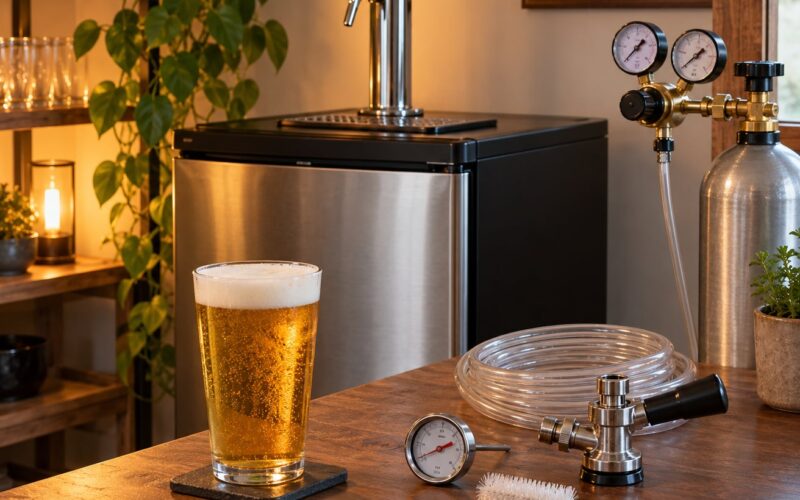
- Your refractometer — a digital model with automatic temperature compensation is easier to keep honest than a dial model, and a dual-scale SG/Brix instrument is fine as long as you know which line you are reading.
- Calibration solution — distilled or reverse osmosis water at the instrument’s calibration temperature, plus a commercial test fluid near your working range if you want to check more than zero.
- Your pre-fermentation gravity — either a specific gravity or the Brix reading taken from wort before yeast went in, written down and dated.
- A hydrometer or other gravity reference — a precision hydrometer is the cross-check that tells you whether the corrected number is worth trusting.
- A thermometer — for the sample and the instrument, since temperature errors and alcohol errors are separate problems.
- A correction calculator — BeerSmith, BrewFather, Brewers Friend, the Brülosophy refractometer correction tool, or a spreadsheet built on the Sean Terrill correlation all do the same job.
- A clean sample vessel and your brewing log — a small test tube or a sanitized thief, and somewhere to record temperature, OG, current Brix, corrected FG and the date.
Step-by-Step: How to Correct Refractometer Readings After Fermentation Starts
1. Measure the temperature and take a clean sample
Bring the sample and the instrument to the same temperature first. Most refractometers are calibrated at 20°C (68°F) unless the model says otherwise, and a warm wort sample read on a cold instrument is wrong before alcohol ever enters the picture.
Draw the sample from the beer, not the yeast. A sanitized thief or turkey baster works well; reach into the middle of the vessel and avoid the trub at the bottom and the crust at the top. If the fermenter is warm, chill the sample first or accept a temperature-corrected reading only if your instrument is rated for that range.
Then handle it like this:
- Let the sample settle so suspended yeast and hop debris drop out, or pour off a clear middle portion.
- Swirl gently and let it sit a minute to release dissolved carbon dioxide, which nudges the reading upward on its own.
- Pour off any foam and drop the liquid onto the prism without touching it with the pipette.
- Cover the prism fully, look straight down at the scale, and take two readings. If they disagree by more than half a scale division, redo it.
2. Check the calibration and the scale you are reading
Calibrate before you use the instrument, not after. Put a drop of distilled or RO water on the prism at the calibration temperature and confirm it sits on the 1.000 SG / 0.0 Brix line, then adjust with the dial or set screw as your manual describes. A drop of a known test fluid near your working gravity catches drift that plain water cannot.
This step carries more weight than most people give it. If the refractometer was off by 0.004 at your original gravity, every corrected reading you will ever calculate from that OG inherits the same error.
One thing to be clear about: automatic temperature compensation fixes temperature, never alcohol. Many brewers assume a model marked ATC handles the post-fermentation problem, and it does not.
Also check the scale. A dual-scale instrument shows both SG and Brix, and the correction calculators all want Brix. Read the scale line by line rather than assuming the number near the middle is the gravity.
3. Enter the original gravity and identify the alcohol effect
Your refractometer is calibrated in pure sugar water. It works by measuring how much light bends as it passes through the sample, and it reports a sucrose-equivalent value. Sugar and ethanol do not bend light the same way, and ethanol bends it far less per gram than sugar does. So when yeast strips sugar out of wort and replaces it with alcohol, the refractive index falls by much less than the true gravity does, and the instrument reports a gravity that never existed.
On a 1.071 original gravity pale ale, a finished batch can sit at 1.015 or 1.020 on the refractometer while the hydrometer says something closer to 1.010. Brewers on Homebrewtalk and r/Homebrewing describe exactly this: an apparent reading that refuses to fall, long after the beer has clearly stopped moving.
The same over-reading happens in reverse at the start. Wort is not pure sucrose, so a pre-fermentation reading on a sugar-calibrated scale is itself a converted number. That is what the wort correction factor is for: a value of about 1.040 is the default in BeerSmith and several calculators to rescale a wort Brix reading before the gravity conversion, and you can tune it for your own equipment.
What the alcohol problem means practically is that you need two inputs, not one. The correction tools take your pre-fermentation gravity and your current Brix reading and return a true final gravity. Without that OG figure, there is no honest correction — only rough shortcuts.
If you want the biological side of this, what yeast does in beer covers why attenuation varies so much between one brew and the next.
4. Calculate the corrected reading for the measured conditions

Use a calculator that takes the original gravity and the current Brix. BeerSmith, BrewFather, Brewers Friend and the Brülosophy tool all do; the Sean Terrill correlation spreadsheet is the one long-time brewers tend to trust because it was re-fitted against brewer-submitted data rather than inherited from the old industry standard.
Worked example, using numbers brewers cite often. Original gravity 1.071, which is 17.1 Brix. Fermentation has settled and the refractometer now reads 8.4 Brix. Enter both values and the calculator returns a corrected final gravity of roughly 1.010. That is about 8% alcohol by volume using the simple (OG minus FG) times 131.25 figure.
Now compare that with the shortcut, because seeing both is the fastest way to understand what the correction factor is doing. Dividing 8.4 by the 1.040 wort factor gives 8.08 Plato, and Cobb’s formula, SG equals 259 divided by 259 minus Plato, turns that into about 1.032. Same sample, same instrument, very different answers.
That gap is the reason brewers have largely stopped dividing by 1.040 and calling it a final gravity. The shortcut ignores how much alcohol is present; the OG-based correlation subtracts it explicitly, which is why the corrected number lands nearer the hydrometer. Treat the division route as a rough sanity check and the OG-based calculator as your actual result.
Two limits worth keeping in mind. The published correlations hold best roughly between OG 1.036 and 1.106 and FG 1.007 and 1.022, which covers most ales but not every specialty batch. And the correction is an estimate, not a measurement, so write it in your log as an adjusted figure rather than a confirmed one.
5. Verify the result with an independent measurement
Confirm with a hydrometer while the beer is still where you can reach it. The best moment is a day or two before packaging, when a sample costs you nothing and the beer has had time to drop bright. A precision hydrometer is typically good to about 0.0005 SG, which is tighter than any corrected refractometer figure.
Interpret the difference rather than arguing about it. Corrected refractometer results commonly land within 0.001 to 0.002 SG of the hydrometer on typical low-ABV ales, and brewers usually see the calculated value come out slightly lower than the hydrometer. If the two agree inside that band, move on. If they are more than about 0.003 apart, look again at temperature, calibration and degassing before you trust either number.
There are times to skip the refractometer entirely rather than correct it: sours and anything acid-forward, batches above roughly 10% ABV, low-attenuation or high-gravity beers outside the correlation range, and anything with fruit, honey or other adjuncts added after fermentation. Sour-beer brewers say plainly that no reliable correction exists for the acids, and they are right. Mead, wine and cider sit in the same boat, with a different sugar matrix again.
Common Mistakes That Make a Corrected Reading Wrong
Relying on the refractometer reading without a correction
Reading the SG scale straight off the dial and calling it final gravity is the single most common error, and it is the one that quietly wrecks a logbook. The inflated number makes apparent attenuation look better than real attenuation, understates your alcohol by a point or two, and can convince you a stuck fermentation has finished when it has not.
The fix is simple: from the moment yeast goes in, treat every refractometer number as apparent until it has been converted.
Ignoring temperature or calibration errors
Two errors get bundled together here. Temperature: a sample ten degrees off the calibration point shifts the reading whether or not alcohol is present, and automatic temperature compensation covers a limited range, so check what your model actually compensates for. Recalibrate whenever the instrument is cold, wet, dropped or moved between the fridge and a warm bench.
Calibration: distilled or RO water confirms the zero point, and a test fluid confirms the working range. Do both before the original gravity reading, not at the end of fermentation, because a bad OG poisons every correction you will make later.
One brewer in an r/Homebrewing thread found a 0.004 OG variance against the hydrometer on a first wort reading even after calibrating with distilled water. Instruments drift, and the only way to know is to check.
Mistaking a conversion estimate for a final gravity
A corrected reading is arithmetic on a single measurement, not a second measurement. It is good arithmetic, but it carries an error band, and treating 1.010 as confirmed rather than estimated is how people end up filing inaccurate figures for a competition entry or a recipe they plan to brew again.
Verify with a hydrometer whenever the number matters: before packaging, after a temperature swing, and any time you are tempted to bottle early. When the correction is outside its reliable range, wait for the sample to degas and take a hydrometer reading instead of arguing with a calculator.
A few habits keep the whole thing tidy:
- Log the original gravity from both instruments, so you can derive a correction factor specific to your refractometer later.
- Use the refractometer mid-ferment as a stability indicator, watching for a Brix reading that stops moving, and the hydrometer for the number you record.
- Note the temperature and the calculator you used next to every corrected figure.
- Re-measure rather than reuse a reading from a sample that has been sitting for an hour.
Frequently Asked Questions
Can I correct a refractometer reading after fermentation starts?
Yes, as long as you recorded the original gravity or pre-fermentation Brix before pitching yeast. Enter that value plus the current Brix reading into a correction calculator and it subtracts the alcohol contribution to give a true final gravity. Without the OG, no honest correction exists and you need a hydrometer.
Does temperature compensation correct a refractometer reading after fermentation?
No. Automatic temperature compensation adjusts for the temperature of the sample and the instrument, nothing more. Alcohol interference is a separate optical problem that only the OG-based conversion handles. You still need both steps: correct for temperature, then correct for alcohol.
Why does my refractometer show higher gravity than my hydrometer?
Alcohol has a different refractive index from sugar and water, and it contributes far less per gram, so the reading does not fall as far as the true gravity does. Dissolved carbon dioxide and suspended yeast push it higher still. A stuck apparent reading of 1.015 to 1.020 on a finished 5% beer is normal behaviour, not a broken instrument.
How do I calculate corrected specific gravity during fermentation?
Take the pre-fermentation gravity and the current Brix reading, then enter both into a calculator built on the Sean Terrill correlation, such as those in BeerSmith, BrewFather, Brewers Friend or the Brülosophy tool. Divide the Brix value by the 1.040 wort factor and Cobb’s formula only as a rough cross-check, since it ignores alcohol entirely.
Should I use a refractometer or hydrometer to confirm final gravity?
Use the hydrometer to confirm. Corrected refractometer figures usually land within about 0.001 to 0.002 SG of a good hydrometer on typical low-ABV ales, which is useful but not definitive. If the batch is sour, above 10% ABV, low attenuation, or has adjuncts added after fermentation, the hydrometer is the only reading worth logging.
Can a refractometer reading be corrected without knowing the original gravity?
Not reliably. The correction works by comparing the pre-fermentation gravity with the current reading, so without the OG there is nothing to subtract the alcohol from. You can estimate ABV roughly from a residual gravity reading, but treat the result as a guess and confirm with a hydrometer before packaging.
Conclusion
Start with the number you may not have: pull your original gravity from the log, note the temperature of the sample, and take a clean, degassed reading. Run those two values through an OG-based correction calculator, write the adjusted gravity down as an estimate, and confirm it with a hydrometer before you package in 2026 or file it in your recipe log.