Set and forget beats burst carbonation for consistency and beer quality, while burst wins on speed. If you have cold beer, a gas line and a firm serving deadline, burst gets you a tappable keg in under a day; if you have a week or two of slack, set and forget gives the same result every time with no guesswork.
Both methods are forced carbonation, and the set and forget vs burst carbonation for kegs decision is really one question: where do you put the pressure, and how long do you hold it there. That choice changes how quickly you can pour, how much gas you burn through, and how much control you have when something goes sideways.
Last reviewed for 2026. Numbers here are typical ranges, not guarantees, and cold liquid is the precondition for everything below.
Table of Contents
- Set and Forget vs Burst Carbonation for Kegs at a Glance
- How Set-and-Forget Carbonation Works
- How Burst Carbonation Works
- Carbonation Speed and Time to Serve
- How long does set-and-forget vs burst carbonation take?
- Carbonation Consistency and Pour Control
- Equipment, Safety, and Operating Control
- Cost, Maintenance, and Common Problems
- Which Should You Choose?
- Frequently Asked Questions
- How long does set-and-forget carbonation take compared with burst carbonation?
- Can I use burst carbonation with a standard CO2 regulator?
- Does a higher serving pressure make beer more carbonated?
- Is forced carbonation safe for every style of beer?
- Should I refrigerate a keg before or after carbonating it?
- Start With Your Service Window
Set and Forget vs Burst Carbonation for Kegs at a Glance
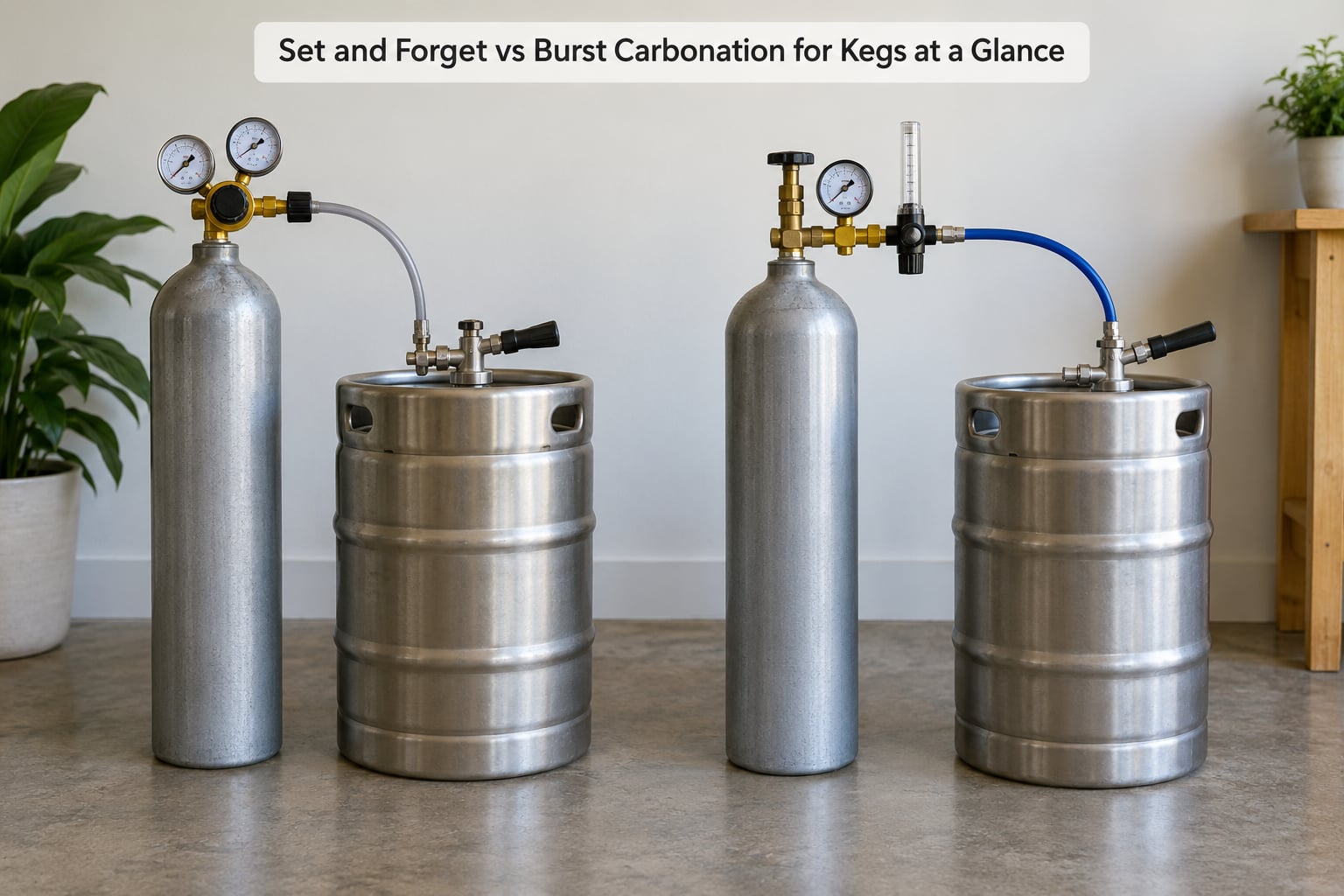
Short version: set and forget holds the keg at the pressure a carbonation chart recommends for its temperature, for days. Burst pushes the keg well above that pressure for hours, then brings it back down. Everything else on the list follows from those two facts.
| Factor | Set and forget | Burst carbonation |
|---|---|---|
| Typical pressure | Chart pressure for the beer, often 8 to 12 PSI at cellar temperature | Roughly 2 to 2.5 times serving pressure, commonly 25 to 30 PSI, with experienced brewers running higher for short bursts |
| Time to carbonate | 5 to 14 days, with 7 to 10 days typical | 8 to 24 hours at high pressure, plus 2 to 3 days settling at serving pressure |
| Beer temperature | Cold, ideally near serving temperature | Cold, and less forgiving if it is warm |
| Agitation | None | Optional rocking or shaking to speed absorption |
| Extra equipment | CO2 cylinder, regulator, coupler, cold space | Same, plus a flow controller or a second accurate gauge helps a lot |
| Consistency | Very high, repeatable keg to keg | Moderate, depends on headspace, timing and agitation |
| Gas use | Lower, most of the gas goes into solution | Higher, part of it simply vents past the coupler seal |
| Failure mode | Waiting too little, serving too warm | Flat beer from excess headspace, gushing pours if tapped too fast |
| Best for | Home drafts, hop-forward beer, sours, competition entries, anything planned ahead | Same-day service, taprooms, events, packaging a keg to bottle |
How Set-and-Forget Carbonation Works
You connect a CO2 regulator to a cold keg and set it to the pressure your carbonation chart calls for at that temperature. Then you walk away. CO2 dissolves into the liquid through the beer and the headspace, and the closer the beer is to the pressure you set, the closer it gets to saturated.
That pressure is usually the same number you will eventually serve at. For most ales and lagers that lands somewhere around 10 to 12 PSI, and wheat and Belgian styles often run higher, in the 15 to 20 PSI range, because their proteins and higher residual sweetness hold on to carbonation differently.
Time is the active ingredient. Cold beer absorbs faster and holds more gas, which is why a keg in a proper glycol chiller can finish in a day while the same keg in a warm keystone takes the better part of two weeks. One Homebrewers Association thread has brewers making both claims, and the temperature variable explains the contradiction perfectly.
Set and forget is convenient rather than genuinely hands-off. The keg still needs a look every twelve hours or so, a beer gun sample, and a pressure adjustment if the chart calls for it at a different number. Brewers on aussiehomebrewer describe a further shortcut: set the pressure, burp the keg to clear the headspace of oxygen, disconnect the cylinder and check back.
How Burst Carbonation Works
Burst carbonation uses the same physics at a different setting. The keg goes well above serving pressure, usually around 30 PSI, for 8 to 24 hours, then drops to serving pressure and rests. The higher pressure pushes more gas into solution, and the shorter window is the whole point.
Many brewers add agitation. A keg rocked or shaken for a few minutes absorbs noticeably faster, which is why The Homebrew Forum protocol of high pressure plus a count of forty shakes and a short wait is popular among people who want beer tonight. The trade is bubble quality: shaken beer tends to come out with coarser, less refined carbonation than beer that absorbed quietly.
Agitation also means a beer gun sample is no longer a casual step. Rocking a keg agitates yeast and sediment, and pulling a sample right after means shooting a cloudy, gushing pour into a waste bucket.
Finally, burst carbonation is the method that punishes a sloppy transfer most visibly. A keg with excess headspace sits at a lower effective CO2 partial pressure than the gauge suggests, so it finishes flatter than the numbers predicted. That single mechanism explains most of the flat-beer complaints on homebrewtalk and r/kegerators.
Carbonation Speed and Time to Serve
How long does set-and-forget vs burst carbonation take?
Set and forget: 5 to 14 days, and cold liquid is what pulls the number toward the short end. Burst: 8 to 24 hours of high pressure, then 2 to 3 days at serving pressure before you tap.
That second wait is the step people skip and then blame the method for. Beer that has been at 30 PSI holds far more gas than it needs at 12 PSI, and the excess needs time to come out of solution. Tap too soon and every pour gushes, then tastes flat and harsh by the end of the pour.
Starting gravity matters too, though less than most people expect. A big, malty strong ale is asking for more carbonation and needs a longer absorption phase, while a light, sharply bitter beer can hit its target carbonation quickly and is the easiest thing to overdo.
The practical takeaway: work backwards from the tap date. A keg that needs to be drinkable on Saturday should be on set-and-forget pressure by Tuesday, or on burst pressure by Thursday night with Friday as the settling day.
Carbonation Consistency and Pour Control
Carbonation strength and serving pressure are two different things, and the set and forget versus burst carbonation for kegs question gets confusing precisely because people use the numbers interchangeably. Strength is how much gas is dissolved. Serving pressure is how hard you push it out of the nozzle.
Raise serving pressure on an already well-carbonated keg and you do not get more carbonation, you get foam. The extra pressure simply compresses the gas that is already there, and the pour comes out gushy and hard to control.
Set and forget delivers finer, more consistent bubble structure because the beer absorbs gently and evenly over days. One homebrewtalk poster put it simply: a couple of weeks at carbonation pressure improves the beer in every way. The cost is time, and the benefit is that keg four pours like keg one.
Burst carbonation can hit the same target strength faster, but repeatability drops. Headspace volume, exact duration, how hard the keg was rocked and how cold the beer actually was all vary between batches, and each of those changes the finished result. For a taproom pouring the same beer every night, that variation adds up.
Equipment, Safety, and Operating Control
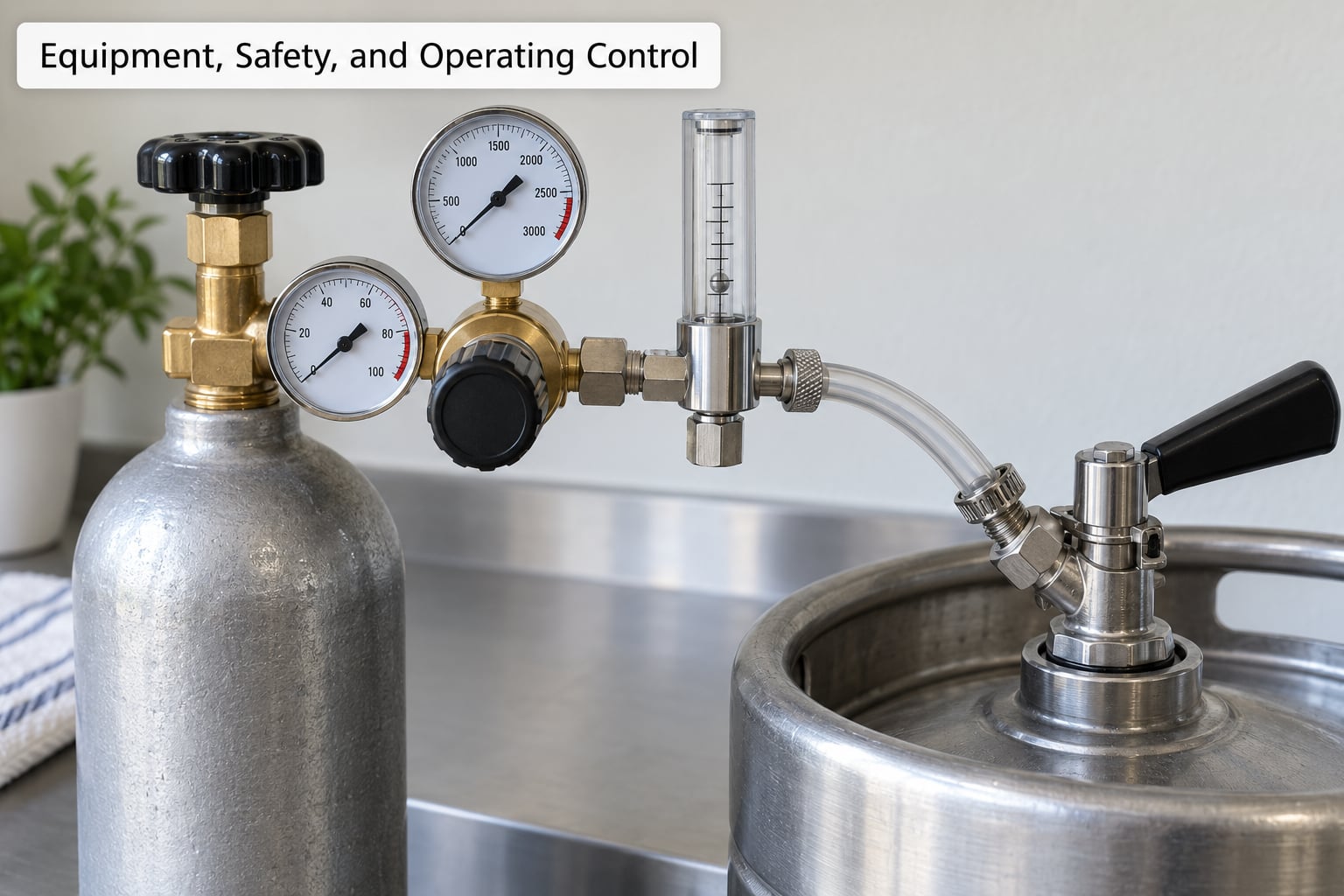
Both methods start from the same kit: a beverage-grade CO2 cylinder, a regulator rated well above your target pressure, a coupler, and cold storage that holds the beer near serving temperature. A twin-stage regulator gives finer control than a single-stage unit, which matters when you are chasing a specific number rather than simply staying connected.
Burst carbonation is where a flow controller earns its keep. Restricting gas flow makes a large pressure drop predictable instead of a rush, and a second gauge that reads the pressure at the keg rather than at the regulator catches the cases where a narrow hose, a cold line or a partly closed valve is holding back the real number.
Keep every connection rated for the pressure you intend. Keg couplers, ball-lock disconnects and ball-lock bodies all have working limits, and a fitting at the wrong rating is the failure you do not want to discover on a Saturday. Secure cylinders upright, chain them, and never leave a cylinder in an unrefrigerated room running at burst pressure on a warm day. Venting happens deliberately through the coupler seal, not by loosening a fitting under pressure.
Keg type barely changes the method but does change the safety margin. Ball-lock kegs and their disconnects have specific pressure ratings, Sankey kegs and couplers have different ones, and a USBC-style spear keg is the sturdiest of the three. Check what your own vessel is rated for rather than assuming a number from a forum post applies to your setup.
Cost, Maintenance, and Common Problems
Set and forget is cheaper in gas because the working pressure is low and most of the CO2 ends up in the beer instead of escaping past a seal. Burst carbonation uses noticeably more per keg, and a busy taproom can drain a standard cylinder over a weekend, which is why high-volume operators move to larger cylinders or a bulk tank.
Extra gauges and a flow controller are a small one-time cost that pays for itself the first time a reading surprises you. Beyond that, maintenance is identical for both methods: leak check the couplers, clean the regulator, replace worn o-rings, and keep the keg lines cold.
Flat beer with the gauge reading target pressure almost always traces to one of four causes. Excess headspace dilutes the effective pressure, so leave a few inches of expansion room and no more. The beer was too warm when it went on, so chill first and carbonate second. The coupler or regulator is leaking, which a leak detector or a soapy-water check will find. Or nobody waited long enough after dropping from burst pressure to serving pressure.
Over-foaming and gushing pours point to the opposite problem, usually tapping too soon after a burst or serving pressure set too high for the style. Uneven fizz from the start of the keg to the end means uneven absorption, and shaking makes it worse. A butterscotch or off-diacetyl note has nothing to do with carbonation at all; it points to skipping or shortening the diacetyl rest before the beer ever reached the keg.
One more variable worth knowing: gas from a premixed cylinder is more consistent than dry ice from a bulk drum, which introduces small pressure swings as the ice sublimates. That is a fine distinction until you are running a line with a sensitive regulator and blaming it for a flat keg.
Which Should You Choose?
Choose set and forget when quality and repeatability matter more than speed. It is the right default for a first keg, for hop-forward beer where coarse carbonation dulls the aroma, for sours, and for any competition or judging entry. If you can plan a week or two ahead, it is simply the better method.
Choose burst carbonation when a deadline is real. Same-day service, a taproom turning kegs quickly, an event with a fixed tap time, or a force-carbonated keg you want to package to bottle all justify the speed. The requirement is cold beer, a dependable pressure read, and the discipline to wait out the settling period afterwards.
For most people, the honest answer is that set and forget is the default and burst is a deliberate trade. A brewer on r/Homebrewing captured the reason better than any chart: it keeps you from drinking it before it is perfect. A brewer elsewhere in the same discussion runs 30 PSI for a day and drops to serving pressure, which works fine if that is the beer and that is the weekend.
If you want the repeatable result on a short timeline, there is a hybrid that experienced brewers use without calling it by name. Carbonate hard for a day, drop to the pressure you will serve at, and then give the keg several days of quiet before anyone taps it. You borrow most of the speed of the burst and most of the quality of the slow method, at the cost of a schedule that assumes you planned ahead anyway.
Frequently Asked Questions
How long does set-and-forget carbonation take compared with burst carbonation?
Set-and-forget carbonation usually takes 5 to 14 days at serving pressure, with 7 to 10 days typical, and cold beer pulls that toward the short end. Burst carbonation needs roughly 8 to 24 hours at 25 to 30 PSI, then 2 to 3 more days at serving pressure so the excess gas can settle out before you tap.
Can I use burst carbonation with a standard CO2 regulator?
Yes, a standard beverage-grade regulator handles burst carbonation, provided it is rated above the pressure you intend to run and the hose and coupler are rated for it too. A twin-stage regulator or a flow controller gives you a more accurate, more repeatable read, which matters when the difference between 25 and 30 PSI decides whether the keg finishes carbed.
Does a higher serving pressure make beer more carbonated?
No. Serving pressure controls how hard the gas is pushed through the nozzle, not how much gas is dissolved in the beer. Carbonation strength comes from pressure, temperature and time during the carbing stage. Turning the serving pressure up on a fully carbonated keg mostly buys you foam, gushing pours and a flat, harsh-tasting beer at the end of the pour.
Is forced carbonation safe for every style of beer?
Forced carbonation suits most styles once a diacetyl rest is done, but the serving target changes a lot. Standard ales and lagers usually sit at 10 to 12 PSI, while wheat and Belgian styles often need 15 to 20 PSI. Push past what the style wants and the result is a gushing pour, so match the pressure to the style rather than to the method you used.
Should I refrigerate a keg before or after carbonating it?
Before, and keep it cold throughout. Cold beer absorbs carbonation faster and holds more of it, which is the whole reason a keg in a glycol chiller can finish in a day while the same keg in a warm room takes two weeks. A keg that is warm when it goes on pressure will not reach true carbonation at any pressure you would be willing to run.
Start With Your Service Window
Decide when the keg has to be drinkable, then pick the method that fits. Burst carbonation earns its keep when that tap time is days away, provided the beer is cold and you give it a settling period at serving pressure. Everything else, from a first keg to a competition entry, goes on set-and-forget at the pressure your carbonation chart recommends.
Either way, do the boring parts properly: diacetyl rest finished, cold transfer, sanitized fittings, a few inches of headspace, and a real check of both pressure and a poured sample before the first person lines up.